Paper II — Q5
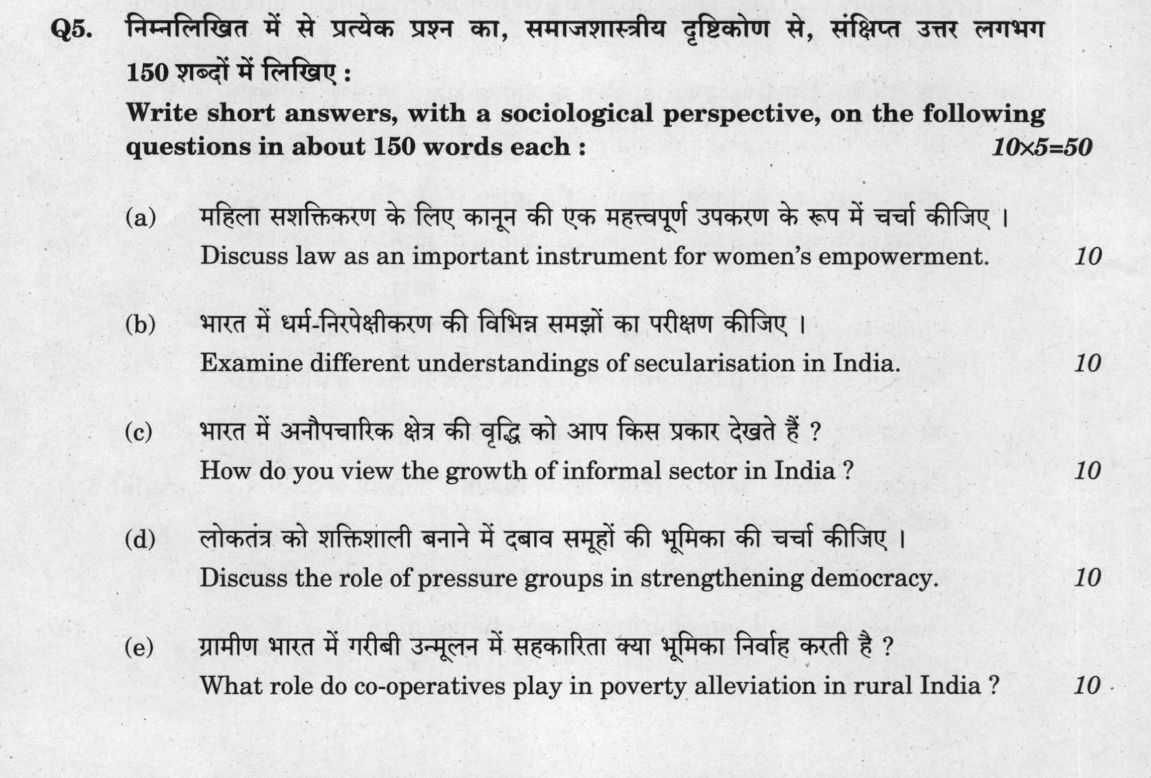
Write short answers, with a sociological perspective, on the following questions in about 150 words each: (a) Discuss law as an…
Write short answers, with a sociological perspective, on the following questions in about 150 words each:
Discuss law as an important instrument for women's empowerment. 10 marks
Examine different understandings of secularisation in India. 10 marks
How do you view the growth of informal sector in India? 10 marks
Discuss the role of pressure groups in strengthening democracy. 10 marks
What role do co-operatives play in poverty alleviation in rural India? 10 marks
हिंदी में प्रश्न पढ़ें
निम्नलिखित में से प्रत्येक प्रश्न का, समाजशास्त्रीय दृष्टिकोण से, संक्षिप्त उत्तर लगभग 150 शब्दों में लिखिए :
महिला सशक्तिकरण के लिए कानून की एक महत्वपूर्ण उपकरण के रूप में चर्चा कीजिए । (10 अंक)
भारत में धर्म-निरपेक्षीकरण की विभिन्न समझों का परीक्षण कीजिए । (10 अंक)
भारत में अनौपचारिक क्षेत्र की वृद्धि को आप किस प्रकार देखते हैं ? (10 अंक)
लोकतंत्र को शक्तिशाली बनाने में दबाव समूहों की भूमिका की चर्चा कीजिए । (10 अंक)
ग्रामीण भारत में गरीबी उन्मूलन में सहकारिता क्या भूमिका निभाती है ? (10 अंक)
Model answer
Written by UPSC Answer Check against this question's marking rubric, to the 150-word length. UPSC does not publish answers for Mains — this is one way to score well, not an official key.
(a) Law as an Instrument for Women's Empowerment
From a sociological perspective, law functions as both an instrument of social engineering and a reflection of prevailing power relations. The structural-functionalist and liberal perspectives view legal instrumentalism as an enabling framework that dismantles patriarchal norms and guarantees formal equality. Landmark legislative interventions, such as the Hindu Code Bills (1950s), the 73rd and 74th Constitutional Amendments institutionalising political reservation for women, the Protection of Women from Domestic Violence Act (PWDVA) 2005, and the Criminal Law (Amendment) Act 2013, have restructured rights around property, political agency, and bodily integrity.
However, critical feminist sociologists like Nivedita Menon highlight the limits of legal liberalism, arguing that legal codification often domesticates radical feminist demands within patriarchal state frameworks. Formal rights do not automatically translate into substantive justice due to deeply entrenched patriarchal ideologies, class-caste intersections, and institutional apathy. Legal categories frequently treat women as a homogenous group, failing to address how Dalit or tribal women experience violence and exclusion differently. Thus, while law creates institutional discursive space and normative legitimacy, true empowerment requires transformative grassroots mobilisation to bridge the gap between formal legality and social reality.
(b) Different Understandings of Secularisation in India
Secularisation in the Indian context departs significantly from classical Western models. The Eurocentric paradigm, rooted in modernisation theory, defines secularisation as the linear retreat and privatization of religion alongside structural differentiation. In contrast, Indian sociology recognises that religion remains deeply intertwined with everyday public and social life.
Indian constitutional secularism, as Rajeev Bhargava conceptualises, is defined by "principled distance," where the state neither adopts a religion nor enforces strict wall-of-separation, but selectively intervenes to promote equality, such as reforming caste discrimination or personal laws, while treating all faiths with equal respect (sarva dharma sambhava). Conversely, anti-secularist critics like Ashis Nandy and T.N. Madan argue that modern state secularism is an alien, elite Western imposition that weakens traditional inter-community accommodation, provoking communalist reactions. Furthermore, sociologists studying "multiple secularisms" note how caste and community identity continuously politicise religious symbols, demonstrating that secularisation in India is not a vanishing of faith, but a dynamic, contested renegotiation of state-religion-society relations.
(c) Growth of Informal Sector in India
The expansion of the informal sector—accounting for over 85 percent of India’s non-agricultural workforce—can be interpreted through competing sociological paradigms. The classical dualist perspective viewed informality as a residual, transitional phase of development that would gradually dissolve as modern, formal capitalist industries absorbed surplus rural labour.
In contrast, structuralist scholars, notably Jan Breman, demonstrate that the growth of informality is not transitional, but an integral, permanent strategy of contemporary capitalist accumulation. Capital deliberately utilizes informalisation, subcontracting, and casualisation to depress wages, bypass labour regulations, and ensure flexible accumulation. Breman’s concept of "footloose labour" illustrates how structural vulnerability compels millions of circular migrants into precarious, unregulated work without social security. Moreover, this informality is deeply mediated by caste, class, and gender hierarchies, with Dalits, Adivasis, and women disproportionately relegated to the lowest-paying, most hazardous tiers of informal work. Informality in India thus reflects a dual regime of economic exclusion and segmented labour markets.
(d) Role of Pressure Groups in Strengthening Democracy
Pressure groups occupy an intermediary space between civil society and the state, acting as vital conduits for articulating collective interests. From a pluralist perspective, echoing Robert Dahl, pressure groups deepen substantive democracy by dispersing power away from a centralized state, fostering political participation, and ensuring diverse societal interests—such as trade unions, agrarian bodies like the Samyukt Kisan Morcha, and environmental groups—influence policy formulation.
However, the elite theory perspective offers a critical counterpoint, arguing that pressure groups often reinforce existing socio-economic hierarchies. Institutionalized, well-resourced business lobbies (such as FICCI and CII) exercise disproportionate access to state machinery and policymaking, out-manoeuvring subaltern, informal-worker, and marginalised caste associations. Furthermore, many pressure groups in India organize along primordial lines of caste and religion, at times entrenching patron-client networks and identity politics rather than advancing universal citizenship rights. Ultimately, pressure groups strengthen democracy only to the extent that the public sphere remains democratised, allowing subaltern and marginalised voices equitable institutional leverage against elite capture.
(e) Role of Co-operatives in Rural Poverty Alleviation
Cooperatives have historically served as crucial institutional mechanisms for rural transformation and collective bargaining. The functionalist-modernisation approach highlights their capacity to build local social capital, scale up smallholder output, and insulate rural producers from predatory market intermediaries. The celebrated success of the Amul and National Dairy Development Board (NDDB) model demonstrated how cooperative federations can generate sustainable rural livelihoods, empower women dairy producers, and enhance nutritional security.
Nevertheless, critical sociological assessments reveal significant structural deficits. Agrarian sociologists and World Bank evaluations point to the widespread phenomenon of elite capture, wherein dominant landowning castes and local political elites monopolize credit and agricultural processing cooperatives, diverting resources to sustain patron-client networks. Cooperatives often succumb to bureaucratisation and state over-regulation, which erodes democratic member-control. Critically, landless agricultural labourers, tenant farmers, and Dalit households are frequently excluded from cooperative governance due to structural asset-less-ness. For cooperatives to effectively eradicate rural poverty, structural land reforms, equitable asset distribution, and institutional safeguards against elite domination remain indispensable.
What "Discuss" is asking you to do
Lay the issue out from more than one side — how it arose, what is claimed for it, what is held against it, and where it now stands. UPSC attaches discuss to broad topics with several live dimensions, so coverage of the dimensions earns more than the strength of your opinion.
Structure that answers it
Set the issue up → the case as it is made → the case against → the dimension both sides leave out → where the balance now lies
Where marks are lost
Listing facts with no thread between them, or arguing one side throughout and calling it a discussion.
How this answer will be evaluated
Approach
Framework: Sociological Perspective (Paper II). (a) discuss: intro > 3-4 dimensions > example > balanced close | (b) examine: intro > how/why with reasoning > evidence > conclusion | (c) comment: context > arguments both sides > judgment > close | (d) discuss: intro > 3-4 dimensions > example > balanced close | (e) comment: context > arguments both sides > judgment > close Full marks: Sociological depth, specific Indian data, clear thinker references, balanced critique.
Key points expected
- Define law as an instrument of social change
- Cite specific legislation (e.g., 2005/2013 Acts)
- Link legal rights to structural empowerment
- Mention implementation gap or sociological critique
- Define secularisation in sociological terms
- Distinguish 'Western' vs 'Indian' secularism
- Explain the concept of 'principled distance'
- Reference to specific thinkers (e.g., Ambedkar/Amartya Sen)
Evaluation rubric
Each sub-part is marked on its own, against the marks and word limit printed on the paper.
- (a) Law as an instrument for women's empowerment. 10 marks · 150 words
discuss— intro → 3-4 dimensions → example → balanced close
Must cover
- Define law as an instrument of social change
- Cite specific legislation (e.g., 2005/2013 Acts)
- Link legal rights to structural empowerment
- Mention implementation gap or sociological critique
Loses marks
- Listing laws without sociological analysis
- Ignoring the gap between law and practice
Earns more
- Reference to CEDAW or UN conventions
- Mention of specific judicial pronouncement
- Contrast between de jure and de facto status
Extra mark
- Cite specific NFHS data on legal awareness
- Reference to specific Supreme Court case
- (b) Different understandings of secularisation in India. 10 marks · 150 words
examine— intro → how/why with reasoning → evidence → conclusion
Must cover
- Define secularisation in sociological terms
- Distinguish 'Western' vs 'Indian' secularism
- Explain the concept of 'principled distance'
- Reference to specific thinkers (e.g., Ambedkar/Amartya Sen)
Loses marks
- Confusing secularism with anti-religion
- Failing to distinguish Indian model from Western
Earns more
- Mention of 'Sarva Dharma Samabhava'
- Reference to specific constitutional articles (Art 25-28)
- Discussion of 'Gandhian' vs 'Constitutional' secularism
Extra mark
- Reference to specific Supreme Court judgment on secularism
- Mention of specific contemporary debate (e.g., UCC)
- (c) Growth of informal sector in India. 10 marks · 150 words
comment— context → arguments both sides → judgment → close
Must cover
- Define informal sector (ILO/PLFS criteria)
- Analyze causes of growth (structural unemployment)
- Discuss sociological implications (precarity)
- Mention specific data (e.g., PLFS 2017-18)
Loses marks
- Treating informal sector as purely economic
- Ignoring the social security deficit
Earns more
- Reference to 'Gig Economy' or 'Platform work'
- Mention of specific schemes (e.g., EShram)
- Discussion of 'informalization of formal sector'
Extra mark
- Cite specific PLFS percentage for informal employment
- Reference to specific ILO report
- (d) Role of pressure groups in strengthening democracy. 10 marks · 150 words
discuss— intro → 3-4 dimensions → example → balanced close
Must cover
- Define pressure groups (interest groups)
- Explain role in 'participatory democracy'
- Mention specific types (associational/cause)
- Discuss 'iron triangle' or 'lobbying' critique
Loses marks
- Confusing pressure groups with political parties
- Ignoring the 'dark side' of lobbying
Earns more
- Reference to specific Indian pressure group (e.g., CII)
- Mention of 'social movements' as pressure groups
- Discussion of 'elite capture' vs 'mass mobilization'
Extra mark
- Reference to specific Supreme Court case on RTI
- Mention of specific NGO (e.g., PUCL)
- (e) Role of co-operatives in poverty alleviation in rural India. 10 marks · 150 words
comment— context → arguments both sides → judgment → close
Must cover
- Define co-operatives (RCA 1912/2002)
- Explain 'social capital' and 'collective action'
- Mention specific sectors (credit/agriculture)
- Discuss 'self-help groups' (SHGs) linkage
Loses marks
- Ignoring the 'elite capture' problem in co-ops
- Treating co-ops as purely economic entities
Earns more
- Reference to specific state model (e.g., Kerala)
- Mention of 'Amul' or 'Narmada' as examples
- Discussion of 'financial inclusion' via co-ops
Extra mark
- Cite specific RBI data on co-op credit
- Reference to specific NITI Aayog report
Practice this exact question
Write your answer and it is marked point by point against the model answer above — what you covered, what you missed, what you got wrong.
Evaluate my answer →More from Sociology 2022 Paper II
- Q2 (a) Critically examine G.S. Ghurye's Indological approach to the understanding of Indian…
- Q3 (a) Critically examine Yogendra Singh's thesis on 'Modernisation of Indian Tradition'. (2…
- Q4 (a) Examine the social background of growth of Indian nationalism. (20 marks) (b) Explain…
- Q5 Write short answers, with a sociological perspective, on the following questions in about…
- Q6 (a) Examine whether rural bondage still continues to be a social reality. Give your argum…
- Q7 (a) "Instead of promoting equality in society, the present system of education itself has…
- Q8 (a) Bring out the various issues involved in Dalit movements in India. (20 marks) (b) Cri…