Paper II — Q4
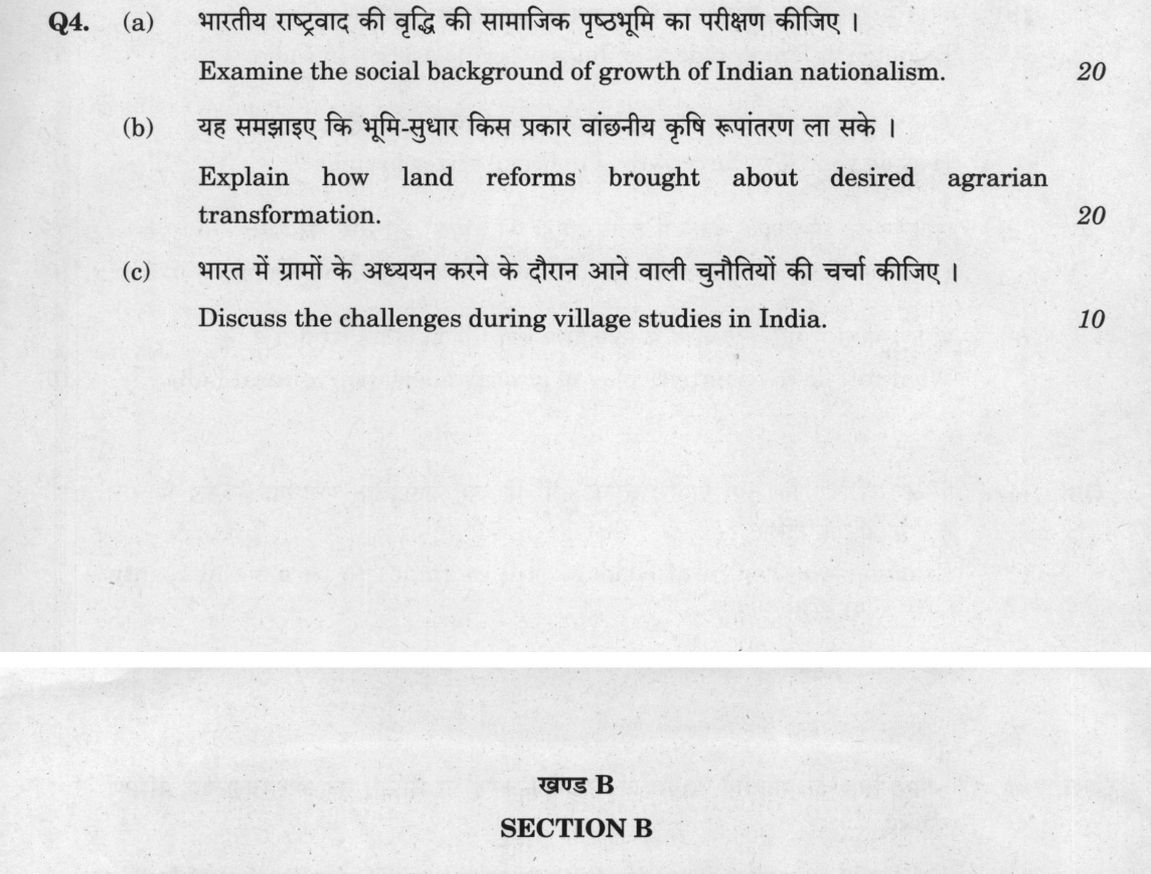
(a) Examine the social background of growth of Indian nationalism. (20 marks) (b) Explain how land reforms brought about desired…
Examine the social background of growth of Indian nationalism. 20 marks
Explain how land reforms brought about desired agrarian transformation. 20 marks
Discuss the challenges during village studies in India. 10 marks
हिंदी में प्रश्न पढ़ें
भारतीय राष्ट्रवाद की वृद्धि की सामाजिक पृष्ठभूमि का परीक्षण कीजिए । (20 अंक)
यह समझाइए कि भूमि-सुधार किस प्रकार वांछनीय कृषि रूपान्तरण ला सके । (20 अंक)
भारत में ग्रामों के अध्ययन करने के दौरान आने वाली चुनौतियों की चर्चा कीजिए । (10 अंक)
Model answer
Written by UPSC Answer Check against this question's marking rubric, to the expected length. UPSC does not publish answers for Mains — this is one way to score well, not an official key.
Social background of nationalism. Indian nationalism emerged from colonial social transformations rather than from a pre-existing cultural unity. Macaulay’s Minute of 1835 produced an English-educated middle class capable of articulating a common political language and imagining a shared public. Print capitalism widened this public: Hickey’s English Bengal Gazette and Roy’s Bengali Sambad Kaumudi and Persian Mirat-ul-Akbar carried reformist, rationalist and nationalist ideas beyond courtly circles. Socio-religious reform movements such as the Brahmo Samaj and Arya Samaj challenged ritualism and orthodoxy, creating horizontal solidarity across regions and communities. Economic grievances, especially the drain theory advanced by Dadabhai Naoroji and R.C. Dutt, gave colonial exploitation a political content. Railways and the postal system linked regions, markets and associations, making a national public sphere possible. This public sphere allowed local grievances to be framed as national issues. The finding is that nationalism was socially rooted in colonial modernity, not merely a political reaction. The class-caste nexus was central: the Congress became a platform for elite aspirations, with lawyers, doctors and teachers leading provincial associations and shaping demands. This produced tension between Moderate elite nationalism and Gandhian mass nationalism, in which caste and class interests were negotiated rather than simply represented.
Land reforms and agrarian transformation. Land reforms were intended to bring about a desired agrarian transformation by dismantling feudal intermediaries, securing tenants, redistributing surplus land, consolidating fragmented holdings, encouraging cooperative farming, raising productivity and delivering social justice. Zamindari abolition, as in the UP Zamindari Abolition Act 1950 and Bihar Land Reforms Act 1950, attacked the revenue-extracting class and sought to place cultivation closer to tillers. Tenancy reforms gave security of tenure and fair rent; ceiling legislation attempted redistribution of surplus land to landless and marginal farmers. Consolidation and cooperatives were meant to reduce fragmentation and strengthen collective action, but implementation varied. Bhoodan and Gramdan, associated with Vinoba Bhave, sought voluntary surrender of land and village-level sharing, adding a moral-political dimension to state legislation. These measures did reduce some feudal relations and created a more market-oriented countryside. Kathleen Gough’s “rich peasant” shows the rise of capitalist agriculture, while the Lenin–Chayanov debate helps explain peasant differentiation: some households invested in wage labour and credit, others remained subsistence-oriented. Yet transformation was incomplete. Semi-feudalism persisted, as Ashok Rudra and Pranab Bardhan argue, through tenancy, debt and local power. The Green Revolution was partly an unintended outcome of partial reform, because better-resourced farmers could adopt high-yielding varieties, widening differentiation.
Challenges in village studies. Village studies in India have been shaped by colonial ethnography, whose legacy required critique. Colonial ethnography often treated villages as objects of administrative control rather than lived social worlds. Dumont’s Homo Hierarchicus was challenged by McKim Marriott and Ronald Inden for overgeneralising caste as a total social fact. A related problem is methodological nationalism: treating the nation-state as the natural frame, so that the village is read as a miniature India, while early studies also suffered village isolationism, constructing the village as bounded, self-sufficient and timeless. The insider–outsider problem is evident in Srinivas’s Rampura fieldwork, where his position shaped the concept of sanskritisation. Caste and gender barriers restrict access to households, rituals and labour, often silencing women and lower castes. The post-structural turn, in Amita Baviskar and Dipankar Gupta, questions the “village” itself as a stable unit, showing it as a site of migration, market, state and gendered experience.
In sum, colonial knowledge production, post-colonial state intervention and village ethnography together shaped modern Indian sociology: nationalism supplied the political field, land reforms restructured agrarian power, and village studies exposed the methodological limits of representing rural India and set the terms for its critical self-reflection.
What "Examine" is asking you to do
Test the proposition the question puts to you and return a finding on how far it holds. Examine stems carry a claim, or ask whether something has happened, and expect evidence weighed both ways before the extent is stated — often with remedial measures attached.
Structure that answers it
Restate the claim as the question frames it → evidence that supports it → evidence that undercuts it → the conditions under which it holds → verdict on how far it stands
Where marks are lost
Stopping at description. An examination has to reach a finding, and “examine with justification” means the extent must be stated, not implied.
How this answer will be evaluated
Approach
Framework: Sociology Paper II (Indian Society). (a) examine: intro > how/why with reasoning > evidence > conclusion | (b) explain: definition/context > points in order > small example > short close | (c) challenges: 3-4 challenges > solutions mapped to them > conclusion Full marks: Comprehensive, analytical, and well-structured with specific examples and data.
Key points expected
- Link economic exploitation to social discontent
- Role of the emerging middle class
- Impact of colonial education and social reform
- Integration of regional/local grievances into national movement
- Abolition of intermediaries (Zamindari/Abolition Acts)
- Land ceiling and redistribution
- Tenancy reforms and tenant rights
- Assessment of success vs. failure (e.g., 'land to the tiller')
Evaluation rubric
Each sub-part is marked on its own, against the marks and word limit printed on the paper.
- (a) Analyze the social conditions and class dynamics that facilitated the rise of Indian nationalism. 20 marks
examine— intro → how/why with reasoning → evidence → conclusion
Must cover
- Link economic exploitation to social discontent
- Role of the emerging middle class
- Impact of colonial education and social reform
- Integration of regional/local grievances into national movement
Loses marks
- Treating nationalism as purely political
- Ignoring the role of the peasantry
- Chronological listing without social analysis
Earns more
- Reference to specific social reform movements
- Mention of specific nationalist leaders' social backgrounds
- Discussion of the 'unifying' role of the press
Extra mark
- Citing specific historical data on class composition
- Reference to a specific sociological study on nationalism
- (b) Describe the mechanisms of land reforms and their impact on agrarian structure. 20 marks
explain— definition/context → points in order → small example → short close
Must cover
- Abolition of intermediaries (Zamindari/Abolition Acts)
- Land ceiling and redistribution
- Tenancy reforms and tenant rights
- Assessment of success vs. failure (e.g., 'land to the tiller')
Loses marks
- Confusing land reform with agricultural policy
- Ignoring the role of moneylenders
- Overstating the success of redistribution
Earns more
- Mention of specific state-level variations
- Discussion of the 'Green Revolution' interaction
- Reference to the 1953 Land Commission
Extra mark
- Citing specific data on land distribution (e.g., NABARD)
- Reference to a specific court case on land rights
- (c) Identify and discuss the methodological and practical difficulties in studying Indian villages. 10 marks
challenges— 3-4 challenges → solutions mapped to them → conclusion
Must cover
- Heterogeneity of Indian villages
- Methodological issues (sampling, definition of 'village')
- Access and language barriers
- Rapid social change and urbanization
Loses marks
- Focusing only on economic challenges
- Ignoring the role of caste in village dynamics
- Vague generalizations without specific examples
Earns more
- Reference to specific studies (e.g., M.N. Srinivas)
- Discussion of the 'village' vs. 'rural' distinction
Extra mark
- Mention of specific modern data collection challenges
- Reference to a specific ethnographic study
Practice this exact question
Write your answer and it is marked point by point against the model answer above — what you covered, what you missed, what you got wrong.
Evaluate my answer →More from Sociology 2022 Paper II
- Q1 Write short answers, with a sociological perspective, on the following questions in about…
- Q2 (a) Critically examine G.S. Ghurye's Indological approach to the understanding of Indian…
- Q3 (a) Critically examine Yogendra Singh's thesis on 'Modernisation of Indian Tradition'. (2…
- Q4 (a) Examine the social background of growth of Indian nationalism. (20 marks) (b) Explain…
- Q5 Write short answers, with a sociological perspective, on the following questions in about…
- Q6 (a) Examine whether rural bondage still continues to be a social reality. Give your argum…
- Q7 (a) "Instead of promoting equality in society, the present system of education itself has…