Paper I — Q1
Answer the following questions in about 150 words each: (a) What is the distinctiveness of the feminist method of social…
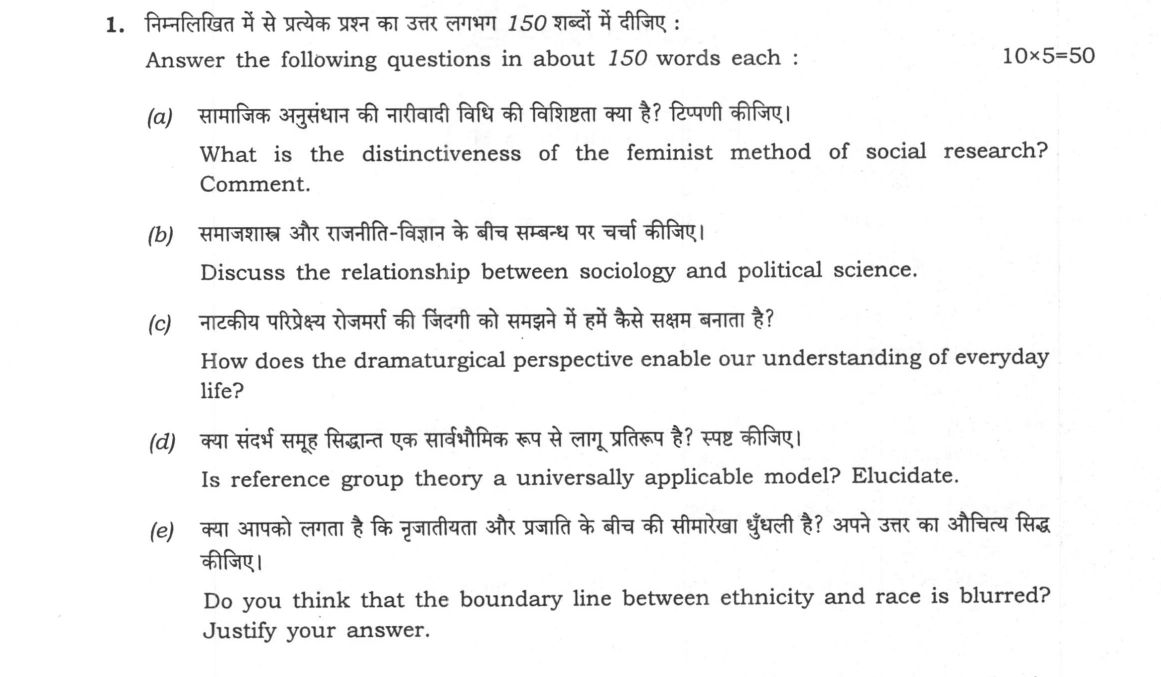
Answer the following questions in about 150 words each:
What is the distinctiveness of the feminist method of social research? Comment. 10 marks
Discuss the relationship between sociology and political science. 10 marks
How does the dramaturgical perspective enable our understanding of everyday life? 10 marks
Is reference group theory a universally applicable model? Elucidate. 10 marks
Do you think that the boundary line between ethnicity and race is blurred? Justify your answer. 10 marks
हिंदी में प्रश्न पढ़ें
निम्नलिखित में से प्रत्येक प्रश्न का उत्तर लगभग 150 शब्दों में दीजिए :
सामाजिक अनुसंधान की नारीवादी विधि की विशिष्टता क्या है? टिप्पणी कीजिए। (10 अंक)
समाजशास्त्र और राजनीति-विज्ञान के बीच संबंध पर चर्चा कीजिए। (10 अंक)
नाटकीय परिप्रेक्ष्य रोजमर्रा की जिंदगी को समझने में हमें कैसे सक्षम बनाता है? (10 अंक)
क्या संदर्भ समूह सिद्धांत एक सार्वभौमिक रूप से लागू प्रतिरूप है? स्पष्ट कीजिए। (10 अंक)
क्या आपको लगता है कि नृजातीयता और प्रजाति के बीच की सीमारेखा धुंधली है? अपने उत्तर का औचित्य सिद्ध कीजिए। (10 अंक)
Model answer
Written by UPSC Answer Check against this question's marking rubric, to the 150-word length. UPSC does not publish answers for Mains — this is one way to score well, not an official key.
(a) Distinctiveness of the Feminist Method of Social Research
The distinctiveness of the feminist method lies primarily in its epistemological critique of conventional, positivist "malestream" sociology. Feminist methodology rejects the positivist ideal of value neutrality, arguing that conventional research reflects an androcentric bias masquerading as universal objectivity. Drawing on Sandra Harding’s feminist standpoint epistemology and Donna Haraway’s concept of situated knowledge, this approach asserts that marginalized social locations, specifically women’s lived experiences, provide a more complete and less distorted understanding of social reality.
Methodologically, it prioritizes reflexivity, breaking the hierarchical divide between the researcher and the researched by fostering non-exploitative, intersubjective relationships. Techniques such as oral histories and qualitative interviews are favoured to uncover unvoiced domestic and emotional realities. However, critics like Martyn Hammersley contend that feminism provides a distinctive epistemological stance and political agenda rather than entirely unique empirical methods. Ultimately, feminist methodology fundamentally redefines the research process by linking knowledge production directly with emancipatory social change.
(b) Relationship between Sociology and Political Science
Sociology and political science share an enduring, symbiotic relationship centered on the study of power, authority, and social order. Traditionally, political science focused narrowly on the formal state, constitutional frameworks, and institutional mechanisms of governance. In contrast, sociology examined informal power structures, social stratification, and the broader societal roots of collective behaviour.
The convergence of both disciplines gave rise to political sociology, pioneered by Max Weber and Seymour Martin Lipset, which examines how political processes are embedded within social matrices. In the Indian context, this interdisciplinary synergy is evident in the study of caste-politics dynamics (Rajni Kothari’s politicisation of caste) and democratic deepening (Christophe Jaffrelot). While political science increasingly adopts sociological perspectives on social movements, identities, and voting behaviour, sociology maintains a wider purview that spans non-political institutions such as family, religion, and deviance. Thus, while political science studies the architecture of the state, sociology illuminates the social foundations that sustain or challenge it.
(c) The Dramaturgical Perspective in Everyday Life
Erving Goffman’s dramaturgical perspective, articulated in The Presentation of Self in Everyday Life, utilizes the metaphor of the theatre to analyse the micro-dynamics of everyday interaction. Goffman conceptualises social life as a continuous performance wherein actors engage in "impression management" to guide and control how others perceive them, thereby establishing a shared "definition of the situation."
Everyday interaction is structured across distinct spatial domains. The "front stage" is where individuals perform formal social roles using institutionalized scripts, props, and expressive manners that conform to normative expectations. The "back stage" provides a private sphere where performers step out of character, drop their social masks, and manage emotional strain or rehearse future performances. By framing everyday encounters as ritualistic performances directed at saving face and avoiding embarrassment, dramaturgy reveals that social order is not merely an external macro-structure, but a precarious reality actively sustained through continuous, situated interpersonal interactions.
(d) Universality of Reference Group Theory
Robert K. Merton developed reference group theory to elucidate how individuals orient their attitudes and behaviour toward non-membership groups, driven by mechanisms of relative deprivation and anticipatory socialization. While the theory provides powerful insights into social mobility within open, achievement-oriented, and individualistic Western class structures, its cross-cultural applicability is bounded.
In collectivist and rigidly stratified societies, the scope for selecting reference groups is structurally restricted. In the traditional Indian caste system, ascription strictly circumscribes social mobility. As M.N. Srinivas demonstrated through the concept of Sanskritization, lower castes attempting anticipatory socialization by adopting upper-caste cultural motifs frequently met severe punitive sanctions from dominant castes rather than legitimized upward mobility. Furthermore, in close-knit, collectivist communities, individual comparisons are subordinated to group norms, limiting autonomous reference group selection. Therefore, while Merton’s model universally explains the cognitive process of comparison, its empirical realization remains contingent upon the degree of institutional openness and structural fluidity within a society.
(e) Blurring Boundaries: Race and Ethnicity
Analytically, race and ethnicity have distinct conceptual origins: race historically referred to categories based on perceived, unchangeable biological and phenotypical traits, whereas ethnicity signified collective identity rooted in shared cultural heritage, language, religion, or historical memories.
However, constructivist sociologists such as Fredrik Barth and Richard Jenkins argue that this boundary line is profoundly blurred because both are socially constructed, relational, and historically mutable modes of group identification. Physical markers acquire social meaning only through cultural interpretation, while cultural differences are frequently essentialized and treated as immutable biological facts. In India, this fluidity emerged in colonial anthropometry (Herbert Risley) attempting to racialise caste, a premise contested by G.S. Ghurye and B.R. Ambedkar, who demonstrated that caste operates as an endogamous, socio-cultural hierarchy rather than a distinct racial division. Modern census politics, ethnic mobilizations, and state categorizations continue to demonstrate that race and ethnicity operate along an overlapping continuum of socially constructed identities rather than as discrete, fixed categories.
What "Discuss" is asking you to do
Lay the issue out from more than one side — how it arose, what is claimed for it, what is held against it, and where it now stands. UPSC attaches discuss to broad topics with several live dimensions, so coverage of the dimensions earns more than the strength of your opinion.
Structure that answers it
Set the issue up → the case as it is made → the case against → the dimension both sides leave out → where the balance now lies
Where marks are lost
Listing facts with no thread between them, or arguing one side throughout and calling it a discussion.
How this answer will be evaluated
Approach
Framework: Sociology Paper I (UPSC). (a) comment: context > arguments both sides > judgment > close | (b) discuss: intro > 3-4 dimensions > example > balanced close | (c) explain: definition/context > points in order > small example > short close | (d) explain: definition/context > points in order > small example > short close | (e) justify: claim > 3-4 reasons > evidence > conclusion Full marks: Precise definitions, named thinkers, specific examples, and a clear, justified conclusion.
Key points expected
- Define feminist method as a critique of positivism
- Mention 'personal is political' or 'standpoint theory'
- Contrast with traditional male-dominated research
- Provide a concluding judgment on its utility
- Define the scope of both disciplines
- Identify areas of overlap (e.g., power, state, social movements)
- Highlight key differences in focus (society vs. state)
- Provide a balanced conclusion on their interdependence
Evaluation rubric
Each sub-part is marked on its own, against the marks and word limit printed on the paper.
- (a) Contextualize feminist method and provide a judgment on its distinctiveness. · 150 words
comment— context → arguments both sides → judgment → close
Must cover
- Define feminist method as a critique of positivism
- Mention 'personal is political' or 'standpoint theory'
- Contrast with traditional male-dominated research
- Provide a concluding judgment on its utility
Loses marks
- Treating feminism as a topic rather than a method
- Ignoring the epistemological critique of positivism
- Vague generalities without specific methodological features
Earns more
- Reference to Dorothy Smith or Sandra Harding
- Mention of 'standpoint epistemology'
- Example of gendered data collection
- Critique of 'value-free' sociology
Extra mark
- Reference to specific Indian feminist research (e.g., on dowry)
- Mention of 'intersectionality' in method
- (b) Analyze the relationship between sociology and political science across multiple dimensions. · 150 words
discuss— intro → 3-4 dimensions → example → balanced close
Must cover
- Define the scope of both disciplines
- Identify areas of overlap (e.g., power, state, social movements)
- Highlight key differences in focus (society vs. state)
- Provide a balanced conclusion on their interdependence
Loses marks
- Treating the two as completely separate
- Ignoring the shared focus on power and authority
- Vague generalities without specific examples of overlap
Earns more
- Reference to Max Weber's work on bureaucracy
- Mention of 'political sociology' as a sub-field
- Example of studying social movements (e.g., Narmada Bachao Andolan)
- Distinction between 'society' and 'state' as primary units
Extra mark
- Reference to specific Indian political sociologists (e.g., M.N. Srinivas)
- Mention of 'state-society' relations in Indian context
- (c) Explain how the dramaturgical perspective helps understand everyday life. · 150 words
explain— definition/context → points in order → small example → short close
Must cover
- Define dramaturgical perspective (Goffman)
- Explain 'front stage' and 'back stage' concepts
- Describe 'impression management' in daily interactions
- Provide a concrete example of everyday life (e.g., job interview)
Loses marks
- Confusing dramaturgical perspective with structural functionalism
- Ignoring the performative aspect of social interaction
- Vague generalities without specific Goffmanian concepts
Earns more
- Reference to Erving Goffman's 'The Presentation of Self'
- Mention of 'face-work' and 'face-threatening acts'
- Example of 'role distance' or 'defining the situation'
- Application to digital interactions (e.g., social media)
Extra mark
- Reference to specific Goffman concepts like 'civil inattention'
- Mention of 'total institutions' (e.g., prisons, hospitals)
- (d) Elucidate whether reference group theory is a universally applicable model. · 150 words
explain— definition/context → points in order → small example → short close
Must cover
- Define reference group theory (Merton)
- Explain 'aspirational' and 'normative' reference groups
- Discuss its applicability in different social contexts
- Provide a balanced judgment on its universality
Loses marks
- Treating reference group theory as a universal law
- Ignoring its limitations in different cultural contexts
- Vague generalities without specific examples
Earns more
- Reference to Robert K. Merton's work
- Example of 'aspirational' reference group (e.g., celebrities)
- Example of 'normative' reference group (e.g., peer group)
- Critique of its applicability in non-Western contexts
Extra mark
- Reference to specific Indian examples (e.g., caste as reference group)
- Mention of 'social comparison theory' (Festinger)
- (e) Justify whether the boundary line between ethnicity and race is blurred. · 150 words
justify— claim → 3-4 reasons → evidence → conclusion
Must cover
- Define ethnicity and race
- Explain the social construction of both concepts
- Provide examples of their overlap (e.g., African Americans)
- Provide a justified conclusion on the blurring of boundaries
Loses marks
- Treating race as a biological fact
- Ignoring the social construction of ethnicity
- Vague generalities without specific examples
Earns more
- Reference to 'social constructionism' (e.g., Omi and Winant)
- Example of 'racialization' of ethnic groups
- Mention of 'intersectionality' (e.g., race and ethnicity)
- Critique of biological determinism in race
Extra mark
- Reference to specific Indian examples (e.g., Adivasis and caste)
- Mention of 'racialization' in the Indian context
Practice this exact question
Write your answer and it is marked point by point against the model answer above — what you covered, what you missed, what you got wrong.
Evaluate my answer →More from Sociology 2023 Paper I
- Q1 Answer the following questions in about 150 words each: (a) What is the distinctiveness o…
- Q2 (a) What, according to Robert Michels, is the iron law of oligarchy? Do lions and foxes i…
- Q3 (a) What are the characteristics of scientific method? Do you think that scientific metho…
- Q4 (a) Do you think that common sense is the starting point of social research? What are its…