Paper I — Q7
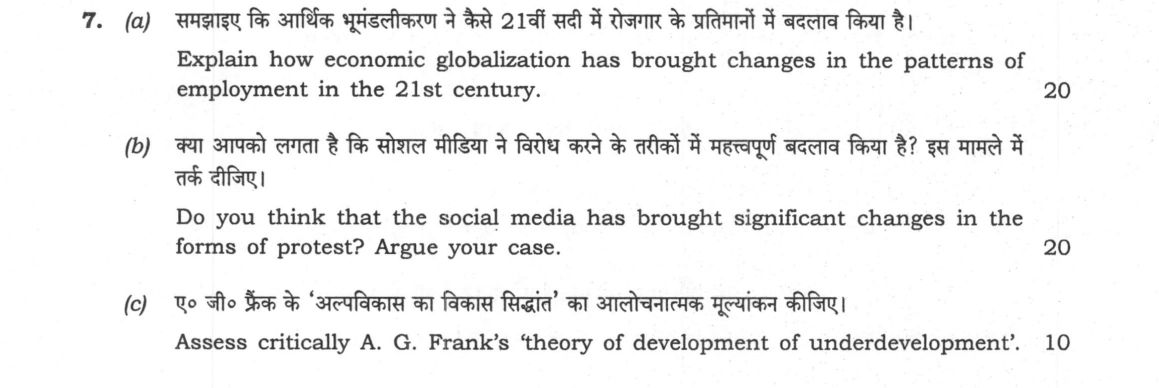
(a) Explain how economic globalization has brought changes in the patterns of employment in the 21st century. (20 marks) (b) Do…
Explain how economic globalization has brought changes in the patterns of employment in the 21st century. 20 marks
Do you think that the social media has brought significant changes in the forms of protest? Argue your case. 20 marks
Assess critically A. G. Frank's 'theory of development of underdevelopment'. 10 marks
हिंदी में प्रश्न पढ़ें
समझाइए कि आर्थिक भूमंडलीकरण ने कैसे 21वीं सदी में रोजगार के प्रतिमानों में बदलाव किया है। (20 अंक)
क्या आपको लगता है कि सोशल मीडिया ने विरोध करने के तरीकों में महत्वपूर्ण बदलाव किया है? इस मामले में तर्क दीजिए। (20 अंक)
ए० जी० फ्रैंक के 'अल्पविकास का विकास सिद्धांत' का आलोचनात्मक मूल्यांकन कीजिए। (10 अंक)
Model answer
Written by UPSC Answer Check against this question's marking rubric, to the expected length. UPSC does not publish answers for Mains — this is one way to score well, not an official key.
Economic Globalization and Changing Employment Patterns
Economic globalization, driven by post-Fordist flexible accumulation and informational capitalism (Manuel Castells), has radically transformed employment structures in the twenty-first century. Transnational capital has restructured the international division of labour by unbundling production processes, causing a structural shift from secure, standard Fordist employment toward hyper-flexible, deregulated work regimes.
Globally, this manifests in the informalization of formal work and the rise of what Guy Standing conceptualizes as the *precariat*—a growing class characterized by occupational instability, lack of institutional security, and wage volatility. Simultaneously, the feminization of the workforce has expanded, particularly in global supply chains, characterized by lower wages and precarious contracts. In India, this transition is visible in the bifurcation of the labour market: a high-skilled, globally integrated IT-BPO services boom alongside expanding Special Economic Zones (SEZs) and widespread contractualization across manufacturing. Furthermore, the rapid growth of the platform economy—embodied by aggregators such as Ola, Zomato, and Amazon Flex—has commodified urban labour under the guise of micro-entrepreneurship, transforming formal wage-labour into atomized, algorithmic piecework lacking social safety nets.
Social Media and Transformations in Protest
Social media has fundamentally transformed the morphology of collective action, shifting traditional organization-led protests toward digitally mediated networks of mobilization. As Lance Bennett and Alexandra Segerberg argue, the classical logic of "collective action"—reliant on formal organizational hierarchies and collective identities—has evolved into "connective action," organized through personalized content-sharing, hashtag activism, and networked individualism (Castells).
In India, this transformation is evident across multiple mass movements. The #MeToo movement bypassed institutional apathy to establish decentralized public accountability. The anti-CAA/NRC demonstrations utilized digital platforms for real-time coordination, spontaneous assemblies, and localized logistics. Similarly, the 2020–21 Farmers' Protest operationalized Twitter/X and video platforms to counter mainstream media narratives, mobilize global diaspora solidarity, and sustain long-term sit-ins.
However, this structural shift is neither absolute nor unproblematic. Digital mobilization often fosters "slacktivism" or clicktivism, where online engagement fails to translate into sustained political pressure. Moreover, social media activism remains circumscribed by deep digital divides of caste, class, gender, and geography, alongside state surveillance and algorithmic suppression, meaning physical mobilization and institutional bargaining remain indispensable for structural political change.
Critical Assessment of Frank's Dependency Theory
Andre Gunder Frank’s development of underdevelopment fundamentally challenged linear modernisation paradigms by conceptualizing underdevelopment not as an original, traditional stage, but as an active, ongoing historical-structural process. Employing a core-periphery and metropolis-satellite framework, Frank demonstrated how global capitalism structurally drains economic surplus from peripheral satellites to enrich metropolitan cores through unequal exchange, locking dependent nations into persistent stagnation.
While Frank accurately exposed the imperialist dynamics of colonial and neo-colonial extraction, his framework suffers from significant theoretical and empirical limitations. Sociologically, it is over-deterministic and economically reductionist; by prioritizing external exchange relations over internal modes of production, it ignores domestic class structures, agrarian power configurations, and state autonomy (as critiqued by Robert Brenner and Fernando Henrique Cardoso).
Empirically, the theory cannot account for the rapid industrialization of East Asian Newly Industrializing Countries (NICs) such as South Korea and Taiwan, nor the contemporary economic rise of China and India within the global capitalist architecture. These trajectories illustrate that peripheral and semi-peripheral nations possess structural agency, making underdevelopment contingent rather than an inescapable outcome of global capitalist integration.
What "Explain" is asking you to do
Make the working of something clear — what sets it off, what follows from what, and what it produces. Explain is the Commission's mechanism word: it dominates the technical papers and the “explain why” stems, where the marks sit in the causal chain and not in the label.
Structure that answers it
State what it is → the initiating condition → the chain of cause, step by step → an instance where it plays out → what the chain produces
Where marks are lost
Describing what something looks like instead of why it works that way. Naming the stages without linking them reads as description too.
How this answer will be evaluated
Approach
Framework: UPSC Sociology Paper I. (a) explain: definition/context > points in order > small example > short close | (b) comment: context > arguments both sides > judgment > close | (c) critique: the claim > its strengths > its weaknesses > your judgment Full marks: Precise definitions, clear argumentation, specific examples, and balanced critical assessment.
Key points expected
- Define economic globalization in the 21st-century context
- Explain the rise of the gig economy and platform work
- Discuss the shift from formal to informal employment
- Analyze the impact of automation and AI on labor
- Define the role of social media in modern protest
- Contrast traditional street protests with digital activism
- Discuss the concept of 'slacktivism' or 'clicktivism'
- Provide a specific example of a social media-led movement
Evaluation rubric
Each sub-part is marked on its own, against the marks and word limit printed on the paper.
- (a) Contextualize globalization and detail specific shifts in 21st-century employment patterns. 20 marks
explain— definition/context → points in order → small example → short close
Must cover
- Define economic globalization in the 21st-century context
- Explain the rise of the gig economy and platform work
- Discuss the shift from formal to informal employment
- Analyze the impact of automation and AI on labor
Loses marks
- Treating globalization as a purely economic phenomenon
- Ignoring the impact on women's labor force participation
- Vague generalizations without specific employment examples
Earns more
- Reference to 'precariat' or 'flexible labor' concepts
- Mention of global supply chain restructuring
- Discussion of remote work and digital nomadism
- Reference to the 'destruction of the middle class'
Extra mark
- Citing specific data from ILO or World Bank
- Reference to a specific Indian platform (e.g., Zomato/Swiggy)
- (b) Argue whether social media has fundamentally altered the nature and forms of protest. 20 marks
comment— context → arguments both sides → judgment → close
Must cover
- Define the role of social media in modern protest
- Contrast traditional street protests with digital activism
- Discuss the concept of 'slacktivism' or 'clicktivism'
- Provide a specific example of a social media-led movement
Loses marks
- Presenting social media as a purely positive tool
- Ignoring the role of traditional media in protest
- Failing to distinguish between online and offline action
Earns more
- Reference to 'hashtag activism' or 'viral protests'
- Discussion of state surveillance and digital repression
- Mention of the 'Arab Spring' or 'Black Lives Matter'
- Analysis of the 'echo chamber' effect on protest
Extra mark
- Citing a specific Indian movement (e.g., #SaveOurSawaal)
- Reference to a specific scholar on digital sociology
- (c) Critically assess A.G. Frank's theory of development of underdevelopment. 10 marks
critique— the claim → its strengths → its weaknesses → your judgment
Must cover
- Define 'development of underdevelopment' and 'metropolis-satellite' link
- Explain the mechanism of surplus extraction
- Identify the core argument of dependency theory
- Provide a critical assessment of the theory's limitations
Loses marks
- Treating the theory as purely descriptive
- Ignoring the role of internal factors in underdevelopment
- Confusing dependency theory with structuralism
Earns more
- Reference to 'unequal exchange' or 'periphery' concepts
- Mention of the 'World-System' theory connection
- Discussion of the 'false consciousness' of elites
- Comparison with modernization theory
Extra mark
- Citing a specific case study from the Global South
- Reference to a specific critique by a later scholar
Practice this exact question
Write your answer and it is marked point by point against the model answer above — what you covered, what you missed, what you got wrong.
Evaluate my answer →More from Sociology 2023 Paper I
- Q4 (a) Do you think that common sense is the starting point of social research? What are its…
- Q5 Answer the following questions in about 150 words each: (a) Examine the relevance of corp…
- Q6 (a) What are the different dimensions of qualitative method? Do you think that qualitativ…
- Q7 (a) Explain how economic globalization has brought changes in the patterns of employment…
- Q8 (a) What is Taylorism? Analyze its merits and demerits. (20 marks) (b) What are new relig…