Paper I — Q2
(a) What, according to Robert Michels, is the iron law of oligarchy? Do lions and foxes in Vilfredo Pareto's theory, essentially…
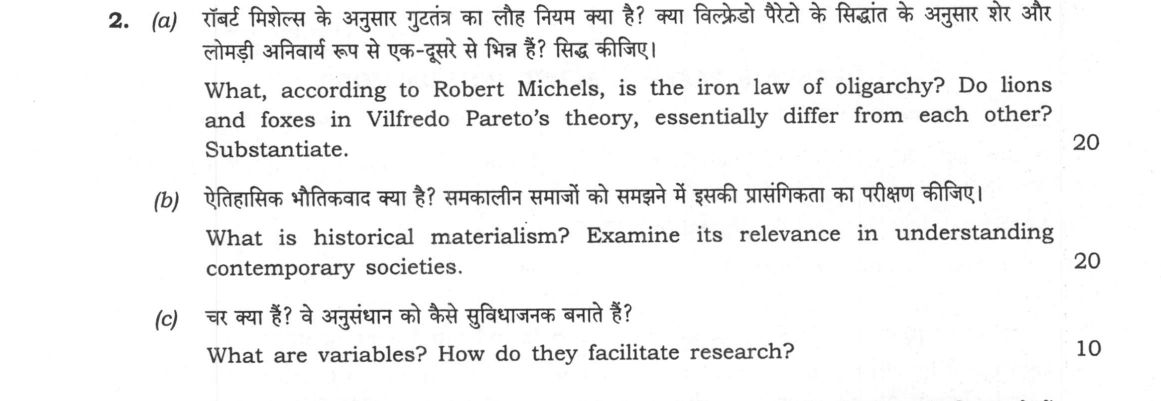
What, according to Robert Michels, is the iron law of oligarchy? Do lions and foxes in Vilfredo Pareto's theory, essentially differ from each other? Substantiate. 20 marks
What is historical materialism? Examine its relevance in understanding contemporary societies. 20 marks
What are variables? How do they facilitate research? 10 marks
हिंदी में प्रश्न पढ़ें
रॉबर्ट मिशेल्स के अनुसार गुणतंत्र का लोह नियम क्या है? क्या विलफ्रेडो पैरेटो के सिद्धांत के अनुसार शेर और लोमड़ी अनिवार्य रूप से एक-दूसरे से भिन्न हैं? सिद्ध कीजिए। (20 अंक)
ऐतिहासिक भौतिकवाद क्या है? समकालीन समाजों को समझने में इसकी प्रासंगिकता का परीक्षण कीजिए। (20 अंक)
चर क्या हैं? वे अनुसंधान को कैसे सुविधाजनक बनाते हैं? (10 अंक)
Model answer
Written by UPSC Answer Check against this question's marking rubric, to the expected length. UPSC does not publish answers for Mains — this is one way to score well, not an official key.
Classical sociological theories provide critical lenses to dissect power, historical transformation, and empirical methodology.
Iron Law of Oligarchy and Circulation of Elites Robert Michels, in Political Parties (1911), formulated the "iron law of oligarchy," encapsulated in the aphorism: "who says organization, says oligarchy." Michels argued that large-scale organization creates an inescapable functional necessity for specialization, centralized coordination, and administrative expertise. This structural necessity leads to bureaucratization, the emergence of a entrenched leadership elite with a monopoly over information, and the apathy of the masses. Consequently, democratic organizations inevitably degenerate into oligarchies where leaders prioritize self-preservation over the collective interest.
Vilfredo Pareto approached power through psychological reductionism in his theory of the circulation of elites. He distinguished between two governing types based on non-logical "residues." "Lions" are governed by Class II residues (persistence of aggregates), relying on traditional solidarity, direct force, and decisive coercion. "Foxes" are governed by Class I residues (instinct for combinations), relying on cunning, manipulation, financial speculation, and diplomatic deceit.
Lions and foxes differ fundamentally in their methods of governance and psychological traits: foxes co-opt and manipulate in mercantile or parliamentary systems, but their inability to use violent force makes them vulnerable to displacement by forceful lions, who eventually decay into foxes, driving a perpetual, cyclical circulation. While Pareto roots elite dominance in cyclical psychological residues, Michels attributes it to structural and organizational dynamics. Both, however, exhibit deterministic cynicism, neglecting counter-tendencies highlighted by Robert Dahl’s pluralist model.
Historical Materialism and Contemporary Relevance Karl Marx’s historical materialism explains societal development through material and economic conditions. The economic substructure or base—consisting of forces of production (technology, raw materials, human labor) and relations of production (class ownership)—conditions the legal, political, and ideological superstructure. As productive forces advance, they conflict with existing relations of production, generating dialectical class contradictions that drive transitions between modes of production: from slavery to feudalism, capitalism, and ultimately communism.
Examining contemporary societies confirms the enduring analytical strength of this framework: First, digital capitalism and the platform economy illustrate how new technological forces create hyper-exploitative relations of production, transforming workers into an alienated precariat managed by algorithmic control. Second, the global ecological crisis exemplifies Marx’s "metabolic rift," where capital accumulation irreparably disrupts nature's material cycles. Third, corporate monopolization of social media and news ecosystems demonstrates how the economic base manufactures cultural and ideological hegemony.
However, historical materialism is limited by economic determinism. It struggles to adequately account for autonomous cultural stratifications—such as caste endogamy in India—and underestimates the decentralized, non-economic microphysics of power theorized by Michel Foucault.
Variables in Sociological Research Variables are measurable characteristics, attributes, or properties that take on different values across units of analysis. They transform abstract conceptual ideas into empirical, observable indicators. Sociological variables include independent variables (presumed causes), dependent variables (observed effects), intervening variables (mediating linkages), and extraneous variables (confounding factors to be controlled). They are measured on nominal, ordinal, interval, or ratio scales.
Variables facilitate research by enabling precise operationalization, converting broad theories into testable hypotheses. They allow sociologists to establish causal inference through statistical control and multivariate analysis, eliminate spurious associations, and permit empirical replication. For example, in studying social mobility, caste identity acts as a nominal independent variable, educational attainment serves as an ordinal dependent variable, and household income functions as a control variable.
Conclusion An examination of these paradigms demonstrates that while Michels, Pareto, and Marx provide structural critiques of power and historical dynamics, contemporary analysis demands integrating their structural insights with pluralistic frameworks and rigorous, variable-driven empirical research to fully grasp complex social realities.
What "Examine" is asking you to do
Test the proposition the question puts to you and return a finding on how far it holds. Examine stems carry a claim, or ask whether something has happened, and expect evidence weighed both ways before the extent is stated — often with remedial measures attached.
Structure that answers it
Restate the claim as the question frames it → evidence that supports it → evidence that undercuts it → the conditions under which it holds → verdict on how far it stands
Where marks are lost
Stopping at description. An examination has to reach a finding, and “examine with justification” means the extent must be stated, not implied.
How this answer will be evaluated
Approach
Framework: Sociology Paper 1 (UPSC). (a) justify: claim > 3-4 reasons > evidence > conclusion | (b) examine: intro > how/why with reasoning > evidence > conclusion | (c) explain: definition/context > points in order > small example > short close Full marks: Precise definitions, clear distinction between concepts, strong contemporary application, and logical flow.
Key points expected
- Define Iron Law of Oligarchy (Michels)
- Explain why oligarchy is inevitable in large organizations
- Define Pareto's 'Lions' (instinct of combination)
- Define Pareto's 'Foxes' (instinct of derivation)
- Define Historical Materialism (Marx/Engels)
- Explain 'base' (economy) and 'superstructure' (culture/law)
- Link mode of production to social change
- Apply to a contemporary issue (e.g., digital economy, labor)
Evaluation rubric
Each sub-part is marked on its own, against the marks and word limit printed on the paper.
- (a) Define Michels' law and substantiate the distinction between Pareto's lions and foxes. 20 marks
justify— claim → 3-4 reasons → evidence → conclusion
Must cover
- Define Iron Law of Oligarchy (Michels)
- Explain why oligarchy is inevitable in large organizations
- Define Pareto's 'Lions' (instinct of combination)
- Define Pareto's 'Foxes' (instinct of derivation)
Loses marks
- Confusing 'Lions' with 'Foxes' definitions
- Treating Iron Law as a descriptive fact rather than a sociological law
- Failing to substantiate the 'essential difference' between the two types
Earns more
- Contrast 'instinct of combination' vs 'instinct of derivation'
- Link Michels' law to the 'elite circulation' concept
- Mention 'logomachy' or 'logomachists' in Michels' context
- Reference 'residues' as the basis of Pareto's theory
Extra mark
- Cite specific example from Michels' 'Political Parties'
- Reference Pareto's 'Sociology of Elites' (Cours de sociologie)
- (b) Define historical materialism and examine its relevance to contemporary societies. 20 marks
examine— intro → how/why with reasoning → evidence → conclusion
Must cover
- Define Historical Materialism (Marx/Engels)
- Explain 'base' (economy) and 'superstructure' (culture/law)
- Link mode of production to social change
- Apply to a contemporary issue (e.g., digital economy, labor)
Loses marks
- Defining it as just 'history is important'
- Ignoring the economic base in the definition
- Failing to connect the theory to a modern context
Earns more
- Mention 'dialectical materialism' as the method
- Reference 'class struggle' as the engine of history
- Discuss 'ideology' as a tool of the ruling class
- Critique or nuance the theory (e.g., cultural materialism)
Extra mark
- Cite specific contemporary data (e.g., gig economy stats)
- Reference a specific Marxist sociologist (e.g., Althusser, Gramsci)
- (c) Define variables and explain how they facilitate research. 10 marks
explain— definition/context → points in order → small example → short close
Must cover
- Define 'variable' in research context
- Distinguish Independent (IV) and Dependent (DV) variables
- Explain how variables allow for hypothesis testing
- Mention 'control' variables or confounding factors
Loses marks
- Confusing 'variable' with 'data point'
- Failing to distinguish IV and DV
- Vague explanation of 'facilitation' without mentioning hypothesis testing
Earns more
- Give a simple example (e.g., education vs income)
- Mention 'operationalization' of variables
- Reference 'correlation' vs 'causation' in variable analysis
Extra mark
- Mention 'mediating' or 'moderating' variables
- Reference a specific research design (e.g., experimental)
Practice this exact question
Write your answer and it is marked point by point against the model answer above — what you covered, what you missed, what you got wrong.
Evaluate my answer →More from Sociology 2023 Paper I
- Q1 Answer the following questions in about 150 words each: (a) What is the distinctiveness o…
- Q2 (a) What, according to Robert Michels, is the iron law of oligarchy? Do lions and foxes i…
- Q3 (a) What are the characteristics of scientific method? Do you think that scientific metho…
- Q4 (a) Do you think that common sense is the starting point of social research? What are its…
- Q5 Answer the following questions in about 150 words each: (a) Examine the relevance of corp…