Paper I — Q4
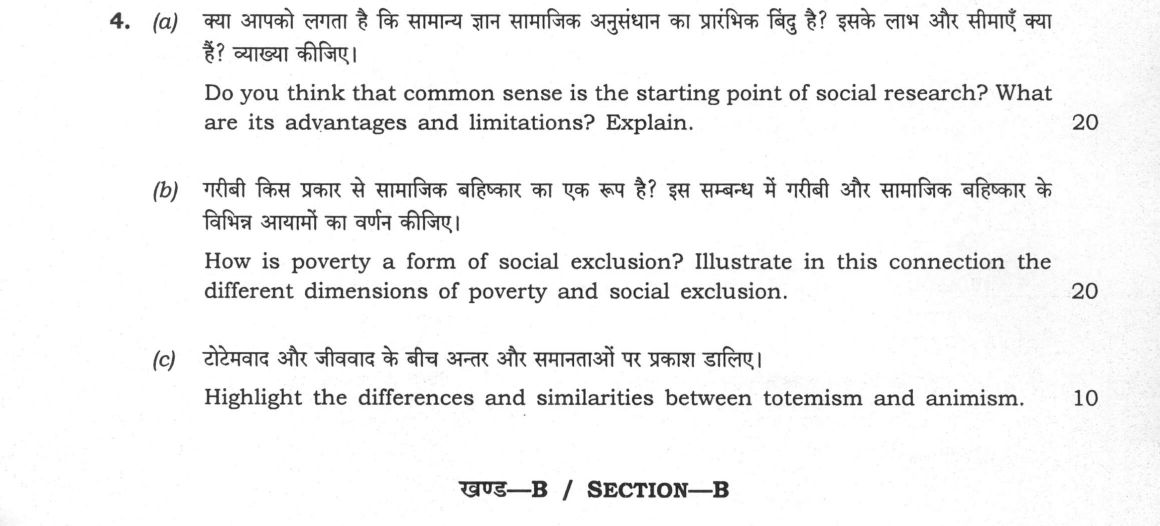
(a) Do you think that common sense is the starting point of social research? What are its advantages and limitations? Explain…
Do you think that common sense is the starting point of social research? What are its advantages and limitations? Explain. 20 marks
How is poverty a form of social exclusion? Illustrate in this connection the different dimensions of poverty and social exclusion. 20 marks
Highlight the differences and similarities between totemism and animism. 10 marks
हिंदी में प्रश्न पढ़ें
क्या आपको लगता है कि सामान्य ज्ञान सामाजिक अनुसंधान का प्रारंभिक बिंदु है? इसके लाभ और सीमाएं क्या हैं? व्याख्या कीजिए। (20 अंक)
गरीबी किस प्रकार से सामाजिक बहिष्कार का एक रूप है? इस संबंध में गरीबी और सामाजिक बहिष्कार के विभिन्न आयामों का वर्णन कीजिए। (20 अंक)
टोटेमवाद और जीववाद के बीच अंतर और समानताओं पर प्रकाश डालिए। (10 अंक)
Model answer
Written by UPSC Answer Check against this question's marking rubric, to the expected length. UPSC does not publish answers for Mains — this is one way to score well, not an official key.
Common Sense as the Starting Point of Social Research
Common sense constitutes what Alfred Schutz termed the "natural attitude"—the unexamined, taken-for-granted stock of knowledge actors employ to navigate everyday life. As Peter Berger and Thomas Luckmann explain, common sense represents sedimented, socially constructed meanings that make social reality coherent. Consequently, it inevitably serves as the primary starting point of sociological research. Max Weber’s method of Verstehen bridges common-sense understanding and scientific analysis by taking actors’ subjective meanings as the raw data for causal explanation. Harold Garfinkel’s breaching experiments demonstrated that social order is actively sustained through these shared, implicit common-sense assumptions.
The primary advantage of common sense lies in its empirical groundedness: it provides researchers with intuitive hypotheses, contextual familiarity, and direct access to lived experiences. However, its limitations are significant. Common sense is unsystematic, localized, and permeated by ideological biases that naturalize historical inequalities as "natural order." Unlike scientific sociology, it lacks comparative rigor, methodological falsifiability, and conceptual reflexivity. While social research must begin with common-sense constructs to understand human action, it must subject them to systematic empirical testing to build valid sociological knowledge.
Poverty as Social Exclusion: Dimensions and Mechanisms
Poverty is increasingly understood not merely as income insufficiency, but as a relational rupture. Amartya Sen reframes poverty as capability deprivation, while Graham Room conceptualizes social exclusion as the structural detachment of individuals and groups from mainstream social, economic, and political institutions.
This multi-dimensional process operates across distinct spheres: Economic dimension: Structural exclusion from secure labor markets traps individuals in precarious, informal work devoid of legal protections. Social dimension: Poverty generates acute network isolation, anomie, and relational shame, cutting individuals off from vital bridging social capital. Political dimension: Impoverished groups suffer systematic disenfranchisement and institutional neglect, illustrated by arbitrary urban slum evictions where informal dwellers lack property titles and administrative grievance redressal. Cultural dimension: Structural poverty entails deep stigmatization. In India, manual scavenging communities face an overlap of extreme economic deprivation and hereditary caste pollution, while development-induced displacement of Adivasi communities strips them of customary forest resources, eroding cultural identity and undermining statutory protections under the PESA Act, 1996.
Poverty therefore acts as social exclusion precisely because it converts material deficits into cumulative, intergenerational denial of citizenship and dignity.
Totemism and Animism: Comparative Analysis
Edward Tylor and J.G. Frazer conceptualized animism through an intellectualist lens, defining it as the belief in spiritual beings, souls, and personal spirits. They argued that early humans devised animism as a proto-scientific hypothesis to explain biological enigmas such as dreams, trances, and death. In contrast, Émile Durkheim, in The Elementary Forms of Religious Life, identified totemism among Australian Aborigines as the most elementary religious system. For Durkheim, totemism is the worship of an impersonal force symbolized by a clan emblem (the totem), establishing the fundamental division between the sacred and the profane.
Similarities: Both animism and totemism conceptualize non-empirical realities, generate systems of ritual practice, regulate human conduct, and bind individuals into moral communities that mediate human relationships with nature.
Differences: Animism focuses on individual psychological cognition, locating the origin of belief in dreams and individual souls. Totemism is inherently collective: the totem represents the clan itself, generated through "collective effervescence." Furthermore, Durkheim directly critiqued Tylor’s intellectualism, arguing that if animism were mere cognitive illusion, religion could not have sustained human societies across millennia. In totemism, religion worships society, fulfilling an objective social-integrative function rather than a psychological or speculative one.
What "Explain" is asking you to do
Make the working of something clear — what sets it off, what follows from what, and what it produces. Explain is the Commission's mechanism word: it dominates the technical papers and the “explain why” stems, where the marks sit in the causal chain and not in the label.
Structure that answers it
State what it is → the initiating condition → the chain of cause, step by step → an instance where it plays out → what the chain produces
Where marks are lost
Describing what something looks like instead of why it works that way. Naming the stages without linking them reads as description too.
How this answer will be evaluated
Approach
Framework: Sociology Paper 1 (UPSC). (a) explain: definition/context > points in order > small example > short close | (b) examine: intro > how/why with reasoning > evidence > conclusion | (c) highlight: name the salient points > one line of substance each > close Full marks: Comprehensive, well-structured, uses specific thinkers and examples, clear distinction between concepts.
Key points expected
- Define common sense vs. scientific knowledge
- Name a thinker (e.g., Durkheim, Weber, Popper)
- List specific advantages (e.g., hypothesis generation)
- List specific limitations (e.g., bias, lack of verification)
- Define poverty as a form of social exclusion
- Identify dimensions of poverty (economic, social, political)
- Identify dimensions of social exclusion (access, participation)
- Illustrate the connection with specific examples
Evaluation rubric
Each sub-part is marked on its own, against the marks and word limit printed on the paper.
- (a) Evaluate common sense as a starting point for social research, detailing its utility and constraints. 20 marks
explain— definition/context → points in order → small example → short close
Must cover
- Define common sense vs. scientific knowledge
- Name a thinker (e.g., Durkheim, Weber, Popper)
- List specific advantages (e.g., hypothesis generation)
- List specific limitations (e.g., bias, lack of verification)
Loses marks
- Treating common sense as purely negative
- Ignoring the 'starting point' aspect of the question
- Vague generalities without specific sociological concepts
Earns more
- Contrast common sense with scientific method
- Use a specific example of a common sense fallacy
- Reference the 'sociological imagination' (Mills)
Extra mark
- Reference a specific study where common sense failed
- Mention the role of 'prejudice' in research
- (b) Analyze poverty as social exclusion and illustrate the overlapping dimensions of both concepts. 20 marks
examine— intro → how/why with reasoning → evidence → conclusion
Must cover
- Define poverty as a form of social exclusion
- Identify dimensions of poverty (economic, social, political)
- Identify dimensions of social exclusion (access, participation)
- Illustrate the connection with specific examples
Loses marks
- Treating poverty and exclusion as entirely separate
- Focusing only on economic poverty
- Lack of specific illustrations or examples
Earns more
- Reference Amartya Sen's capability approach
- Mention specific marginalized groups (e.g., SC/ST, women)
- Discuss the multidimensional nature of poverty (MPI)
Extra mark
- Cite a specific Indian statistic (e.g., NFHS, PLFS)
- Reference a specific government scheme (e.g., MGNREGA)
- (c) Compare totemism and animism, identifying key differences and similarities. 10 marks
highlight— name the salient points → one line of substance each → close
Must cover
- Define totemism
- Define animism
- List key differences (e.g., focus, scope)
- List key similarities (e.g., belief in spirits)
Loses marks
- Confusing the two concepts
- Failing to provide both differences and similarities
- Vague definitions without specific examples
Earns more
- Reference specific anthropologists (e.g., Tylor, Frazer)
- Use a specific example of a totemic group
- Discuss the evolution of these concepts
Extra mark
- Mention a specific contemporary example
- Reference a specific debate in anthropology
Practice this exact question
Write your answer and it is marked point by point against the model answer above — what you covered, what you missed, what you got wrong.
Evaluate my answer →More from Sociology 2023 Paper I
- Q1 Answer the following questions in about 150 words each: (a) What is the distinctiveness o…
- Q2 (a) What, according to Robert Michels, is the iron law of oligarchy? Do lions and foxes i…
- Q3 (a) What are the characteristics of scientific method? Do you think that scientific metho…
- Q4 (a) Do you think that common sense is the starting point of social research? What are its…
- Q5 Answer the following questions in about 150 words each: (a) Examine the relevance of corp…
- Q6 (a) What are the different dimensions of qualitative method? Do you think that qualitativ…
- Q7 (a) Explain how economic globalization has brought changes in the patterns of employment…