Paper I — Q6
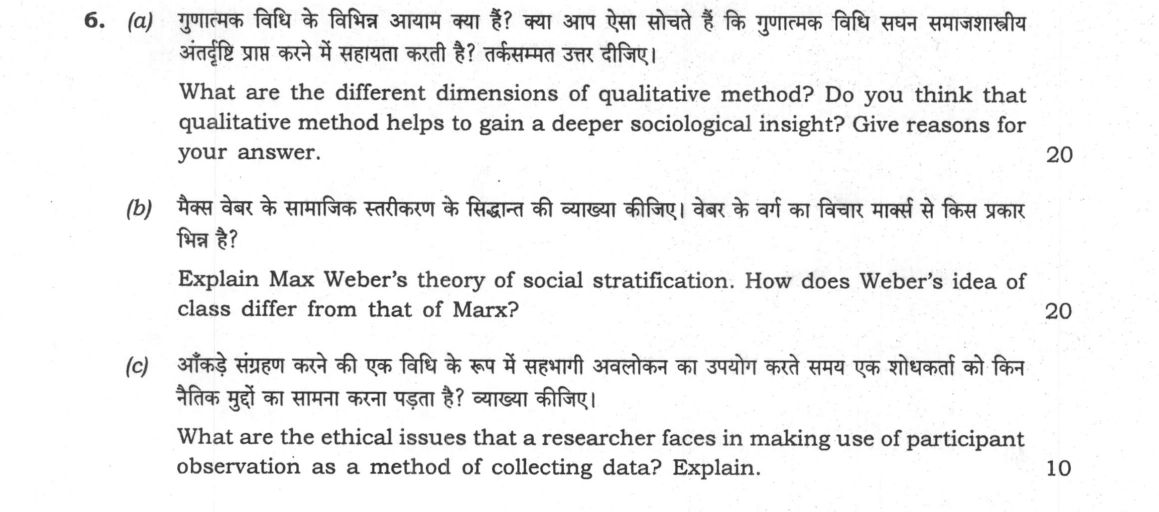
(a) What are the different dimensions of qualitative method? Do you think that qualitative method helps to gain a deeper…
What are the different dimensions of qualitative method? Do you think that qualitative method helps to gain a deeper sociological insight? Give reasons for your answer. 20 marks
Explain Max Weber's theory of social stratification. How does Weber's idea of class differ from that of Marx? 20 marks
What are the ethical issues that a researcher faces in making use of participant observation as a method of collecting data? Explain. 10 marks
हिंदी में प्रश्न पढ़ें
गुणात्मक विधि के विभिन्न आयाम क्या हैं? क्या आप ऐसा सोचते हैं कि गुणात्मक विधि सघन समाजशास्त्रीय अंतर्दृष्टि प्राप्त करने में सहायता करती है? तर्कसम्मत उत्तर दीजिए। (20 अंक)
मैक्स वेबर के सामाजिक स्तरीकरण के सिद्धांत की व्याख्या कीजिए। वेबर के वर्ग का विचार मार्क्स से किस प्रकार भिन्न है? (20 अंक)
आँकड़े संग्रहण करने की एक विधि के रूप में सहभागी अवलोकन का उपयोग करते समय एक शोधकर्ता को किन नैतिक मुद्दों का सामना करना पड़ता है? व्याख्या कीजिए। (10 अंक)
Model answer
Written by UPSC Answer Check against this question's marking rubric, to the expected length. UPSC does not publish answers for Mains — this is one way to score well, not an official key.
Dimensions and Depth of Qualitative Methods
Qualitative methodology conceptualises the social world as an ongoing production of meaning by reflexive actors. Its core dimensions include: Verstehen (Weber’s interpretive understanding of subjective motives); contextual embeddedness, wherein social action is analysed within its natural, socio-historical milieu; reflexivity, which requires the researcher to scrutinise their own positionality and biases; thick description (Clifford Geertz), which decodes the layered symbolic meanings behind observed behaviour; and inductive theory-building, exemplified by Barney Glaser and Anselm Strauss’s Grounded Theory, where conceptual frameworks are generated directly from empirical data rather than pre-existing deductive hypotheses.
Qualitative methods provide deeper sociological insight because they capture the processual dynamics, emotional textures, and micro-level realities of human agency that quantitative metrics obscure. By uncovering the lived experiences and meaning-making processes of actors, qualitative inquiry explains why and how structural phenomena occur, rather than merely measuring how much. However, this depth involves trade-offs. As Norman Denzin notes, interpretive research faces validity and replicability challenges due to investigator subjectivity, idiosyncratic data interpretation, and limited cross-context generalisability. Nevertheless, when evaluated on ecological validity and authentic representation of social phenomena rather than statistical representativeness, qualitative methods provide indispensable ontological depth.
Max Weber’s Stratification and the Contrast with Marx
Max Weber formulated a multidimensional model of social stratification, arguing that power is distributed across three distinct yet interacting societal orders: economic, social, and political, as detailed in his essay Class, Status, Party.
Class (The Economic Order): For Weber, class is not merely an occupational group or property relation, but a collective sharing a common "market situation" that determines their life chances. This produces multiple economic groupings based on skills, assets, and services offered in the market (e.g., propertied elites, propertyless intelligentsia, petty bourgeoisie, and manual workers).
Status (The Social Order): Status stratification is based on social honour, prestige, and distinct styles of life. Status groups maintain their boundaries through "social closure"—mechanisms like endogamy, commensality, and exclusionary social practices (exemplified by the Indian caste system).
Party (The Political Order): Parties are associations oriented toward the acquisition of social power to influence communal action and institutional policies, operating within modern bureaucratic structures.
Weber’s model differs fundamentally from Karl Marx’s formulation in Das Kapital. While Marx advanced an economic determinism that reduced social stratification to ownership versus non-ownership of the means of production, Weber insisted on the analytical autonomy of status and party from class. Consequently, while Marx envisioned class polarisation into two antagonistic camps (bourgeoisie and proletariat) with the inevitable transformation of a "class-in-itself" into a revolutionary "class-for-itself," Weber viewed class consciousness as contingent and fragmented. Weber demonstrated that status affiliations and social closure frequently cross-cut class divisions, preventing unified political mobilisation and resulting in enduring structural pluralism rather than inevitable proletarian revolution.
Ethical Issues in Participant Observation
Participant observation requires prolonged immersion in the everyday life of a community, generating acute ethical tensions:
Informed Consent versus Covert Research: Covert observation undermines subject autonomy and involves deliberate deception, as highlighted in the controversy surrounding Laud Humphreys’ Tearoom Trade, where private homosexual encounters were recorded and participants traced without consent.
Confidentiality and Risk of Harm: Close observation frequently uncovers illicit, deviant, or stigmatised practices. Inadequate anonymisation can expose vulnerable informants to legal prosecution or social ostracism.
Role Conflict and Detachment: The immersion required creates a tension between professional detachment and "going native," where emotional entanglement compromises analytical objectivity or creates unfulfillable expectations of patronage.
Exit Strategy: Terminating fieldwork after establishing deep personal relations can lead to feelings of desertion and exploitation among informants.
To resolve these challenges, contemporary researchers follow professional guidelines (such as the American Sociological Association ethics code), secure institutional ethics approval, use strict pseudonyms, and maintain negotiated, transparent exit strategies. In Indian sociology, M.N. Srinivas demonstrated reflexive ethical navigation in The Remembered Village, balancing empathetic participant observation in Rampura with rigorous transparency, role clarity, and protective field ethics.
Methodological rigour in sociology ultimately depends on combining the interpretive depth of qualitative enquiry with systematic ethical reflexivity, ensuring that empirical findings retain explanatory validity without violating human dignity.
What "Explain" is asking you to do
Make the working of something clear — what sets it off, what follows from what, and what it produces. Explain is the Commission's mechanism word: it dominates the technical papers and the “explain why” stems, where the marks sit in the causal chain and not in the label.
Structure that answers it
State what it is → the initiating condition → the chain of cause, step by step → an instance where it plays out → what the chain produces
Where marks are lost
Describing what something looks like instead of why it works that way. Naming the stages without linking them reads as description too.
How this answer will be evaluated
Approach
(a) discuss: intro > 3-4 dimensions > example > balanced close | (b) compare: paired headings or table > key differences > significance > conclusion | (c) highlight: name the salient points > one line of substance each > close Full marks: Precise definitions, clear distinctions, specific examples, and strong analytical reasoning.
Key points expected
- Define qualitative method and its core dimensions
- Identify at least three distinct dimensions (e.g., interpretive, inductive)
- Argue for deeper insight using specific sociological reasoning
- Provide a balanced conclusion on its utility
- Explain Weber's three dimensions of stratification (class, status, party)
- Define Weber's concept of class (market situation)
- Define Marx's concept of class (relation to means of production)
- Clearly articulate the key differences between Weber and Marx
Evaluation rubric
Each sub-part is marked on its own, against the marks and word limit printed on the paper.
- (a) Define qualitative method dimensions and justify its role in sociological insight. 20 marks
discuss— intro → 3-4 dimensions → example → balanced close
Must cover
- Define qualitative method and its core dimensions
- Identify at least three distinct dimensions (e.g., interpretive, inductive)
- Argue for deeper insight using specific sociological reasoning
- Provide a balanced conclusion on its utility
Loses marks
- Confusing qualitative with quantitative methods
- Listing dimensions without explaining their sociological value
- Vague generalizations without specific reasoning
Earns more
- Mention specific qualitative techniques (interviews, ethnography)
- Contrast with quantitative method to highlight depth
- Reference a specific qualitative study or thinker
Extra mark
- Cite a specific Indian qualitative study
- Reference a specific methodological text
- (b) Explain Weber's stratification theory and contrast his class concept with Marx's. 20 marks
compare— paired headings or table → key differences → significance → conclusion
Must cover
- Explain Weber's three dimensions of stratification (class, status, party)
- Define Weber's concept of class (market situation)
- Define Marx's concept of class (relation to means of production)
- Clearly articulate the key differences between Weber and Marx
Loses marks
- Conflating status and class in Weber's theory
- Ignoring the market situation aspect of Weber's class
- Presenting Marx's view without the means of production focus
Earns more
- Mention Weber's 'Economy and Society' or specific works
- Use specific examples of status groups or parties
- Discuss the role of power in Weber's framework
Extra mark
- Reference a specific Weberian case study
- Mention a specific Marxist critique of Weber
- (c) Identify and explain ethical issues in participant observation. 10 marks
highlight— name the salient points → one line of substance each → close
Must cover
- Define participant observation briefly
- Identify at least three ethical issues (e.g., consent, deception)
- Explain the nature of each ethical issue
- Mention the tension between data quality and ethics
Loses marks
- Listing issues without explaining them
- Ignoring the specific context of participant observation
- Confusing general research ethics with specific observational issues
Earns more
- Discuss informed consent challenges
- Mention the issue of researcher identity disclosure
- Reference specific ethical guidelines (e.g., ASA)
Extra mark
- Mention a specific famous ethical breach case
- Reference a specific ethical code
Practice this exact question
Write your answer and it is marked point by point against the model answer above — what you covered, what you missed, what you got wrong.
Evaluate my answer →More from Sociology 2023 Paper I
- Q3 (a) What are the characteristics of scientific method? Do you think that scientific metho…
- Q4 (a) Do you think that common sense is the starting point of social research? What are its…
- Q5 Answer the following questions in about 150 words each: (a) Examine the relevance of corp…
- Q6 (a) What are the different dimensions of qualitative method? Do you think that qualitativ…
- Q7 (a) Explain how economic globalization has brought changes in the patterns of employment…
- Q8 (a) What is Taylorism? Analyze its merits and demerits. (20 marks) (b) What are new relig…