Paper I — Q3
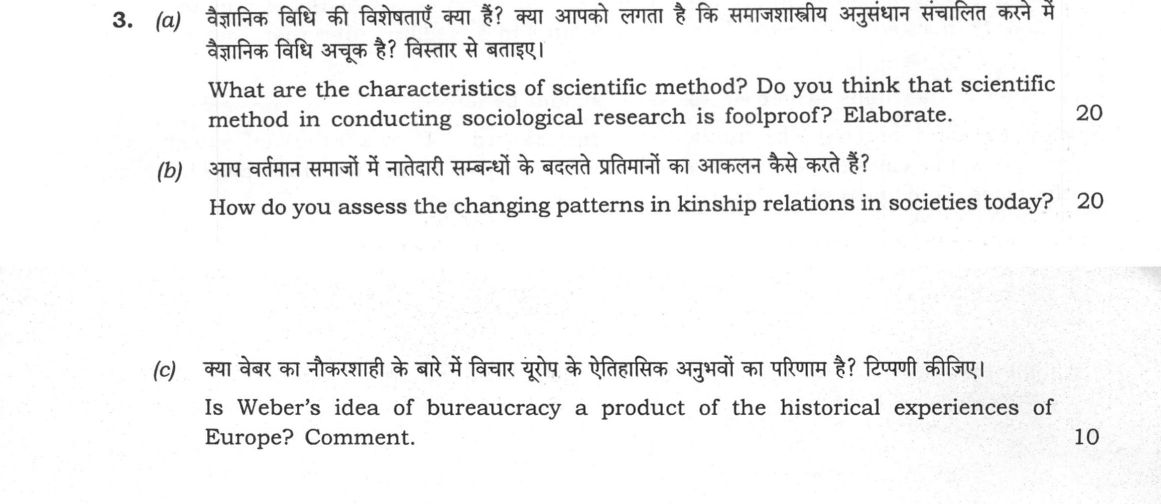
(a) What are the characteristics of scientific method? Do you think that scientific method in conducting sociological research is…
What are the characteristics of scientific method? Do you think that scientific method in conducting sociological research is foolproof? Elaborate. 20 marks
How do you assess the changing patterns in kinship relations in societies today? 20 marks
Is Weber's idea of bureaucracy a product of the historical experiences of Europe? Comment. 10 marks
हिंदी में प्रश्न पढ़ें
वैज्ञानिक विधि की विशेषताएं क्या हैं? क्या आपको लगता है कि समाजशास्त्रीय अनुसंधान संचालित करने में वैज्ञानिक विधि अचूक है? विस्तार से बताइए। (20 अंक)
आप वर्तमान समाजों में नातेदारी संबंधों के बदलते प्रतिमानों का आकलन कैसे करते हैं? (20 अंक)
क्या वेबर का नौकरशाही के बारे में विचार यूरोप के ऐतिहासिक अनुभवों का परिणाम है? टिप्पणी कीजिए। (10 अंक)
Model answer
Written by UPSC Answer Check against this question's marking rubric, to the expected length. UPSC does not publish answers for Mains — this is one way to score well, not an official key.
Scientific Method and its Limits in Sociological Research
The scientific method is characterized by systematic empirical observation, rigorous hypothesis testing, reliability, verifiability, and objectivity. In standard philosophy of science, it proceeds through Karl Popper’s criterion of falsifiability or shifts across Thomas Kuhn’s paradigms. However, applying this framework to sociology is far from foolproof. Alvin Gouldner’s emphasis on reflexivity highlights that sociologists are themselves embedded in the social contexts they study, making absolute detachment unattainable. Max Weber’s interpretive sociology (Verstehen) established that human behavior is laden with subjective meanings, requiring empathetic understanding rather than the mere causal determinism of the natural sciences. Weber clarified that while sociologists must maintain ethical neutrality (Wertfreiheit) during analysis, research selection is inevitably conditioned by value-relevance (Wertbeziehung).
Post-positivist and feminist standpoint theorists like Sandra Harding have demonstrated that universal objectivity often reflects patriarchal, dominant-group epistemologies. Decolonial scholars further argue that applying uncritical positivistic metrics universally reproduces Eurocentric hegemony. Domestically, ongoing debates surrounding caste census enumeration expose the politics of measurement, demonstrating that social categorization, operationalizing indicators, and data collection are intrinsically contested, political processes rather than neutral, foolproof exercises.
Changing Patterns in Kinship Relations Today
Kinship systems are shifting away from traditional lineage-based structures toward bilateral ties, negotiated partnerships, and heightened individual choice. Anthony Giddens characterizes modern partnerships as "pure relationships" sustained solely by emotional satisfaction, a shift accelerated by what Ulrich Beck terms the individualization of modern life. Technological and legal advances—such as Assisted Reproductive Technologies (ART), commercial surrogacy, and the expansion of digital kinship within transnational migration networks—have decoupled biological procreation from legal and domestic cohabitation.
Assessing these changes reveals a dual reality. Structural-functionalist claims of a linear transition to the isolated nuclear family fail to capture empirical complexity. Feminist political economy shows that the gendered burden of care work remains persistently asymmetric despite shifting household forms. In India, data from the National Family Health Survey (NFHS-5) and NCAER rural surveys show the resilience of modified joint family networks operating across separate physical households. Moreover, landmark jurisprudence, including the Supreme Court’s recognition of live-in relationships in S. Khushboo v. Kanniammal and the expanded understanding of family and gender identity in the NALSA (2014) judgment, demonstrates that kinship in contemporary societies is increasingly defined by elective affinity, contractual negotiation, and constitutional rights.
Weberian Bureaucracy and European Historical Specificity
Max Weber’s formulation of rational-legal bureaucracy—defined by formal hierarchy, codified rules, written documentation, and impersonal detachment—was shaped by the rise of the Prussian administrative state, Bismarckian state-building, and European industrial capitalism. Weber constructed this model as a methodological ideal type, an analytical heuristic rather than a universal empirical reality. Consequently, its claim to universal rationality reflects distinct Western historical experiences.
Post-colonial theorists, notably Sudipta Kaviraj and Partha Chatterjee, argue that transplanting this administrative blueprint to the Global South produced a distinct colonial bureaucracy designed for elite domination and revenue extraction rather than civic rationality. Historically, imperial China’s civil service operated on Confucian moral-philosophical statecraft, offering an alternative model of administrative coherence that Weber largely dismissed as patrimonial. In contemporary India, the persistence of informal networks, political patron-client dynamics, and recent reforms like lateral entry into civil services highlight that modern administrative systems remain continually mediated by local political economy rather than conforming strictly to Weber's Eurocentric ideal.
Sociological inquiry thus demonstrates that social research, family structures, and administrative institutions cannot be divorced from their historical contexts, requiring methodological reflexivity and localized frameworks of analysis.
What "Elaborate" is asking you to do
Give the full detailed account the question has compressed into a line — every dimension of it, with specifics. Elaborate rewards completeness and detail rather than clarification or argument: the examiner is checking whether you can fill out a topic without being told what its parts are.
Structure that answers it
State the proposition → first dimension in detail → second dimension in detail → the part the statement leaves implicit → the consolidated picture
Where marks are lost
Repeating the statement at greater length instead of adding substance. Elaborate also punishes narrowness: omitting a whole dimension costs more here than anywhere else in this family.
How this answer will be evaluated
Approach
(a) discuss: intro > 3-4 dimensions > example > balanced close | (b) examine: intro > how/why with reasoning > evidence > conclusion | (c) comment: context > arguments both sides > judgment > close Full marks: Precise definitions, named thinkers, strong Indian examples, and clear critical judgment.
Key points expected
- List core characteristics (observation, hypothesis, verification).
- Name a key thinker (e.g., Durkheim, Popper).
- Argue why it is not 'foolproof' (subjectivity, value-freedom).
- Provide an Indian sociological example.
- Contrast traditional (joint) vs modern (nuclear) patterns.
- Identify drivers (urbanization, industrialization, education).
- Discuss impact on social support systems.
- Use Indian context (e.g., migration, women's status).
Evaluation rubric
Each sub-part is marked on its own, against the marks and word limit printed on the paper.
- (a) Define scientific method and critically evaluate its limitations in sociological research. 20 marks
discuss— intro → 3-4 dimensions → example → balanced close
Must cover
- List core characteristics (observation, hypothesis, verification).
- Name a key thinker (e.g., Durkheim, Popper).
- Argue why it is not 'foolproof' (subjectivity, value-freedom).
- Provide an Indian sociological example.
Loses marks
- Treating scientific method as purely natural science.
- Ignoring the 'foolproof' aspect of the question.
Earns more
- Mention 'value-freedom' vs 'value-commitment'.
- Reference specific sociological method (survey/ethnography).
Extra mark
- Cite a specific study (e.g., Srinivas) as example.
- (b) Assess the transformation of kinship structures in contemporary societies. 20 marks
examine— intro → how/why with reasoning → evidence → conclusion
Must cover
- Contrast traditional (joint) vs modern (nuclear) patterns.
- Identify drivers (urbanization, industrialization, education).
- Discuss impact on social support systems.
- Use Indian context (e.g., migration, women's status).
Loses marks
- Generalizing without specific sociological concepts.
- Ignoring the 'assessment' (critical view) aspect.
Earns more
- Mention 'individualization' or 'companionate marriage'.
- Reference changing role of elders.
Extra mark
- Cite NFHS data on family size or migration.
- (c) Evaluate the European historical roots of Weber's bureaucracy concept. 10 marks
comment— context → arguments both sides → judgment → close
Must cover
- Define Weber's ideal type of bureaucracy.
- Link to European context (state-building, rationalization).
- Provide a balanced judgment on its universality.
Loses marks
- Describing bureaucracy without the 'European' link.
- Failing to provide a judgment/comment.
Earns more
- Mention 'rational-legal authority'.
- Contrast with traditional/charismatic authority.
Extra mark
- Reference specific European historical event (e.g., Reformation).
Practice this exact question
Write your answer and it is marked point by point against the model answer above — what you covered, what you missed, what you got wrong.
Evaluate my answer →More from Sociology 2023 Paper I
- Q1 Answer the following questions in about 150 words each: (a) What is the distinctiveness o…
- Q2 (a) What, according to Robert Michels, is the iron law of oligarchy? Do lions and foxes i…
- Q3 (a) What are the characteristics of scientific method? Do you think that scientific metho…
- Q4 (a) Do you think that common sense is the starting point of social research? What are its…
- Q5 Answer the following questions in about 150 words each: (a) Examine the relevance of corp…
- Q6 (a) What are the different dimensions of qualitative method? Do you think that qualitativ…