Paper I — Q5
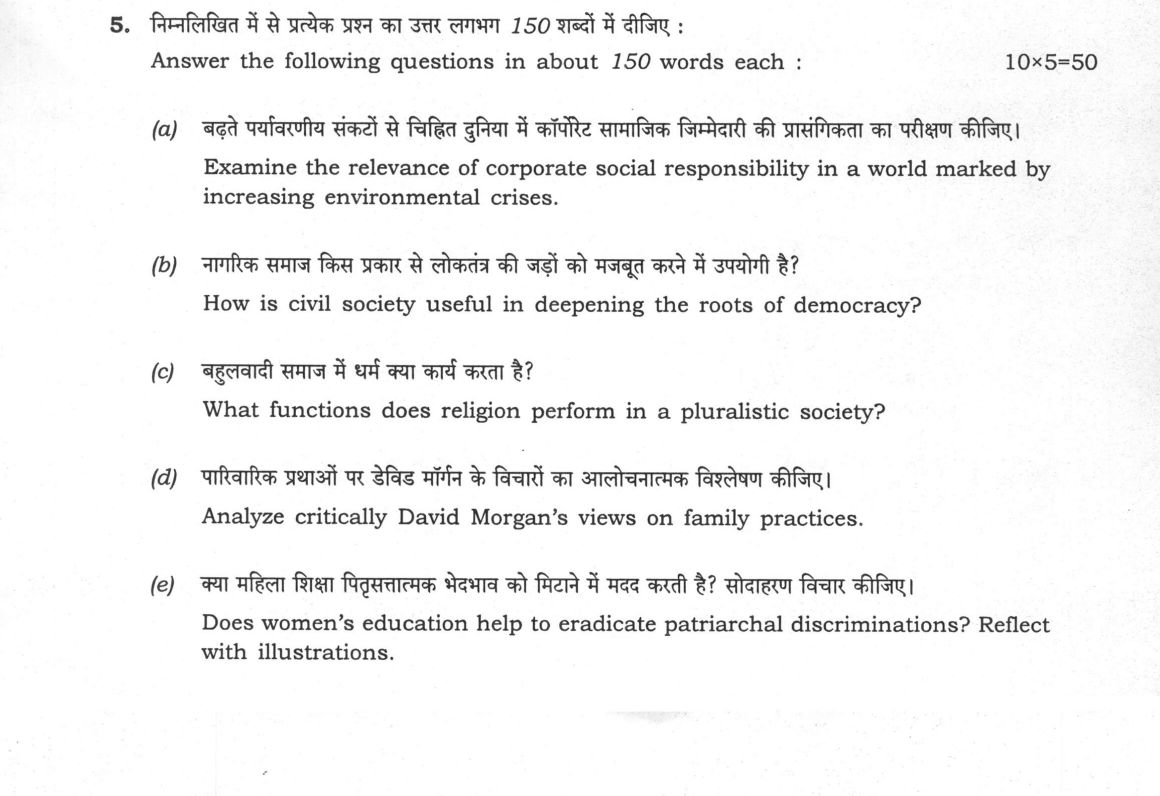
Answer the following questions in about 150 words each: (a) Examine the relevance of corporate social responsibility in a world…
Answer the following questions in about 150 words each:
Examine the relevance of corporate social responsibility in a world marked by increasing environmental crises. 10 marks
How is civil society useful in deepening the roots of democracy? 10 marks
What functions does religion perform in a pluralistic society? 10 marks
Analyze critically David Morgan's views on family practices. 10 marks
Does women's education help to eradicate patriarchal discriminations? Reflect with illustrations. 10 marks
हिंदी में प्रश्न पढ़ें
निम्नलिखित में से प्रत्येक प्रश्न का उत्तर लगभग 150 शब्दों में दीजिए :
बढ़ते पर्यावरणीय संकटों से चिह्नित दुनिया में कॉर्पोरेट सामाजिक जिम्मेदारी की प्रासंगिकता का परीक्षण कीजिए। (10 अंक)
नागरिक समाज किस प्रकार से लोकतंत्र की जड़ों को मजबूत करने में उपयोगी है? (10 अंक)
बहुलवादी समाज में धर्म क्या कार्य करता है? (10 अंक)
पारिवारिक प्रथाओं पर डेविड मॉर्गन के विचारों का आलोचनात्मक विश्लेषण कीजिए। (10 अंक)
क्या महिला शिक्षा पितृसत्तात्मक भेदभाव को मिटाने में मदद करती है? सोदाहरण विचार कीजिए। (10 अंक)
Model answer
Written by UPSC Answer Check against this question's marking rubric, to the 150-word length. UPSC does not publish answers for Mains — this is one way to score well, not an official key.
(a) Relevance of Corporate Social Responsibility in Increasing Environmental Crises
Corporate Social Responsibility (CSR) bridges economic activity and ecological accountability by operationalising John Elkington’s ‘Triple Bottom Line’ (People, Planet, Profit). It expands Archie Carroll’s CSR pyramid from mere voluntary philanthropy to mandatory ecological stewardship. In India, this transition is institutionalised through Section 135 and Schedule VII of the Companies Act 2013, mandating corporate spending on environmental sustainability, conservation, and agroforestry.
Sociologically, Ulrich Beck’s ‘Risk Society’ illustrates that industrial modernisation produces manufactured ecological hazards that traditional market mechanisms fail to address. However, CSR often degenerates into ‘greenwashing’—cosmetic compliance and superficial carbon-offsetting that obscure systemic resource extraction and ecological degradation. Furthermore, CSR projects frequently lack community-led participatory governance, functioning instead as top-down corporate public relations. CSR is therefore relevant only if it moves beyond compensatory tokenism to structural ecological modernisation that re-embeds business operations within planetary boundaries.
(b) Civil Society and Deepening the Roots of Democracy
Civil society acts as an intermediary realm between the private sphere and the state, vital for deepening substantive democracy. Robert Putnam demonstrated that dense networks of civic engagement generate ‘social capital’ (trust and reciprocity) essential for institutional performance. Jürgen Habermas framed this space as the ‘public sphere’, where communicative rationality and deliberation hold state power accountable.
In India, grassroots mobilisations have expanded democratic citizenship from formal voting to participatory governance. The Mazdoor Kisan Shakti Sangathan (MKSS) pioneered social audits, leading to the Right to Information Act, while the Narmada Bachao Andolan articulated subaltern ecological rights against state developmentalism. However, civil society is vulnerable to ‘NGO-ization’—the depoliticisation of radical movements through donor funding—and elite capture, where urban, middle-class associations prioritise aesthetic and consumerist concerns over structural redistribution. Thus, civil society deepens democracy primarily when it retains its contentious, rights-based character rather than functioning merely as an outsourced delivery arm of state policy.
(c) Functions of Religion in a Pluralistic Society
In a pluralistic society, religion exhibits a dual sociological character. Émile Durkheim identified religion as a source of the ‘collective conscience’ and social solidarity, whereas Peter Berger observed that pluralism fractures the singular ‘sacred canopy’, compelling traditions to co-exist in an open market of meaning.
S.N. Eisenstadt’s framework of ‘multiple modernities’ demonstrates that religious traditions provide distinct moral frameworks that enrich democratic discourse without requiring total secularisation. In India, syncretic developments such as the Bhakti-Sufi traditions historically fostered cross-communal solidarity, mutual tolerance, and shared cultural practices. Conversely, when religious identities become politicised, pluralism risks degenerating into communalism, competitive fundamentalism, and boundary-marking that fragment national integration. Ultimately, in pluralistic societies, religion functions either as an integrative moral resource or as an axis of polarization, contingent upon state neutrality and the strength of inter-group civic ties.
(d) Critical Analysis of David Morgan’s Views on Family Practices
David Morgan reoriented the sociology of the family from the conventional structural-functionalist view (Talcott Parsons, G.P. Murdock), which treated the family as a fixed institution, toward the fluid concept of ‘family practices’—understood as ‘doing family’. Drawing upon practice theory (Pierre Bourdieu, Anthony Giddens), Morgan foregrounded everyday, relational, and reflexive activities that individuals construct and label as familial.
Morgan’s approach successfully accounts for modern relational fluidity, destigmatising diverse formations such as single-parent households, cohabitation, and queer kinships. However, this interactional framework attracts critical scrutiny for over-emphasising agency. By prioritising micro-level negotiations, Morgan creates an artificial dualism between everyday practices and institutional structures. This downplays the enduring power of structural constraints—such as property laws, endogamous caste codes, and patriarchal divisions of domestic labour—that continue to determine and constrain family practices. Therefore, while Morgan’s framework captures subjective relationality, it must be balanced with structural political economy to explain the reproduction of familial inequalities.
(e) Women’s Education and Eradication of Patriarchal Discriminations
Women’s education is central to Human Capital Theory and Amartya Sen’s Capability Approach, enhancing female agency, autonomy, and voice. Demographic evidence from the National Family Health Survey (NFHS-5) confirms that maternal education directly correlates with delayed age at marriage, decline in Total Fertility Rate (TFR), lower maternal mortality, and increased participation in household decisions.
However, education alone has not eliminated patriarchal structures. ASER data highlights persistent gender gaps in foundational and technical learning. Structurally, higher educational attainment has coincided with low female labour force participation (FLFP) and occupational segregation (educated ghettoization), reflecting the enduring burden of unpaid care work. Moreover, among middle and upper strata, education often leads to ‘dowry inflation’, where a woman’s schooling is leveraged to secure higher-status marital alliances rather than economic independence. Persistent son-meta preference across educated classes indicates that cognitive advancement does not automatically dissolve patriarchal mindsets. Education is a vital catalyst, but eradicating patriarchal discrimination requires concurrent labour market transformation and cultural restructuring.
What "Examine" is asking you to do
Test the proposition the question puts to you and return a finding on how far it holds. Examine stems carry a claim, or ask whether something has happened, and expect evidence weighed both ways before the extent is stated — often with remedial measures attached.
Structure that answers it
Restate the claim as the question frames it → evidence that supports it → evidence that undercuts it → the conditions under which it holds → verdict on how far it stands
Where marks are lost
Stopping at description. An examination has to reach a finding, and “examine with justification” means the extent must be stated, not implied.
How this answer will be evaluated
Approach
Framework: Sociology Paper I (UPSC). (a) examine: intro > how/why with reasoning > evidence > conclusion | (b) explain: definition/context > points in order > small example > short close | (c) explain: definition/context > points in order > small example > short close | (d) critique: the claim > its strengths > its weaknesses > your judgment | (e) comment: context > arguments both sides > judgment > close Full marks: Precise sociological concepts, named thinkers, and specific Indian examples.
Key points expected
- Define CSR in environmental context
- Identify specific environmental crises (e.g., climate change)
- Explain how CSR addresses these crises
- Provide a corporate example
- Define civil society (NGOs, media, etc.)
- Explain role in political socialization
- Explain role in accountability/oversight
- Mention 'deepening' (participation beyond voting)
Evaluation rubric
Each sub-part is marked on its own, against the marks and word limit printed on the paper.
- (a) Link CSR to environmental crisis mitigation and corporate accountability. · 150 words
examine— intro → how/why with reasoning → evidence → conclusion
Must cover
- Define CSR in environmental context
- Identify specific environmental crises (e.g., climate change)
- Explain how CSR addresses these crises
- Provide a corporate example
Loses marks
- Generic definition without environmental focus
- Ignoring the 'crisis' aspect of the prompt
Earns more
- Mention of Triple Bottom Line
- Reference to ESG criteria
- Critique of 'greenwashing'
Extra mark
- Specific Indian corporate case study
- Reference to specific environmental policy
- (b) Detail mechanisms by which civil society strengthens democratic foundations. · 150 words
explain— definition/context → points in order → small example → short close
Must cover
- Define civil society (NGOs, media, etc.)
- Explain role in political socialization
- Explain role in accountability/oversight
- Mention 'deepening' (participation beyond voting)
Loses marks
- Confusing civil society with state/government
- Listing functions without linking to 'deepening'
Earns more
- Reference to Habermas (public sphere)
- Example of RTI or public interest litigation
- Mention of social movements
Extra mark
- Specific Indian NGO example (e.g., PUCL)
- Reference to specific democratic theory
- (c) List and explain the sociological functions of religion in a diverse society. · 150 words
explain— definition/context → points in order → small example → short close
Must cover
- Define pluralistic society
- Explain social integration/cohesion
- Explain moral regulation/norms
- Explain identity formation
Loses marks
- Theological rather than sociological answer
- Ignoring the 'pluralistic' constraint
Earns more
- Reference to Durkheim (social facts)
- Mention of 'social glue' concept
- Balanced view (integration vs. conflict)
Extra mark
- Reference to specific Indian context (e.g., caste/religion)
- Mention of functionalist vs. conflict perspective
- (d) Critically analyze David Morgan's specific views on family practices. · 150 words
critique— the claim → its strengths → its weaknesses → your judgment
Must cover
- Identify David Morgan (sociologist)
- State his core argument (e.g., 'doing family')
- Analyze the concept of 'family practices'
- Provide a critical evaluation (strengths/limits)
Loses marks
- Generic discussion of family without Morgan
- Describing family without critical analysis
Earns more
- Mention of 'doing family' concept
- Contrast with structural functionalism
- Reference to 'family as process'
Extra mark
- Specific citation of Morgan's work
- Comparison with another family sociologist
- (e) Evaluate the impact of women's education on patriarchal discrimination with examples. · 150 words
comment— context → arguments both sides → judgment → close
Must cover
- Define patriarchal discrimination
- Link education to empowerment/agency
- Provide specific illustrations (e.g., marriage, work)
- Offer a balanced judgment (does it fully eradicate?)
Loses marks
- Assuming education is a 'magic bullet'
- Lack of specific illustrations
Earns more
- Reference to 'human capital' theory
- Mention of 'socialization' vs. 'structural' barriers
- Example of changing gender roles
Extra mark
- Specific statistic on women's literacy/employment
- Reference to specific Indian data (NFHS)
Practice this exact question
Write your answer and it is marked point by point against the model answer above — what you covered, what you missed, what you got wrong.
Evaluate my answer →More from Sociology 2023 Paper I
- Q2 (a) What, according to Robert Michels, is the iron law of oligarchy? Do lions and foxes i…
- Q3 (a) What are the characteristics of scientific method? Do you think that scientific metho…
- Q4 (a) Do you think that common sense is the starting point of social research? What are its…
- Q5 Answer the following questions in about 150 words each: (a) Examine the relevance of corp…
- Q6 (a) What are the different dimensions of qualitative method? Do you think that qualitativ…
- Q7 (a) Explain how economic globalization has brought changes in the patterns of employment…
- Q8 (a) What is Taylorism? Analyze its merits and demerits. (20 marks) (b) What are new relig…