Paper I — Q8
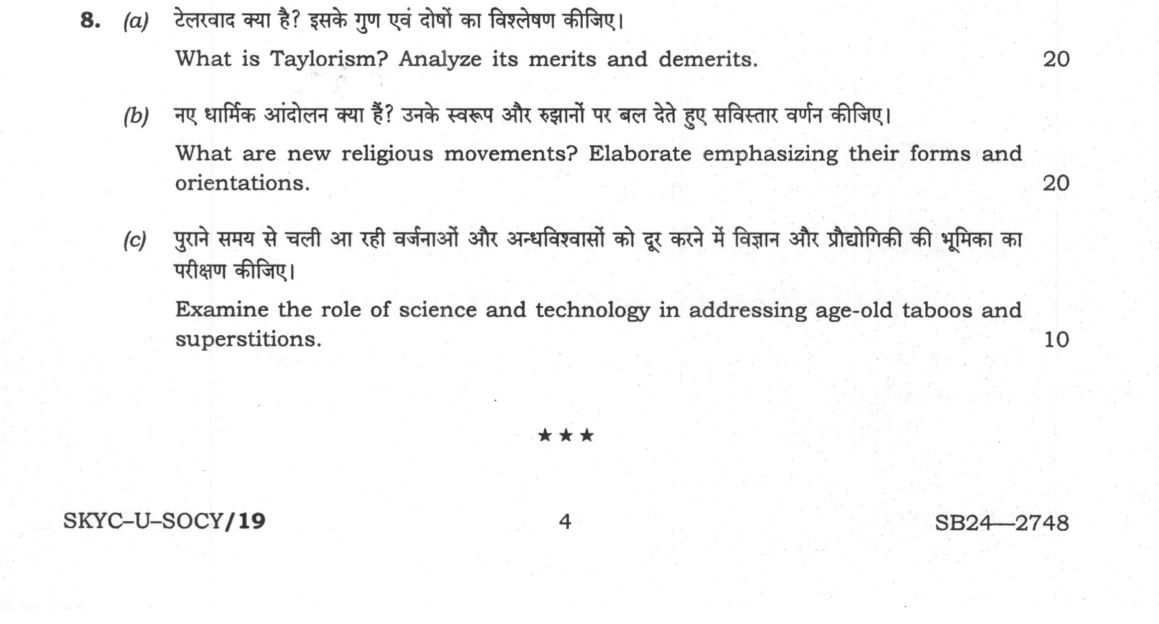
(a) What is Taylorism? Analyze its merits and demerits. (20 marks) (b) What are new religious movements? Elaborate emphasizing…
What is Taylorism? Analyze its merits and demerits. 20 marks
What are new religious movements? Elaborate emphasizing their forms and orientations. 20 marks
Examine the role of science and technology in addressing age-old taboos and superstitions. 10 marks
हिंदी में प्रश्न पढ़ें
टेलरवाद क्या है? इसके गुण एवं दोषों का विश्लेषण कीजिए। (20 अंक)
नए धार्मिक आंदोलन क्या हैं? उनके स्वरूप और रुझानों पर बल देते हुए सविस्तार वर्णन कीजिए। (20 अंक)
पुराने समय से चली आ रही वर्जनाओं और अंधविश्वासों को दूर करने में विज्ञान और प्रौद्योगिकी की भूमिका का परीक्षण कीजिए। (10 अंक)
Model answer
Written by UPSC Answer Check against this question's marking rubric, to the expected length. UPSC does not publish answers for Mains — this is one way to score well, not an official key.
Taylorism, formulated by F.W. Taylor in 1911, is a system of scientific management that seeks to make work rational by replacing rule-of-thumb methods with engineered procedures. Its four principles are: develop science for each element of work; scientifically select and train workers; cooperate with workers to ensure work is done scientifically; and divide work and responsibility between managers and workers. It relies on time-motion studies, standardisation, and the separation of conception from execution, whereby planning is centralised in management and execution is reduced to repetitive tasks. In practice, craft knowledge is replaced by managerial measurement.
Merits and demerits Its merits are clear: it raises efficiency and productivity, reduces waste, and creates standardised methods that can be taught and replicated. For Indian manufacturing and SMEs, such discipline can improve quality, reduce costs, and help small units compete in organised markets. It can make production predictable for Indian SMEs facing regular demand. Yet its demerits are equally serious. By breaking tasks into narrow operations, Taylorism deskills labour, a point Braverman develops in her analysis of labour process. It also produces alienation in Marx’s sense, because workers lose control over the whole process and become appendages of machines. The same separation that raises efficiency also produces deskilling and alienation. The system can become bureaucratically rigid, resisting local knowledge and innovation, and it often provokes worker resistance, as seen in historical trade-union opposition to speed-ups and piece-rate systems. Resistance may appear as strikes, slowdowns, or informal sabotage.
New religious movements New religious movements (NRMs) are religious groups that emerge outside established mainstream traditions and are often defined against the older church-sect typology. Wallis classifies them according to their relationship with the world: world-affirming, world-rejecting, and world-accommodating. World-affirming groups seek to transform society; world-rejecting groups withdraw from or oppose the existing order; world-accommodating groups work within society while maintaining distinct identity. World-affirming groups may seek social transformation; world-rejecting groups may form separate communities; world-accommodating groups may negotiate with institutions. NRMs have grown in post-industrial and globalised contexts, where individualism, mobility, and spiritual searching create demand for new meanings. In India, ISKCON, the Art of Living, Brahma Kumaris, and the growth of Pentecostal Christianity show this diversity. Their orientations are equally varied: some are fundamentalist, insisting on exclusive truth; some are syncretic, blending Hindu, Buddhist, or local elements; some are therapeutic, offering meditation, yoga, or counselling; and some follow the prosperity-gospel, linking faith with material success.
Science, technology and taboos Science and technology address age-old taboos and superstitions by producing what Weber called disenchantment: the replacement of magical explanations with testable, rational ones. In India, ASHA workers using mobile health applications can explain child mortality, vaccination, or nutrition in evidence-based terms, weakening fatalistic beliefs. Satellite-based crop advisories help farmers decide sowing and irrigation, countering ritual determinism in agriculture. ISRO’s weather prediction and disaster-warning systems reduce dependence on omens or ritual interventions during floods and droughts. These interventions matter because taboos regulate food, gender, and farming.
However, the limits are important. Science can itself become scientism, a belief system that treats technical solutions as morally superior. Technology may reinforce new hierarchies through the digital divide, where the poor lack access to devices, data, or literacy. Superstition also persists despite literacy: in Kerala, temple-entry debates and menstrual taboos in modern workplaces show that scientific knowledge does not automatically erase social habit.
Thus, Taylorism, NRMs, and scientific temper are not isolated phenomena. They represent modernising forces in contemporary India: rationalisation in work, religious transformation in meaning-making, and scientific temper in public life. The challenge is to combine rationalisation with dignity, religious renewal with tolerance, and scientific temper with social justice. A balanced view accepts their emancipatory potential while guarding against managerial exploitation, religious exclusivism, and new technological inequalities.
What "Analyse" is asking you to do
Break the subject into its working parts and show how they act on each other. The marks are in the interconnections — which factor drives which, and what the resulting structure explains — not in the inventory of factors.
Structure that answers it
Define the whole → separate it into its parts → show which part drives which → what that interaction produces → what the structure implies
Where marks are lost
A flat list of causes with no account of which drives which. An answer of neatly separated headings, each self-contained, scores as description.
How this answer will be evaluated
Approach
Framework: Sociology Paper 1 (UPSC). (a) analyse: intro > causes > effects > stakeholders/linkages > way forward | (b) explain: definition/context > points in order > small example > short close | (c) examine: intro > how/why with reasoning > evidence > conclusion Full marks: Precise definitions, clear analytical structure, specific examples, and strong sociological grounding.
Key points expected
- Define Taylorism as scientific management
- Name Frederick W. Taylor
- Analyze merits (efficiency, standardization)
- Analyze demerits (de-skilling, alienation)
- Define New Religious Movements (NRM)
- Distinguish NRM from cults/sects
- Elaborate on forms (e.g., syncretic, revivalist)
- Elaborate on orientations (e.g., world-rejecting, world-accommodating)
Evaluation rubric
Each sub-part is marked on its own, against the marks and word limit printed on the paper.
- (a) Define Taylorism and analyze its merits and demerits. 20 marks
analyse— intro → causes → effects → stakeholders/linkages → way forward
Must cover
- Define Taylorism as scientific management
- Name Frederick W. Taylor
- Analyze merits (efficiency, standardization)
- Analyze demerits (de-skilling, alienation)
Loses marks
- Confusing Taylorism with Fordism
- Listing points without analytical depth
- Ignoring the 'demerits' aspect
Earns more
- Reference to time and motion studies
- Mention of differential piece-rate system
- Link to industrial sociology (e.g., Weber)
Extra mark
- Reference to specific Taylorist factory case study
- Mention of 'The Principles of Scientific Management'
- (b) Define new religious movements and elaborate on their forms and orientations. 20 marks
explain— definition/context → points in order → small example → short close
Must cover
- Define New Religious Movements (NRM)
- Distinguish NRM from cults/sects
- Elaborate on forms (e.g., syncretic, revivalist)
- Elaborate on orientations (e.g., world-rejecting, world-accommodating)
Loses marks
- Using 'cult' as a synonym for NRM
- Failing to distinguish forms from orientations
- Vague definitions without sociological basis
Earns more
- Reference to sociological typologies (e.g., Wessinger)
- Mention of 'New Age' movements
- Distinction between 'cult' and 'NRM' in academic context
Extra mark
- Specific example of an Indian NRM (e.g., ISKCON)
- Reference to 'New Religious Movements' by specific sociologist
- (c) Examine the role of science and technology in addressing taboos and superstitions. 10 marks
examine— intro → how/why with reasoning → evidence → conclusion
Must cover
- Identify specific taboos/superstitions
- Explain scientific/technological intervention
- Analyze the impact on social behavior
- Provide a concrete example
Loses marks
- Generalizing without specific examples
- Ignoring the 'taboo' aspect
- Failing to link technology to social change
Earns more
- Reference to medical science (e.g., vaccines)
- Reference to communication technology (e.g., internet)
- Mention of 'rationalization' (Weber)
Extra mark
- Reference to specific government health campaign
- Mention of 'scientific temper' in Constitution
Practice this exact question
Write your answer and it is marked point by point against the model answer above — what you covered, what you missed, what you got wrong.
Evaluate my answer →More from Sociology 2023 Paper I
- Q5 Answer the following questions in about 150 words each: (a) Examine the relevance of corp…
- Q6 (a) What are the different dimensions of qualitative method? Do you think that qualitativ…
- Q7 (a) Explain how economic globalization has brought changes in the patterns of employment…
- Q8 (a) What is Taylorism? Analyze its merits and demerits. (20 marks) (b) What are new relig…