Paper II — Q1
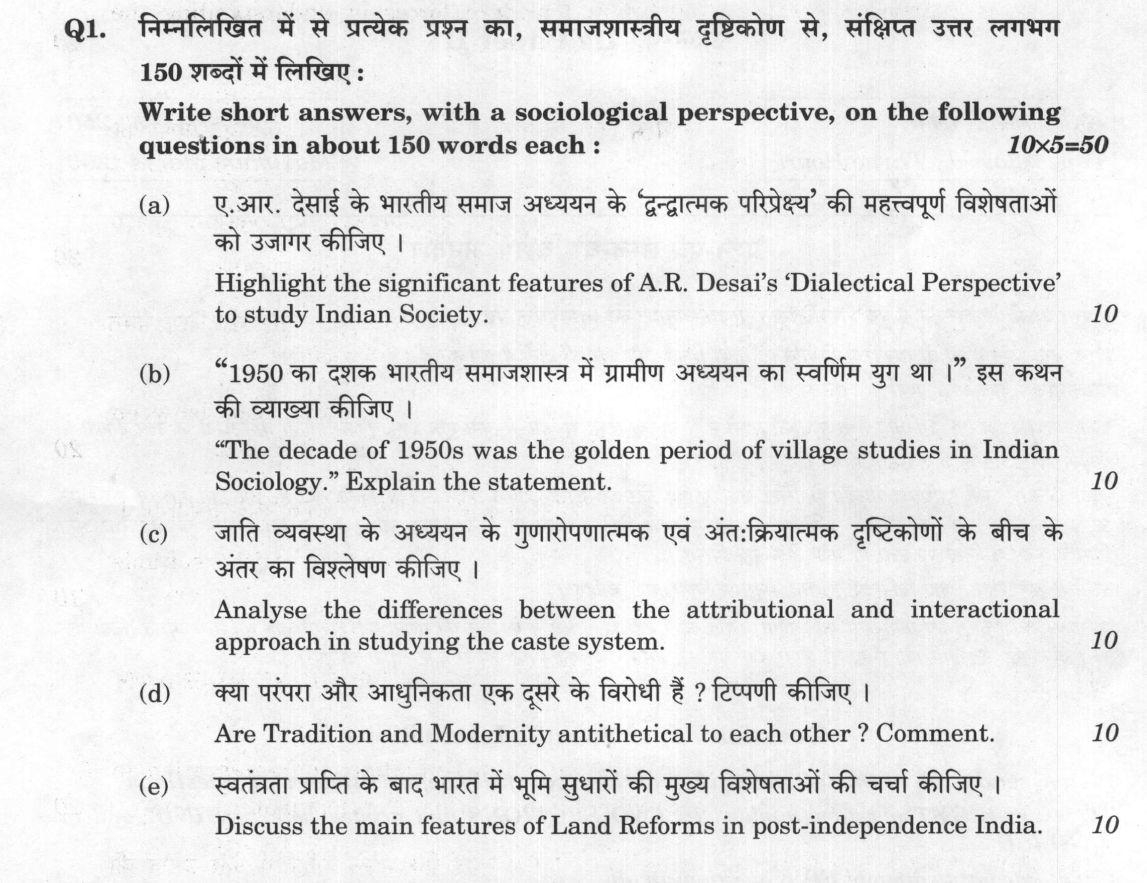
Write short answers, with a sociological perspective, on the following questions in about 150 words each: (a) Highlight the…
Write short answers, with a sociological perspective, on the following questions in about 150 words each:
Highlight the significant features of A.R. Desai's 'Dialectical Perspective' to study Indian Society. 10 marks
"The decade of 1950s was the golden period of village studies in Indian Sociology." Explain the statement. 10 marks
Analyse the differences between the attributional and interactional approach in studying the caste system. 10 marks
Are Tradition and Modernity antithetical to each other ? Comment. 10 marks
Discuss the main features of Land Reforms in post-independence India. 10 marks
हिंदी में प्रश्न पढ़ें
निम्नलिखित में से प्रत्येक प्रश्न का, समाजशास्त्रीय दृष्टिकोण से, संक्षिप्त उत्तर लगभग 150 शब्दों में लिखिए :
ए.आर. देसाई के भारतीय समाज अध्ययन के 'द्वंद्वात्मक परिप्रेक्ष्य' की महत्वपूर्ण विशेषताओं को उजागर कीजिए । (10 अंक)
"1950 का दशक भारतीय समाजशास्त्र में ग्रामीण अध्ययन का स्वर्णिम युग था ।" इस कथन की व्याख्या कीजिए । (10 अंक)
जाति व्यवस्था के अध्ययन के गुणारोपणात्मक एवं अंतःक्रियात्मक दृष्टिकोणों के बीच के अंतर का विश्लेषण कीजिए । (10 अंक)
क्या परंपरा और आधुनिकता एक दूसरे के विरोधी हैं ? टिप्पणी कीजिए । (10 अंक)
स्वतंत्रता प्राप्ति के बाद भारत में भूमि सुधारों की मुख्य विशेषताओं की चर्चा कीजिए । (10 अंक)
Model answer
Written by UPSC Answer Check against this question's marking rubric, to the 150-word length. UPSC does not publish answers for Mains — this is one way to score well, not an official key.
(a) A.R. Desai’s dialectical perspective A.R. Desai’s dialectical perspective treats Indian society not as static customs but as a historically changing formation shaped by modes of production and class relations. Its features are rooted in historical materialism: economic base, property relations and exploitation are central to understanding caste, religion and politics. Desai foregrounds class contradiction, arguing that colonialism reorganised Indian society by imposing new property relations, market integration and bureaucratic state power, while transforming older hierarchies. He rejects structural-functionalism, which presents caste as self-equilibrating, and sees society as a field of conflict, resistance and transformation. Colonial impact is analysed not merely as cultural contact but as a mode of production that created new classes, dislocated peasants and made the national movement class-based. Thus social change is driven by contradictions between tradition and modernity, ruler and ruled, indigenous and colonial structures. The perspective makes Indian society dynamic, linking caste, class and colonialism to revolutionary transformation.
(b) The 1950s as a golden period The 1950s became a golden period of village studies because post-independence India needed empirical knowledge of rural society for planning, nation-building and democratic decentralisation. The Community Development Programme and the Planning Commission’s Research Programmes Committee created demand for systematic fieldwork. Institutional support, especially from the Planning Commission and later the Indian Council of Social Science Research, made sustained rural studies possible. S.C. Dube’s Shamirpet study, F.G. Bailey’s Bisipara fieldwork and Srinivas’s Rampura fieldwork, begun in 1948 and shaping the 1950s debate, became reference points for caste, kinship, land and local power. These studies examined how extension services, cooperatives and political mobilisation entered village life, helping sociology treat India as an empirical field rather than colonial speculation. Their significance lies in combining state interest, institutional funding and monographic fieldwork, making the village central to understanding Indian modernity.
(c) Attributional and interactional approaches The attributional approach studies caste as ascribed status, where identity is fixed by birth, ritual rank and structural position. Dumont and Ghurye emphasise hierarchy, purity and pollution, endogamy and a closed social order in which caste is a moral and religious classification. Here caste is a stable structure; change is deviation or modern intrusion. The interactional approach, associated with Marriott and Srinivas, shifts attention from fixed attributes to social processes: exchange, patronage, jajmani relations, dependency, dominance and everyday negotiation. Caste is not a closed hierarchy but a field of transaction in which groups maintain, contest and modify positions. Marriott’s purificatory interaction and Srinivas’s mobility concepts show caste relations are processual and open to mobility, though structurally constrained. The difference is between caste as static attributional order and caste as interactional process. Attributional analysis explains the architecture of hierarchy; interactional analysis explains how hierarchy is reproduced, contested and transformed through action.
(d) Tradition and modernity Tradition and modernity are often presented as antithetical, especially in Rostow’s modernization theory, where societies move from traditional to modern stages and old institutions are displaced. Here modernity means rationality, industrialisation, individualism and secularism, while tradition means hierarchy, religion and particularism. Indian sociology offers a dialectical view. The Rudolphs and Yogendra Singh show that modernity in India did not simply erase tradition; it was selectively adapted, reinterpreted and embedded in existing social forms. Sanskritization and westernization illustrate this: lower castes may adopt upper-caste rituals, and urban Indians may combine modern professions with traditional family and religious practices. Multiple modernities emerge because communities negotiate modern institutions through caste, kinship and local politics. Thus, tradition and modernity are not simply opposed; they are mutually constitutive. Modernity transforms tradition, while tradition mediates modernity. The Indian case shows social change is neither linear replacement nor pure continuity, but dialectical selective adaptation and creative synthesis.
(e) Land reforms Post-independence land reforms aimed to restructure agrarian class relations by removing feudal intermediaries, securing tenants and limiting land concentration. Main features were abolition of zamindari, tenancy reforms, ceilings on landholdings, consolidation of holdings, and Bhoodan-Gramdan. Zamindari abolition removed intermediaries and made cultivators direct relations with the state, though former zamindars retained control through false names. Tenancy reforms protected tenants from eviction and excessive rent; ceilings aimed to redistribute surplus land to landless and marginal farmers. Consolidation made holdings contiguous and improved productivity. Bhoodan-Gramdan added voluntary redistribution, but impact was limited. The Green Revolution linked land reform to productivity in Punjab, Haryana and western Uttar Pradesh. Yet implementation was uneven across states, shaped by bureaucracy, politics and dominant-class resistance. Thus land reforms failed to alter agrarian power structure, leaving caste and class inequalities intact. A way forward requires agrarian reform, secure tenancy, redistribution and support for small farmers.
What "Highlight" is asking you to do
Bring the notable features of the named material forward and make their weight visible — what each feature is, and what gives it importance. Highlight expects substantive coverage of the features, not a thin selection from them.
Structure that answers it
The material and what makes a feature notable within it → feature, with the point that gives it weight → the same for each further feature → the composite picture they form
Where marks are lost
Naming features flatly as a list and never showing why any one of them signifies.
How this answer will be evaluated
Approach
Framework: Sociological Perspective (UPSC Sociology Paper II). (a) highlight: name the salient points > one line of substance each > close | (b) explain: definition/context > points in order > small example > short close | (c) analyse: intro > causes > effects > stakeholders/linkages > way forward | (d) comment: context > arguments both sides > judgment > close | (e) discuss: intro > 3-4 dimensions > example > balanced close Full marks: Precise sociological terminology, clear distinction between concepts, strong Indian examples, and a balanced argument.
Key points expected
- Name A.R. Desai and his dialectical materialist stance
- Explain the concept of 'social formation' in the Indian context
- Discuss the interplay of caste, class, and colonialism
- Mention the role of the state in the transition of society
- Mention the establishment of the Indian Sociological Society (ISS)
- Cite the 'Village Studies' project (e.g., 1950s-60s)
- Name key scholars (e.g., M.N. Srinivas, G.S. Ghurye, S.C. Dube)
- Explain the focus on caste, kinship, and religion in rural settings
Evaluation rubric
Each sub-part is marked on its own, against the marks and word limit printed on the paper.
- (a) Identify and explain the core tenets of A.R. Desai's dialectical approach to Indian society. 10 marks · 150 words
highlight— name the salient points → one line of substance each → close
Must cover
- Name A.R. Desai and his dialectical materialist stance
- Explain the concept of 'social formation' in the Indian context
- Discuss the interplay of caste, class, and colonialism
- Mention the role of the state in the transition of society
Loses marks
- Treating Desai as a general liberal sociologist
- Ignoring the materialist/economic base of his argument
- Confusing his view with M.N. Srinivas's modernization theory
Earns more
- Reference to 'Socio-Economic History of India'
- Mention of 'Asiatic Mode of Production' critique
- Link to the concept of 'semi-feudal, semi-colonial' society
- Contrast with functionalist or liberal perspectives
Extra mark
- Citation of a specific work by Desai
- Reference to a contemporary application of his theory
- (b) Justify why the 1950s are considered the golden age of village studies in Indian sociology. 10 marks · 150 words
explain— definition/context → points in order → small example → short close
Must cover
- Mention the establishment of the Indian Sociological Society (ISS)
- Cite the 'Village Studies' project (e.g., 1950s-60s)
- Name key scholars (e.g., M.N. Srinivas, G.S. Ghurye, S.C. Dube)
- Explain the focus on caste, kinship, and religion in rural settings
Loses marks
- Focusing on urban sociology instead of rural
- Ignoring the specific 1950s context
- Confusing village studies with general rural development
Earns more
- Reference to specific studies (e.g., 'The Sanskritized Village')
- Mention of the 'Sanskritization' concept
- Discussion of the 'dominant caste' concept
- Note on the methodological shift to fieldwork
Extra mark
- Mention of a specific village study (e.g., Rampur, Alipura)
- Reference to the role of the Planning Commission
- (c) Compare the attributional and interactional approaches to studying the caste system. 10 marks · 150 words
analyse— intro → causes → effects → stakeholders/linkages → way forward
Must cover
- Define the attributional approach (status, hierarchy, purity)
- Define the interactional approach (dominance, power, conflict)
- Contrast the focus on 'what caste is' vs 'how caste works'
- Mention key proponents (e.g., Srinivas vs. Dumont/Isaacs)
Loses marks
- Confusing the two approaches
- Failing to distinguish between status and power
- Ignoring the sociological implications of each approach
Earns more
- Reference to 'Sanskritization' (attributional)
- Reference to 'Dominant Caste' (interactional)
- Mention of 'Purity and Pollution' (Dumont)
- Discussion of 'Caste as a system of stratification' vs 'social control'
Extra mark
- Citation of a specific study on caste conflict
- Reference to a contemporary caste issue
- (d) Evaluate the relationship between tradition and modernity in the Indian context. 10 marks · 150 words
comment— context → arguments both sides → judgment → close
Must cover
- Define tradition and modernity in a sociological context
- Argue that they are not necessarily antithetical
- Provide examples of 'tradition in modernity' (e.g., IT sector, festivals)
- Discuss the concept of 'modernization' vs 'westernization'
Loses marks
- Presenting a simplistic 'tradition vs modernity' binary
- Ignoring the Indian context
- Failing to provide concrete examples
Earns more
- Reference to 'Sanskritization' as a bridge
- Mention of 'Cultural lag' (Ogburn)
- Discussion of 'Glocalization'
- Example of a traditional institution adapting to modernity
Extra mark
- Citation of a specific study on tradition/modernity
- Reference to a current debate on cultural identity
- (e) Outline the main features and objectives of land reforms in post-independence India. 10 marks · 150 words
discuss— intro → 3-4 dimensions → example → balanced close
Must cover
- Mention the abolition of the Zamindari system
- Discuss the introduction of land ceilings
- Explain the concept of 'land to the tiller'
- Mention the role of the state in land redistribution
Loses marks
- Ignoring the regional variations in land reform
- Failing to mention the political context of the reforms
- Confusing land reform with agricultural development
Earns more
- Reference to specific state-level reforms (e.g., West Bengal, Kerala)
- Mention of the 'Green Revolution' impact on land
- Discussion of the 'failure' or 'success' of reforms
- Reference to the 'Land Reforms Act'
Extra mark
- Citation of a specific statistic on land distribution
- Reference to a current debate on land rights
Practice this exact question
Write your answer and it is marked point by point against the model answer above — what you covered, what you missed, what you got wrong.
Evaluate my answer →More from Sociology 2023 Paper II
- Q1 Write short answers, with a sociological perspective, on the following questions in about…
- Q2 (a) Do you agree with the view of Andre Beteille that India's villages are representative…
- Q3 (a) Contextualize Louis Dumont's concept of 'binary opposition' with reference to caste s…
- Q4 (a) Analyse the perspectives of Isolation, Assimilation and Integration in understanding…