Paper II — Q8
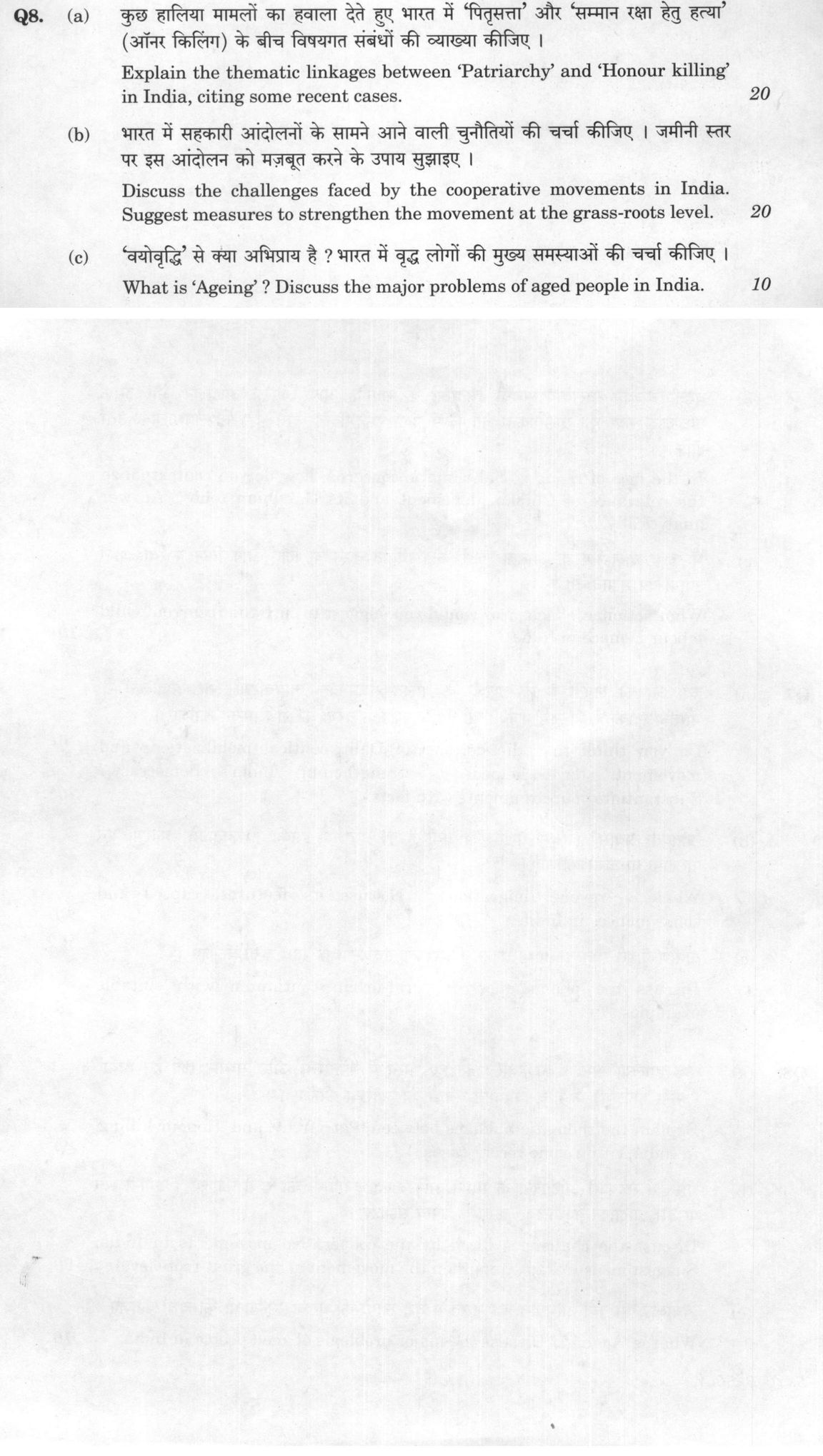
(a) Explain the thematic linkages between 'Patriarchy' and 'Honour killing' in India, citing some recent cases. (20 marks) (b)…
Explain the thematic linkages between 'Patriarchy' and 'Honour killing' in India, citing some recent cases. 20 marks
Discuss the challenges faced by the cooperative movements in India. Suggest measures to strengthen the movement at the grass-roots level. 20 marks
What is 'Ageing' ? Discuss the major problems of aged people in India. 10 marks
हिंदी में प्रश्न पढ़ें
कुछ हालिया मामलों का हवाला देते हुए भारत में 'पितृसत्ता' और 'सम्मान रक्षा हेतु हत्या' (ऑनर किलिंग) के बीच विषयगत संबंधों की व्याख्या कीजिए । (20 अंक)
भारत में सहकारी आंदोलनों के सामने आने वाली चुनौतियों की चर्चा कीजिए । जमीनी स्तर पर इस आंदोलन को मजबूत करने के उपाय सुझाइए । (20 अंक)
'वयोवृद्धि' से क्या अभिप्राय है ? भारत में वृद्ध लोगों की मुख्य समस्याओं की चर्चा कीजिए । (10 अंक)
Model answer
Written by UPSC Answer Check against this question's marking rubric, to the expected length. UPSC does not publish answers for Mains — this is one way to score well, not an official key.
These three issues—honour, cooperatives and ageing—show how social structures shape vulnerability, agency and collective life in India.
Patriarchy and honour killing Patriarchy in India is not merely male dominance but a structural order that regulates female sexuality, marriage, lineage and caste reputation. Honour killing is its extreme enforcement mechanism: when a woman or man asserts choice in marriage, especially across caste or gotra lines, the family and caste community read this as damage to izzat and a violation of gotra exogamy and caste-purity anxiety. To restore collective honour, they may use coercion, exile, boycott or murder. Because honour is reputational, the response is public: the family seeks to reassert control over the group’s social capital. Khap panchayats in Haryana and Punjab have often provided social legitimacy to such decisions, even though they have no legal authority. Recent cases show this causal chain: the 2021 Kausalya–Shankar case in Tamil Nadu and a 2022 Delhi case involving a young woman killed after family opposition to her marriage illustrate how intimate choices become collective honour crimes. The 2020 Nikita Tomar case in Haryana, widely discussed, was a stalking-related murder rather than a familial honour killing; it is useful as a contrast, showing that not every gender violence is an honour killing, but both reveal patriarchal control over women’s mobility and choice.
Cooperative movements Cooperatives in India face structural and operational challenges. Political interference converts member-owned institutions into patronage tools; bureaucratisation and weak professional management reduce efficiency; poor credit access persists because of weak governance and dependence on government refinance; member apathy weakens democratic control; and regional imbalance is visible in stronger performance in Gujarat and Kerala compared with much of BIMARU. The Amul dairy model, with strong member participation and professional management, contrasts with IFFCO, a multi-state cooperative owned by cooperative societies that is more centralized and sector-specific. To strengthen the movement at the grass-roots level, professional management must be insulated from politics. ICT integration can improve transparency, credit scoring, supply-chain linkage and member participation. Women-led cooperatives, such as Kerala’s Kudumbashree model, can deepen inclusion and local accountability. NABARD linkage should provide refinance and capacity building, while legal reform must complete the 97th Constitutional Amendment’s promise. The Supreme Court in Union of India v. Rajendra Shah (2021) struck down Part IXB to the extent it applied to state cooperatives for lack of ratification, though it remains valid for multi-state cooperatives; therefore states must enact enabling laws ensuring regular elections, member rights and independent oversight.
Ageing and old-age vulnerability Ageing is both a biological process and a social construction shaped by demographic transition, family structure, labour markets and welfare policy. In India, the elderly face economic dependency, pension gaps, healthcare burden, empty-nest syndrome, elder abuse and feminisation of ageing, as women outlive men and often remain dependent, especially in rural areas. NSS 75th Round (2017-18) on elderly conditions indicates a rising elderly population, with about 10 per cent of the population aged 60 and above, and growing health-care needs. The Maintenance and Welfare of Parents and Senior Citizens Act 2007 provides a legal remedy, but implementation is weak. The SAGE portal, meant to simplify maintenance claims, is limited by low awareness, digital divide, delays and poor enforcement. Strengthening old-age security requires universal pension coverage, home-based care, accessible healthcare, and active ageing programmes.
In sum, these themes show that social structures determine who is protected or punished. Honour killing exposes patriarchal control; cooperatives show how governance shapes collective economic action; ageing shows how lifecycle vulnerability is shaped by welfare. A way forward requires legal enforcement, democratic institutions and grassroots inclusion.
What "Explain" is asking you to do
Make the working of something clear — what sets it off, what follows from what, and what it produces. Explain is the Commission's mechanism word: it dominates the technical papers and the “explain why” stems, where the marks sit in the causal chain and not in the label.
Structure that answers it
State what it is → the initiating condition → the chain of cause, step by step → an instance where it plays out → what the chain produces
Where marks are lost
Describing what something looks like instead of why it works that way. Naming the stages without linking them reads as description too.
How this answer will be evaluated
Approach
Framework: Sociology Paper II: Define > Thinker > Argument > Indian illustration. (a) explain: definition/context > points in order > small example > short close | (b) discuss: intro > 3-4 dimensions > example > balanced close | (c) discuss: intro > 3-4 dimensions > example > balanced close Full marks: Precise definitions, specific cases/data, clear linkages, and well-mapped solutions.
Key points expected
- Define Patriarchy as a structural system of male dominance
- Link Honour killing to the control of female sexuality
- Cite at least two specific recent cases (e.g., Punjab/Haryana)
- Explain the 'family honour' logic as a patriarchal mechanism
- Identify 3-4 specific challenges (e.g., political interference, lack of funds)
- Suggest measures specifically for the grass-roots level
- Map solutions directly to the identified challenges
- Reference the Cooperative Societies Act or relevant policy
Evaluation rubric
Each sub-part is marked on its own, against the marks and word limit printed on the paper.
- (a) Thematic linkages between Patriarchy and Honour killing with recent cases. 20 marks
explain— definition/context → points in order → small example → short close
Must cover
- Define Patriarchy as a structural system of male dominance
- Link Honour killing to the control of female sexuality
- Cite at least two specific recent cases (e.g., Punjab/Haryana)
- Explain the 'family honour' logic as a patriarchal mechanism
Loses marks
- Treating honour killing as mere 'crime of passion'
- Ignoring the gendered nature of the violence
- Vague references to 'social issues' without specific cases
Earns more
- Reference to NCRB data on honour killings
- Mention of specific legal provisions (IPC 302/307)
- Contrast between 'family honour' and 'individual rights'
Extra mark
- Citation of a specific Supreme Court judgment
- Reference to a specific sociological study on caste/patriarchy
- (b) Challenges of cooperative movements and measures for grass-roots strengthening. 20 marks
discuss— intro → 3-4 dimensions → example → balanced close
Must cover
- Identify 3-4 specific challenges (e.g., political interference, lack of funds)
- Suggest measures specifically for the grass-roots level
- Map solutions directly to the identified challenges
- Reference the Cooperative Societies Act or relevant policy
Loses marks
- Generic 'challenges' without specific cooperative context
- Solutions that are not implementable at grass-roots level
- Ignoring the political dimension of cooperative governance
Earns more
- Mention of specific cooperative types (e.g., dairy, credit)
- Reference to the 97th Amendment (cooperatives in 9th Schedule)
- Discussion of 'one member, one vote' principle
Extra mark
- Citation of a specific successful cooperative model (e.g., Amul)
- Reference to a specific government scheme for cooperatives
- (c) Definition of Ageing and major problems of aged people in India. 10 marks
discuss— intro → 3-4 dimensions → example → balanced close
Must cover
- Define 'Ageing' (biological/social process)
- List 3-4 major problems (e.g., health, financial, social isolation)
- Provide Indian context for these problems
- Briefly mention existing support systems (e.g., Indira Gandhi scheme)
Loses marks
- Defining ageing only as 'getting old'
- Listing problems without Indian context
- Ignoring the social dimension of ageing
Earns more
- Reference to NFHS data on elderly health
- Mention of 'social isolation' as a key problem
- Discussion of 'financial dependency' on children
Extra mark
- Citation of a specific government scheme for elderly
- Reference to a specific sociological study on elderly in India
Practice this exact question
Write your answer and it is marked point by point against the model answer above — what you covered, what you missed, what you got wrong.
Evaluate my answer →More from Sociology 2023 Paper II
- Q5 Write short answers, with a sociological perspective, on the following questions in about…
- Q6 (a) How do you account for the increasing significance of religion in public and personal…
- Q7 (a) Do you think that the decades of Dalit political mobilizations and movements have hel…
- Q8 (a) Explain the thematic linkages between 'Patriarchy' and 'Honour killing' in India, cit…