Paper II — Q3
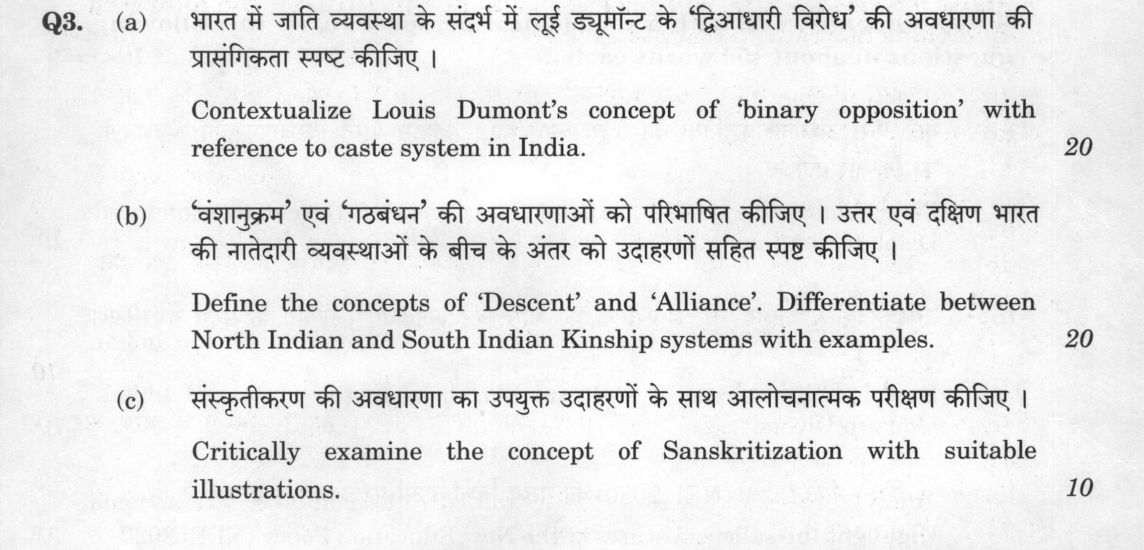
(a) Contextualize Louis Dumont's concept of 'binary opposition' with reference to caste system in India. (20 marks) (b) Define…
Contextualize Louis Dumont's concept of 'binary opposition' with reference to caste system in India. 20 marks
Define the concepts of 'Descent' and 'Alliance'. Differentiate between North Indian and South Indian Kinship systems with examples. 20 marks
Critically examine the concept of Sanskritization with suitable illustrations. 10 marks
हिंदी में प्रश्न पढ़ें
भारत में जाति व्यवस्था के संदर्भ में लुई ड्यूमॉन्ट के 'द्विआधारी विरोध' की अवधारणा की प्रासंगिकता स्पष्ट कीजिए । (20 अंक)
'वंशानुक्रम' एवं 'गठबंधन' की अवधारणाओं को परिभाषित कीजिए । उत्तर एवं दक्षिण भारत की नातेदारी व्यवस्थाओं के बीच के अंतर को उदाहरणों सहित स्पष्ट कीजिए । (20 अंक)
संस्कृतीकरण की अवधारणा का उपयुक्त उदाहरणों के साथ आलोचनात्मक परीक्षण कीजिए । (10 अंक)
Model answer
Written by UPSC Answer Check against this question's marking rubric, to the expected length. UPSC does not publish answers for Mains — this is one way to score well, not an official key.
Caste, kinship, and mobility form the core structural triad of Indian social organization.
Dumont’s Binary Opposition in Caste
In Homo Hierarchicus (1970), Louis Dumont applied structuralism to argue that the caste system is organized around the fundamental binary opposition of the pure and the impure. For Dumont, this religious-ideological binary constitutes the overarching principle of caste, distinguishing traditional Indian society, which is built on holistic hierarchy, from modern Western society, which is rooted in individualistic egalitarianism. In this scheme, status (the pure Brahmin) ideologically encompasses temporal power (the Kshatriya ruler).
However, this structuralist formulation has faced substantial critique. Dipankar Gupta rejects Dumont’s consensual hierarchy, arguing that caste is characterized by horizontal ethnicity and contested discrete ideologies, where multiple castes claim superior origin rather than accepting a singular vertical scale of purity. Gloria Goodwin Raheja, in her study of Pahansu (The Poison in the Gift), demonstrates that caste relations operate along an axis of centrality and periphery mediated by auspiciousness and inauspiciousness (shubh/ashubh), rather than pure/impure binaries. Additionally, Declan Quigley critiques Dumont’s Brahmin-centric view, emphasizing the political centrality of the king and noting that modern caste substantialization has turned castes into competing political interest groups.
Descent, Alliance, and Regional Kinship Variations
Kinship systems are analyzed through descent and alliance theories. Descent theory treats unilineal (patrilineal or matrilineal) or bilateral genealogical transmission of group membership, property, and rights across generations as primary. Alliance theory (Claude Lévi-Strauss) treats the exchange of women through marriage as the foundational mechanism creating enduring reciprocal networks between kin groups.
Using Irawati Karve’s comparative framework (Kinship Organization in India), regional kinship systems reveal sharp contrasts:
North Indian Kinship is grounded in patrilineal descent and rigorous negative marriage rules. It enforces gotra, pravara, and sapinda exogamy, prohibiting marriage across four lineages (father, mother, father's mother, mother's mother), alongside strict village exogamy. Marriages are hypergamous, creating asymmetrical affinal relations where bride-givers are socially subordinate to bride-takers.
South Indian Kinship operates fundamentally on alliance principles within the Dravidian linguistic framework. It emphasizes positive marriage rules, favouring isogamous cross-cousin unions (marriage with mother’s brother’s daughter or father’s sister’s daughter) and maternal uncle-niece unions, seen among Tamil Iyers and Mudaliars. Dravidian terminology differentiates parallel and cross-relatives, fostering lineage segmentation and repeated marital alliances within closed circles rather than spatial exogamy.
Critical Examination of Sanskritization
M.N. Srinivas conceptualized Sanskritization as the process by which lower castes or tribes adopt the rituals, vegetarianism, customs, and beliefs of twice-born (dvija) castes to claim higher status. Drawing on Robert K. Merton’s reference group theory, Srinivas showed that this process enables positional change within the caste system without altering its overarching structural framework, often mediated by emulating the local dominant caste.
However, Sanskritization has notable limitations:
Yogendra Singh notes that under contemporary conditions, secularization, modernization, and westernization have surpassed ritual emulation as pathways to upward mobility. André Béteille emphasizes that political power, reservations, and class mobility provide secular avenues of advancement outside the ritual hierarchy. Srinivas himself later acknowledged that non-Brahmin dominant castes often serve as reference models, diluting the concept's exclusively orthodox orientation. Crucially, Sanskritization offers limited mobility for Dalits; attempts to adopt upper-caste cultural symbols frequently encounter violent upper-caste backlash rather than social acceptance, demonstrating that ritual imitation cannot overcome entrenched socio-economic deprivation.
While structural binaries and alliance rules have historically regulated status and kinship, democratic politics, legal guarantees, and class differentiation continue to transform and contest these traditional hierarchies across India.
What "Contextualize" is asking you to do
Take the concept the question names and situate it in the specific setting it gives you, showing how that setting makes sense of it and where the fit strains. UPSC uses this to ask that a theoretical concept be applied to a named Indian case, not that background be narrated.
Structure that answers it
The concept in its own terms → the setting named in the question → the concept applied to that setting, point by point → where the fit strains → what the application establishes
Where marks are lost
Background for its own sake, never connected back. Explaining the concept at length and never reaching the case named in the question loses most of the marks.
How this answer will be evaluated
Approach
(a) explain: definition/context > points in order > small example > short close | (b) compare: paired headings or table > key differences > significance > conclusion | (c) critique: the claim > its strengths > its weaknesses > your judgment Full marks: Precise definitions, clear North/South contrast, strong critique of Sanskritization with specific examples.
Key points expected
- Define Dumont's 'binary opposition' (Purity vs Pollution)
- Link hierarchy to ritual status, not just economic rank
- Explain 'Encompassing' (Hegemony) of the Brahminical ideal
- Apply to specific caste interactions (e.g., Brahmin vs Dalit)
- Define 'Descent' (lineage) and 'Alliance' (marriage)
- Identify North Indian system: Unilineal (Patrilineal) + Exogamy
- Identify South Indian system: Bilateral + Endogamy (Gotra)
- Provide specific examples (e.g., Jajmani vs Tamil Gotra)
Evaluation rubric
Each sub-part is marked on its own, against the marks and word limit printed on the paper.
- (a) Explain Dumont's binary opposition (Purity/Pollution) as the structural logic of the Indian caste system. 20 marks
explain— definition/context → points in order → small example → short close
Must cover
- Define Dumont's 'binary opposition' (Purity vs Pollution)
- Link hierarchy to ritual status, not just economic rank
- Explain 'Encompassing' (Hegemony) of the Brahminical ideal
- Apply to specific caste interactions (e.g., Brahmin vs Dalit)
Loses marks
- Treating caste as purely economic (Marxist view only)
- Describing caste without the Purity/Pollution axis
- Name-dropping Dumont without explaining the binary
Earns more
- Mention Dumont's 'Homo Hierarchicus'
- Contrast Dumont with M.N. Srinivas or M.S. Aney
- Reference 'dominance' vs 'subordination' in Dumont's terms
Extra mark
- Cite specific Dumont text or page reference
- Mention Dumont's critique of Western individualism
- (b) Define Descent/Alliance and contrast North vs South Indian kinship systems with examples. 20 marks
compare— paired headings or table → key differences → significance → conclusion
Must cover
- Define 'Descent' (lineage) and 'Alliance' (marriage)
- Identify North Indian system: Unilineal (Patrilineal) + Exogamy
- Identify South Indian system: Bilateral + Endogamy (Gotra)
- Provide specific examples (e.g., Jajmani vs Tamil Gotra)
Loses marks
- Confusing 'Descent' with 'Descent group' (lineage/clan)
- Generalizing 'North' as only Hindu (ignoring tribal)
- Failing to distinguish Alliance from Descent
Earns more
- Mention 'Jajmani system' for North India
- Mention 'Gotra exogamy' vs 'Gotra endogamy' distinction
- Reference M.N. Srinivas or Dumont on kinship
Extra mark
- Cite specific tribal or regional kinship data
- Mention 'Cross-cousin marriage' in South India
- (c) Critically examine Sanskritization: definition, process, and its limitations/criticisms. 10 marks
critique— the claim → its strengths → its weaknesses → your judgment
Must cover
- Define 'Sanskritization' (M.N. Srinivas)
- Explain the mechanism (lower castes adopting upper caste traits)
- Provide a suitable illustration (e.g., Yadavs, Jats)
- Critique the concept (e.g., ignores economic power, gender)
Loses marks
- Describing Sanskritization as purely religious
- Ignoring the 'critical' aspect (only describing, not evaluating)
- Confusing Sanskritization with 'Assimilation'
Earns more
- Mention 'Westernization' as a contrast
- Reference Srinivas's 'Social Change in Modern India'
- Mention 'Hegemony' in the Sanskritization process
Extra mark
- Cite a specific contemporary example (e.g., political mobilization)
- Mention 'Sanskritization' vs 'Sanskritization of the state'
Practice this exact question
Write your answer and it is marked point by point against the model answer above — what you covered, what you missed, what you got wrong.
Evaluate my answer →More from Sociology 2023 Paper II
- Q1 Write short answers, with a sociological perspective, on the following questions in about…
- Q2 (a) Do you agree with the view of Andre Beteille that India's villages are representative…
- Q3 (a) Contextualize Louis Dumont's concept of 'binary opposition' with reference to caste s…
- Q4 (a) Analyse the perspectives of Isolation, Assimilation and Integration in understanding…
- Q5 Write short answers, with a sociological perspective, on the following questions in about…
- Q6 (a) How do you account for the increasing significance of religion in public and personal…