Paper II — Q5
Write short answers, with a sociological perspective, on the following questions in about 150 words each: (a) Citing some case…
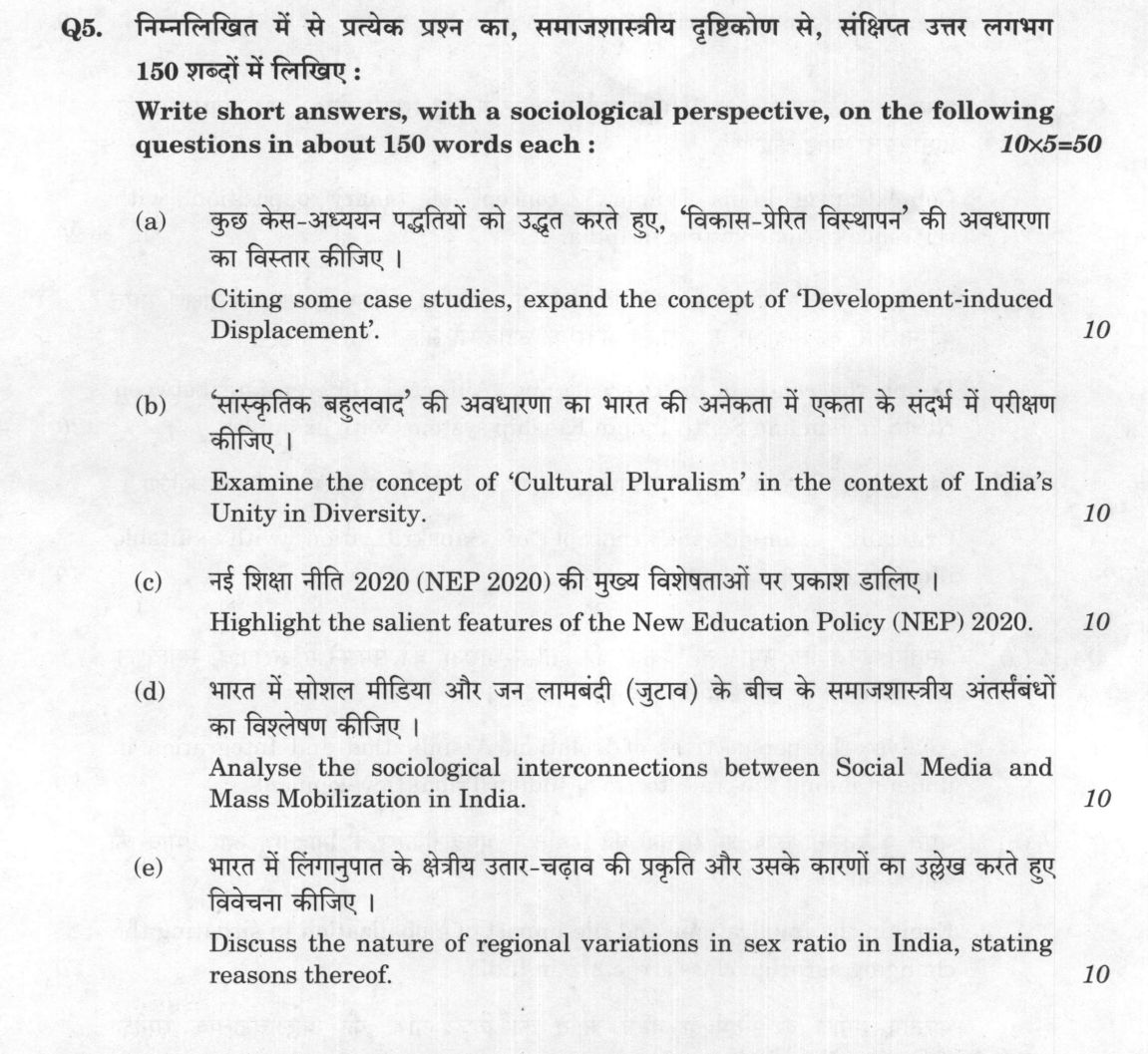
Write short answers, with a sociological perspective, on the following questions in about 150 words each:
Citing some case studies, expand the concept of 'Development-induced Displacement'. 10 marks
Examine the concept of 'Cultural Pluralism' in the context of India's Unity in Diversity. 10 marks
Highlight the salient features of the New Education Policy (NEP) 2020. 10 marks
Analyse the sociological interconnections between Social Media and Mass Mobilization in India. 10 marks
Discuss the nature of regional variations in sex ratio in India, stating reasons thereof. 10 marks
हिंदी में प्रश्न पढ़ें
निम्नलिखित में से प्रत्येक प्रश्न का, समाजशास्त्रीय दृष्टिकोण से, संक्षिप्त उत्तर लगभग 150 शब्दों में लिखिए :
कुछ केस-अध्ययन पद्धतियों को उद्धृत करते हुए, 'विकास-प्रेरित विस्थापन' की अवधारणा का विस्तार कीजिए । (10 अंक)
'सांस्कृतिक बहुलवाद' की अवधारणा का भारत की अनेकता में एकता के संदर्भ में परीक्षण कीजिए । (10 अंक)
नई शिक्षा नीति 2020 (NEP 2020) की मुख्य विशेषताओं पर प्रकाश डालिए । (10 अंक)
भारत में सोशल मीडिया और जन लामबंदी (जुटाव) के बीच के समाजशास्त्रीय अंतर्संबंधों का विश्लेषण कीजिए । (10 अंक)
भारत में लिंगानुपात के क्षेत्रीय उतार-चढ़ाव की प्रकृति और उसके कारणों का उल्लेख करते हुए विवेचना कीजिए । (10 अंक)
Model answer
Written by UPSC Answer Check against this question's marking rubric, to the 150-word length. UPSC does not publish answers for Mains — this is one way to score well, not an official key.
(a) Development-Induced Displacement
Development-induced displacement refers to the involuntary uprooting of populations to facilitate infrastructure, industrialization, or conservation projects. Sociologist Michael Cernea conceptualizes this through the Impoverishment Risks and Reconstruction (IRR) model, identifying structural risks such as landlessness, joblessness, homelessness, marginalization, food insecurity, and loss of common property resources. Unlike voluntary migration driven by economic aspiration, forced displacement severs populations from their ecological, economic, and cultural lifeworlds.
Empirical evidence demonstrates how development projects disproportionately impact marginalized groups, especially Adivasis. The Sardar Sarovar Project on the Narmada River displaced hundreds of thousands of agrarian and tribal families across Gujarat, Maharashtra, and Madhya Pradesh, sparking the Narmada Bachao Andolan to challenge inadequate state compensation. Similarly, the Polavaram Dam in Andhra Pradesh has submerged tribal habitations, fracturing customary livelihoods. In Jharkhand, the Koel-Karo hydroelectric project witnessed prolonged tribal mobilization against the alienation of ancestral sasandiri (burial) lands. Displacement without rights-based rehabilitation transforms developmental interventions into structural violence.
(b) Cultural Pluralism in the Context of India’s Unity in Diversity
Cultural pluralism, as articulated by Horace Kallen, envisions society as a "cultural mosaic" rather than an assimilative "melting pot," where distinct ethnic, linguistic, and religious groups maintain their unique identities within a common political framework. In India, "Unity in Diversity" operationalizes pluralism not through coercive assimilation, but through institutional accommodation and constitutional safeguards.
The Indian Constitution embeds pluralism through fundamental rights: Articles 29 and 30 protect the linguistic and educational rights of minorities, while Articles 350A and 350B mandate facilities for instruction in mother tongues and establish the Special Officer for Linguistic Minorities.
However, examining this dynamic reveals persistent tensions. Pluralism faces challenges from majoritarian homogenization, which seeks cultural uniformity, alongside violent regional assertions and ethnic chauvinism. The sociological reality shows that cultural pluralism in India is an active, ongoing negotiation between state integration and sub-national distinctiveness, requiring constant democratic renewal to prevent pluralism from degenerating into fragmented communalism.
(c) Salient Features of the New Education Policy (NEP) 2020
The National Education Policy (NEP) 2020 introduces structural shifts in Indian education. It replaces the traditional 10+2 system with a 5+3+3+4 curricular structure, formalizing Early Childhood Care and Education (ECCE) for children aged three to six to address early cognitive disparities.
To mitigate cultural alienation, NEP mandates instruction in the mother tongue, local language, or regional language up to Grade 5. In higher education, it promotes multidisciplinary flexibility, multiple entry and exit points with an Academic Bank of Credits, and sets a target to raise the Gross Enrolment Ratio (GER) to 50% by 2035.
Sociologically, while the policy aims to bridge historical social stratifications through universalized foundational literacy, its heavy reliance on digital pedagogy raises concerns. In an unequal society, the digital divide along class, caste, and rural-urban lines threatens to reproduce educational stratification unless accompanied by equitable public infrastructure investment.
(d) Social Media and Mass Mobilization in India
Manuel Castells’ framework of "networked social movements" illustrates how digital communication technologies construct autonomous public spheres, bypassing traditional institutional and media gatekeepers. In India, social media platforms provide critical affordances: instant virality, relative anonymity, low entry barriers, and horizontal, leaderless mobilization.
These dynamics were evident in the anti-CAA/NRC mobilizations, where digital networks coordinated local protests like Shaheen Bagh; the 2020–21 Farmers' Movement, which deployed initiatives like Tractor2Twitr to counter mainstream narratives; and the #MeTooIndia campaign, which exposed institutionalized patriarchy through decentralized victim narratives.
However, social media’s mobilizing capacity presents structural pathologies. Algorithmic echo chambers, automated disinformation, and majoritarian polarization generate intense digital tribalism. Furthermore, while social media excels at rapid, ephemeral agitation, its lack of formal organizational hierarchy frequently impedes long-term institutional bargaining, making sustained structural change difficult without grounded grassroots mobilization.
(e) Regional Variations in Sex Ratio in India
India exhibits a pronounced regional divergence in sex ratios, reflecting varied cultural, kinship, and socio-economic structures. The north-western states—particularly Punjab and Haryana—have historically recorded severely masculinized child sex ratios (hovering around 850–900 females per 1,000 males), whereas southern states like Kerala (1,084 females per 1,000 males in Census 2011) and northeastern states demonstrate balanced or feminized demographic outcomes.
These regional variations stem from deep structural factors: The North-West is characterized by rigid patrilineal and patrilocal kinship systems, strict village exogamy, hypergamy, and dowry inflation. These combine with agrarian political economy and norms of female seclusion (purdah) to render female labor socially invisible, fostering intense son preference and daughter elimination through sex-selective technologies.
Conversely, the South and North-East exhibit higher female autonomy, cross-cousin marriage practices that retain women close to natal kinship support, historical matriliny among Meghalaya's Khasi and Garo tribes, and elevated female literacy and public health access, collectively securing higher female survival rates.
What "Examine" is asking you to do
Test the proposition the question puts to you and return a finding on how far it holds. Examine stems carry a claim, or ask whether something has happened, and expect evidence weighed both ways before the extent is stated — often with remedial measures attached.
Structure that answers it
Restate the claim as the question frames it → evidence that supports it → evidence that undercuts it → the conditions under which it holds → verdict on how far it stands
Where marks are lost
Stopping at description. An examination has to reach a finding, and “examine with justification” means the extent must be stated, not implied.
How this answer will be evaluated
Approach
Framework: Sociological Perspective (UPSC Sociology Paper II). (a) explain: definition/context > points in order > small example > short close | (b) examine: intro > how/why with reasoning > evidence > conclusion | (c) highlight: name the salient points > one line of substance each > close | (d) analyse: intro > causes > effects > stakeholders/linkages > way forward | (e) discuss: intro > 3-4 dimensions > example > balanced close Full marks: Precise sociological definitions, specific Indian case studies, and clear analytical links between concepts and data.
Key points expected
- Define 'Development-induced Displacement' (DID)
- Cite at least one specific Indian case study (e.g., Narmada, Sardar Sarovar)
- Identify the sociological impact (loss of livelihood, social fabric)
- Mention the mechanism of displacement (submergence, land acquisition)
- Define 'Cultural Pluralism' in the Indian context
- Explain the mechanism of 'Unity in Diversity'
- Provide evidence of coexistence (e.g., festivals, languages, religions)
- Link pluralism to national integration
Evaluation rubric
Each sub-part is marked on its own, against the marks and word limit printed on the paper.
- (a) Define Development-induced Displacement and illustrate with specific case studies. 10 marks · 150 words
explain— definition/context → points in order → small example → short close
Must cover
- Define 'Development-induced Displacement' (DID)
- Cite at least one specific Indian case study (e.g., Narmada, Sardar Sarovar)
- Identify the sociological impact (loss of livelihood, social fabric)
- Mention the mechanism of displacement (submergence, land acquisition)
Loses marks
- Generic description of 'development' without specific displacement focus
- Listing cases without sociological analysis of impact
Earns more
- Reference to specific rehabilitation policies (e.g., R&R policy)
- Mention of specific tribal or marginalized groups affected
- Contrast between economic gain and social cost
Extra mark
- Citation of a specific sociologist (e.g., M.N. Srinivas, Veena Das)
- Reference to a specific legal judgment (e.g., Narmada Bachao Andolan)
- (b) Analyze how Cultural Pluralism sustains Unity in Diversity in India. 10 marks · 150 words
examine— intro → how/why with reasoning → evidence → conclusion
Must cover
- Define 'Cultural Pluralism' in the Indian context
- Explain the mechanism of 'Unity in Diversity'
- Provide evidence of coexistence (e.g., festivals, languages, religions)
- Link pluralism to national integration
Loses marks
- Treating 'Unity in Diversity' as a slogan without sociological depth
- Ignoring the tension/conflict aspect of pluralism
Earns more
- Reference to 'Composite Culture' (Zakir Husain)
- Mention of constitutional provisions (Fundamental Rights)
- Discussion of 'Sanskritization' or 'Westernization' as dynamic processes
Extra mark
- Citation of a specific thinker (e.g., Amartya Sen, M.N. Srinivas)
- Reference to a specific contemporary debate on cultural identity
- (c) List and explain the key features of NEP 2020. 10 marks · 150 words
highlight— name the salient points → one line of substance each → close
Must cover
- Mention the 5+3+3+4 curricular structure
- Highlight the shift to multidisciplinary education
- Note the focus on vocational education (from Class 8)
- Mention the role of the National Education Research Institute (NERI)
Loses marks
- Listing features without explaining their sociological significance
- Confusing NEP 2020 with previous policies (e.g., NEP 1986)
Earns more
- Reference to the 'Foundational Literacy and Numeracy' (FLN) mission
- Mention of the 'Single Window' for higher education
- Discussion of the 'National Mission on Foundational Literacy'
Extra mark
- Citation of a specific committee report (e.g., Tandon Committee)
- Reference to a specific implementation challenge
- (d) Examine the sociological link between Social Media and Mass Mobilization in India. 10 marks · 150 words
analyse— intro → causes → effects → stakeholders/linkages → way forward
Must cover
- Define the role of Social Media in mobilization
- Explain the mechanism of 'networked publics' (Zittrain)
- Provide an Indian example (e.g., #MeToo, Farm Laws, Citizenship Act)
- Analyze the impact on traditional political structures
Loses marks
- Treating Social Media as a neutral tool without sociological analysis
- Ignoring the role of state surveillance or censorship
Earns more
- Reference to 'Digital Divide' and its impact on mobilization
- Mention of 'Echo Chambers' or 'Filter Bubbles'
- Discussion of 'Cyber Activism' vs. 'Offline Action'
Extra mark
- Citation of a specific sociologist (e.g., Manuel Castells, Sherry Turkle)
- Reference to a specific legal case (e.g., IT Act Section 66A)
- (e) Analyze regional variations in sex ratio in India and their causes. 10 marks · 150 words
discuss— intro → 3-4 dimensions → example → balanced close
Must cover
- Identify regions with high/low sex ratio (e.g., Kerala vs. Haryana)
- Explain the role of 'Son Preference' (cultural factor)
- Mention the impact of 'Female Fetal Sex Selection' (medical factor)
- Discuss the role of 'Women's Empowerment' (economic factor)
Loses marks
- Listing regions without explaining the sociological causes
- Ignoring the role of 'Medical Technology' in sex selection
Earns more
- Reference to 'NFHS' data (e.g., NFHS-5)
- Mention of 'Child Marriage' and its impact on sex ratio
- Discussion of 'Patriarchal' structures in specific regions
Extra mark
- Citation of a specific sociologist (e.g., Amartya Sen, Madhu Kishwar)
- Reference to a specific policy (e.g., Prohibition of Child Marriage Act)
Practice this exact question
Write your answer and it is marked point by point against the model answer above — what you covered, what you missed, what you got wrong.
Evaluate my answer →More from Sociology 2023 Paper II
- Q2 (a) Do you agree with the view of Andre Beteille that India's villages are representative…
- Q3 (a) Contextualize Louis Dumont's concept of 'binary opposition' with reference to caste s…
- Q4 (a) Analyse the perspectives of Isolation, Assimilation and Integration in understanding…
- Q5 Write short answers, with a sociological perspective, on the following questions in about…
- Q6 (a) How do you account for the increasing significance of religion in public and personal…
- Q7 (a) Do you think that the decades of Dalit political mobilizations and movements have hel…
- Q8 (a) Explain the thematic linkages between 'Patriarchy' and 'Honour killing' in India, cit…