Paper II — Q6
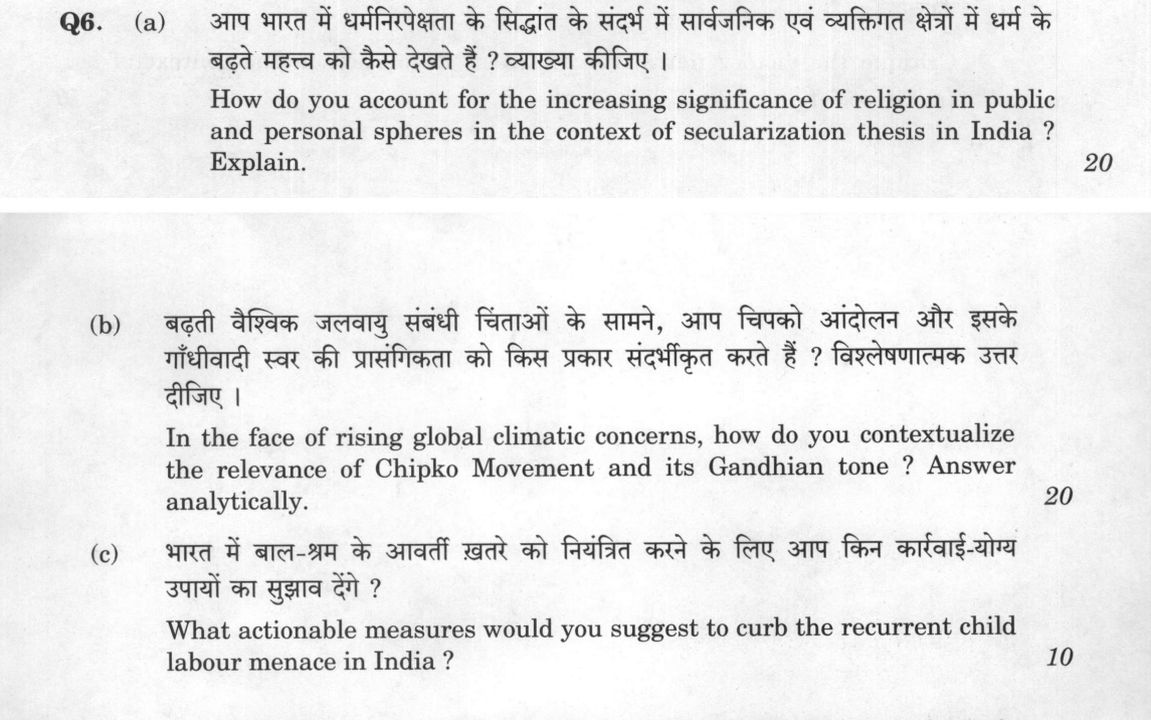
(a) How do you account for the increasing significance of religion in public and personal spheres in the context of…
How do you account for the increasing significance of religion in public and personal spheres in the context of secularization thesis in India ? Explain. 20 marks
In the face of rising global climatic concerns, how do you contextualize the relevance of Chipko Movement and its Gandhian tone ? Answer analytically. 20 marks
What actionable measures would you suggest to curb the recurrent child labour menace in India ? 10 marks
हिंदी में प्रश्न पढ़ें
आप भारत में धर्मनिरपेक्षता के सिद्धांत के संदर्भ में सार्वजनिक एवं व्यक्तिगत क्षेत्रों में धर्म के बढ़ते महत्व को कैसे देखते हैं ? व्याख्या कीजिए । (20 अंक)
बढ़ती वैश्विक जलवायु संबंधी चिंताओं के सामने, आप चिपको आंदोलन और इसके गांधीवादी स्वर की प्रासंगिकता को किस प्रकार संदर्भित करते हैं ? विश्लेषणात्मक उत्तर दीजिए । (20 अंक)
भारत में बाल-श्रम के आवर्ती खतरे को नियंत्रित करने के लिए आप किन कारवाई-योग्य उपायों का सुझाव देंगे ? (10 अंक)
Model answer
Written by UPSC Answer Check against this question's marking rubric, to the expected length. UPSC does not publish answers for Mains — this is one way to score well, not an official key.
The contemporary Indian experience reflects the fractures of post-colonial modernity, manifesting simultaneously in the reassertion of faith against secular orthodoxy, ecological vulnerability under extractivist growth, and persistent socio-economic deprivations like child labour.
Re-evaluating Secularization: Faith in Public and Personal Spheres
The classical secularization thesis posited that modernization inevitably leads to the decline and privatization of religion. However, José Casanova’s "de-privatization" thesis and S.N. Eisenstadt’s framework of "multiple modernities" explain that modernization reconfigures rather than extinguishes sacred commitments. Indian exceptionalism demonstrates that state-led secularization did not privatize faith; instead, democratic mobilization fostered the politicization of religion.
In the public sphere, religion has become the dominant idiom for political consolidation and ideological contestation, evident in the mass mobilization of the Ayodhya movement, the assertion of rights during the Citizenship Amendment Act (CAA) protests, and the moral policing of cow vigilantism. Concurrently, in the personal sphere, rapid urbanization and market anxieties have not produced rationalist disaffection. Instead, religion adapts dynamically through commodification and technological mediation: seen in the massive expansion of pilgrimage tourism, the ubiquity of astrology apps, and the rise of individualized "spiritual but not religious" (SBNR) identities among the middle classes. Faith serves as an indispensable psychic anchor against capitalist alienation while offering communal belonging.
Contextualizing Chipko’s Gandhian Tone Amid Global Climatic Concerns
Madhav Gadgil and Ramachandra Guha categorize the Chipko Movement as a pioneering environmental social movement that linked forest conservation directly to peasant subsistence. Its explicitly Gandhian tone—practicing non-violent satyagraha, asserting village self-reliance (gram swaraj), and advocating moral trusteeship over ecological commons—offers vital lessons for contemporary climate justice. Chipko highlights the efficacy of indigenous ecological knowledge against technocratic resource extraction, providing a philosophical foundation echoed today in decentralized climate mobilizations like Fridays for Future India.
However, contextualizing Chipko analytically also reveals its limitations. Chipko placed a disproportionate, gendered burden of daily conservation labor onto hill women without restructuring underlying rural poverty or property relations. Furthermore, while the later Narmada Bachao Andolan operated at a macro-political, transnational scale to challenge the developmental state, Chipko remained localized. Today's global climate crisis demands that localized Gandhian moral stewardship be complemented by robust state-science institutional partnerships to govern complex, large-scale decarbonization.
Actionable Measures to Curb Child Labour
Addressing the persistent recurrence of child labour in India requires systemic legal, structural, and institutional interventions:
Legislative reforms must close the loopholes in the Child Labour (Prohibition and Regulation) Amendment Act, 2016, specifically by removing the exemption permitting children to work in "family enterprises." Concurrently, the Right to Education (RTE) Act must be universalized up to 18 years, accompanied by government-run bridge schools that reintegrate rescued children into formal schooling.
Structural interventions must focus on adult economic security. Expanding MGNREGA work guarantees and raising rural wages reduces households' dependency on supplementary child earnings. Establishing mandatory, quality crèches at all agricultural and construction worksites prevents older siblings—predominantly young girls—from dropping out of school to perform domestic childcare. Furthermore, mandatory human rights due diligence must be enforced across supply chains, instituting a "Child Labour Free India Pledge" in vulnerable sectors such as cocoa, coffee, hybrid seeds, and cotton farming.
Implementation failures stemming from weak labour inspection across the massive informal economy must be rectified through an inter-departmental convergence model that synchronizes the Integrated Child Development Services (ICDS), Ministry of Education, and Ministry of Labour. Digital real-time tracking, coupled with dedicated labour inspectorates for the unorganized sector, is critical to ensuring rescue and sustained rehabilitation.
Navigating these triple challenges requires anchoring policy in a unified Gandhian ethic: fostering inter-faith tolerance against majoritarianism, practicing ecological trusteeship against climate breakdown, and applying Antyodaya to eliminate the exploitation of the child.
What "Explain" is asking you to do
Make the working of something clear — what sets it off, what follows from what, and what it produces. Explain is the Commission's mechanism word: it dominates the technical papers and the “explain why” stems, where the marks sit in the causal chain and not in the label.
Structure that answers it
State what it is → the initiating condition → the chain of cause, step by step → an instance where it plays out → what the chain produces
Where marks are lost
Describing what something looks like instead of why it works that way. Naming the stages without linking them reads as description too.
How this answer will be evaluated
Approach
Framework: Sociology Paper II: Define > Thinker > Argument > Indian illustration. (a) explain: definition/context > points in order > small example > short close | (b) analyse: intro > causes > effects > stakeholders/linkages > way forward | (c) suggest: the problem in one line > implementable measures > who acts > conclusion Full marks: Precise definitions, named thinkers, Indian data, and a clear analytical position.
Key points expected
- Define secularization thesis (Weber/Durkheim)
- Identify public sphere manifestations (politics/rituals)
- Identify personal sphere manifestations (identity/agency)
- Contrast Western vs Indian secularization trajectory
- Define Chipko Movement and its Gandhian tone
- Link to global climatic concerns (climate justice)
- Analyse the 'Gandhian tone' (non-violence/ahimsa)
- Evaluate relevance for contemporary environmental activism
Evaluation rubric
Each sub-part is marked on its own, against the marks and word limit printed on the paper.
- (a) Explain the paradox of rising religious significance in India despite the secularization thesis. 20 marks
explain— definition/context → points in order → small example → short close
Must cover
- Define secularization thesis (Weber/Durkheim)
- Identify public sphere manifestations (politics/rituals)
- Identify personal sphere manifestations (identity/agency)
- Contrast Western vs Indian secularization trajectory
Loses marks
- Treating secularization as mere state policy
- Ignoring the 'personal sphere' aspect
- Name-dropping thinkers without argument
Earns more
- Reference to 'Sanskritization' (M.N. Srinivas)
- Reference to 'Secularism' (Rajni Kothari)
- Mention of 'Religious Revivalism' (G.S. Ghurye)
- Citing NFHS data on religious practice
Extra mark
- Specific statistic from NFHS-5
- Reference to a specific contemporary political event
- (b) Analyse the relevance of the Chipko Movement's Gandhian tone in the context of global climatic concerns. 20 marks
analyse— intro → causes → effects → stakeholders/linkages → way forward
Must cover
- Define Chipko Movement and its Gandhian tone
- Link to global climatic concerns (climate justice)
- Analyse the 'Gandhian tone' (non-violence/ahimsa)
- Evaluate relevance for contemporary environmental activism
Loses marks
- Describing the movement without analysis
- Ignoring the 'Gandhian tone' aspect
- Failing to link to 'global climatic concerns'
Earns more
- Reference to Vandana Shiva's work
- Mention of 'Ecofeminism' (Greta Gaard)
- Link to 'Sustainable Development' (Brundtland Report)
- Comparison with modern movements (Fridays for Future)
Extra mark
- Specific data on carbon sequestration
- Reference to a specific UNFCCC resolution
- (c) Suggest actionable measures to curb the recurrent child labour menace in India. 10 marks
suggest— the problem in one line → implementable measures → who acts → conclusion
Must cover
- Identify the problem (recurrent child labour)
- Suggest implementable measures (policy/programmatic)
- Identify who acts (government/NGOs/community)
- Provide a conclusion on expected impact
Loses marks
- Vague suggestions without implementation details
- Ignoring the 'recurrent' nature of the problem
- Focusing only on punishment, not prevention
Earns more
- Reference to 'Child and Adolescent Labour (Prohibition and Regulation) Act, 1986'
- Mention of 'Right to Education Act, 2009'
- Reference to 'National Child Labour Project'
- Mention of 'Child Labour (Prohibition and Regulation) Amendment Act, 2016'
Extra mark
- Specific statistic from Census 2011
- Reference to a specific state-level initiative
Practice this exact question
Write your answer and it is marked point by point against the model answer above — what you covered, what you missed, what you got wrong.
Evaluate my answer →More from Sociology 2023 Paper II
- Q3 (a) Contextualize Louis Dumont's concept of 'binary opposition' with reference to caste s…
- Q4 (a) Analyse the perspectives of Isolation, Assimilation and Integration in understanding…
- Q5 Write short answers, with a sociological perspective, on the following questions in about…
- Q6 (a) How do you account for the increasing significance of religion in public and personal…
- Q7 (a) Do you think that the decades of Dalit political mobilizations and movements have hel…
- Q8 (a) Explain the thematic linkages between 'Patriarchy' and 'Honour killing' in India, cit…