Paper II — Q2
(a) Do you agree with the view of Andre Beteille that India's villages are representative of Indian society's basic…
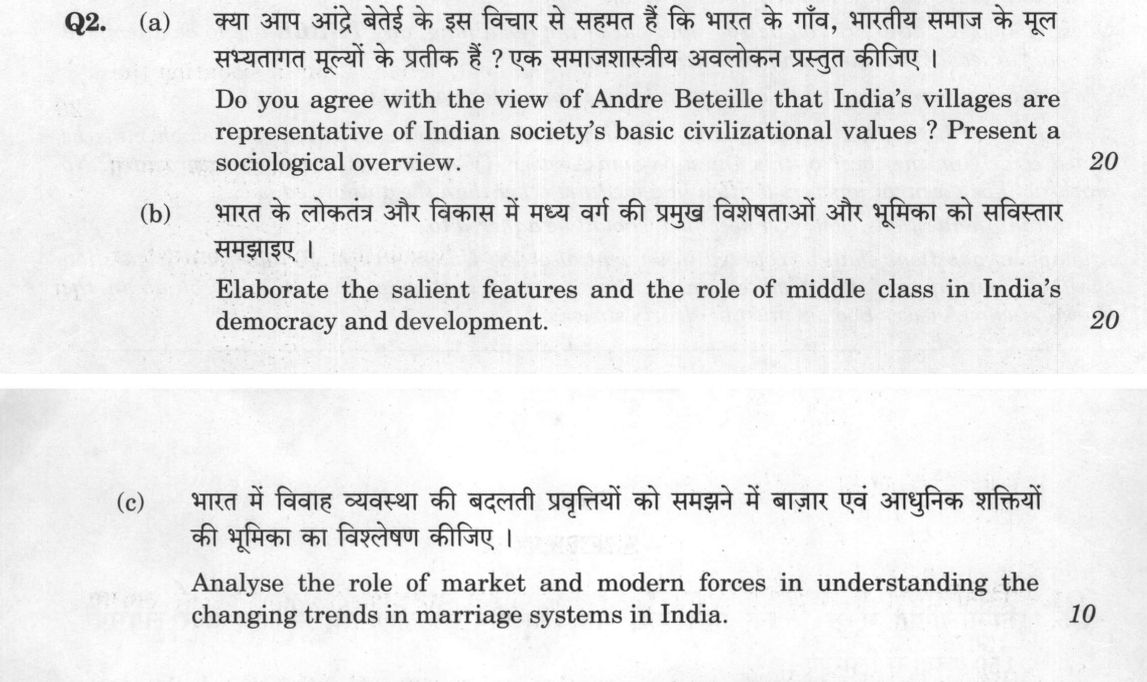
Do you agree with the view of Andre Beteille that India's villages are representative of Indian society's basic civilizational values ? Present a sociological overview. 20 marks
Elaborate the salient features and the role of middle class in India's democracy and development. 20 marks
Analyse the role of market and modern forces in understanding the changing trends in marriage systems in India. 10 marks
हिंदी में प्रश्न पढ़ें
क्या आप आंद्रे बेटेille के इस विचार से सहमत हैं कि भारत के गांव, भारतीय समाज के मूल सभ्यतागत मूल्यों के प्रतीक हैं ? एक समाजशास्त्रीय अवलोकन प्रस्तुत कीजिए । (20 अंक)
भारत के लोकतंत्र और विकास में मध्य वर्ग की प्रमुख विशेषताओं और भूमिका को सविस्तार समझाइए । (20 अंक)
भारत में विवाह व्यवस्था की बदलती प्रवृत्तियों को समझने में बाजार एवं आधुनिक शक्तियों की भूमिका का विश्लेषण कीजिए । (10 अंक)
Model answer
Written by UPSC Answer Check against this question's marking rubric, to the expected length. UPSC does not publish answers for Mains — this is one way to score well, not an official key.
Indian modernity is best analysed through locality, class and family, and I do not agree with the view as stated, because Beteille did not treat Indian villages as repositories of basic civilizational values or as a microcosm of Indian society. His argument against the civilizational-repository thesis insisted that caste, class, state and market processes make villages historically differentiated. This contrasts with M. N. Srinivas’s Sanskritisation and Louis Dumont’s homo hierarchicus, which read village life as a site where hierarchical values are reproduced. Epistemologically, the problem is treating the village as an analytical “unit” rather than a “locale” embedded in wider structures. Redfield’s little tradition and Marriott’s “village India” construct both risk reifying locality. Post-Green Revolution studies by A. R. Rudra and M. Lipton show capitalist differentiation, land markets, wage labour and agrarian conflict, undermining the civilizational repository image. Yet contemporary NCR villages studied by Jeffrey and Chopra show hybridity: traditional kinship persists alongside real estate, migration and informal work, so the village remains a useful locale, not a civilizational essence.
Middle class The middle class is best understood through definitional debate rather than a fixed income bracket. NCAER-style income measures capture consumption capacity, while occupation-status definitions capture professional, managerial and service roles. Dipankar Gupta’s “mistaken modernity” stresses aspirational mimicry of Western consumer culture, whereas Leela Fernandes’s “politics of the governed” highlights how middle-class subjects negotiate state power, citizenship and everyday governance. In democracy, the middle class has acted as a stabiliser in Kothari’s “Congress system” thesis, supporting pluralist, centrist politics and institutional continuity. Yet it can also support authoritarian populism, as argued by Irfan Ahmad and Christophe Jaffrelot, when insecurity, status anxiety and anti-elite sentiment are mobilised. In development, especially after 1991 liberalisation, the middle class drives consumption-led growth, formal and informal services, and social movements such as anti-corruption and environmental campaigns, making it both a market actor and a political subject.
Marriage systems Market and modern forces reshape marriage by turning family formation into a calculative, mobile and legally mediated process. Goode’s modernisation thesis links education, urbanisation and female employment to individual choice, secularisation and delayed marriage. Jyoti Uberoi’s “family law” perspective counters that law and family are mutually constitutive: courts, personal laws and social norms co-produce marriage. Market forces include dowry inflation, analysed by Srinivas and Anderson, and matrimonial websites, which commodify caste, education and income while enabling inter-caste matching, especially in IT sectors. Legal changes, including the Hindu Marriage Act, 1955, and its amendments, education and female employment alter bargaining power and residence patterns. Regional variation is crucial: Kerala’s relatively egalitarian marriage patterns differ from Haryana, where skewed sex ratios intensify marriage-market competition and bride-price/dowry pressures.
Synthesis Village studies, middle-class formation and marriage systems must be analysed together. The village is not a civilizational container but a locale where caste, market and state intersect; the middle class is not merely a consumer stratum but a political formation that stabilises or destabilises democracy; marriage is not only a family rite but a market and legal field. A way forward is to read contemporary India through these mutually constitutive domains: agrarian change shapes class mobility, class mobility reshapes family strategy, and family strategy reproduces or challenges caste and gender hierarchies. This integrated analysis shows that tradition and modernity are not opposites but ongoing negotiations in Indian social transformation.
What "Analyse" is asking you to do
Break the subject into its working parts and show how they act on each other. The marks are in the interconnections — which factor drives which, and what the resulting structure explains — not in the inventory of factors.
Structure that answers it
Define the whole → separate it into its parts → show which part drives which → what that interaction produces → what the structure implies
Where marks are lost
A flat list of causes with no account of which drives which. An answer of neatly separated headings, each self-contained, scores as description.
How this answer will be evaluated
Approach
Framework: Sociological Overview / Analytical Framework. (a) discuss: intro > 3-4 dimensions > example > balanced close | (b) examine: intro > how/why with reasoning > evidence > conclusion | (c) analyse: intro > causes > effects > stakeholders/linkages > way forward Full marks: Comprehensive sociological analysis with named thinkers, specific Indian examples, and balanced arguments.
Key points expected
- Define Andre Beteille's specific argument on village society
- Identify 3-4 core civilizational values (e.g., hierarchy, kinship, religion)
- Contrast Beteille's view with a counter-perspective (e.g., M.N. Srinivas)
- Provide Indian illustration of village social structure
- Define 'middle class' in the Indian context
- List 3-4 salient features (e.g., education, occupation, consumption)
- Explain role in democracy (e.g., voting, political participation)
- Explain role in development (e.g., economic growth, social mobility)
Evaluation rubric
Each sub-part is marked on its own, against the marks and word limit printed on the paper.
- (a) Sociological overview of Andre Beteille's view on Indian villages as representative of civilizational values. 20 marks
discuss— intro → 3-4 dimensions → example → balanced close
Must cover
- Define Andre Beteille's specific argument on village society
- Identify 3-4 core civilizational values (e.g., hierarchy, kinship, religion)
- Contrast Beteille's view with a counter-perspective (e.g., M.N. Srinivas)
- Provide Indian illustration of village social structure
Loses marks
- Name-dropping Beteille without explaining his argument
- Generalizing about villages without sociological concepts
- Ignoring the 'civilizational values' aspect of the question
Earns more
- Reference to specific Beteille works (e.g., 'The Study of a Village')
- Mention of caste hierarchy or joint family as values
- Discussion of 'village as microcosm' concept
- Balanced conclusion on the validity of the view
Extra mark
- Citation of specific data from Beteille's fieldwork
- Reference to contemporary changes in village values
- (b) Elaboration of salient features and role of middle class in India's democracy and development. 20 marks
examine— intro → how/why with reasoning → evidence → conclusion
Must cover
- Define 'middle class' in the Indian context
- List 3-4 salient features (e.g., education, occupation, consumption)
- Explain role in democracy (e.g., voting, political participation)
- Explain role in development (e.g., economic growth, social mobility)
Loses marks
- Confusing middle class with upper or lower class
- Focusing only on economic role, ignoring democratic role
- Using vague terms like 'educated people' without sociological definition
Earns more
- Reference to M.N. Srinivas or other sociologists on middle class
- Mention of 'new middle class' vs 'old middle class'
- Link to urbanization and industrialization
- Discussion of middle class as a stabilizing force
Extra mark
- Citation of NFHS or Census data on middle class size
- Reference to specific political movements led by middle class
- (c) Analysis of the role of market and modern forces in changing marriage systems in India. 10 marks
analyse— intro → causes → effects → stakeholders/linkages → way forward
Must cover
- Identify 2-3 changing trends in marriage systems
- Explain the role of market forces (e.g., consumerism, media)
- Explain the role of modern forces (e.g., urbanization, education)
- Link these forces to specific changes (e.g., rise of love marriages)
Loses marks
- Focusing only on one type of marriage (e.g., only love marriages)
- Ignoring the 'market' aspect of the question
- Generalizing without specific examples of changing trends
Earns more
- Mention of 'companionate marriage' or 'nuclear family' trends
- Reference to changing age of marriage
- Discussion of 'arranged love marriages' as a hybrid form
- Link to gender equality and women's empowerment
Extra mark
- Citation of specific data on marriage trends (e.g., from NFHS)
- Reference to specific media or market examples
Practice this exact question
Write your answer and it is marked point by point against the model answer above — what you covered, what you missed, what you got wrong.
Evaluate my answer →More from Sociology 2023 Paper II
- Q1 Write short answers, with a sociological perspective, on the following questions in about…
- Q2 (a) Do you agree with the view of Andre Beteille that India's villages are representative…
- Q3 (a) Contextualize Louis Dumont's concept of 'binary opposition' with reference to caste s…
- Q4 (a) Analyse the perspectives of Isolation, Assimilation and Integration in understanding…
- Q5 Write short answers, with a sociological perspective, on the following questions in about…