Paper II — Q4
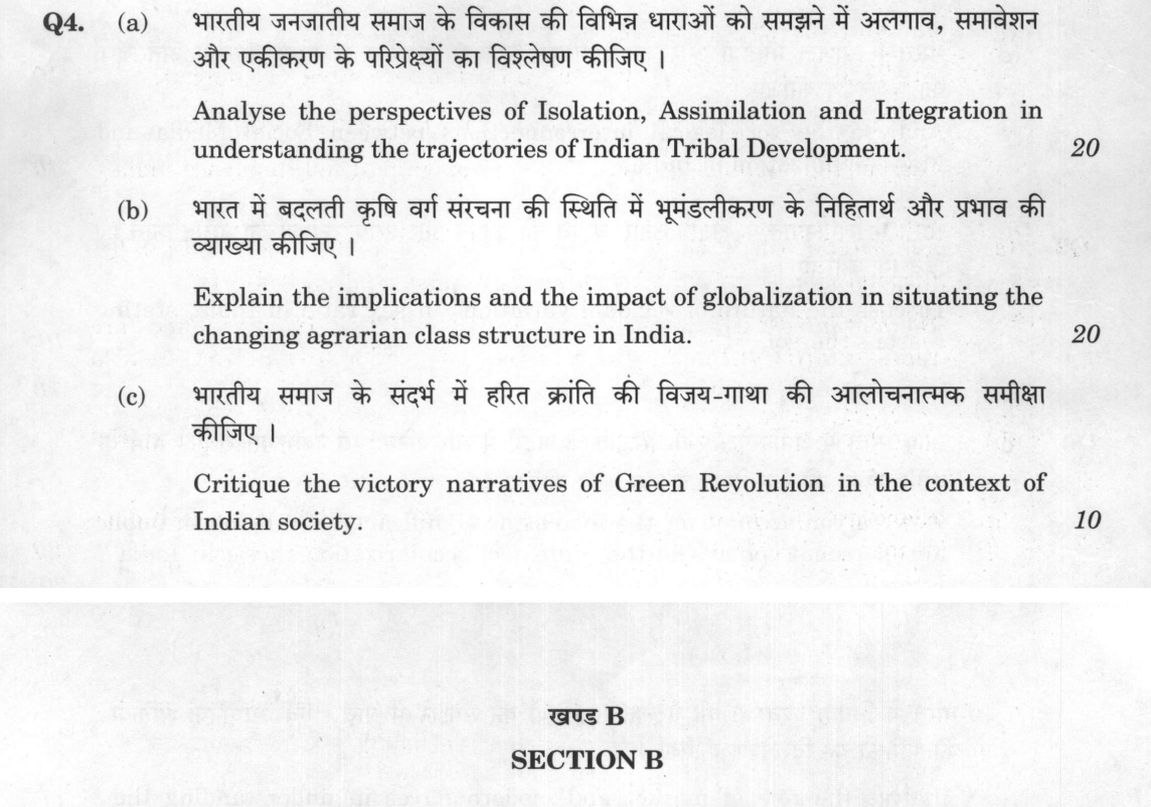
(a) Analyse the perspectives of Isolation, Assimilation and Integration in understanding the trajectories of Indian Tribal…
Analyse the perspectives of Isolation, Assimilation and Integration in understanding the trajectories of Indian Tribal Development. 20 marks
Explain the implications and the impact of globalization in situating the changing agrarian class structure in India. 20 marks
Critique the victory narratives of Green Revolution in the context of Indian society. 10 marks
हिंदी में प्रश्न पढ़ें
भारतीय जनजातीय समाज के विकास की विभिन्न धाराओं को समझने में अलगाव, समावेशन और एकीकरण के परिप्रेक्ष्यों का विश्लेषण कीजिए । (20 अंक)
भारत में बदलती कृषि वर्ग संरचना की स्थिति में भूमंडलीकरण के निहितार्थ और प्रभाव की व्याख्या कीजिए । (20 अंक)
भारतीय समाज के संदर्भ में हरित क्रांति की विजय-गाथा की आलोचनात्मक समीक्षा कीजिए । (10 अंक)
Model answer
Written by UPSC Answer Check against this question's marking rubric, to the expected length. UPSC does not publish answers for Mains — this is one way to score well, not an official key.
Post-colonial India’s tribal and agrarian transformations reflect competing paradigms of state-led modernization, market integration, and social justice.
Tribal Development: Isolation, Assimilation, and Integration
The isolationist perspective, rooted in colonial policies of "excluded areas" and initially advocated by Verrier Elwin as a "National Park" approach, sought to insulate tribal communities from non-tribal exploitation, usurious money-lending, and cultural disruption. However, as G.S. Ghurye argued, absolute isolation fossilized socio-economic backwardness and treated indigenous groups as exotic anthropological exhibits. Conversely, the assimilationist perspective—represented by G.S. Ghurye’s characterization of tribes as "Backward Hindus" and Herbert Risley’s evolutionary taxonomy—advocated absorbing tribes into the dominant civilizational mainstream. In practice, assimilation triggered severe cultural erosion, land alienation, and the integration of tribals into the lowest echelons of the caste hierarchy as landless laborers.
To resolve this dialectic, Jawaharlal Nehru formulated the Tribal Panchsheel, later institutionalized through the Dhebar Commission (1960–61). This integrationist perspective advanced a middle path: socio-economic development through state support while preserving tribal autonomy, language, and customary rights. This paradigm found constitutional expression in the Fifth and Sixth Schedules, and subsequently in the PESA Act (1996) and the Forest Rights Act (2006). In practice, however, integration has frequently functioned as an ideological cover for state-sponsored resource extraction, inducing involuntary displacement for dams, mines, and industrial corridors.
Globalization and the Changing Agrarian Class Structure
Post-1991 economic liberalization and integration into the WTO regime fundamentally restructured India's agrarian political economy. The retreat of state extension services, reduction of agricultural input subsidies, and expansion of corporate agribusiness through contract farming and corporate land acquisition dismantled traditional agrarian ties.
As Terence Byres and Henry Bernstein observe, globalization accelerated capitalist differentiation and "de-peasantization." Sociologists Utsa Patnaik and V.K. Ramachandran highlight three decisive structural shifts: First, the decline of classical semi-feudal tenancy relations in favor of entrepreneurial, capital-intensive agrarian capitalism led by a commercialized rural elite. Second, the erosion of the "missing middle"—small and marginal peasants who, faced with unviable input costs and volatile global crop prices, were forced to lease out or sell land. Third, the rapid growth of a differentiated, landless rural proletariat dependent on precarious, circular migration and casual non-farm wage labor.
Critique of the Green Revolution Narrative
The state narrative, championed by M.S. Swaminathan and C. Subramaniam, framed the Green Revolution as an unmitigated technological triumph that achieved national food self-sufficiency, ended humiliating dependence on PL-480 shipments, and modernized Indian agriculture through High-Yielding Varieties (HYV), canal irrigation, and chemical fertilizers.
A sociological critique from below exposes the profound social and ecological costs of this strategy. As Francine Frankel demonstrated, the technology was not resource-neutral: it disproportionately enriched large landowning "bullock capitalists," while marginal tenants were evicted due to farm mechanization, intensifying rural class polarization. Geographically, it institutionalized uneven development, concentrating public investment in Punjab, Haryana, and Western Uttar Pradesh while bypassing dryland and eastern agrarian belts. Furthermore, the intensive monoculture generated severe ecological crises—water table depletion, soil salinity, and pesticide toxicity—which over time culminated in chronic indebtedness, agrarian distress, and endemic farmer suicides across the Green Revolution belt.
Conclusion
The trajectories of tribal integration, globalization-led class shifts, and the Green Revolution reveal a shared contradiction: the prioritization of aggregate growth over equity, ecological sustainability, and local autonomy. Overcoming this requires decentralizing natural resource governance through Gram Sabhas under PESA, revitalizing state support for smallholder agriculture, and pivoting from input-heavy monocultures toward regionally balanced agro-ecological practices.
What "Analyse" is asking you to do
Break the subject into its working parts and show how they act on each other. The marks are in the interconnections — which factor drives which, and what the resulting structure explains — not in the inventory of factors.
Structure that answers it
Define the whole → separate it into its parts → show which part drives which → what that interaction produces → what the structure implies
Where marks are lost
A flat list of causes with no account of which drives which. An answer of neatly separated headings, each self-contained, scores as description.
How this answer will be evaluated
Approach
Framework: Sociology Paper II (Indian Society). (a) analyse: intro > causes > effects > stakeholders/linkages > way forward | (b) explain: definition/context > points in order > small example > short close | (c) critique: the claim > its strengths > its weaknesses > your judgment Full marks: All parts show deep analytical engagement with named thinkers, specific Indian examples, and balanced judgment.
Key points expected
- Define Isolation, Assimilation, and Integration perspectives
- Link each perspective to specific tribal development trajectories
- Contrast the three perspectives analytically
- Take a position on the most viable approach
- Define agrarian class structure and its components
- Explain specific mechanisms of globalization's impact
- Show how class relations are being restructured
- Provide Indian examples of changing agrarian classes
Evaluation rubric
Each sub-part is marked on its own, against the marks and word limit printed on the paper.
- (a) Compare Isolation, Assimilation, and Integration perspectives on tribal development trajectories. 20 marks
analyse— intro → causes → effects → stakeholders/linkages → way forward
Must cover
- Define Isolation, Assimilation, and Integration perspectives
- Link each perspective to specific tribal development trajectories
- Contrast the three perspectives analytically
- Take a position on the most viable approach
Loses marks
- Treating the three perspectives as identical
- Name-dropping thinkers without explaining their arguments
- Common-sense opinion without analytical framework
Earns more
- Name specific thinkers (e.g., Verghese Kurien, M.N. Srinivas)
- Reference specific tribal groups (e.g., Santhal, Gond, Naga)
- Discuss PESA Act or FRA implications
- Reference specific government schemes (e.g., TRIFED, DTP)
Extra mark
- Cite specific tribal census data or NFHS statistics
- Reference a specific contemporary tribal movement or conflict
- (b) Explain how globalization impacts and reshapes agrarian class structure in India. 20 marks
explain— definition/context → points in order → small example → short close
Must cover
- Define agrarian class structure and its components
- Explain specific mechanisms of globalization's impact
- Show how class relations are being restructured
- Provide Indian examples of changing agrarian classes
Loses marks
- Vague generalizations about 'globalization' without specific mechanisms
- Ignoring the class dimension and focusing only on economic growth
- No Indian context or examples
Earns more
- Reference specific global trade agreements (e.g., WTO, FTA)
- Discuss agribusiness and corporate farming
- Reference specific states or regions (e.g., Punjab, Haryana, Andhra)
- Discuss land acquisition and displacement
Extra mark
- Cite specific FLFPR or NFHS data on landholding patterns
- Reference a specific current debate (e.g., farm laws, land reforms)
- (c) Critique the victory narratives of Green Revolution in Indian society. 10 marks
critique— the claim → its strengths → its weaknesses → your judgment
Must cover
- State the Green Revolution victory narrative
- Identify specific weaknesses or failures of the narrative
- Provide evidence of social/environmental costs
- Offer a balanced judgment on its legacy
Loses marks
- One-sided praise without critique
- Ignoring the social dimension and focusing only on production
- No specific evidence or examples
Earns more
- Reference specific regions (e.g., Punjab, Haryana, MP)
- Discuss environmental degradation (water, soil)
- Reference specific social consequences (inequality, displacement)
- Name specific critics (e.g., Vandana Shiva, M.S. Swaminathan)
Extra mark
- Cite specific data on water table decline or pesticide use
- Reference a specific contemporary issue (e.g., farmer suicides, groundwater crisis)
Practice this exact question
Write your answer and it is marked point by point against the model answer above — what you covered, what you missed, what you got wrong.
Evaluate my answer →More from Sociology 2023 Paper II
- Q1 Write short answers, with a sociological perspective, on the following questions in about…
- Q2 (a) Do you agree with the view of Andre Beteille that India's villages are representative…
- Q3 (a) Contextualize Louis Dumont's concept of 'binary opposition' with reference to caste s…
- Q4 (a) Analyse the perspectives of Isolation, Assimilation and Integration in understanding…
- Q5 Write short answers, with a sociological perspective, on the following questions in about…
- Q6 (a) How do you account for the increasing significance of religion in public and personal…
- Q7 (a) Do you think that the decades of Dalit political mobilizations and movements have hel…