Paper II — Q7
(a) Do you think that the decades of Dalit political mobilizations and movements have helped in strengthening India's democracy ?…
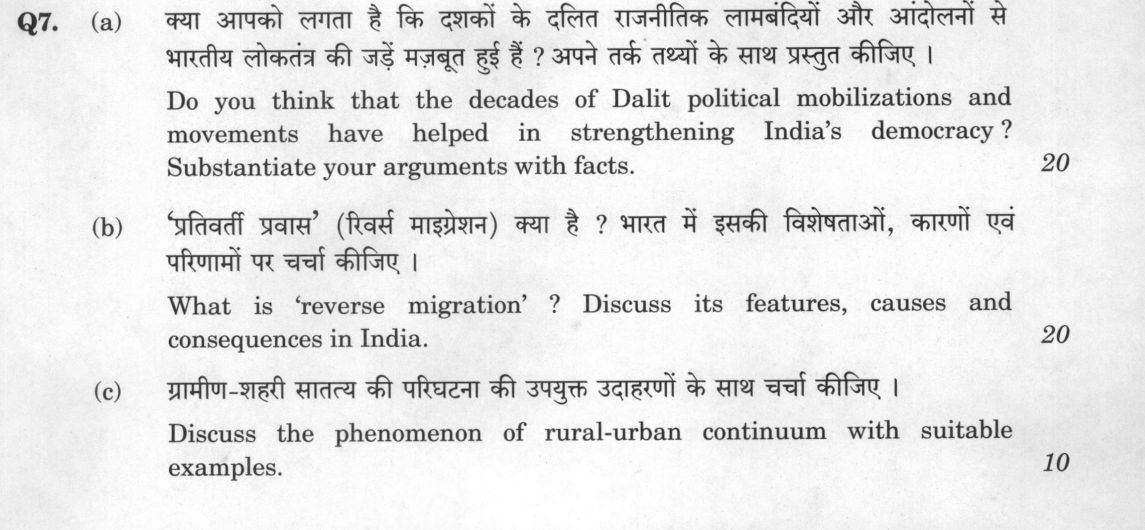
Do you think that the decades of Dalit political mobilizations and movements have helped in strengthening India's democracy ? Substantiate your arguments with facts. 20 marks
What is 'reverse migration' ? Discuss its features, causes and consequences in India. 20 marks
Discuss the phenomenon of rural-urban continuum with suitable examples. 10 marks
हिंदी में प्रश्न पढ़ें
क्या आपको लगता है कि दशकों के दलित राजनीतिक लामबंदियों और आंदोलनों से भारतीय लोकतंत्र की जड़ें मजबूत हुई हैं ? अपने तर्क तथ्यों के साथ प्रस्तुत कीजिए । (20 अंक)
'प्रतिवर्ती प्रवास' (रिवर्स माइग्रेशन) क्या है ? भारत में इसकी विशेषताओं, कारणों एवं परिणामों पर चर्चा कीजिए । (20 अंक)
ग्रामीण-शहरी सातत्य की परिघटना की उपयुक्त उदाहरणों के साथ चर्चा कीजिए । (10 अंक)
Model answer
Written by UPSC Answer Check against this question's marking rubric, to the expected length. UPSC does not publish answers for Mains — this is one way to score well, not an official key.
India’s contemporary socio-political landscape reflects a profound reconfiguration of power relations, demographic movements, and spatial structures, fundamentally transforming the nature of democratic citizenship.
Dalit Political Mobilisation and Democratic Deepening
Decades of Dalit assertion have deepened Indian democracy by transforming subordinate subjects into assertive political actors. Politically, the rise of the Bahujan Samaj Party (BSP) under Kanshi Ram and Mayawati demonstrated the power of autonomous Dalit politics, breaking upper-caste hegemony in north India. Grassroots representation expanded through reservation in Panchayati Raj Institutions (PRIs) via the 73rd and 74th Constitutional Amendments, ensuring Dalit political agency at the village level. Institutionally, mobilisations forced the enactment of progressive protective measures, notably the Scheduled Castes and Scheduled Tribes (Prevention of Atrocities) Act, 1989.
However, this mobilisation reveals significant democratic paradoxes. Sociologists highlight that Kanshi Ram’s pragmatic "social engineering"—forging opportunistic alliances across divergent castes—often prioritized numerical electoral arithmetic over radical anti-caste ideological reform, fostering transactional vote-bank politics. Substantive democratisation has been hindered by intra-Dalit elite capture, where a vocal, educated creamy layer monopolises benefits, leaving marginalized sub-castes excluded. Furthermore, political representation has not eliminated social subjugation; systemic caste violence persists alongside institutional tokenism, showing that formal political inclusion has outpaced socio-economic emancipation.
Reverse Migration: Features, Causes, and Consequences
Reverse migration refers to the involuntary or distress-driven return of internal migrants from urban centres back to their rural places of origin. Unlike circular migration—which is a planned, seasonal, and cyclical livelihood strategy—reverse migration represents an abrupt breakdown of the urban-rural mobility cycle.
Its features and causes became starkly visible during the COVID-19 lockdown-triggered exodus, driven by the abrupt loss of urban informal livelihoods, absence of social safety nets, and housing insecurity in metropolises.
The consequences were multidimensional. Rural economies were forced to absorb unprecedented labour shocks, leading to a massive surge in demand for MGNREGS work and putting immense pressure on agricultural land. Household economies suffered from the collapse of urban remittances, plunging millions back into transient poverty. However, post-2021 trends revealed rapid re-urbanisation patterns, as rural economies could not sustain the surplus labour force, forcing migrants to return to precarious urban informal sectors.
The Rural-Urban Continuum
The rural-urban continuum conceptualises settlement patterns not as a rigid rural-urban dichotomy, but as a gradual, uninterrupted socio-spatial spectrum. Robert Redfield and Milton Singer conceptualised this through the transmission of great and little traditions across intermediate spaces. In India, M.N. Srinivas observed how sanskritisation and westernisation operate simultaneously in semi-urban transitions, while Radhakamal Mukerjee highlighted the ecological interdependence within intermediate zones.
Empirically, this continuum is evident in the rapid growth of Census Towns, the peri-urban transitions surrounding mega-cities like Gurgaon where agrarian structures overlap with corporate enclaves, and Kerala’s continuous rurban settlement pattern. Sociologically, rural and urban spheres penetrate each other through commuting, shared media, and extended kinship networks.
At the policy level, schemes like the Smart Cities Mission and AMRUT, alongside the Shyama Prasad Mukherji Rurban Mission, increasingly recognize this fluidity. A binary approach to planning is inadequate; there is a critical need for integrated territorial development that addresses regional infrastructure, land-use zoning, and livelihood security across the continuum.
A holistic way forward requires institutionalising these transformations: bridging the gap between Dalit formal representation and substantive social justice, developing universal social protection floors for footloose migrant labour, and adopting regional planning paradigms that dissolve rigid rural-urban administrative binaries.
What "Discuss" is asking you to do
Lay the issue out from more than one side — how it arose, what is claimed for it, what is held against it, and where it now stands. UPSC attaches discuss to broad topics with several live dimensions, so coverage of the dimensions earns more than the strength of your opinion.
Structure that answers it
Set the issue up → the case as it is made → the case against → the dimension both sides leave out → where the balance now lies
Where marks are lost
Listing facts with no thread between them, or arguing one side throughout and calling it a discussion.
How this answer will be evaluated
Approach
Framework: Sociology Paper II (UPSC). (a) justify: claim > 3-4 reasons > evidence > conclusion | (b) discuss: intro > 3-4 dimensions > example > balanced close | (c) discuss: intro > 3-4 dimensions > example > balanced close Full marks: Comprehensive, well-structured, with specific examples, data, and clear arguments.
Key points expected
- Link mobilization to specific democratic gains (e.g., representation, policy)
- Cite specific movements (e.g., BSP, Phulera, Satyashodhak)
- Provide factual evidence of impact (e.g., SC/ST reservation, laws)
- Conclude with a clear judgment on the strengthening of democracy
- Define 'reverse migration' clearly
- Identify 3-4 key features (e.g., return to rural areas, post-pandemic)
- Explain 3-4 causes (e.g., economic downturn, urbanization limits)
- Analyze 3-4 consequences (e.g., rural revitalization, urban labor shortage)
Evaluation rubric
Each sub-part is marked on its own, against the marks and word limit printed on the paper.
- (a) Claim that Dalit mobilization strengthened democracy, supported by 3-4 reasons and evidence. 20 marks
justify— claim → 3-4 reasons → evidence → conclusion
Must cover
- Link mobilization to specific democratic gains (e.g., representation, policy)
- Cite specific movements (e.g., BSP, Phulera, Satyashodhak)
- Provide factual evidence of impact (e.g., SC/ST reservation, laws)
- Conclude with a clear judgment on the strengthening of democracy
Loses marks
- Vague generalizations without specific examples
- Ignoring the 'strengthening' aspect and only describing movements
- Name-dropping without explaining the argument
Earns more
- Mention specific thinkers (e.g., Ambedkar, Phule)
- Reference specific legislation (e.g., SC/ST Act)
- Use data on SC/ST representation in legislatures
- Discuss the shift from 'politics of presence' to 'politics of power'
Extra mark
- Cite a specific Supreme Court judgment on reservation
- Reference a specific census or NFHS statistic on SC/ST status
- (b) Define reverse migration and discuss its features, causes, and consequences in India. 20 marks
discuss— intro → 3-4 dimensions → example → balanced close
Must cover
- Define 'reverse migration' clearly
- Identify 3-4 key features (e.g., return to rural areas, post-pandemic)
- Explain 3-4 causes (e.g., economic downturn, urbanization limits)
- Analyze 3-4 consequences (e.g., rural revitalization, urban labor shortage)
Loses marks
- Confusing reverse migration with general rural-urban migration
- Listing causes without explaining their mechanism
- Ignoring the 'consequences' aspect
Earns more
- Reference specific data (e.g., Migrant Workers Survey)
- Discuss the role of the pandemic as a catalyst
- Mention specific sectors affected (e.g., construction, manufacturing)
- Link to broader trends like de-industrialization or rural entrepreneurship
Extra mark
- Cite a specific government scheme for migrant workers
- Reference a specific study or report on reverse migration
- (c) Explain the rural-urban continuum with suitable examples. 10 marks
discuss— intro → 3-4 dimensions → example → balanced close
Must cover
- Define 'rural-urban continuum'
- Explain the concept of a spectrum rather than a binary
- Provide 2-3 suitable examples (e.g., peri-urban areas, small towns)
- Briefly discuss the significance of the concept
Loses marks
- Treating rural and urban as distinct, unconnected categories
- Lack of specific examples
- Overly long or detailed answer for a 10-mark question
Earns more
- Mention specific examples like 'growing towns' or 'rural-urban fringe'
- Reference specific data on urbanization trends
- Discuss the role of infrastructure in blurring boundaries
- Link to concepts like 'urbanization' or 'ruralization'
Extra mark
- Cite a specific example of a town transitioning to a city
- Reference a specific study on rural-urban linkages
Practice this exact question
Write your answer and it is marked point by point against the model answer above — what you covered, what you missed, what you got wrong.
Evaluate my answer →More from Sociology 2023 Paper II
- Q4 (a) Analyse the perspectives of Isolation, Assimilation and Integration in understanding…
- Q5 Write short answers, with a sociological perspective, on the following questions in about…
- Q6 (a) How do you account for the increasing significance of religion in public and personal…
- Q7 (a) Do you think that the decades of Dalit political mobilizations and movements have hel…
- Q8 (a) Explain the thematic linkages between 'Patriarchy' and 'Honour killing' in India, cit…