Paper II — Q1
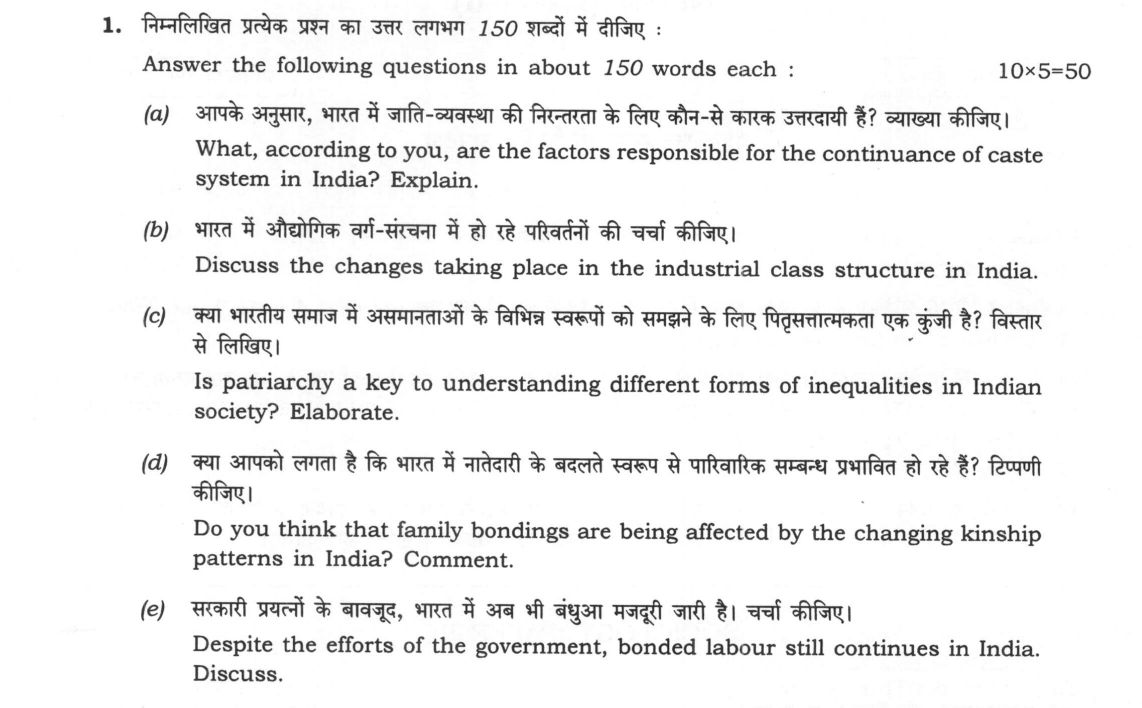
Answer the following questions in about 150 words each: (a) What, according to you, are the factors responsible for the…
Answer the following questions in about 150 words each:
What, according to you, are the factors responsible for the continuance of caste system in India? Explain. 10 marks
Discuss the changes taking place in the industrial class structure in India. 10 marks
Is patriarchy a key to understanding different forms of inequalities in Indian society? Elaborate. 10 marks
Do you think that family bondings are being affected by the changing kinship patterns in India? Comment. 10 marks
Despite the efforts of the government, bonded labour still continues in India. Discuss. 10 marks
हिंदी में प्रश्न पढ़ें
निम्नलिखित प्रत्येक प्रश्न का उत्तर लगभग 150 शब्दों में दीजिए :
आपके अनुसार, भारत में जाति-व्यवस्था की निरंतरता के लिए कौन-से कारक उत्तरदायी हैं? व्याख्या कीजिए। (10 अंक)
भारत में औद्योगिक वर्ग-संरचना में हो रहे परिवर्तनों की चर्चा कीजिए। (10 अंक)
क्या भारतीय समाज में असमानताओं के विभिन्न स्वरूपों को समझने के लिए पितृसत्तात्मकता एक कुंजी है? विस्तार से लिखिए। (10 अंक)
क्या आपको लगता है कि भारत में नातेदारी के बदलते स्वरूप से पारिवारिक संबंध प्रभावित हो रहे हैं? टिप्पणी कीजिए। (10 अंक)
सरकारी प्रयत्नों के बावजूद, भारत में अब भी बंधुआ मजदूरी जारी है। चर्चा कीजिए। (10 अंक)
Model answer
Written by UPSC Answer Check against this question's marking rubric, to the 150-word length. UPSC does not publish answers for Mains — this is one way to score well, not an official key.
(a) Factors Responsible for the Continuance of Caste System in India
The persistence of the caste system in contemporary India reflects its adaptive capacity across ritual, political, and economic spheres. Historically grounded in Louis Dumont’s conceptualization of ritual hierarchy and purity-pollution, caste endogamy remains widely practiced, preserving social boundaries and hereditary wealth transfer. In the political domain, as Kanchan Chandra argues, caste operates as a vital information shortcut and an instrument for patronage mobilization within competitive electoral democracy, institutionalizing caste-based voting blocs. In the economic realm, traditional occupational ties have transformed into implicit occupational endogamy through caste-based social capital and informal hiring networks. Modernization exhibits an urban anonymity paradox: while city spaces offer transactional neutrality, caste reproduces itself structurally through residential segregation and discriminatory housing practices. Furthermore, contemporary digital caste networks—ranging from specialized matrimonial portals to localized caste associations on digital platforms—have reinforced horizontal caste solidarity, enabling caste identity to thrive within modern institutional spaces.
(b) Changes in the Industrial Class Structure in India
India's industrial class structure has undergone a fundamental transformation marked by informalization, fragmentation, and reconfiguration of class boundaries. Foremost is the sweeping informalization of labour, conceptualized by Jan Breman as the expansion of "footloose labour," wherein workers endure precarious, unorganized conditions without social security. The classic organized industrial proletariat has shrunk due to subcontracting, outsourcing, and flexible labour regimes. Concurrently, platform capitalism and the gig economy have fragmented the industrial workforce into atomized, platform-dependent micro-contractors, undermining conventional collective bargaining and trade unionism. At the upper tier, economic liberalization has fostered a managerial and professional "new middle class," as analyzed by Satish Deshpande, rooted in high-end services and manufacturing. However, these changes demonstrate a persistent caste-class overlap, particularly in sunrise sectors like Information Technology, where upper-caste cultural capital dominates lucrative managerial cadres, while marginalized castes remain over-represented in precarious industrial and gig labour.
(c) Patriarchy and Forms of Inequality in Indian Society
Patriarchy is an overarching organizing principle of structural inequality in India, operating in tandem with caste, class, and regional disparities. Applying Sylvia Walby’s framework, Indian society illustrates a shift from private patriarchy (exclusion within household domains) to public patriarchy, where women enter public, educational, and economic spheres but remain segregated and subordinated. Kimberlé Crenshaw’s intersectionality framework is essential in India: Dalit and Adivasi women endure compounded disadvantages, where patriarchal subjugation intersects with caste atrocities and economic destitution. In the economy, patriarchy produces horizontal and vertical labour market segmentation, pushing women into low-wage, informal sectors while leaving them saddled with an asymmetric reproductive burden of unpaid care work. However, patriarchy is not monolithic; matrilineal exceptions, such as the Khasi and Garo communities of Meghalaya and the traditional Nayar taravad system of Kerala, demonstrate alternative lineage and property structures, showing that gendered inequality is culturally constructed and structurally varied.
(d) Changing Kinship Patterns and Family Bondings
Changing kinship patterns in India reflect structural shifts alongside resilient cultural values, modifying the nature of family bonding rather than disintegrating it. Rapid urbanization and occupational mobility have accelerated household nuclearization with growing bilateral trends, wherein kinship networks increasingly integrate maternal relatives alongside traditional patrilineages. However, as A.M. Shah highlights, structural nuclearization does not equate to the erosion of joint family values; ideological and functional jointness persists through mutual economic assistance, crisis management, and ritual obligations. In globalized contexts, transnational families preserve affective ties through technology-mediated intimacy, utilizing digital platforms to bridge geographical distances. Concurrently, regional variations documented by Iravati Karve continue to matter: North Indian kinship, traditionally structured by village exogamy and strict lineage distance, is adapting towards greater companionate ties, while South Indian isogamous preferences persist in modified forms. Consequently, family bonding has shifted from rigid normative dependency toward negotiated, emotionally dynamic kinship networks.
(e) Persistence of Bonded Labour in India
Despite constitutional guarantees under Article 23 and the enactment of the Bonded Labour System (Abolition) Act, 1976, bonded labour persists in India through modernized forms of neo-bondage. Contemporary debt bondage functions through interlocked credit and labour markets, where structural poverty, absence of institutional credit, and agricultural stagnation compel marginalized households to take non-institutional advances from employers. This phenomenon is acutely prevalent among seasonal distress migrants working in unorganized sectors such as brick kilns, stone quarries, construction, and commercial agriculture. The persistence of the middleman and contractor system—operated by intermediaries such as thekedars and *sardars*—exploits the socio-economic vulnerabilities of Scheduled Castes and Scheduled Tribes, keeping workers trapped in cycle-bound, unfree labour arrangements. Weak administrative identification, low rates of prosecution, and delayed rehabilitation under state schemes allow the cycle to continue. Effectively addressing this requires aggressive enforcement of labour laws, universal access to formal credit, and targeted structural rehabilitation for vulnerable migratory communities.
What "Discuss" is asking you to do
Lay the issue out from more than one side — how it arose, what is claimed for it, what is held against it, and where it now stands. UPSC attaches discuss to broad topics with several live dimensions, so coverage of the dimensions earns more than the strength of your opinion.
Structure that answers it
Set the issue up → the case as it is made → the case against → the dimension both sides leave out → where the balance now lies
Where marks are lost
Listing facts with no thread between them, or arguing one side throughout and calling it a discussion.
How this answer will be evaluated
Approach
Framework: Sociology Paper II (UPSC). (a) explain: definition/context > points in order > small example > short close | (b) discuss: intro > 3-4 dimensions > example > balanced close | (c) explain: definition/context > points in order > small example > short close | (d) comment: context > arguments both sides > judgment > close | (e) discuss: intro > 3-4 dimensions > example > balanced close Full marks: Analytical depth, named thinkers, Indian data, clear argument
Key points expected
- Economic factors (land ownership, occupational closure)
- Political factors (vote banks, reservation politics)
- Social/Cultural factors (endogamy, purity-pollution)
- Religious factors (Hindu theology, Dharma)
- Rise of middle class (service sector)
- Changes in working class (informalization, gig economy)
- Decline of traditional industrial working class
- Emergence of new class formations
Evaluation rubric
Each sub-part is marked on its own, against the marks and word limit printed on the paper.
- (a) Identify and explain factors sustaining the caste system in India. · 150 words
explain— definition/context → points in order → small example → short close
Must cover
- Economic factors (land ownership, occupational closure)
- Political factors (vote banks, reservation politics)
- Social/Cultural factors (endogamy, purity-pollution)
- Religious factors (Hindu theology, Dharma)
Loses marks
- Treating caste as purely religious
- Ignoring economic dimensions of caste
- Vague generalizations without specific factors
Earns more
- Reference to M.N. Srinivas (Sanskritization)
- Reference to Louis Dumont (Homo Hierarchicus)
- Mention of caste associations/organizations
- Link to modernization and caste
Extra mark
- Specific data on caste-based political representation
- Reference to specific Supreme Court judgment on caste
- (b) Discuss changes in industrial class structure in India. · 150 words
discuss— intro → 3-4 dimensions → example → balanced close
Must cover
- Rise of middle class (service sector)
- Changes in working class (informalization, gig economy)
- Decline of traditional industrial working class
- Emergence of new class formations
Loses marks
- Confusing class with caste
- Ignoring informal sector
- Static view of class structure
Earns more
- Reference to Karl Marx (class structure)
- Reference to Max Weber (status groups)
- Mention of IT/ITES sector impact
- Discussion of class mobility
Extra mark
- Specific data on service sector employment
- Reference to specific industrial policy change
- (c) Elaborate on patriarchy as key to understanding inequalities in Indian society. · 150 words
explain— definition/context → points in order → small example → short close
Must cover
- Definition of patriarchy (male dominance)
- Gender inequality (work, education, health)
- Intersection with caste/class
- Institutional patriarchy (family, law, religion)
Loses marks
- Reducing patriarchy to 'women's issues'
- Ignoring intersectionality
- Essentialist view of gender
Earns more
- Reference to Simone de Beauvoir
- Reference to Gayatri Spivak
- Mention of NFHS data on gender
- Discussion of women's movements
Extra mark
- Specific data on gender wage gap
- Reference to specific gender law (e.g., 498A)
- (d) Comment on impact of changing kinship patterns on family bonding in India. · 150 words
comment— context → arguments both sides → judgment → close
Must cover
- Shift from joint to nuclear family
- Impact of urbanization/migration
- Changes in authority structures
- Impact on elderly care/child rearing
Loses marks
- Assuming joint family is disappearing
- Ignoring regional variations
- Confusing family with household
Earns more
- Reference to M.N. Srinivas (joint family)
- Reference to Irawati Karve (family types)
- Mention of FLFPR data on family size
- Discussion of 'new family forms'
Extra mark
- Specific data on nuclear family percentage
- Reference to specific kinship study
- (e) Discuss why bonded labour continues despite government efforts. · 150 words
discuss— intro → 3-4 dimensions → example → balanced close
Must cover
- Causes (debt, poverty, lack of alternatives)
- Government efforts (Bonded Labour Abolition Act 1976)
- Implementation failures
- Structural factors (caste, landlessness)
Loses marks
- Blaming only 'lack of awareness'
- Ignoring structural causes
- Assuming law alone can solve it
Earns more
- Reference to Bonded Labour Abolition Act 1976
- Mention of specific sectors (brick kilns, agriculture)
- Discussion of debt bondage mechanism
- Reference to NCRB data
Extra mark
- Specific data on bonded labour prevalence
- Reference to specific state's efforts
Practice this exact question
Write your answer and it is marked point by point against the model answer above — what you covered, what you missed, what you got wrong.
Evaluate my answer →More from Sociology 2024 Paper II
- Q1 Answer the following questions in about 150 words each: (a) What, according to you, are t…
- Q2 (a) Differentiate between 'Western' and 'Indological' perspectives on the study of Indian…
- Q3 (a) Why is the study of marriage important in Sociology? Analyse the implications of chan…
- Q4 (a) How do religious communities contribute to the cultural diversity of India? (20 marks…