Paper II — Q3
(a) Why is the study of marriage important in Sociology? Analyse the implications of changing marriage patterns for Indian…
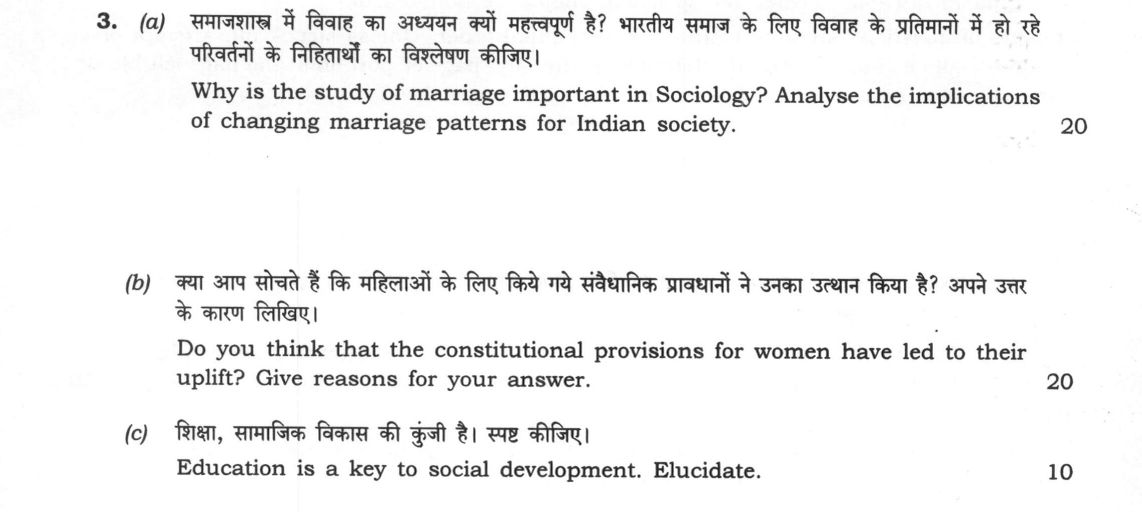
Why is the study of marriage important in Sociology? Analyse the implications of changing marriage patterns for Indian society. 20 marks
Do you think that the constitutional provisions for women have led to their uplift? Give reasons for your answer. 20 marks
Education is a key to social development. Elucidate. 10 marks
हिंदी में प्रश्न पढ़ें
समाजशास्त्र में विवाह का अध्ययन क्यों महत्वपूर्ण है? भारतीय समाज के लिए विवाह के प्रतिमानों में हो रहे परिवर्तनों के निहितार्थों का विश्लेषण कीजिए। (20 अंक)
क्या आप सोचते हैं कि महिलाओं के लिए किये गये संवैधानिक प्रावधानों ने उनका उत्थान किया है? अपने उत्तर के कारण लिखिए। (20 अंक)
शिक्षा, सामाजिक विकास की कुंजी है। स्पष्ट कीजिए। (10 अंक)
Model answer
Written by UPSC Answer Check against this question's marking rubric, to the expected length. UPSC does not publish answers for Mains — this is one way to score well, not an official key.
Sociological Significance of Marriage and Changing Patterns
Sociology views marriage not merely as a personal union but as a core institution regulating sexuality, lineage, and property devolution. Radcliffe-Brown demonstrated how marriage secures systemic kinship equilibrium, while Claude Lévi-Strauss highlighted its function in building wider social solidarity through exchange. In India, legal interventions such as the Hindu Marriage Act 1955 initiated a transition of marriage from an indissoluble sacrament to a contractual civil union.
Analysing contemporary patterns reveals structural shifts across Indian society. NFHS-5 data reflects a rising median age at marriage, driven by female education. Concurrently, the growth of inter-caste and inter-religious marriages, along with urban live-in relationships, directly challenges traditional caste endogamy and patriarchal authority. Furthermore, declining fertility rates and accelerating nuclearisation have restructured domestic roles and female labour force participation. Conversely, adverse sex ratios in states like Haryana and Punjab have created a severe ‘marriage squeeze’, precipitating cross-regional bride imports that often reproduce gender subordination under new demographic pressures.
Constitutional Provisions and Women’s Uplift
The Constitution establishes gender justice through Articles 14 (equality before law), 15(3) (positive discrimination), 16 (equal opportunity), 39(a) (livelihood rights), 42 (just working conditions and maternity relief), 51A(e) (duty to renounce practices derogatory to women), and Article 243D (mandatory one-third reservation in Panchayati Raj Institutions). This framework has birthed vital legislations: the Dowry Prohibition Act, PCPNDT Act, POSH Act, and the expanded Maternity Benefit Amendment Act.
These measures have yielded measurable progress, visible in rising female literacy, falling maternal mortality, and over 1.4 million women participating in grassroots governance. However, the transition from formal de jure equality to substantive de facto uplift remains incomplete. High incidences of domestic crimes and dowry deaths recorded by the National Crime Records Bureau (NCRB), coupled with low conviction rates, reflect structural implementation deficits. Moreover, the benefits of constitutional uplift remain skewed across the intersection of caste and class, leaving Dalit and Adivasi women bearing a double burden of economic deprivation and social violence.
Education as a Key to Social Development
Human capital theorists such as Theodore Schultz and Gary Becker frame education as an investment that enhances human capability and socioeconomic development, aligning with Sustainable Development Goals. In India, UDISE+ and ASER reports indicate near-universal primary enrolment and achieved gender parity, aided by state initiatives like Skill India.
However, education also exhibits reproductive tendencies. Randall Collins’s theory of credentialism highlights how degrees become gatekeeping devices, while Pierre Bourdieu noted that institutional schooling reproduces inequality by validating the cultural capital of dominant classes. In modern India, the post-COVID digital divide has widened learning inequalities. Additionally, the mismatch between educational attainment and formal job creation produces credential inflation and frustrated aspirations. Achieving authentic social development necessitates bridging these contradictions by integrating Émile Durkheim’s focus on moral socialisation with Mahatma Gandhi’s Nai Talim, harmonising vocational skill, cognitive learning, and egalitarian values.
Ultimately, marriage, constitutional rights, and education represent interlocked institutions of social reproduction; realizing transformative development demands that constitutional guarantees and educational gains actively dismantle patriarchal and caste hierarchies within both the domestic and public spheres.
What "Analyse" is asking you to do
Break the subject into its working parts and show how they act on each other. The marks are in the interconnections — which factor drives which, and what the resulting structure explains — not in the inventory of factors.
Structure that answers it
Define the whole → separate it into its parts → show which part drives which → what that interaction produces → what the structure implies
Where marks are lost
A flat list of causes with no account of which drives which. An answer of neatly separated headings, each self-contained, scores as description.
How this answer will be evaluated
Approach
(a) analyse: intro > causes > effects > stakeholders/linkages > way forward | (b) comment: context > arguments both sides > judgment > close | (c) explain: definition/context > points in order > small example > short close Full marks: Precise sociological concepts, specific Indian data, clear judgment, and strong analytical structure.
Key points expected
- Define marriage as a social institution
- Name a key sociologist (e.g., Goode, Murdock)
- Identify specific changing patterns (e.g., love marriage, divorce)
- Link changes to social consequences (e.g., family structure)
- Cite specific constitutional provisions (e.g., Art 14, 15, 39)
- Present arguments for uplift (e.g., legal equality)
- Present arguments against/limits (e.g., implementation gap)
- Provide a clear judgment/position
Evaluation rubric
Each sub-part is marked on its own, against the marks and word limit printed on the paper.
- (a) Sociological significance of marriage and implications of changing patterns in India. 20 marks
analyse— intro → causes → effects → stakeholders/linkages → way forward
Must cover
- Define marriage as a social institution
- Name a key sociologist (e.g., Goode, Murdock)
- Identify specific changing patterns (e.g., love marriage, divorce)
- Link changes to social consequences (e.g., family structure)
Loses marks
- Common-sense opinion without sociological theory
- Name-dropping thinkers without explaining their argument
- Ignoring the 'implications' part of the question
Earns more
- Mention specific Indian data (e.g., NFHS divorce rates)
- Contrast traditional vs modern marriage forms
- Discuss impact on gender roles
- Reference specific legal changes (e.g., Special Marriage Act)
Extra mark
- Cite specific statistic (e.g., FLFPR or divorce rate)
- Reference a specific contemporary debate or case
- (b) Judgment on whether constitutional provisions have led to women's uplift. 20 marks
comment— context → arguments both sides → judgment → close
Must cover
- Cite specific constitutional provisions (e.g., Art 14, 15, 39)
- Present arguments for uplift (e.g., legal equality)
- Present arguments against/limits (e.g., implementation gap)
- Provide a clear judgment/position
Loses marks
- Listing provisions without analyzing their impact
- Vague generalizations about 'women's rights'
- Failing to take a clear position
Earns more
- Mention specific laws (e.g., DPSP, 73rd Amendment)
- Use data to support the judgment (e.g., literacy, workforce)
- Discuss the gap between law and social reality
- Reference specific committees or reports
Extra mark
- Cite a specific Supreme Court judgment
- Reference a specific committee (e.g., National Commission for Women)
- (c) Elucidate how education acts as a key to social development. 10 marks
explain— definition/context → points in order → small example → short close
Must cover
- Define the link between education and development
- Explain mechanisms (e.g., human capital, social mobility)
- Provide a specific example or illustration
- Conclude with the significance of this link
Loses marks
- Vague statements without specific mechanisms
- Ignoring the 'social' aspect of development
- Lack of a clear conclusion
Earns more
- Mention specific indicators (e.g., HDI, literacy rate)
- Discuss the role of education in reducing inequality
- Reference specific policies (e.g., RTE Act)
- Contract formal vs informal education
Extra mark
- Cite a specific statistic (e.g., literacy rate)
- Reference a specific policy or program
Practice this exact question
Write your answer and it is marked point by point against the model answer above — what you covered, what you missed, what you got wrong.
Evaluate my answer →More from Sociology 2024 Paper II
- Q1 Answer the following questions in about 150 words each: (a) What, according to you, are t…
- Q2 (a) Differentiate between 'Western' and 'Indological' perspectives on the study of Indian…
- Q3 (a) Why is the study of marriage important in Sociology? Analyse the implications of chan…
- Q4 (a) How do religious communities contribute to the cultural diversity of India? (20 marks…
- Q5 Answer the following questions in about 150 words each: (a) Examine with suitable example…
- Q6 (a) Discuss the major challenges related to women's reproductive health in India. What me…