Paper II — Q8
(a) Highlight the major contributions of the reform movements in pre-independent India. (20 marks) (b) Identify different forms…
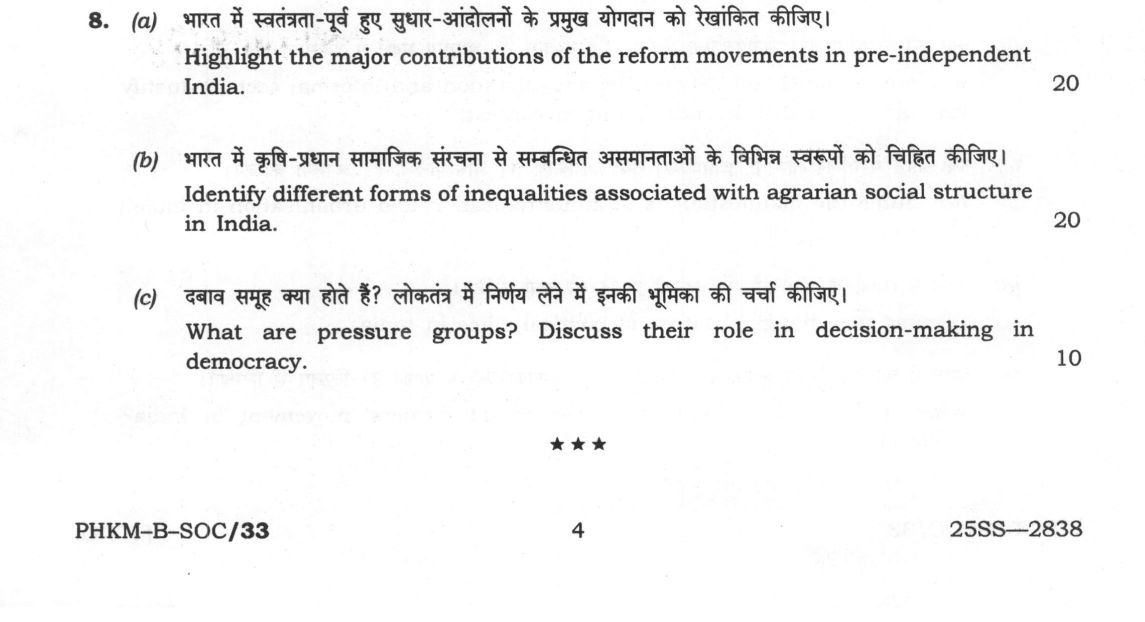
Highlight the major contributions of the reform movements in pre-independent India. 20 marks
Identify different forms of inequalities associated with agrarian social structure in India. 20 marks
What are pressure groups? Discuss their role in decision-making in democracy. 10 marks
हिंदी में प्रश्न पढ़ें
भारत में स्वतंत्रता-पूर्व हुए सुधार-आन्दोलनों के प्रमुख योगदान को रेखांकित कीजिए। (20 अंक)
भारत में कृषि-प्रधान सामाजिक संरचना से सम्बन्धित असमानताओं के विभिन्न स्वरूपों को चिह्नित कीजिए। (20 अंक)
दबाव समूह क्या होते हैं? लोकतंत्र में निर्णय लेने में इनकी भूमिका की चर्चा कीजिए। (10 अंक)
Model answer
Written by UPSC Answer Check against this question's marking rubric, to the expected length. UPSC does not publish answers for Mains — this is one way to score well, not an official key.
Social change, structural hierarchies, and power dynamics in India reflect continuous negotiations between civil society, the state, and marginalised groups. From colonial-era social reforms to contemporary democratic interest articulation, these processes have continuously contested entrenched inequalities.
Major Contributions of Reform Movements in Pre-Independent India
The socio-religious reform movements of the nineteenth and twentieth centuries targeted obscurantist practices and laid the ideological bedrock for modern India. Raja Ram Mohan Roy’s Brahmo Samaj spearheaded attacks on sati, culminating in the 1829 abolition, and vigorously challenged child marriage. Swami Dayananda Saraswati’s Arya Samaj established extensive Dayanand Anglo-Vedic (DAV) educational networks and initiated the shuddhi movement to reclaim social standing for the marginalised. The Aligarh Movement, led by Sir Syed Ahmad Khan, synthesised modern scientific education with Islamic identity through the Mohammedan Anglo-Oriental College. In the south, Periyar E.V. Ramasamy’s Self-Respect Movement radicalised the anti-caste discourse by advocating for caste annihilation, non-Brahmin self-respect marriages, and radical gender equality.
Beyond socio-religious critique, these movements transformed the socio-political sphere. They expanded the nationalist mass base through an emergent vernacular print culture and symbolic cultural resources. Crucially, reformers pioneered female education, facilitating women’s entry into the public sphere. These efforts directly motivated transformative legal interventions, notably the Hindu Widows’ Remarriage Act 1856 and the Age of Consent Act 1891.
Inequalities in the Agrarian Social Structure
Agrarian inequality in India remains deeply institutionalised across multiple axes:
Land Ownership and Caste-Class Congruence: Colonial land tenure systems (Zamindari, Ryotwari) entrenched skewed landholdings. Post-independence land ceiling legislations suffered widespread evasion, leaving the Gini coefficient of operational landholdings persistently high. This mirrors caste-class overlap: dominant castes (such as Jats, Marathas, and Kammas) monopolise land ownership, while Dalits and Adivasis remain predominantly landless. Per the NSSO 70th Round, over 60 percent of rural Dalit households are landless agricultural labourers.
Labour Exploitation and Gender Disparities: Agrarian relations sustain exploitative arrangements, including unrecorded sharecropping (bataidari), debt bondage, and chronic violations of minimum wage laws. Concurrently, the feminisation of agriculture has expanded female manual labour without formal land titles or institutional credit access, rendering women’s farm work economically invisible.
Regional Disparities: Agrarian structures diverge regionally; Green Revolution belts in Punjab and Haryana foster capitalist farming with severe migrant labour precarity, contrasting sharply with semi-feudal stagnation and persistent landlessness in states like Bihar and Eastern Uttar Pradesh.
Pressure Groups and Democratic Decision-Making
Pressure groups are organised collectives that perform interest articulation by influencing state policies from the outside, distinct from political parties which seek direct state power through interest aggregation. Following Wyn Grant’s typology, they operate as sectional (advocating specific group interests) or promotional (pursuing public causes), functioning through insider or outsider strategies.
In Indian democracy, pressure groups shape decision-making at multiple stages. They set policy agendas through grassroots mobilisations, seen in the Chipko Movement and the Narmada Bachao Andolan. They directly inform policy formulation through institutionalised consultations, as exercised by corporate associations like FICCI and CII. Groups like the Mazdoor Kisan Shakti Sangathan (MKSS) monitored policy implementation, catalysing the Right to Information Act 2005. Furthermore, environmental and civil rights groups leverage the judiciary via Public Interest Litigations (PILs) to enforce administrative accountability. However, their efficacy is constrained by elite capture, asymmetric access to financial resources, and a democratic deficit arising from unaccountable lobbying.
To conclude, while historical reform movements generated modern social consciousness and pressure groups opened institutional channels for democratic contestation, the persistence of deep-seated agrarian and structural inequalities necessitates ongoing land reforms and egalitarian policy interventions to achieve substantive democratic citizenship.
What "Highlight" is asking you to do
Bring the notable features of the named material forward and make their weight visible — what each feature is, and what gives it importance. Highlight expects substantive coverage of the features, not a thin selection from them.
Structure that answers it
The material and what makes a feature notable within it → feature, with the point that gives it weight → the same for each further feature → the composite picture they form
Where marks are lost
Naming features flatly as a list and never showing why any one of them signifies.
How this answer will be evaluated
Approach
Framework: Sociology Paper II (Indian Society & Social Issues). (a) highlight: name the salient points > one line of substance each > close | (b) examine: intro > how/why with reasoning > evidence > conclusion | (c) explain: definition/context > points in order > small example > short close Full marks: Comprehensive, specific, and analytically sound answers with clear examples and theoretical grounding.
Key points expected
- Name specific movements (e.g., Brahmo, Arya Samaj, Aligarh)
- Link reform to specific social issue (e.g., Sati, Caste)
- Identify key reformers (e.g., R.G. Bhandarkar, Jyotiba Phule)
- Mention impact on modern Indian social fabric
- Define agrarian social structure (land ownership, labor)
- Identify caste-based inequalities in land access
- Discuss class-based inequalities (landlord vs. laborer)
- Mention gender inequalities in agrarian context
Evaluation rubric
Each sub-part is marked on its own, against the marks and word limit printed on the paper.
- (a) Salient contributions of pre-independence reform movements to Indian social structure. 20 marks
highlight— name the salient points → one line of substance each → close
Must cover
- Name specific movements (e.g., Brahmo, Arya Samaj, Aligarh)
- Link reform to specific social issue (e.g., Sati, Caste)
- Identify key reformers (e.g., R.G. Bhandarkar, Jyotiba Phule)
- Mention impact on modern Indian social fabric
Loses marks
- Generalizing without naming specific movements
- Confusing pre-independence with post-independence reforms
- Listing names without explaining their specific contribution
Earns more
- Reference to specific legislative outcomes (e.g., Sati Abolition Act)
- Contrast between orthodox and reformist perspectives
- Mention of women's education initiatives
- Reference to anti-caste movements (e.g., Jyotiba Phule)
Extra mark
- Specific date of a key reform act
- Reference to a specific reformist text or journal
- (b) Different forms of inequalities within the agrarian social structure in India. 20 marks
examine— intro → how/why with reasoning → evidence → conclusion
Must cover
- Define agrarian social structure (land ownership, labor)
- Identify caste-based inequalities in land access
- Discuss class-based inequalities (landlord vs. laborer)
- Mention gender inequalities in agrarian context
Loses marks
- Discussing general social inequality without agrarian focus
- Ignoring the role of caste in agrarian structure
- Failing to distinguish between class and caste inequalities
Earns more
- Reference to specific land tenure systems (e.g., Zamindari)
- Mention of bonded labor or debt bondage
- Reference to specific tribal or Adivasi land issues
- Link to contemporary agrarian distress
Extra mark
- Specific statistic on land ownership distribution
- Reference to a specific land reform act
- (c) Definition of pressure groups and their role in democratic decision-making. 10 marks
explain— definition/context → points in order → small example → short close
Must cover
- Define pressure groups (interest groups, non-partisan)
- Explain their role in policy formulation
- Mention their role in representing marginalized interests
- Discuss their influence on public opinion
Loses marks
- Confusing pressure groups with political parties
- Failing to link their role to democratic decision-making
- Providing only a definition without discussing their role
Earns more
- Examples of specific pressure groups (e.g., trade unions, NGOs)
- Mention of lobbying or advocacy techniques
- Reference to their role in social movements
- Discussion of their limitations or criticisms
Extra mark
- Reference to a specific recent pressure group campaign
- Mention of a specific legal provision regarding pressure groups
Practice this exact question
Write your answer and it is marked point by point against the model answer above — what you covered, what you missed, what you got wrong.
Evaluate my answer →More from Sociology 2024 Paper II
- Q5 Answer the following questions in about 150 words each: (a) Examine with suitable example…
- Q6 (a) Discuss the major challenges related to women's reproductive health in India. What me…
- Q7 (a) Analyse the trilogy between environmental movement, development and tribal identity.…
- Q8 (a) Highlight the major contributions of the reform movements in pre-independent India. (…