Paper II — Q4
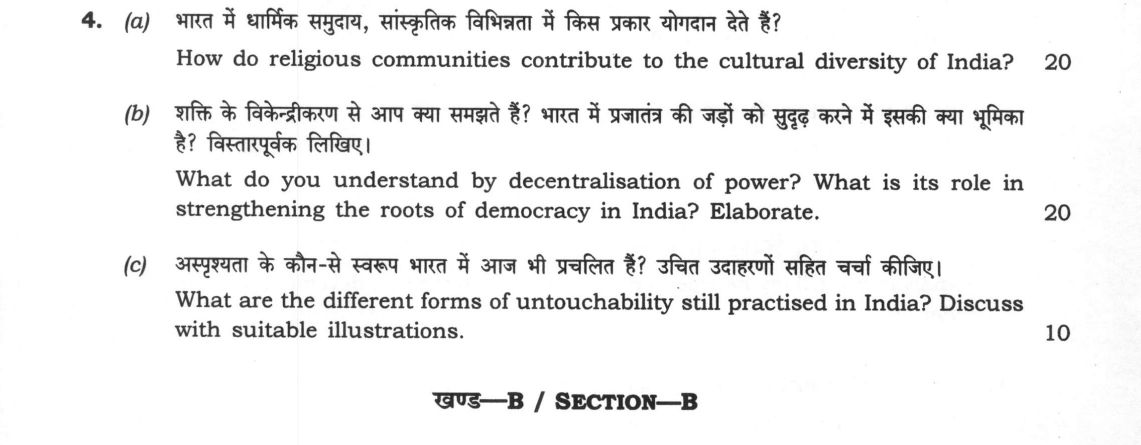
(a) How do religious communities contribute to the cultural diversity of India? (20 marks) (b) What do you understand by…
How do religious communities contribute to the cultural diversity of India? 20 marks
What do you understand by decentralisation of power? What is its role in strengthening the roots of democracy in India? Elaborate. 20 marks
What are the different forms of untouchability still practised in India? Discuss with suitable illustrations. 10 marks
हिंदी में प्रश्न पढ़ें
भारत में धार्मिक समुदाय, सांस्कृतिक विविधता में किस प्रकार योगदान देते हैं? (20 अंक)
शक्ति के विकेन्द्रीकरण से आप क्या समझते हैं? भारत में प्रजातंत्र की जड़ों को मज़बूत करने में इसकी क्या भूमिका है? विस्तारपूर्वक लिखिए। (20 अंक)
अस्पृश्यता के कौन-से स्वरूप भारत में आज भी प्रचलित हैं? उचित उदाहरणों सहित चर्चा कीजिए। (10 अंक)
Model answer
Written by UPSC Answer Check against this question's marking rubric, to the expected length. UPSC does not publish answers for Mains — this is one way to score well, not an official key.
India’s pluralism is not a collection of separate faiths but a living process in which religious communities shape culture, democracy and social hierarchy. Their contribution to diversity is structural, institutional and experiential; decentralisation seeks to make that diversity politically manageable; and the persistence of untouchability shows that inclusion remains unfinished.
Religious communities and cultural diversity Religious communities generate diversity through sectarian and doctrinal variety, and through institutional pluralism. Hinduism contains Vaishnava, Shaiva, Shakta and Smarta traditions, temple cults, bhakti and tantra, and regional deities that make local culture distinct. Islam in India is marked by Sufism, Dargah culture, Barelvi and Deobandi currents, and shared festivals such as Eid and Muharram that enter public calendars. Christianity displays denominational diversity—Catholic, Protestant, Pentecostal—through churches, schools and social service. Sikhism offers an egalitarian critique of caste through langar, Guru Granth Sahib and Khalsa discipline, while Jainism and Buddhism provide heterodox challenges to Brahmanical hierarchy through ahimsa, renunciation and anti-caste ethics. A lived religion approach shows that boundaries are blended: Basant Panchami is observed by Hindus and, in some regions, by people of other faiths; pilgrimage circuits such as Ajmer Sharif and Velankanni draw cross-regional and cross-communal crowds; and linguistic-religious overlaps in Urdu-Hindi and Punjabi show that faith, language and culture are mutually constitutive. The Sachar Committee’s report on Muslim deprivation reminds us that religious identity also intersects with structural inequality, though this is distinct from caste untouchability.
Decentralisation and democratic roots Decentralisation of power means the transfer of authority from the state to local institutions across political, administrative and fiscal dimensions. The 73rd and 74th Constitutional Amendments were a watershed because they made Panchayati Raj and urban local bodies constitutional, devolved functions, functionaries and funds, and created Gram Sabhas and Ward Committees. The Finance Commission’s grants and state finance commissions strengthen fiscal capacity. Its role in strengthening the roots of democracy is threefold. First, it expands participation: reservation for women, SCs and STs in PRIs brings historically excluded groups into decision-making, and social audit under MGNREGA makes public works accountable to beneficiaries. Second, it deepens accountability: local bodies are closer to citizens, and participatory budgeting, as in Kerala’s People’s Plan, allows villages to prioritise roads, water and sanitation. Third, it recognises identity: territorial autonomy under the Fifth and Sixth Schedules and special provisions for tribal and border areas allow distinct communities to govern local affairs, linking cultural diversity to democratic representation.
Contemporary untouchability Untouchability survives in occupational, spatial, religious and digital forms. Occupational segregation persists in manual scavenging and leather work, where caste determines dirty labour despite legal prohibition. Residential segregation appears in Dalit ghettos and “upper caste” colonies that deny access to common spaces. Temple entry exclusion continues in some regions, and digital and infrastructural untouchability appears when Dalits are excluded from common water sources, online platforms or public services. Honour killings and violence over inter-caste marriage show that untouchability is enforced through family and community power. NCRB data on atrocities against SCs and STs, and cases such as Khairlanji, the Una flogging and Rohith Vemula’s institutional exclusion, demonstrate that the problem is not historical but present. Article 17 and the SC/ST (Prevention of Atrocities) Act remain under-implemented.
Cultural diversity, democratic decentralisation and anti-untouchability are mutually reinforcing. Religious communities enrich India’s culture, but their diversity must be protected from majoritarianism and caste pollution. Decentralisation gives local democracy the capacity to recognise difference, while anti-untouchability laws and social movements test whether that democracy is substantive. Inclusive nation-building therefore requires constitutional equality, local participation and a public culture that treats diversity as a source of strength, not a threat.
What "Elaborate" is asking you to do
Give the full detailed account the question has compressed into a line — every dimension of it, with specifics. Elaborate rewards completeness and detail rather than clarification or argument: the examiner is checking whether you can fill out a topic without being told what its parts are.
Structure that answers it
State the proposition → first dimension in detail → second dimension in detail → the part the statement leaves implicit → the consolidated picture
Where marks are lost
Repeating the statement at greater length instead of adding substance. Elaborate also punishes narrowness: omitting a whole dimension costs more here than anywhere else in this family.
How this answer will be evaluated
Approach
Framework: Sociology Paper II: Define > Thinker > Argument > Indian illustration. (a) discuss: intro > 3-4 dimensions > example > balanced close | (b) examine: intro > how/why with reasoning > evidence > conclusion | (c) discuss: intro > 3-4 dimensions > example > balanced close Full marks: Precise definitions, specific Indian examples, and clear analytical links between concepts and outcomes.
Key points expected
- Define cultural diversity in the Indian context
- Identify specific contributions of at least two distinct religious communities
- Link religious practices to tangible cultural elements (art, festivals, language)
- Provide a contemporary Indian illustration of this contribution
- Define decentralisation of power (transfer of authority to local levels)
- Explain the mechanism of Panchayati Raj (73rd Amendment)
- Explain the mechanism of Municipalities (74th Amendment)
- Link local governance to the 'roots of democracy' (participation, accountability)
Evaluation rubric
Each sub-part is marked on its own, against the marks and word limit printed on the paper.
- (a) Explain the contribution of religious communities to India's cultural diversity. 20 marks
discuss— intro → 3-4 dimensions → example → balanced close
Must cover
- Define cultural diversity in the Indian context
- Identify specific contributions of at least two distinct religious communities
- Link religious practices to tangible cultural elements (art, festivals, language)
- Provide a contemporary Indian illustration of this contribution
Loses marks
- Generalizing without specific examples of religious contributions
- Focusing only on one religion (e.g., only Hinduism)
- Confusing religious diversity with linguistic diversity
Earns more
- Mention specific festivals (e.g., Diwali, Eid, Christmas) as cultural markers
- Reference specific art forms (e.g., Mughal architecture, temple sculpture)
- Discuss the concept of 'composite culture' or 'secularism'
- Mention the role of religious texts in literature
Extra mark
- Cite a specific statistic on religious demographics (e.g., Census 2011)
- Reference a specific Supreme Court judgment on secularism
- (b) Define decentralisation and examine its role in strengthening democracy in India. 20 marks
examine— intro → how/why with reasoning → evidence → conclusion
Must cover
- Define decentralisation of power (transfer of authority to local levels)
- Explain the mechanism of Panchayati Raj (73rd Amendment)
- Explain the mechanism of Municipalities (74th Amendment)
- Link local governance to the 'roots of democracy' (participation, accountability)
Loses marks
- Confusing decentralisation with federalism (state vs center)
- Failing to link local bodies to democratic participation
- Ignoring the constitutional status of local bodies
Earns more
- Mention the 73rd and 74th Constitutional Amendments specifically
- Discuss the role of Gram Sabha in grassroots democracy
- Reference the 11th Finance Commission's role in devolution
- Mention the reservation of seats for SC/ST/OBC in local bodies
Extra mark
- Cite a specific state's success in Panchayati Raj (e.g., Kerala, Rajasthan)
- Reference a specific Supreme Court judgment on local governance
- (c) Discuss different forms of untouchability still practised in India with illustrations. 10 marks
discuss— intro → 3-4 dimensions → example → balanced close
Must cover
- Define untouchability in the contemporary context
- Identify at least two distinct forms (e.g., social, economic, religious)
- Provide a specific illustration for each form identified
- Link the forms to the persistence of caste hierarchy
Loses marks
- Focusing only on historical forms (pre-1950)
- Failing to provide specific illustrations for the forms
- Confusing untouchability with general poverty
Earns more
- Mention 'manual scavenging' as a form of economic untouchability
- Reference 'separate water taps' or 'separate seating' as social forms
- Discuss 'religious exclusion' (e.g., temple entry restrictions)
- Mention the Scheduled Castes (Prevention of Atrocities) Act
Extra mark
- Cite a specific recent case of untouchability (e.g., a specific incident)
- Reference a specific NGO working against untouchability
Practice this exact question
Write your answer and it is marked point by point against the model answer above — what you covered, what you missed, what you got wrong.
Evaluate my answer →More from Sociology 2024 Paper II
- Q1 Answer the following questions in about 150 words each: (a) What, according to you, are t…
- Q2 (a) Differentiate between 'Western' and 'Indological' perspectives on the study of Indian…
- Q3 (a) Why is the study of marriage important in Sociology? Analyse the implications of chan…
- Q4 (a) How do religious communities contribute to the cultural diversity of India? (20 marks…
- Q5 Answer the following questions in about 150 words each: (a) Examine with suitable example…
- Q6 (a) Discuss the major challenges related to women's reproductive health in India. What me…
- Q7 (a) Analyse the trilogy between environmental movement, development and tribal identity.…