Paper II — Q5
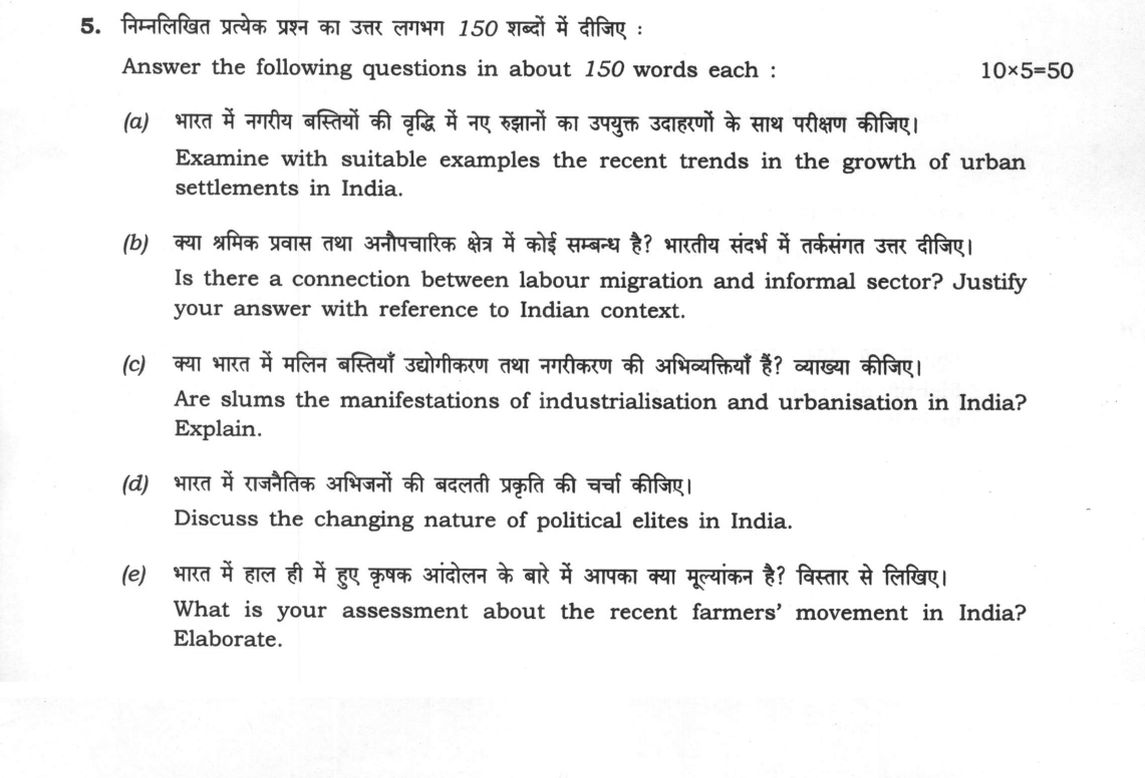
Answer the following questions in about 150 words each: (a) Examine with suitable examples the recent trends in the growth of…
Answer the following questions in about 150 words each:
Examine with suitable examples the recent trends in the growth of urban settlements in India. 10 marks
Is there a connection between labour migration and informal sector? Justify your answer with reference to Indian context. 10 marks
Are slums the manifestations of industrialisation and urbanisation in India? Explain. 10 marks
Discuss the changing nature of political elites in India. 10 marks
What is your assessment about the recent farmers' movement in India? Elaborate. 10 marks
हिंदी में प्रश्न पढ़ें
निम्नलिखित प्रत्येक प्रश्न का उत्तर लगभग 150 शब्दों में दीजिए :
भारत में नगरीय बस्तियों की वृद्धि में नए रुझानों का उपयुक्त उदाहरणों के साथ परीक्षण कीजिए। (10 अंक)
क्या श्रमिक प्रवास तथा अनौपचारिक क्षेत्र में कोई संबंध है? भारतीय संदर्भ में तर्कसंगत उत्तर दीजिए। (10 अंक)
क्या भारत में मलिन बस्तियाँ उद्योगीकरण तथा नगरीकरण की अभिव्यक्तियाँ हैं? व्याख्या कीजिए। (10 अंक)
भारत में राजनीतिक अभिजनों की बदलती प्रकृति की चर्चा कीजिए। (10 अंक)
भारत में हाल ही में हुए कृषक आंदोलन के बारे में आपका क्या मूल्यांकन है? विस्तार से लिखिए। (10 अंक)
Model answer
Written by UPSC Answer Check against this question's marking rubric, to the 150-word length. UPSC does not publish answers for Mains — this is one way to score well, not an official key.
(a) Recent Trends in the Growth of Urban Settlements in India
Urban growth in India exhibits a dual character marked by metropolitan concentration alongside spontaneous, dispersed growth. Census 2011 data highlights the persistence of metropolitan primacy, with 53 million-plus urban agglomerations housing over 40% of the urban population. Concurrently, a significant trend is the proliferation of "Census Towns"—settlements that possess urban demographic characteristics but remain under rural governance—which accounted for nearly 30% of urban growth between 2001 and 2011.
Furthermore, rapid peri-urbanization along regional transit corridors (such as the Delhi-NCR and Bengaluru outer regions) and localized counter-urbanization among affluent strata reflect post-industrial spatial restructuring. As Amitabh Kundu (2011) examines, this process represents "exclusionary urbanization." Formal planning, private capital, and state infrastructural investments remain concentrated in high-end metropolitan nodes, driving low-income populations into unserviced peri-urban peripheries and deepening spatial and socioeconomic polarization.
(b) Labour Migration and the Informal Sector
Labour migration and the informal sector in India share an intrinsic structural nexus. Jan Breman conceptualizes this through the idea of "footloose labour," wherein distress-driven rural migrants are absorbed into precarious, unregulated urban jobs. Periodic Labour Force Survey (PLFS) data consistently shows that nearly 90% of India's workforce operates in the informal economy, with inter-state and intra-state migrants heavily concentrated in construction, domestic work, logistics, and street commerce.
Rejecting the dualist assumption that informality is merely a temporary, residual stage of modernization, Barbara Harriss-White demonstrates that the informal sector is a permanent, structural necessity for Indian capitalism. Circular and seasonal migration—prominent among brick-kiln workers and sugarcane harvesters—creates a pliable, non-unionized labour force. This informalization allows capital to minimize wage costs and evade statutory welfare obligations, while shifting the burden of social reproduction onto the rural subsistence economy.
(c) Slums as Manifestations of Industrialisation and Urbanisation
Slums in India are the direct outcome of uneven capitalist industrialization, structural housing market failures, and the neoliberal state's withdrawal from social housing provision. Applying the dual labour market thesis, formal industrial growth depends on low-cost informal labour without providing commensurate wages or living infrastructure, compelling workers to create self-built settlements on marginal lands.
This spatial exclusion produces a sharp divide between recognized settlements and non-notified slums. While notified settlements like Mumbai’s Dharavi have evolved into highly productive informal industrial and recycling clusters, non-notified slums face severe municipal neglect, lack basic tenure security, clean water, and sanitation, and remain vulnerable to eviction. As Saskia Sassen’s framework illustrates, Indian urbanization systematically extracts economic surplus from subaltern labour while marginalizing workers into dense, degraded urban enclaves.
(d) The Changing Nature of Political Elites in India
India's political elite has undergone a profound transformation since independence. The post-colonial era was characterized by an upper-caste, Western-educated, nationalist elite operating within the Nehruvian consensus. Yogendra Yadav conceptualizes the first major shift as the "Second Democratic Upsurge," which marked the plebeianization of politics through the mobilization of Other Backward Classes (OBCs) and Dalits across northern and southern India.
In recent decades, this elite formation has evolved further through intense regionalization and the rise of state-level agrarian and caste-based leadership. More recently, there has been a dual trend of professional-technocratic induction alongside the documented rise of money power and criminalization within electoral politics, as highlighted by Association for Democratic Reforms (ADR) data. As André Béteille observed, this signifies a "crisis of institutions," wherein democratic deepening has widened representation while eroding institutional autonomy and constitutional norms.
(e) Assessment of the Recent Farmers' Movement in India
The 2020–21 farmers' movement against the three agricultural reform acts marked a significant evolution in Indian agrarian mobilization. Unlike the 1980s New Farmers' Movements led by figures like Sharad Joshi and Mahendra Singh Tikait—which Gail Omvedt characterized as single-issue, commodity-centric agitations of rich peasants ("Bharat versus India")—the recent movement constructed broader sociological solidarities.
The movement achieved a notable caste-class convergence, uniting landowning Jats, smallholders, and landless Dalit agricultural labourers, while seeing substantial participation from women. Mobilizing through traditional institutions like khap panchayats and community langars, alongside modern digital campaigns, it successfully challenged the perceived corporatization of agriculture. However, its focus on defending minimum support prices (MSP) and state procurement also revealed the limits of corporatist demands, highlighting the unresolved structural crisis of smallholder agrarian viability in a liberalized economy.
What "Examine" is asking you to do
Test the proposition the question puts to you and return a finding on how far it holds. Examine stems carry a claim, or ask whether something has happened, and expect evidence weighed both ways before the extent is stated — often with remedial measures attached.
Structure that answers it
Restate the claim as the question frames it → evidence that supports it → evidence that undercuts it → the conditions under which it holds → verdict on how far it stands
Where marks are lost
Stopping at description. An examination has to reach a finding, and “examine with justification” means the extent must be stated, not implied.
How this answer will be evaluated
Approach
Framework: Sociology Paper II: Define > Thinker > Argument > Indian illustration. (a) examine: intro > how/why with reasoning > evidence > conclusion | (b) justify: claim > 3-4 reasons > evidence > conclusion | (c) explain: definition/context > points in order > small example > short close | (d) discuss: intro > 3-4 dimensions > example > balanced close | (e) comment: context > arguments both sides > judgment > close Full marks: Precise application of sociological concepts, strong Indian data, clear argumentation, and balanced judgment.
Key points expected
- Identify specific recent trends (e.g., deconcentration, smart cities)
- Provide reasoning for the trends (economic/policy drivers)
- Include suitable examples of specific settlements
- Conclude on the nature of current urbanization
- State the connection clearly
- Provide 3-4 reasons for the link
- Use Indian context/evidence
- Conclude on the structural nature of the link
Evaluation rubric
Each sub-part is marked on its own, against the marks and word limit printed on the paper.
- (a) Identify and reason through recent trends in Indian urban settlement growth with examples. · 150 words
examine— intro → how/why with reasoning → evidence → conclusion
Must cover
- Identify specific recent trends (e.g., deconcentration, smart cities)
- Provide reasoning for the trends (economic/policy drivers)
- Include suitable examples of specific settlements
- Conclude on the nature of current urbanization
Loses marks
- Listing trends without reasoning
- Using outdated examples (pre-2000) as 'recent'
Earns more
- Reference to Census 2011 or NSSO data
- Mention of specific smart city projects
- Discussion of peri-urban growth
Extra mark
- Specific statistic on urban population growth rate
- Reference to a specific urban planning policy
- (b) Justify the link between labour migration and the informal sector in India. · 150 words
justify— claim → 3-4 reasons → evidence → conclusion
Must cover
- State the connection clearly
- Provide 3-4 reasons for the link
- Use Indian context/evidence
- Conclude on the structural nature of the link
Loses marks
- Defining terms without justifying the link
- Ignoring the 'Indian context' requirement
Earns more
- Reference to PLFS or NSSO data on migration
- Mention of specific informal sectors (construction, domestic)
- Discussion of 'push' and 'pull' factors
Extra mark
- Specific statistic on informal employment share
- Reference to a specific migration study
- (c) Explain whether slums are manifestations of industrialisation and urbanisation in India. · 150 words
explain— definition/context → points in order → small example → short close
Must cover
- Define slums in the context of urbanisation
- Explain the link to industrialisation (rural-urban migration)
- Explain the link to urbanisation (housing deficit)
- Provide a small example and short close
Loses marks
- Treating slums as purely a poverty issue
- Failing to link to industrialisation/urbanisation
Earns more
- Reference to 'urbanisation without industrialisation'
- Mention of specific slum areas (e.g., Dharavi)
- Discussion of informal housing markets
Extra mark
- Specific statistic on slum population
- Reference to a specific urban housing policy
- (d) Discuss the changing nature of political elites in India. · 150 words
discuss— intro → 3-4 dimensions → example → balanced close
Must cover
- Introduce the concept of political elites
- Identify 3-4 dimensions of change (e.g., caste, class, gender)
- Provide examples of changing elite composition
- Close with a balanced view on the nature of change
Loses marks
- Focusing only on one dimension (e.g., caste)
- Ignoring the 'changing' aspect (static description)
Earns more
- Reference to 'social base of parties' (Lajpat Rai)
- Mention of 'new politics' vs 'old politics'
- Discussion of regional parties and elite capture
Extra mark
- Specific statistic on caste composition of MPs
- Reference to a specific election study
- (e) Provide an assessment of the recent farmers' movement in India. · 150 words
comment— context → arguments both sides → judgment → close
Must cover
- Provide context of the movement
- Present arguments from both sides (farmers vs state)
- Offer a judgment/assessment
- Close with a forward-looking statement
Loses marks
- Taking a purely partisan stance
- Failing to provide an 'assessment' (just describing)
Earns more
- Reference to specific demands (e.g., MSP, land acquisition)
- Mention of specific events (e.g., Delhi border protests)
- Discussion of 'farmers' vs 'landowners' debate
Extra mark
- Specific statistic on agricultural distress
- Reference to a specific government policy
Practice this exact question
Write your answer and it is marked point by point against the model answer above — what you covered, what you missed, what you got wrong.
Evaluate my answer →More from Sociology 2024 Paper II
- Q2 (a) Differentiate between 'Western' and 'Indological' perspectives on the study of Indian…
- Q3 (a) Why is the study of marriage important in Sociology? Analyse the implications of chan…
- Q4 (a) How do religious communities contribute to the cultural diversity of India? (20 marks…
- Q5 Answer the following questions in about 150 words each: (a) Examine with suitable example…
- Q6 (a) Discuss the major challenges related to women's reproductive health in India. What me…
- Q7 (a) Analyse the trilogy between environmental movement, development and tribal identity.…
- Q8 (a) Highlight the major contributions of the reform movements in pre-independent India. (…