Paper II — Q6
(a) Discuss the major challenges related to women's reproductive health in India. What measures would you suggest to overcome…
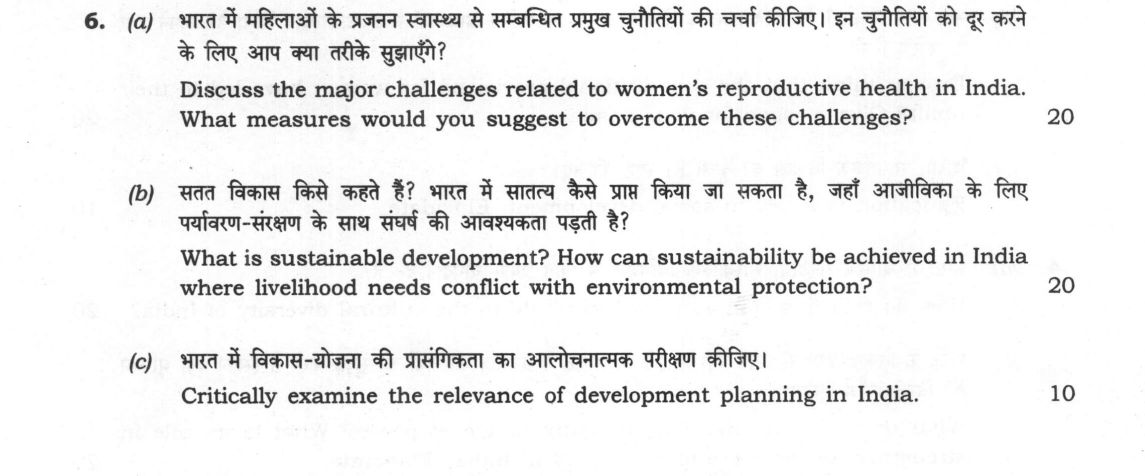
Discuss the major challenges related to women's reproductive health in India. What measures would you suggest to overcome these challenges? 20 marks
What is sustainable development? How can sustainability be achieved in India where livelihood needs conflict with environmental protection? 20 marks
Critically examine the relevance of development planning in India. 10 marks
हिंदी में प्रश्न पढ़ें
भारत में महिलाओं के प्रजनन स्वास्थ्य से सम्बन्धित प्रमुख चुनौतियों की चर्चा कीजिए। इन चुनौतियों को दूर करने के लिए आप क्या तरीके सुझाएँगे? (20 अंक)
सतत विकास किसे कहते हैं? भारत में सातत्य कैसे प्राप्त किया जा सकता है, जहाँ आजीविका के लिए पर्यावरण-संरक्षण के साथ संघर्ष की आवश्यकता पड़ती है? (20 अंक)
भारत में विकास-योजना की प्रासंगिकता का आलोचनात्मक परीक्षण कीजिए। (10 अंक)
Model answer
Written by UPSC Answer Check against this question's marking rubric, to the expected length. UPSC does not publish answers for Mains — this is one way to score well, not an official key.
Development in India cannot be understood as separate tracks of gender, environment and state intervention; these interconnected themes shape each other. Women’s reproductive health, ecological sustainability and planning are linked because poor health limits human capital, environmental degradation undermines livelihoods, and planning determines whether growth is inclusive or extractive.
Women’s reproductive health is constrained by patriarchal household decision-making, son preference and limited male participation in family planning. NFHS-5 shows that unmet need for modern contraception is about 12% among married women aged 15–49, while the Maternal Mortality Ratio, though improved, remains high at 97 per 1,00,000 live births. Cultural norms often delay care-seeking, restrict autonomy over contraception and childbearing, and make women dependent on in-laws or husbands for decisions. Son preference can intensify pressure for repeated pregnancies. Systemic failures compound this: primary health centres are often under-resourced, trained birth attendants are scarce in remote areas, and anaemia affects 57% of women aged 15–49 according to NFHS-5. Access to safe abortion, though improved under the Medical Termination of Pregnancy (Amendment) Act, 2021, which extends gestational limits for certain categories, is uneven due to stigma, provider reluctance and weak facilities. Measures must be multi-level. Janani Suraksha Yojana and Pradhan Mantri Matru Vandana Yojana should be expanded and better monitored, while community-based health workers, especially ASHA and ANM, need better incentives, training and supply chains. Male involvement programmes in family planning and comprehensive sexuality education in schools and community spaces can shift norms, reduce early marriage and increase shared decision-making. Hospital infrastructure, emergency obstetric care and blood banks must be expanded, especially in high-MMR districts.
Sustainable development, as defined by the Brundtland Commission and reflected in the SDG framework, embodies intergenerational equity by meeting present needs without compromising future generations, balancing the three pillars: economic, social and environmental. The debate between weak and strong sustainability matters: weak sustainability assumes natural capital can be replaced by human-made capital, while strong sustainability treats ecosystems as non-substitutable. In India, livelihood needs often conflict with environmental protection. The Narmada Bachao Andolan highlighted displacement caused by large dams; mining in Jharkhand and Odisha has damaged tribal lands, forests and livelihoods; climate-induced agrarian distress forces risky land use; and informal sector pollution from tanneries and brick kilns harms workers and communities. Reconciliation requires just transition frameworks that compensate affected workers and communities, community forest rights under the Forest Rights Act, 2006, and support for organic and System of Rice Intensification agriculture. Circular economy models in MSMEs can reduce waste, while climate-resilient MGNREGA work can combine employment with water conservation and ecological restoration.
Development planning in India has been central to state-led modernisation. The Five-Year Plans contributed to the Green Revolution, space programmes and health infrastructure, but also produced regional inequality, displacement and ecological degradation. The shift from Five-Year Plans to NITI Aayog reflects a move from centralised targets to cooperative federalism and market-friendly policy. Neoliberal critiques argue that planning crowds out markets and creates bureaucratic rigidity, while post-development arguments question whether externally designed plans can capture local knowledge or may impose one-size-fits-all growth. Yet planning remains relevant because markets alone cannot correct health, environmental and gender externalities. The 73rd and 74th Amendments provide a basis for democratic decentralised planning through panchayats and municipalities, enabling participatory alternatives that link local priorities with national goals.
Thus, a way forward is gender-sensitive, participatory planning that treats reproductive health, ecological limits and livelihood security as one integrated agenda. Such planning must be rooted in local institutions, accountable to affected communities, and attentive to the needs of women, tribal and informal workers. Only then can India reconcile sustainability with social justice.
What "Discuss" is asking you to do
Lay the issue out from more than one side — how it arose, what is claimed for it, what is held against it, and where it now stands. UPSC attaches discuss to broad topics with several live dimensions, so coverage of the dimensions earns more than the strength of your opinion.
Structure that answers it
Set the issue up → the case as it is made → the case against → the dimension both sides leave out → where the balance now lies
Where marks are lost
Listing facts with no thread between them, or arguing one side throughout and calling it a discussion.
How this answer will be evaluated
Approach
Framework: Sociology Paper II: Define > Thinker > Argument > Indian illustration. (a) challenges: 3-4 challenges > solutions mapped to them > conclusion | (b) explain: definition/context > points in order > small example > short close | (c) critique: the claim > its strengths > its weaknesses > your judgment Full marks: Comprehensive, well-structured, with specific Indian examples and data.
Key points expected
- 3-4 distinct challenges (e.g., anemia, maternal mortality, access to care)
- Measures mapped directly to the identified challenges
- Indian context (e.g., NFHS data, specific schemes)
- Balanced conclusion on overcoming challenges
- Definition of sustainable development (e.g., Brundtland)
- Explanation of the livelihood-environment conflict in India
- Specific strategies for achieving sustainability in India
- Short conclusion on the balance
Evaluation rubric
Each sub-part is marked on its own, against the marks and word limit printed on the paper.
- (a) Identify 3-4 reproductive health challenges and map specific measures to overcome them. 20 marks
challenges— 3-4 challenges → solutions mapped to them → conclusion
Must cover
- 3-4 distinct challenges (e.g., anemia, maternal mortality, access to care)
- Measures mapped directly to the identified challenges
- Indian context (e.g., NFHS data, specific schemes)
- Balanced conclusion on overcoming challenges
Loses marks
- Listing challenges without corresponding measures
- Vague generalities without Indian context
- Ignoring the 'measures' part of the question
Earns more
- Mention of specific schemes (e.g., Janani Suraksha Yojana)
- Reference to NFHS-5 data on maternal health
- Discussion of social determinants (education, poverty)
- Mention of specific health indicators (MMR, TBR)
Extra mark
- Citing specific NFHS-5 statistic (e.g., MMR, TBR)
- Mentioning a specific recent policy or committee report
- (b) Define sustainable development and explain how to balance livelihood and environment in India. 20 marks
explain— definition/context → points in order → small example → short close
Must cover
- Definition of sustainable development (e.g., Brundtland)
- Explanation of the livelihood-environment conflict in India
- Specific strategies for achieving sustainability in India
- Short conclusion on the balance
Loses marks
- Defining sustainability without addressing the conflict
- Ignoring the Indian context
- Vague solutions without specific examples
Earns more
- Mentioning the Brundtland Report (1987)
- Examples of sustainable livelihoods (e.g., organic farming, eco-tourism)
- Reference to specific Indian policies (e.g., National Action Plan on Climate Change)
- Discussion of the 'triple bottom line' (economic, social, environmental)
Extra mark
- Citing a specific Indian case study of sustainable development
- Mentioning a specific international agreement (e.g., Paris Agreement)
- (c) Critically examine the relevance of development planning in India. 10 marks
critique— the claim → its strengths → its weaknesses → your judgment
Must cover
- The claim: Development planning is relevant
- Strengths of development planning in India
- Weaknesses/limits of development planning
- Your judgment on its relevance
Loses marks
- Only listing strengths without critique
- Ignoring the Indian context
- Vague judgment without specific reasoning
Earns more
- Mentioning specific Five-Year Plans
- Discussion of the NITI Aayog transition
- Reference to specific planning failures or successes
- Mentioning the role of central vs. state planning
Extra mark
- Citing a specific planning document or report
- Mentioning a specific economist's critique of planning
Practice this exact question
Write your answer and it is marked point by point against the model answer above — what you covered, what you missed, what you got wrong.
Evaluate my answer →More from Sociology 2024 Paper II
- Q3 (a) Why is the study of marriage important in Sociology? Analyse the implications of chan…
- Q4 (a) How do religious communities contribute to the cultural diversity of India? (20 marks…
- Q5 Answer the following questions in about 150 words each: (a) Examine with suitable example…
- Q6 (a) Discuss the major challenges related to women's reproductive health in India. What me…
- Q7 (a) Analyse the trilogy between environmental movement, development and tribal identity.…
- Q8 (a) Highlight the major contributions of the reform movements in pre-independent India. (…