Paper II — Q7
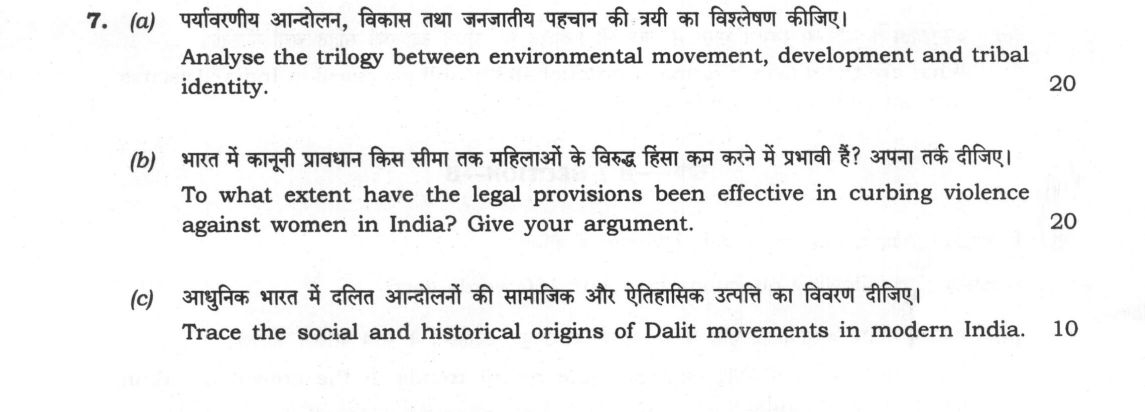
(a) Analyse the trilogy between environmental movement, development and tribal identity. (20 marks) (b) To what extent have the…
Analyse the trilogy between environmental movement, development and tribal identity. 20 marks
To what extent have the legal provisions been effective in curbing violence against women in India? Give your argument. 20 marks
Trace the social and historical origins of Dalit movements in modern India. 10 marks
हिंदी में प्रश्न पढ़ें
पर्यावरणीय आन्दोलन, विकास तथा जनजातीय पहचान की त्रयी का विश्लेषण कीजिए। (20 अंक)
भारत में कानूनी प्रावधान किस सीमा तक महिलाओं के विरुद्ध हिंसा कम करने में प्रभावी हैं? अपना तर्क दीजिए। (20 अंक)
आधुनिक भारत में दलित आन्दोलनों की सामाजिक और ऐतिहासिक उत्पत्ति का विवरण दीजिए। (10 अंक)
Model answer
Written by UPSC Answer Check against this question's marking rubric, to the expected length. UPSC does not publish answers for Mains — this is one way to score well, not an official key.
Environmental Movements, Development, and Tribal Identity
The dialectic between state-led developmentalism, environmental protection, and tribal identity reflects the structural friction between modernising state paradigms and indigenous modes of subsistence. Madhav Gadgil and Ramachandra Guha conceptualise post-colonial development as 'internal colonialism', wherein resource-rich tribal peripheries are systematically exploited to sustain urban-industrial growth. Sociologists like Amita Baviskar and K. Sivaramakrishnan demonstrate that tribal identity is not merely an essentialised cultural leftover, but an active political construction forged in resistance to ecological alienation and the homogenising nation-state.
This trilogy is historically grounded in subaltern environmentalism. The Chipko Movement (1970s, Uttarakhand), spearheaded by peasant women like Gaura Devi, articulated an ecofeminist defence of community forest rights against commercial timber extraction. The Narmada Bachao Andolan, mobilised by Medha Patkar against the Sardar Sarovar Dam, framed development-induced displacement as a violation of constitutional rights and indigenous cultural survival. Similarly, the Jharkhand Movement politicised unrestrained mineral extraction, land alienation, and deforestation, crystallising tribal identity around the demand for statehood and customary sovereignty over Jal, Jungle, Jameen. Environmental mobilisations thus transform tribal identity from passive marginality into active political agency against predatory development.
Legal Provisions and Violence Against Women
The Indian state has enacted progressive legislations to curb gender-based violence, encompassing the Dowry Prohibition Act 1961, Protection of Women from Domestic Violence Act (PWDVA) 2005, POSH Act 2013 (emanating from the Bhanwari Devi case and Vishaka guidelines), POCSO Act 2012, and the Criminal Law (Amendment) Act 2013 formulated post-Nirbhaya. These are supported by institutional interventions such as Fast Track Special Courts, One Stop Centres (Sakhi), and the Nirbhaya Fund.
However, the efficacy of these legal provisions remains severely circumscribed. According to National Crime Records Bureau (NCRB) 2022 data, despite a persistent rise in reported crimes against women, the pan-India conviction rate stagnates at around 26.5%. Structural legal formalism frequently collapses before deep-seated patriarchal norms embedded within the police apparatus, society, and judiciary, resulting in chronic under-reporting, procedural delays, and secondary victimisation of survivors. Furthermore, the capacity to mobilise the law is heavily mediated by caste and class hierarchies; Dalit and Adivasi women face compounded institutional apathy, demonstrating that legal instruments alone cannot dismantle violence without addressing systemic social stratification.
Origins and Evolution of Dalit Movements
Dalit movements emerged out of resistance to the graded inequality of the caste system, marked by untouchability, rigid occupational immobility, denial of education, temple entry exclusions, agrarian servitude (bonded labour), and severe symbolic stigmatisation.
Historically, Dalit assertion evolved through three distinct phases. The colonial phase (1873–1920s) commenced with non-Brahmin and anti-caste mobilisations, notably Jyotirao Phule’s Satyashodhak Samaj in Maharashtra, Sree Narayana Guru’s SNDP Yogam in Kerala, and the Adi-Hindu and Adi-Dravida movements which claimed original inhabitant status.
The Ambedkarite phase (1920s–1956) shifted the struggle toward civil rights, institutional representation, and self-respect. Dr. B.R. Ambedkar institutionalised collective action through the Bahishkrit Hitakarini Sabha, direct mass action like the Mahad Satyagraha and Kalaram temple entry, structural negotiations at the Round Table Conferences, and ultimately the 1956 mass conversion to Buddhism as a total rejection of the Hindu caste order.
The post-Ambedkar phase witnessed militant ideological resurgence through the Dalit Panthers (1972) in Maharashtra, followed by electoral and political consciousness under Kanshi Ram’s BAMCEF and Bahujan Samaj Party during the post-Mandal era. Contemporary Dalit assertion operates through assertive literature, counter-publics, and digital mobilization.
These environmental, feminist, and Dalit movements collectively demonstrate that Indian democracy is a contested terrain where subaltern groups continuously renegotiate the substantive boundaries of citizenship, social justice, and constitutional recognition.
What "Analyse" is asking you to do
Break the subject into its working parts and show how they act on each other. The marks are in the interconnections — which factor drives which, and what the resulting structure explains — not in the inventory of factors.
Structure that answers it
Define the whole → separate it into its parts → show which part drives which → what that interaction produces → what the structure implies
Where marks are lost
A flat list of causes with no account of which drives which. An answer of neatly separated headings, each self-contained, scores as description.
How this answer will be evaluated
Approach
Framework: Sociology Paper II (Social Change and Development). (a) analyse: intro > causes > effects > stakeholders/linkages > way forward | (b) critically evaluate: positives > negatives/limits > conditions/safeguards > conclusion | (c) trace: start point > the stages in sequence > end point > what changed Full marks: Comprehensive, well-structured, with specific examples and a clear argument.
Key points expected
- Define the 'trilogy' as a conceptual framework
- Link development projects to environmental degradation
- Explain tribal identity as a response to displacement
- Name a specific movement (e.g., Narmada Bachao Andolan)
- Cite specific laws (e.g., 498A, POCSO, Protection of Women Act)
- Analyze the gap between law and implementation
- Discuss the role of the judiciary (e.g., Vishaka guidelines)
- Provide a balanced judgment on effectiveness
Evaluation rubric
Each sub-part is marked on its own, against the marks and word limit printed on the paper.
- (a) Examine the interplay between environmentalism, development, and tribal identity. 20 marks
analyse— intro → causes → effects → stakeholders/linkages → way forward
Must cover
- Define the 'trilogy' as a conceptual framework
- Link development projects to environmental degradation
- Explain tribal identity as a response to displacement
- Name a specific movement (e.g., Narmada Bachao Andolan)
Loses marks
- Treating the three elements as separate topics
- Ignoring the 'identity' aspect of the question
- Vague generalizations without specific Indian examples
Earns more
- Reference to Vandana Shiva or Arjun Appadurai
- Mention of 'Green Colonialism' or 'Developmental State'
- Discussion of the Forest Rights Act (FRA) 2006
- Contrast between 'modernization' and 'sustainable development'
Extra mark
- Citation of the Bhopal gas tragedy or Bhopal disaster
- Reference to the Chipko movement
- (b) Assess the effectiveness of legal provisions in curbing violence against women. 20 marks
critically evaluate— positives → negatives/limits → conditions/safeguards → conclusion
Must cover
- Cite specific laws (e.g., 498A, POCSO, Protection of Women Act)
- Analyze the gap between law and implementation
- Discuss the role of the judiciary (e.g., Vishaka guidelines)
- Provide a balanced judgment on effectiveness
Loses marks
- Listing laws without analyzing their impact
- Ignoring the 'implementation' aspect of the question
- Overly optimistic or pessimistic judgment without evidence
Earns more
- Reference to the 2013 Criminal Law Amendment Act
- Mention of the 'Nirbhaya' case as a turning point
- Discussion of the 'two-tier' justice system
- Reference to the National Commission for Women (NCW)
Extra mark
- Citation of specific NFHS data on domestic violence
- Reference to the 'One Stop Centre' scheme
- (c) Outline the social and historical origins of Dalit movements in modern India. 10 marks
trace— start point → the stages in sequence → end point → what changed
Must cover
- Start with the 'social' origins (caste hierarchy, untouchability)
- Trace the 'historical' origins (pre-colonial to modern)
- Name key figures (e.g., Jyotiba Phule, B.R. Ambedkar)
- Mention the 'end point' (e.g., Dalit Panthers, contemporary movements)
Loses marks
- Focusing only on Ambedkar and ignoring other figures
- Ignoring the 'social' origins (caste hierarchy)
- Vague generalizations without specific historical events
Earns more
- Reference to the 'Jat-Pat-Tukadi' system
- Mention of the 'Poona Pact' (1932)
- Discussion of the 'Buddhist conversion' movement
- Reference to the 'Dalit Panthers' (1970s)
Extra mark
- Citation of the 'Mahad Satyagraha' (1927)
- Reference to the 'Temple Entry' movement
Practice this exact question
Write your answer and it is marked point by point against the model answer above — what you covered, what you missed, what you got wrong.
Evaluate my answer →More from Sociology 2024 Paper II
- Q4 (a) How do religious communities contribute to the cultural diversity of India? (20 marks…
- Q5 Answer the following questions in about 150 words each: (a) Examine with suitable example…
- Q6 (a) Discuss the major challenges related to women's reproductive health in India. What me…
- Q7 (a) Analyse the trilogy between environmental movement, development and tribal identity.…
- Q8 (a) Highlight the major contributions of the reform movements in pre-independent India. (…