Paper II — Q2
(a) Differentiate between 'Western' and 'Indological' perspectives on the study of Indian society. Bring out the major aspects of…
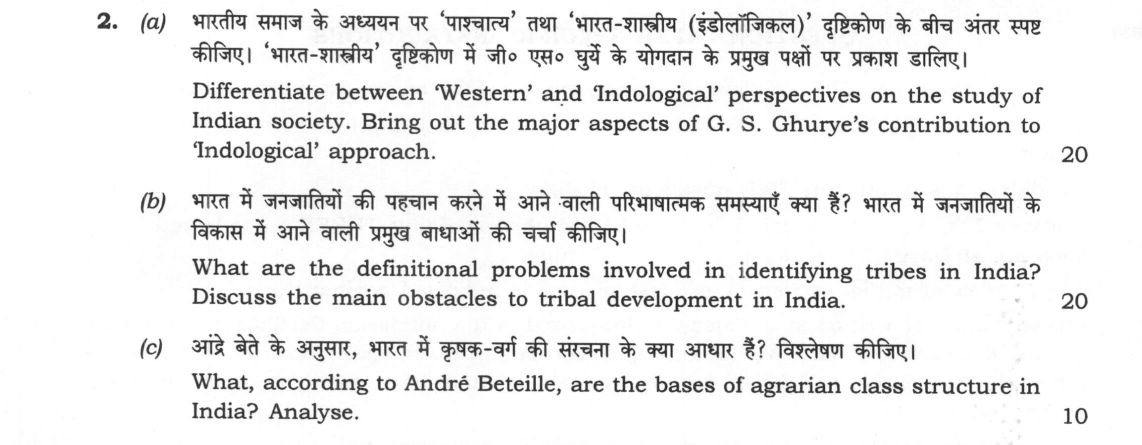
Differentiate between 'Western' and 'Indological' perspectives on the study of Indian society. Bring out the major aspects of G. S. Ghurye's contribution to 'Indological' approach. 20 marks
What are the definitional problems involved in identifying tribes in India? Discuss the main obstacles to tribal development in India. 20 marks
What, according to André Beteille, are the bases of agrarian class structure in India? Analyse. 10 marks
हिंदी में प्रश्न पढ़ें
भारतीय समाज के अध्ययन पर 'पाश्चात्य' तथा 'भारत-शास्त्रीय (इंडोलॉजिकल)' दृष्टिकोण के बीच अंतर स्पष्ट कीजिए। 'भारत-शास्त्रीय' दृष्टिकोण में जी० एस० घुर्ये के योगदान के प्रमुख पक्षों पर प्रकाश डालिए। (20 अंक)
भारत में जनजातियों की पहचान करने में आने वाली परिभाषात्मक समस्याएं क्या हैं? भारत में जनजातियों के विकास में आने वाली प्रमुख बाधाओं की चर्चा कीजिए। (20 अंक)
आंद्रे बेते के अनुसार, भारत में कृषक-वर्ग की संरचना के क्या आधार हैं? विश्लेषण कीजिए। (10 अंक)
Model answer
Written by UPSC Answer Check against this question's marking rubric, to the expected length. UPSC does not publish answers for Mains — this is one way to score well, not an official key.
Perspectives on Indian Society and Ghurye’s Indology
The sociological study of Indian society developed through contrasting epistemologies. The Western perspective, rooted in colonial ethnography (Herbert Risley) and later structural-functionalism (critiqued by M. N. Srinivas for its 'book-view' biases), relied on universalist categories and an Orientalist framework (as conceptualised by Edward Said) that depicted Indian society as static, fragmented, and exotic. In contrast, the Indological perspective—represented by G. S. Ghurye, D. D. Kosambi, and Louis Dumont—utilised classical Sanskrit texts (Vedas, Smritis, Epics) to understand social institutions, emphasizing civilisational continuity, structural wholeness, and a holistic Hindu-centric framework.
G. S. Ghurye pioneered Indology within Indian sociology, infusing it with methodological nationalism. In Caste and Race in India, he combined textual analysis with anthropometry to examine the Indo-Aryan diffusion of caste. In The Aborigines—'So-Called' and Others, Ghurye applied his textual-historical lens to critique Verrier Elwin’s isolationist 'National Park' approach. Ghurye argued that Indian tribes were not distinct aboriginal isolates but 'backward Hindus' historically assimilated into the Hindu social fold through gradual acculturation. Advocating an integrationist stance, he insisted that their socio-economic progress lay in complete integration with mainstream society. However, scholars like S. C. Dube critiqued Ghurye’s Indological approach for privileging normative upper-caste Sanskritic texts over empirical, field-level social realities.
Definitional Problems and Obstacles to Tribal Development
Identifying tribes in India poses acute definitional challenges due to shifting and ambiguous constitutional criteria under Article 342, which rely on subjective traits like primitiveness, geographical isolation, and distinct culture. As André Béteille demonstrated, Indian tribes exist along a fluid 'tribe-caste continuum' rather than in absolute isolation, owing to the historical absorptive capacity of Hindu society. Furthermore, administrative categorisation suffers from contradictions between linguistic and territorial principles, leading to communities being scheduled in one state while excluded in an adjoining one.
Tribal development in independent India faces severe structural obstacles:
- Land Alienation: Systematic dispossession of tribal lands persists despite protective legislations like the Santhal Parganas Tenancy Act.
- Involuntary Displacement: Large infrastructure and irrigation projects, such as the Sardar Sarovar and Polavaram dams, have displaced millions without commensurate rehabilitation.
- Denial of Forest Rights: Despite the Forest Rights Act (FRA), 2006, bureaucratic resistance and procedural bottlenecks obstruct the formalisation of individual and community forest titles.
- Socio-Economic Exploitation: Deep-seated indebtedness to non-tribal moneylenders and middlemen persists, alongside cultural erosion and political marginalisation, despite decentralisation frameworks under PESA, 1996.
André Béteille on Agrarian Class Structure
In Studies in Agrarian Social Structure, André Béteille analysed agrarian hierarchy through empirical, institutional axes rather than purely mechanical Marxist categories. He identified three primary bases of agrarian class:
- Control and Ownership of Land: Béteille distinguished between non-cultivating rentier owners (such as the Bhadralok in Bengal or Mirasdars in Tamil Nadu), cultivating owner-peasants, and landless sharecroppers.
- Relations of Production and Labour: Class position depends on whether production relies on family labour, free contractual wage labour, or unfree/attached labour (tied agricultural workers).
- Caste-Class Overlap and Regional Variations: Comparing Tanjore (Sripuram) with West Bengal, Béteille demonstrated that caste and class do not perfectly coincide. He rejected the orthodox Marxist thesis of a unified, polarising peasantry, emphasizing that internal differentiations and regional diversities shape agrarian relations across India.
Conclusion
While Indology illuminated the civilisational continuities and assimilative processes of Indian society, its textualism obscured grassroots material hierarchies. Bridging this textual heritage with rigorous field-empirical analysis remains essential for resolving contemporary tribal alienation and agrarian class inequities.
What "Differentiate" is asking you to do
Fix the criteria on which the two differ and apply each criterion to both, so the pair can no longer be mixed up. Differentiate stems usually carry a further task attached — describe the mechanism, set out the principles, discuss the applications — and that task carries its own marks.
Structure that answers it
Criterion 1 applied to both → criterion 2 → criterion 3 → summary line or table → the attached second demand answered in full
Where marks are lost
Two standalone definitions placed side by side, leaving the reader to extract the difference. The second common loss is running out of space before the attached task, which is often worth as much as the differentiation.
How this answer will be evaluated
Approach
(a) compare: paired headings or table > key differences > significance > conclusion | (b) discuss: intro > 3-4 dimensions > example > balanced close | (c) analyse: intro > causes > effects > stakeholders/linkages > way forward Full marks: Clear differentiation, specific thinker arguments, Indian data, and balanced analysis.
Key points expected
- Define 'Western' perspective (e.g., colonial, external, structuralist).
- Define 'Indological' perspective (e.g., internal, textual, cultural).
- Contrast the two perspectives clearly.
- Detail G.S. Ghurye's specific contributions to the Indological approach.
- Identify definitional problems (e.g., primitive, isolated, distinct culture).
- Discuss the 5th Schedule and its role in identification.
- List main obstacles to tribal development (e.g., isolation, lack of infrastructure).
- Discuss specific challenges like land alienation or displacement.
Evaluation rubric
Each sub-part is marked on its own, against the marks and word limit printed on the paper.
- (a) Differentiate Western vs Indological perspectives and detail G.S. Ghurye's contribution. 20 marks
compare— paired headings or table → key differences → significance → conclusion
Must cover
- Define 'Western' perspective (e.g., colonial, external, structuralist).
- Define 'Indological' perspective (e.g., internal, textual, cultural).
- Contrast the two perspectives clearly.
- Detail G.S. Ghurye's specific contributions to the Indological approach.
Loses marks
- Confusing 'Indological' with 'Indigenous' or 'Indian' generally.
- Failing to clearly differentiate the two perspectives.
- Vague or generic description of Ghurye's work.
Earns more
- Mention specific Western thinkers (e.g., Weber, Dumont).
- Mention specific Indological thinkers (e.g., Ghurye, Srinivas).
- Use specific examples of Indian society to illustrate the difference.
- Discuss the limitations of both approaches.
Extra mark
- Reference specific Ghurye works (e.g., 'Caste in Modern India').
- (b) Explain definitional problems of tribes and discuss obstacles to tribal development. 20 marks
discuss— intro → 3-4 dimensions → example → balanced close
Must cover
- Identify definitional problems (e.g., primitive, isolated, distinct culture).
- Discuss the 5th Schedule and its role in identification.
- List main obstacles to tribal development (e.g., isolation, lack of infrastructure).
- Discuss specific challenges like land alienation or displacement.
Loses marks
- Treating 'tribes' as a monolithic group.
- Ignoring the legal/constitutional framework (5th Schedule).
- Vague or generic discussion of 'development obstacles'.
Earns more
- Mention specific tribal groups (e.g., Santhal, Gond).
- Reference specific development schemes (e.g., TRIFED, DTP).
- Discuss the impact of modernization on tribal identity.
- Mention specific legal provisions for tribal protection.
Extra mark
- Cite specific statistics on tribal population or development indices.
- (c) Analyse André Beteille's bases of agrarian class structure in India. 10 marks
analyse— intro → causes → effects → stakeholders/linkages → way forward
Must cover
- Identify André Beteille's specific bases (e.g., land ownership, labor).
- Explain how these bases create class structure.
- Analyse the relationship between caste and class in this context.
- Provide an Indian illustration of this structure.
Loses marks
- Confusing Beteille's view with general Marxist class theory.
- Failing to link caste and class as Beteille does.
- Vague or generic discussion of 'agrarian structure'.
Earns more
- Mention specific Beteille works (e.g., 'Caste, Class and the State').
- Discuss the role of the state in agrarian relations.
- Compare Beteille's view with other sociologists (e.g., Srinivas).
- Use specific regional examples (e.g., Tamil Nadu, Kerala).
Extra mark
- Reference specific land reform acts and their impact on class structure.
Practice this exact question
Write your answer and it is marked point by point against the model answer above — what you covered, what you missed, what you got wrong.
Evaluate my answer →More from Sociology 2024 Paper II
- Q1 Answer the following questions in about 150 words each: (a) What, according to you, are t…
- Q2 (a) Differentiate between 'Western' and 'Indological' perspectives on the study of Indian…
- Q3 (a) Why is the study of marriage important in Sociology? Analyse the implications of chan…
- Q4 (a) How do religious communities contribute to the cultural diversity of India? (20 marks…
- Q5 Answer the following questions in about 150 words each: (a) Examine with suitable example…