Paper I — Q1
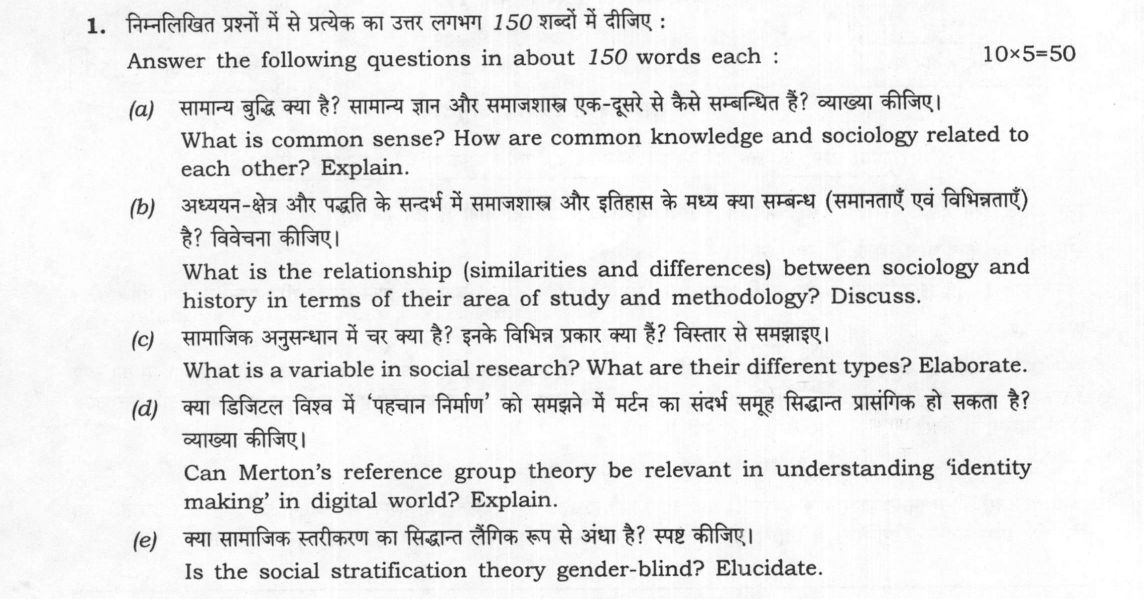
Answer the following questions in about 150 words each: (a) What is common sense? How are common knowledge and sociology related…
Answer the following questions in about 150 words each:
What is common sense? How are common knowledge and sociology related to each other? Explain. 10 marks
What is the relationship (similarities and differences) between sociology and history in terms of their area of study and methodology? Discuss. 10 marks
What is a variable in social research? What are their different types? Elaborate. 10 marks
Can Merton's reference group theory be relevant in understanding 'identity making' in digital world? Explain. 10 marks
Is the social stratification theory gender-blind? Elucidate. 10 marks
हिंदी में प्रश्न पढ़ें
निम्नलिखित प्रश्नों में से प्रत्येक का उत्तर लगभग 150 शब्दों में दीजिए :
सामान्य बुद्धि क्या है? सामान्य ज्ञान और समाजशास्त्र एक-दूसरे से कैसे संबंधित हैं? व्याख्या कीजिए। (10 अंक)
अध्ययन-क्षेत्र और पद्धति के संदर्भ में समाजशास्त्र और इतिहास के मध्य क्या संबंध (समानताएं एवं विभिन्नताएं) है? विवेचना कीजिए। (10 अंक)
सामाजिक अनुसंधान में चर क्या है? इनके विभिन्न प्रकार क्या हैं? विस्तार से समझाइए। (10 अंक)
क्या डिजिटल विश्व में 'पहचान निर्माण' को समझने में मर्टन का संदर्भ समूह सिद्धांत प्रासंगिक हो सकता है? व्याख्या कीजिए। (10 अंक)
क्या सामाजिक स्तरीकरण का सिद्धांत लैंगिक रूप से अंधा है? स्पष्ट कीजिए। (10 अंक)
Model answer
Written by UPSC Answer Check against this question's marking rubric, to the 150-word length. UPSC does not publish answers for Mains — this is one way to score well, not an official key.
(a) Common sense and sociology. Common sense, or common knowledge, is everyday, pre-reflexive knowledge: practical and particular. It helps people navigate immediate situations, but it tends to be anecdotal, untested, and shaped by personal experience, status and local habit. Sociology, by contrast, is a systematic discipline: it formulates concepts, collects evidence, compares cases and tests explanations. C. Wright Mills sharpened this distinction by separating personal troubles, which appear as private misfortunes, from public issues, which arise when many such troubles are linked to social structures. A woman’s unemployment may look like personal failure, but when mass unemployment follows policy change it becomes a public issue requiring structural explanation. Thus common sense supplies raw material, while sociology converts it into general, evidence-based understanding. The causal mechanism is that sociology asks not only what people feel, but why patterns repeat across groups and institutions. This makes social life intelligible rather than merely familiar.
(b) Sociology and history. Sociology and history overlap because both study social phenomena: institutions, power, change and human action in context. Their difference lies in emphasis and method. History is largely idiographic: it reconstructs unique events, periods and personalities, asking what happened and how a particular sequence unfolded. Sociology is largely nomothetic: it seeks general patterns, causal mechanisms and laws or tendencies that recur across cases. E.H. Carr’s remark that history is the sociology of the past captures the link: historical events can be explained by social structures, while sociological generalisations need historical grounding. In Indian studies, for example, the history of land revenue systems explains particular colonial outcomes, while sociology compares agrarian relations across regions to identify class formation. Methodologically, history leans on archival sources, chronology and contextual interpretation; sociology uses surveys, comparative case studies and conceptual models. Together, history supplies specificity, sociology generalisation.
(c) Variables in social research. A variable in social research is a measurable attribute that can take different values across cases. Its variation allows researchers to test relationships. Variables are commonly classified as independent and dependent: the independent variable is the presumed cause or predictor, while the dependent variable is the outcome being explained. In NSS surveys, education may be independent and income dependent. They are also discrete or continuous: discrete variables take countable values, such as number of children, while continuous variables can take infinitely many values within an interval, such as monthly income measured in rupees. Measurement scales further distinguish nominal, ordinal, interval and ratio variables. Caste is nominal because categories have no fixed rank; education level is ordinal because categories are ranked; IQ scores are interval; income is ratio because it has a true zero. Control variables are held constant to rule out confounding; intervening variables mediate, and moderators condition effects. This typology makes causal claims testable.
(d) Merton and digital identity. Merton’s reference group theory is relevant to identity making in the digital world because identity is formed by comparing oneself with groups that supply standards, norms and aspirations. Reference groups are normative, supplying rules, or comparative, supplying benchmarks. They may be membership or non-membership groups; individuals can use their own membership groups as reference groups, while digital platforms make non-membership groups visible. The causal mechanism is upward comparison: social media displays curated lifestyles, so users measure themselves against influencers or aspirational communities. This can produce relative deprivation, where people feel deprived even when their material position improves, because their reference point has shifted upward. This produces identity work: adopting symbols and politics to belong. In India, platforms amplify caste, class and religious markers, enabling self-representation and status performance. Thus Merton’s theory explains how digital visibility turns comparison into identity.
(e) Gender-blindness in stratification. Classical social stratification theory is often gender-blind because it treated class, status and power as if they operated in a gender-neutral public sphere. Marx, Weber, Dahrendorf and Davis-Moore focused on class, status, power and functional rewards, but all assumed a male worker as default. Feminist critiques of Marx and Dahrendorf show that gender organises access to resources, labour and authority. Ann Oakley showed that class is gendered, because women’s class position is mediated by domestic labour, wage dependence and marriage. Kimberlé Crenshaw coined intersectionality, and Patricia Hill Collins developed the matrix of domination and Black feminist thought, showing that race, class and gender operate together. In India, agrarian studies reveal a caste-class-gender nexus: upper-caste men may own land, while Dalit and Adivasi women may be landless labourers facing unpaid care and exclusion. Thus stratification is gendered, and gender-blind theories miss how hierarchy is reproduced.
What "Explain" is asking you to do
Make the working of something clear — what sets it off, what follows from what, and what it produces. Explain is the Commission's mechanism word: it dominates the technical papers and the “explain why” stems, where the marks sit in the causal chain and not in the label.
Structure that answers it
State what it is → the initiating condition → the chain of cause, step by step → an instance where it plays out → what the chain produces
Where marks are lost
Describing what something looks like instead of why it works that way. Naming the stages without linking them reads as description too.
How this answer will be evaluated
Approach
Framework: Sociology Paper 1 (UPSC). (a) explain: definition/context > points in order > small example > short close | (b) discuss: intro > 3-4 dimensions > example > balanced close | (c) explain: definition/context > points in order > small example > short close | (d) explain: definition/context > points in order > small example > short close | (e) explain: definition/context > points in order > small example > short close Full marks: Precise definitions, named thinkers, clear distinctions, Indian examples, no common-sense errors.
Key points expected
- Define common sense as unscientific, subjective knowledge
- Name Durkheim or Weber regarding the sociological method
- Contrast common sense (particular) with sociology (general laws)
- Explain how sociology refines or corrects common sense
- Identify similarity: both study human society and social change
- Distinguish methodology: history (diachronic/past) vs sociology (synchronic/present)
- Note history's focus on unique events vs sociology's general laws
- Mention the 'historical method' vs 'comparative method'
Evaluation rubric
Each sub-part is marked on its own, against the marks and word limit printed on the paper.
- (a) Define common sense and distinguish it from sociological knowledge. · 150 words
explain— definition/context → points in order → small example → short close
Must cover
- Define common sense as unscientific, subjective knowledge
- Name Durkheim or Weber regarding the sociological method
- Contrast common sense (particular) with sociology (general laws)
- Explain how sociology refines or corrects common sense
Loses marks
- Treating common sense as 'wrong' rather than 'unscientific'
- Failing to distinguish 'knowledge' from 'opinion'
Earns more
- Mention 'sociological imagination' (Mills)
- Reference 'common sense' vs 'scientific knowledge' distinction
- Cite Durkheim's 'Suicide' as an example of correcting common sense
Extra mark
- Reference specific Indian context of 'common sense' vs data
- (b) Compare sociology and history in study area and methodology. · 150 words
discuss— intro → 3-4 dimensions → example → balanced close
Must cover
- Identify similarity: both study human society and social change
- Distinguish methodology: history (diachronic/past) vs sociology (synchronic/present)
- Note history's focus on unique events vs sociology's general laws
- Mention the 'historical method' vs 'comparative method'
Loses marks
- Treating history as 'dead' and sociology as 'alive'
- Ignoring the overlap in 'historical sociology'
Earns more
- Reference 'historical sociology' as a bridge
- Mention 'event' vs 'process' distinction
- Cite specific thinkers (e.g., Comte, Marx) on history's role
Extra mark
- Reference specific Indian historical event analyzed sociologically
- (c) Define variables and classify them with examples. · 150 words
explain— definition/context → points in order → small example → short close
Must cover
- Define variable as a measurable attribute with varying values
- Distinguish Independent Variable (IV) from Dependent Variable (DV)
- Define Control Variable (CV) and its role
- Provide a clear example (e.g., Education -> Income)
Loses marks
- Confusing 'variable' with 'constant'
- Failing to provide a concrete example
Earns more
- Mention 'Intervening Variable' or 'Extraneous Variable'
- Distinguish 'Continuous' vs 'Discrete' variables
- Reference 'operationalization' of variables
Extra mark
- Reference specific Indian survey (e.g., NFHS) variable
- (d) Apply Merton's reference group theory to digital identity. · 150 words
explain— definition/context → points in order → small example → short close
Must cover
- Define Merton's 'reference group' (aspirational vs membership)
- Explain 'reference group effect' (upward/downward comparison)
- Link to digital world: social media as reference groups
- Discuss 'identity making' through online peer comparison
Loses marks
- Treating reference groups as only 'membership' groups
- Ignoring the 'aspirational' aspect of digital identity
Earns more
- Mention 'social comparison theory' (Festinger)
- Reference 'digital identity' or 'online self-presentation'
- Cite specific platform (e.g., Instagram, Twitter) as reference group
Extra mark
- Reference specific Indian digital identity debate
- (e) Critique social stratification theory for gender-blindness. · 150 words
explain— definition/context → points in order → small example → short close
Must cover
- Define 'gender-blind' in context of stratification theory
- Identify traditional stratification theories (e.g., Marx, Weber)
- Explain how they focused on class/caste, ignoring gender
- Mention 'feminist critique' of traditional stratification
Loses marks
- Treating 'gender-blind' as 'gender-neutral'
- Failing to name specific traditional theories
Earns more
- Reference 'intersectionality' (Crenshaw)
- Mention 'patriarchy' as a stratification axis
- Cite specific Indian context (e.g., caste-gender intersection)
Extra mark
- Reference specific Indian feminist scholar (e.g., Nivedita Menon)
Practice this exact question
Write your answer and it is marked point by point against the model answer above — what you covered, what you missed, what you got wrong.
Evaluate my answer →More from Sociology 2025 Paper I
- Q1 Answer the following questions in about 150 words each: (a) What is common sense? How are…
- Q2 (a) What is positivism? Critically analyze the major arguments against it. (20 marks) (b)…
- Q3 (a) Compare capability deprivation approach with that of social capital deprivation in un…
- Q4 (a) Give an account of the recent trends of marriage in the Indian context. How are these…