Paper I — Q5
Answer the following questions in about 150 words each: (a) In what way is the scope of sociology unique? Explain. (10…
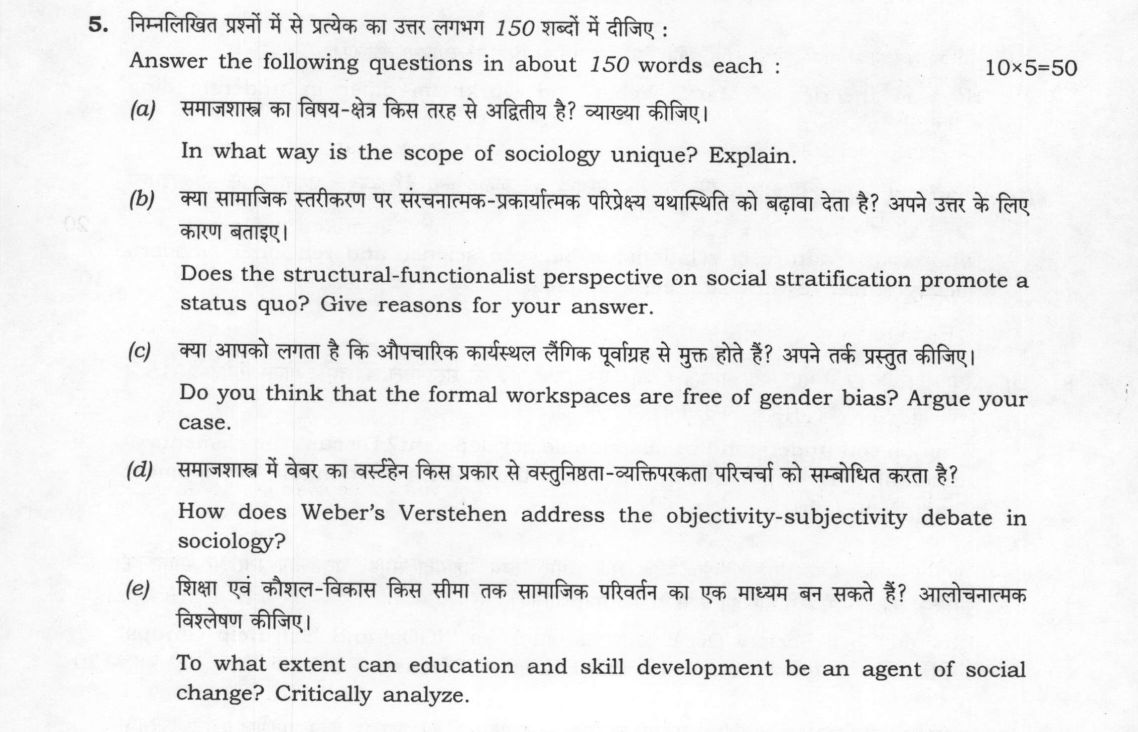
Answer the following questions in about 150 words each:
In what way is the scope of sociology unique? Explain. 10 marks
Does the structural-functionalist perspective on social stratification promote a status quo? Give reasons for your answer. 10 marks
Do you think that the formal workspaces are free of gender bias? Argue your case. 10 marks
How does Weber's Verstehen address the objectivity-subjectivity debate in sociology? 10 marks
To what extent can education and skill development be an agent of social change? Critically analyze. 10 marks
हिंदी में प्रश्न पढ़ें
निम्नलिखित प्रश्नों में से प्रत्येक का उत्तर लगभग 150 शब्दों में दीजिए :
समाजशास्त्र का विषय-क्षेत्र किस तरह से अद्वितीय है? व्याख्या कीजिए। (10 अंक)
क्या सामाजिक स्तरीकरण पर संरचनात्मक-प्रकार्यात्मक परिप्रेक्ष्य यथास्थिति को बढ़ावा देता है? अपने उत्तर के लिए कारण बताइए। (10 अंक)
क्या आपको लगता है कि औपचारिक कार्यस्थल लैंगिक पूर्वाग्रह से मुक्त होते हैं? अपने तर्क प्रस्तुत कीजिए। (10 अंक)
समाजशास्त्र में वेबर का वर्स्टीहेन किस प्रकार से वस्तुनिष्ठता-व्यक्तिपरकता परिचर्चा को सम्बोधित करता है? (10 अंक)
शिक्षा एवं कौशल-विकास किस सीमा तक सामाजिक परिवर्तन का एक माध्यम बन सकते हैं? आलोचनात्मक विश्लेषण कीजिए। (10 अंक)
Model answer
Written by UPSC Answer Check against this question's marking rubric, to the 150-word length. UPSC does not publish answers for Mains — this is one way to score well, not an official key.
(a) Unique Scope of Sociology
Sociology possesses a unique scope because it examines human social life holistically, bridging macro-structures and micro-interactions rather than isolating compartmentalized domains like economics or political science. Émile Durkheim established that social reality consists of "social facts" which are *sui generis*—external to the individual and endowed with coercive power. This causal mechanism dictates that social phenomena cannot be explained through individual psychology or biological reductionism alone. While neoclassical economics reduces action to rational self-interest, sociology demonstrates how collective consciousness, social norms, and institutional structures shape those preferences. By treating society as an emergent, interconnected relational reality, sociology analyzes how institutions such as family, religion, state, and economy dialectically interact. Its scope uniquely transcends disciplinary reductionism, systematically investigating the manifest patterns, latent functions, and unintended structural consequences of collective human action.
(b) Structural-Functionalism and the Status Quo
The structural-functionalist perspective on social stratification inherently promotes a status quo by conceptualizing inequality as an indispensable, universally functional requirement for social equilibrium. Kingsley Davis and Wilbert Moore argue that society must distribute differential rewards—prestige and material wealth—to motivate the most talented individuals to undergo training for functionally critical positions. Talcott Parsons further legitimizes this hierarchy by attributing stratification to a shared value consensus, wherein individuals are evaluated and ranked against common normative standards and pattern variables. Consequently, existing inequalities are framed not as products of historical exploitation, but as rational mechanisms for role allocation and system integration. As conflict theorists like Ralf Dahrendorf and Melvin Tumin argue, by treating the prevailing distribution of power and privilege as optimal, functionalism provides an ideological legitimation for dominant groups, obscuring systemic barriers to mobility and delegitimizing structural change.
(c) Gender Bias in Formal Workspaces
Formal workspaces are not free of gender bias; instead, traditional patriarchal relations are reproduced within rational-legal institutional frameworks. Joan Acker’s theory of "gendered organizations" reveals that the ostensibly neutral "ideal worker" is structurally gendered, assuming an unencumbered male free from unpaid domestic and caregiving responsibilities. Consequently, women face systemic barriers such as the "glass ceiling" and the "sticky floor," which restrict upward mobility and trap them in lower-tier roles. Data from the Periodic Labour Force Survey (PLFS) and the Oxfam India Discrimination Report highlight persistent gender wage disparities and the concentration of women in precarious, lower-paying formal occupations. Furthermore, institutional cultures perpetuate subtle biases through exclusionary male networks, the "motherhood penalty," and uneven enforcement of the POSH Act, 2013. The formal workspace thus reflects a continuum of broader societal patriarchy, functioning as a site of institutionalized gender stratification.
(d) Weber's Verstehen and Objectivity-Subjectivity
Max Weber’s methodological formulation of Verstehen (interpretive understanding) bridges the dualism between naturalistic positivism and radical subjectivism in sociology. Positivism sought universal causal laws through external observation, while idealist historicism rejected generalization in favor of idiosyncratic subjective accounts. Weber synthesized these positions by arguing that sociology must interpret the subjective meanings (Sinn) and motives that actors attach to their actions, while simultaneously providing an objectively valid causal explanation of the course and effects of that action. To maintain scientific rigor, Weber introduced "ideal types" as heuristic, analytical constructs against which empirical reality can be comparatively measured. Furthermore, he resolved the epistemological tension by differentiating between Wertbeziehung (value-relevance), which permits cultural values to guide the selection of research problems, and Wertfreiheit (value-neutrality), which mandates rigorous detachment in data analysis, creating an objective science of subjective social phenomena.
(e) Education and Skill Development as Agents of Social Change
Education and skill development serve as vital instruments for modernization and social mobility, yet their capacity to drive structural change is fundamentally conditioned by existing power dynamics. From a functionalist perspective, education acts as a meritocratic sieve, democratizing opportunity, fostering human capital, and breaking traditional ascribed hierarchies like caste and feudalism. The "Kerala Model" exemplifies how widespread public literacy accelerates demographic transition, health awareness, and marginalized empowerment.
However, a critical conflict perspective reveals that education often acts as an instrument of social reproduction. Samuel Bowles and Herbert Gintis demonstrate through the "correspondence principle" that modern education mirrors the social relations of the capitalist economy, legitimizing inequality through an illusion of merit. In India, despite initiatives like Skill India and the National Education Policy (NEP) 2020, educational capital remains stratified along caste, class, and gender lines, often resulting in credential inflation and educated unemployment. Education alone cannot transform society unless paired with redistributive economic and structural reforms.
What "Explain" is asking you to do
Make the working of something clear — what sets it off, what follows from what, and what it produces. Explain is the Commission's mechanism word: it dominates the technical papers and the “explain why” stems, where the marks sit in the causal chain and not in the label.
Structure that answers it
State what it is → the initiating condition → the chain of cause, step by step → an instance where it plays out → what the chain produces
Where marks are lost
Describing what something looks like instead of why it works that way. Naming the stages without linking them reads as description too.
How this answer will be evaluated
Approach
Framework: Sociology Paper I (UPSC). (a) explain: definition/context > points in order > small example > short close | (b) comment: context > arguments both sides > judgment > close | (c) comment: context > arguments both sides > judgment > close | (d) explain: definition/context > points in order > small example > short close | (e) critique: the claim > its strengths > its weaknesses > your judgment Full marks: Precise definitions, named thinkers, clear arguments, and specific examples for each part.
Key points expected
- Define sociology's specific subject matter (social structure/relations)
- Distinguish scope from psychology (individual) and history (particular)
- Mention the 'social' as the unique unit of analysis
- Reference a founding thinker (Durkheim/Comte) on scope
- Explain the functionalist view (Davis-Moore) of stratification
- Identify the 'status quo' argument (inequality is necessary/functional)
- Contrast with a critical perspective (e.g., Marx/Conflict)
- Provide a clear judgment on the 'status quo' claim
Evaluation rubric
Each sub-part is marked on its own, against the marks and word limit printed on the paper.
- (a) Define the unique scope of sociology and distinguish it from other social sciences. · 150 words
explain— definition/context → points in order → small example → short close
Must cover
- Define sociology's specific subject matter (social structure/relations)
- Distinguish scope from psychology (individual) and history (particular)
- Mention the 'social' as the unique unit of analysis
- Reference a founding thinker (Durkheim/Comte) on scope
Loses marks
- Treating sociology as a general study of society
- Failing to distinguish from other disciplines
- Vague definitions without specific subject matter
Earns more
- Mention the 'social fact' as a unique object
- Contrast with political science (state) or economics (exchange)
- Reference the 'sociological imagination' (Mills)
Extra mark
- Cite a specific definition from a standard textbook (e.g., Giddens)
- (b) Evaluate if structural-functionalism promotes the status quo regarding stratification. · 150 words
comment— context → arguments both sides → judgment → close
Must cover
- Explain the functionalist view (Davis-Moore) of stratification
- Identify the 'status quo' argument (inequality is necessary/functional)
- Contrast with a critical perspective (e.g., Marx/Conflict)
- Provide a clear judgment on the 'status quo' claim
Loses marks
- Describing functionalism without addressing the 'status quo' question
- Failing to contrast with a critical view
- Confusing functionalism with structuralism
Earns more
- Mention the 'meritocratic' assumption of functionalism
- Reference the 'consensus' nature of functionalist theory
- Cite a specific critique (e.g., from a conflict theorist)
Extra mark
- Reference a specific Indian context of stratification (e.g., caste)
- (c) Argue whether formal workspaces are free of gender bias. · 150 words
comment— context → arguments both sides → judgment → close
Must cover
- Define 'formal workspace' and 'gender bias'
- Present arguments for the presence of bias (e.g., wage gap, glass ceiling)
- Present arguments for neutrality (e.g., legal protections, meritocracy)
- Conclude with a reasoned judgment
Loses marks
- Generalizing without specific examples of bias
- Ignoring the 'formal' aspect (focusing only on informal)
- Failing to take a clear position
Earns more
- Mention specific forms of bias (e.g., sexual harassment, promotion bias)
- Reference legal frameworks (e.g., POSH Act in India)
- Use the term 'glass ceiling' or 'glass cliff'
Extra mark
- Cite a specific statistic on gender wage gap
- Reference a specific case study or report
- (d) Explain how Weber's Verstehen addresses the objectivity-subjectivity debate. · 150 words
explain— definition/context → points in order → small example → short close
Must cover
- Define 'Verstehen' (interpretive understanding)
- Explain the objectivity-subjectivity debate in sociology
- Show how Verstehen bridges the gap (understanding subjective meaning)
- Mention Weber's method (ideal types) if relevant
Loses marks
- Defining Verstehen without linking to the debate
- Confusing Verstehen with empathy or sympathy
- Failing to mention Weber by name
Earns more
- Contrast Verstehen with positivism (Comte/Durkheim)
- Mention 'ideal types' as a tool for objectivity
- Reference 'value-freedom' (Wertfreiheit) in Weber's work
Extra mark
- Cite a specific example of Verstehen in action (e.g., studying religion)
- (e) Critically analyze education and skill development as agents of social change. · 150 words
critique— the claim → its strengths → its weaknesses → your judgment
Must cover
- Define education/skill development as agents of change
- Present arguments for their role (e.g., mobility, empowerment)
- Present limitations/critiques (e.g., reproduction of inequality, credentialism)
- Provide a balanced conclusion on their extent
Loses marks
- Only listing benefits without critical analysis
- Ignoring the 'skill development' aspect
- Failing to address the 'extent' of change
Earns more
- Reference Bourdieu's 'cultural capital' or 'reproduction'
- Mention 'human capital' theory
- Reference specific Indian initiatives (e.g., NEP 2020, Skill India)
Extra mark
- Cite a specific statistic on education and income
- Reference a specific policy outcome
Practice this exact question
Write your answer and it is marked point by point against the model answer above — what you covered, what you missed, what you got wrong.
Evaluate my answer →More from Sociology 2025 Paper I
- Q2 (a) What is positivism? Critically analyze the major arguments against it. (20 marks) (b)…
- Q3 (a) Compare capability deprivation approach with that of social capital deprivation in un…
- Q4 (a) Give an account of the recent trends of marriage in the Indian context. How are these…
- Q5 Answer the following questions in about 150 words each: (a) In what way is the scope of s…
- Q6 (a) What is science? Do you think that the methods used in natural sciences can be applie…
- Q7 (a) What is sampling in the context of social research? Discuss different forms of sampli…
- Q8 (a) What do you understand by sustainable development? Discuss the elements of sustainabl…