Paper I — Q3
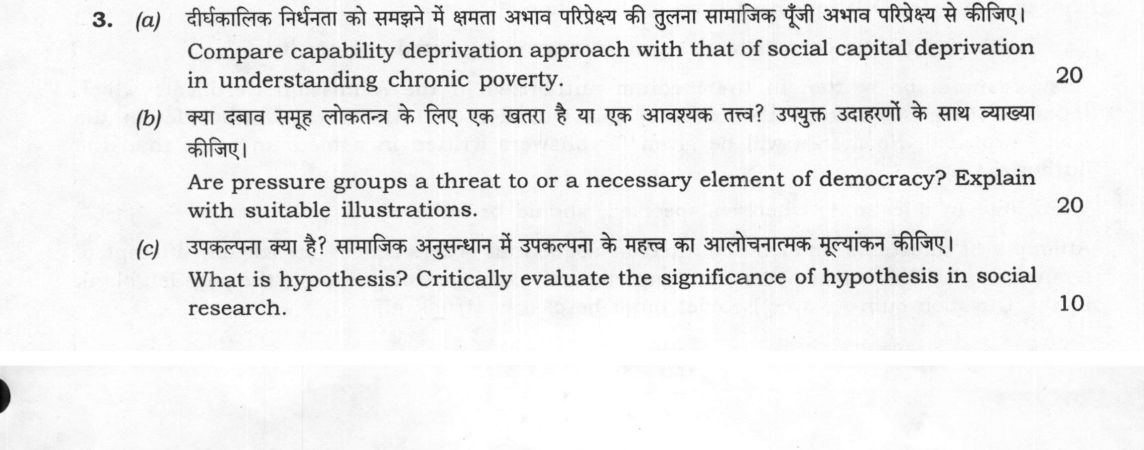
(a) Compare capability deprivation approach with that of social capital deprivation in understanding chronic poverty. (20…
Compare capability deprivation approach with that of social capital deprivation in understanding chronic poverty. 20 marks
Are pressure groups a threat to or a necessary element of democracy? Explain with suitable illustrations. 20 marks
What is hypothesis? Critically evaluate the significance of hypothesis in social research. 10 marks
हिंदी में प्रश्न पढ़ें
दीर्घकालिक निर्धनता को समझने में क्षमता अभाव परिप्रेक्ष्य की तुलना सामाजिक पूंजी अभाव परिप्रेक्ष्य से कीजिए। (20 अंक)
क्या दबाव समूह लोकतंत्र के लिए एक खतरा है या एक आवश्यक तत्व? उपयुक्त उदाहरणों के साथ व्याख्या कीजिए। (20 अंक)
उपकल्पना क्या है? सामाजिक अनुसंधान में उपकल्पना के महत्व का आलोचनात्मक मूल्यांकन कीजिए। (10 अंक)
Model answer
Written by UPSC Answer Check against this question's marking rubric, to the expected length. UPSC does not publish answers for Mains — this is one way to score well, not an official key.
Capability Deprivation versus Social Capital Deprivation in Chronic Poverty
Understanding chronic poverty requires transcending one-dimensional income metrics. Amartya Sen’s Capability Deprivation approach defines poverty as the absence of substantive freedoms to achieve valued "functionings" (beings and doings), governed by personal, social, and environmental conversion factors. In contrast, the Social Capital Deprivation approach (Robert Putnam, James Coleman) conceptualizes chronic poverty as exclusion from reciprocal networks, civic trust, and institutional norms that facilitate resource access and mutual support.
Dimensionally, both approaches view poverty as multidimensional, relational, and enduring. However, while Sen centers on individual agency, freedoms, and the structural barriers hindering conversion of goods into well-being, social capital theorists focus on collective relational ties and community-level deficits.
Pierre Bourdieu’s distinction between economic, cultural, and social capital explains the persistence of intergenerational poverty. Marginalized strata (such as landless laborers and historically disadvantaged castes) suffer from severe social capital deprivation, lacking the bridging networks needed to access institutional credit, quality employment, or legal redress. This relational deficit directly reproduces capability deprivation, entrenching chronic deficits in education, nutrition, and political voice.
Pressure Groups: Threat or Necessary Element of Democracy
Pressure groups occupy a dual location in democratic theory, operating simultaneously as channels of interest articulation and vectors of elite distortion.
As a necessary element, Robert Dahl’s pluralist theory posits that pressure groups safeguard democracy by distributing power among competing interests, ensuring state accountability beyond periodic elections. In India, grassroots groups have deepened substantive democracy. The Samyukt Kisan Morcha (SKM) successfully articulated agrarian grievances against farm legislations, while the Narmada Bachao Andolan (NBA) mobilized displaced tribal populations, compelling the state to integrate rehabilitation entitlements into large-scale developmental planning.
Conversely, pressure groups become a threat when asymmetric economic resources lead to elite capture. Corporate lobbies and industrial conglomerates exercise disproportionate leverage over policy formulation, campaign finance, and regulatory frameworks. This generates a democratic deficit where public welfare is subordinated to private capital, bypassing the egalitarian mandate of representative institutions. Thus, while corporate capture undermines democratic equality, autonomous civil society associations remain essential for pluralist representation.
Nature and Critical Evaluation of Hypotheses in Social Research
A hypothesis is a tentative, testable, and falsifiable proposition specifying an expected relationship between two or more variables. Hypotheses are categorized into null hypotheses (positing no significant relationship) and directional or non-directional alternative hypotheses (predicting the nature of an association).
In deductive sociological research, hypotheses play a pivotal role. Aligning with Karl Popper’s principle of falsification and Robert K. Merton’s middle-range theories, a hypothesis anchors empirical inquiry, prevents arbitrary data collection, operationalizes abstract concepts, and permits systematic causal verification through quantitative techniques.
However, the hypothesis-driven approach faces critical methodological limitations. Inductive and qualitative sociologists, notably Barney Glaser and Anselm Strauss in Grounded Theory, argue that pre-formulated hypotheses impose rigid, ethnocentric, or value-laden categories upon social reality, blinding the researcher to emergent meanings and lived experiences. Furthermore, deductive verification entails risks of confirmation bias, where researchers selectively attend to hypothesis-conforming evidence. Consequently, while indispensable for explanatory and quantitative inquiry, rigid hypothesis testing is frequently suspended in exploratory and phenomenological research.
In conclusion, understanding poverty requires combining capability and social capital metrics, just as sustaining democracy demands balancing pluralist interest groups against elite capture, underpinned by methodologically reflexive social research combining deductive rigor with inductive openness.
What "Compare" is asking you to do
Set the items against each other on named dimensions. In UPSC practice compare already carries both halves — likeness and difference — and where the stem names the dimensions, as in region, nature and climatic impact, those are the headings the examiner expects to see.
Structure that answers it
Dimensions named → both items on dimension 1 → dimension 2 → dimension 3 → where they converge and where they part
Where marks are lost
Two self-contained descriptive blocks with the comparison left for the reader to make. Marks here sit on the dimensions, so an answer that names none of them gives the examiner nothing to award.
How this answer will be evaluated
Approach
Framework: Sociology Paper 1. (a) compare: paired headings or table > key differences > significance > conclusion | (b) comment: context > arguments both sides > judgment > close | (c) critically evaluate: positives > negatives/limits > conditions/safeguards > conclusion Full marks: Precise definitions, named thinkers, strong Indian illustrations, balanced critical analysis.
Key points expected
- Define capability deprivation (Amartya Sen)
- Define social capital deprivation (Putnam/Granovetter)
- Contrast individual vs. relational dimensions
- Link both to chronic poverty mechanisms
- Define pressure groups and their role
- Arguments for necessity (representation, checks)
- Arguments for threat (money, inequality)
- Provide suitable illustrations (Indian/Global)
Evaluation rubric
Each sub-part is marked on its own, against the marks and word limit printed on the paper.
- (a) Contrast capability and social capital approaches to chronic poverty. 20 marks
compare— paired headings or table → key differences → significance → conclusion
Must cover
- Define capability deprivation (Amartya Sen)
- Define social capital deprivation (Putnam/Granovetter)
- Contrast individual vs. relational dimensions
- Link both to chronic poverty mechanisms
Loses marks
- Defining poverty only as income
- Confusing social capital with human capital
- Lack of specific thinker attribution
Earns more
- Mention HDI or FLFPR data
- Reference Indian context (e.g., caste networks)
- Discuss intersection of both deprivations
- Cite specific thinkers (Sen, Bourdieu)
Extra mark
- Reference specific Indian survey data (NFHS)
- Mention specific policy implications
- (b) Assess pressure groups as threat or necessity in democracy. 20 marks
comment— context → arguments both sides → judgment → close
Must cover
- Define pressure groups and their role
- Arguments for necessity (representation, checks)
- Arguments for threat (money, inequality)
- Provide suitable illustrations (Indian/Global)
Loses marks
- Treating pressure groups as only 'bad'
- Ignoring the role of money in politics
- Vague examples without specific names
Earns more
- Mention specific Indian groups (e.g., CII, farmers)
- Reference lobbying vs. corruption
- Discuss 'interest group pluralism'
- Mention specific policy outcomes
Extra mark
- Reference specific Supreme Court judgment
- Cite specific lobbying expenditure data
- (c) Define hypothesis and evaluate its significance in social research. 10 marks
critically evaluate— positives → negatives/limits → conditions/safeguards → conclusion
Must cover
- Define hypothesis (testable proposition)
- Significance: guides research design
- Significance: enables falsification (Popper)
- Limitations: bias or rigidity
Loses marks
- Confusing hypothesis with theory
- Ignoring the 'testable' aspect
- No critical evaluation (only positive)
Earns more
- Distinguish null vs. alternative hypothesis
- Mention operationalization
- Reference specific research method (survey/experiment)
- Discuss 'theory testing' role
Extra mark
- Reference specific sociological study
- Mention specific statistical test
Practice this exact question
Write your answer and it is marked point by point against the model answer above — what you covered, what you missed, what you got wrong.
Evaluate my answer →More from Sociology 2025 Paper I
- Q1 Answer the following questions in about 150 words each: (a) What is common sense? How are…
- Q2 (a) What is positivism? Critically analyze the major arguments against it. (20 marks) (b)…
- Q3 (a) Compare capability deprivation approach with that of social capital deprivation in un…
- Q4 (a) Give an account of the recent trends of marriage in the Indian context. How are these…
- Q5 Answer the following questions in about 150 words each: (a) In what way is the scope of s…
- Q6 (a) What is science? Do you think that the methods used in natural sciences can be applie…