Paper I — Q2
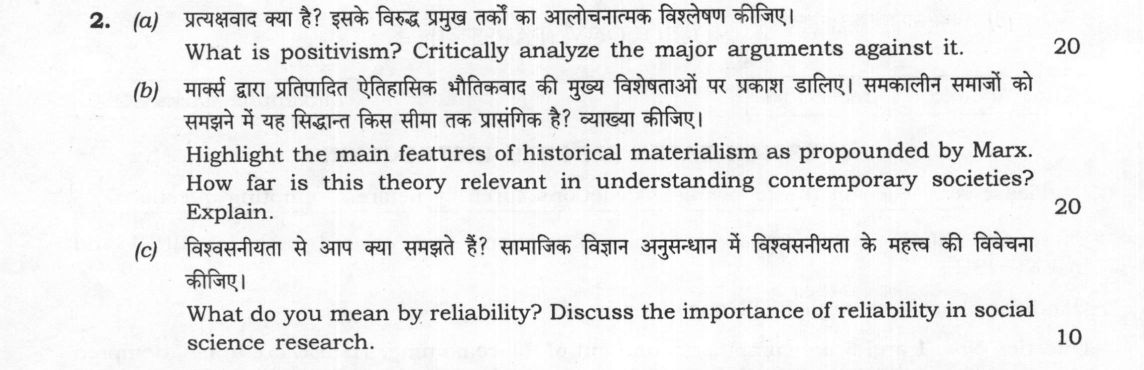
(a) What is positivism? Critically analyze the major arguments against it. (20 marks) (b) Highlight the main features of…
What is positivism? Critically analyze the major arguments against it. 20 marks
Highlight the main features of historical materialism as propounded by Marx. How far is this theory relevant in understanding contemporary societies? Explain. 20 marks
What do you mean by reliability? Discuss the importance of reliability in social science research. 10 marks
हिंदी में प्रश्न पढ़ें
प्रत्यक्षवाद क्या है? इसके विरुद्ध प्रमुख तर्कों का आलोचनात्मक विश्लेषण कीजिए। (20 अंक)
मार्क्स द्वारा प्रतिपादित ऐतिहासिक भौतिकवाद की मुख्य विशेषताओं पर प्रकाश डालिए। समकालीन समाजों को समझने में यह सिद्धांत किस सीमा तक प्रासंगिक है? व्याख्या कीजिए। (20 अंक)
विश्वसनीयता से आप क्या समझते हैं? सामाजिक विज्ञान अनुसंधान में विश्वसनीयता के महत्व की विवेचना कीजिए। (10 अंक)
Model answer
Written by UPSC Answer Check against this question's marking rubric, to the expected length. UPSC does not publish answers for Mains — this is one way to score well, not an official key.
Methodological and theoretical debates in sociology reflect competing approaches to understanding social reality, balancing empirical rigor, historical development, and measurement dependability.
Positivism and Its Critiques
Positivism, formulated by Auguste Comte through his law of three stages, asserts that society can be studied using the methods of the natural sciences. It relies on direct observation, comparison, and systematic classification to uncover invariant social laws.
However, positivism faces profound critiques across sociological traditions. Max Weber rejected its mechanistic determinism, arguing that human action is infused with subjective meaning requiring interpretive understanding (verstehen). Alfred Schutz’s phenomenology demonstrated that social reality is pre-interpreted by actors through intersubjective typifications, making external observation alone inadequate. Critical theorists of the Frankfurt School, such as Adorno and Horkheimer, attacked positivism as "instrumental reason" that uncritically reifies existing power relations into objective social facts. In the philosophy of science, Thomas Kuhn argued that scientific progress operates through historically contingent paradigms rather than cumulative, value-neutral observation.
In India, while positivist approaches dominate large-scale data collection in National Sample Survey (NSS) rounds, sociologists like André Béteille have cautioned that quantitative aggregation oversimplifies the qualitative, lived realities of caste and social stratification. Critically, while positivism provides essential macro-structural patterns, treating human agency as passive data renders it epistemologically incomplete without interpretive depth.
Historical Materialism and Contemporary Relevance
Karl Marx’s historical materialism explains historical change through the development of material production. Its foundational premise is that the economic base—comprising the forces of production (technology, labor power, raw materials) and the relations of production (class relations and property ownership)—conditions the legal, political, and ideological superstructure. Class struggle, emerging from contradictions between developing forces of production and stagnant relations of production, functions as the motor of history.
This framework remains deeply relevant in understanding contemporary societies. In modern digital capitalism, artificial intelligence, automated platforms, and data infrastructure constitute new productive forces, while the gig economy creates hyper-exploitative, precarious relations of production. Furthermore, the global climate crisis demonstrates the fundamental Marxist contradiction between the expanding forces of capital accumulation and the ecological limits of the planet. Nonetheless, historical materialism faces limitations. As B.R. Ambedkar pointed out regarding India, economic reductionism cannot adequately explain the resilience of caste, which acts as an autonomous hierarchy and a division of laborers rather than a mere reflection of class.
Reliability in Social Science Research
Reliability denotes the consistency, stability, and dependability of a research instrument across repeated applications under identical conditions. It is measured through specific dimensions: test-retest reliability (stability over time), parallel-forms reliability (consistency across equivalent instruments), inter-rater reliability (consistency across different observers), and internal consistency (often assessed using Cronbach’s alpha).
In Indian social research, establishing reliability is critical yet methodologically challenging. Severe linguistic and regional diversity threatens the semantic equivalence of standardized survey tools. Furthermore, the social positionality—particularly the caste, gender, and class—of field investigators frequently induces response bias, affecting inter-rater reliability. These measurement challenges are evident in persistent comparability gaps between data generated by the National Sample Survey Office (NSSO) and the National Council of Applied Economic Research (NCAER) regarding household income and consumption expenditure.
Conclusion
These domains demonstrate how epistemological choices govern research methodology. Positivism pursues standardized reliability, interpretivism seeks contextual validity, and Marxian historical materialism validates knowledge through praxis and structural transformation. A robust sociology requires transcending methodological insularity by combining rigorous empirical reliability with interpretive sensitivity and critical structural analysis.
What "Critically analyse" is asking you to do
Break the subject into its working parts and show how they act on each other. The marks are in the interconnections — which factor drives which, and what the resulting structure explains — not in the inventory of factors. “Critically” is not a section added at the end: name the yardstick you are judging by — the evidence, the stated objective, a constitutional principle, a rival explanation — and let a verdict close each part of the body. Where the question quotes a claim, that verdict must land on the claim itself, accepted, qualified or rejected, and not on the theme in general.
Structure that answers it
Define the whole → separate it into its parts → show which part drives which → what that interaction produces → what the structure implies
Where marks are lost
Merits in one paragraph, demerits in the next, and a conclusion calling for a balanced and holistic approach. That is a survey with the judgement left out and it holds the answer in the middle band. The opposite error is reading “critically” as permission to attack — and with the odd pairings, critically describe or critically explain, the exposition still carries most of the marks, the judgement being a layer on it rather than a substitute for it.
How this answer will be evaluated
Approach
Framework: Sociology Paper 1 (Methodology & Theory). (a) critique: the claim > its strengths > its weaknesses > your judgment | (b) highlight: name the salient points > one line of substance each > close | (c) discuss: intro > 3-4 dimensions > example > balanced close Full marks: Precise definitions, named thinkers, critical analysis, Indian data, balanced judgment
Key points expected
- Define positivism (Comte/Durkheim) as science-based social study
- Identify major arguments against positivism (e.g., Weber, interpretivism)
- Critically analyze the validity of these counter-arguments
- Provide a balanced judgment on the scope of positivism
- Highlight main features of historical materialism (base/superstructure, class struggle)
- Explain how this theory applies to understanding contemporary societies
- Provide specific examples of contemporary relevance
- Evaluate the limits or changes in the theory's applicability
Evaluation rubric
Each sub-part is marked on its own, against the marks and word limit printed on the paper.
- (a) Define positivism and critically analyze major arguments against it. 20 marks
critique— the claim → its strengths → its weaknesses → your judgment
Must cover
- Define positivism (Comte/Durkheim) as science-based social study
- Identify major arguments against positivism (e.g., Weber, interpretivism)
- Critically analyze the validity of these counter-arguments
- Provide a balanced judgment on the scope of positivism
Loses marks
- Name-dropping thinkers without explaining their arguments
- Common-sense opinion without theoretical grounding
- Failing to critically analyze (only listing arguments)
Earns more
- Mention specific thinkers (Comte, Durkheim, Weber, Popper)
- Contrast positivism with interpretivism or critical theory
- Use concepts as tools (e.g., value-freedom, objectivity)
- Reference Indian sociological context or data
Extra mark
- Cite a specific statistic or contemporary debate
- Reference a specific Indian sociologist's critique
- (b) Highlight main features of historical materialism and explain its relevance to contemporary societies. 20 marks
highlight— name the salient points → one line of substance each → close
Must cover
- Highlight main features of historical materialism (base/superstructure, class struggle)
- Explain how this theory applies to understanding contemporary societies
- Provide specific examples of contemporary relevance
- Evaluate the limits or changes in the theory's applicability
Loses marks
- Describing features without linking to contemporary relevance
- Name-dropping Marx without explaining the mechanism
- Ignoring the 'how far' aspect (relevance evaluation)
Earns more
- Name Marx and key concepts (mode of production, dialectics)
- Contrast with other sociological perspectives
- Use Indian data or contemporary examples (e.g., caste, capitalism)
- Discuss the evolution of the theory (e.g., Gramsci, Althusser)
Extra mark
- Cite a specific statistic (e.g., FLFPR, NFHS) to illustrate class dynamics
- Reference a current debate on economic inequality
- (c) Define reliability and discuss its importance in social science research. 10 marks
discuss— intro → 3-4 dimensions → example → balanced close
Must cover
- Define reliability (consistency of measurement)
- Discuss the importance of reliability in social science research
- Provide examples of how reliability is ensured (e.g., test-retest)
- Explain the consequences of low reliability in research
Loses marks
- Confusing reliability with validity
- General discussion without specific research context
- Failing to explain the 'importance' (consequences)
Earns more
- Distinguish reliability from validity
- Mention specific methods (Cronbach's alpha, inter-rater reliability)
- Use social science examples (e.g., survey consistency)
- Link to research design and data quality
Extra mark
- Cite a specific study or statistic on reliability
- Reference a specific research methodology text
Practice this exact question
Write your answer and it is marked point by point against the model answer above — what you covered, what you missed, what you got wrong.
Evaluate my answer →More from Sociology 2025 Paper I
- Q1 Answer the following questions in about 150 words each: (a) What is common sense? How are…
- Q2 (a) What is positivism? Critically analyze the major arguments against it. (20 marks) (b)…
- Q3 (a) Compare capability deprivation approach with that of social capital deprivation in un…
- Q4 (a) Give an account of the recent trends of marriage in the Indian context. How are these…
- Q5 Answer the following questions in about 150 words each: (a) In what way is the scope of s…