Paper I — Q6
(a) What is science? Do you think that the methods used in natural sciences can be applied to sociology? Give reasons for your…
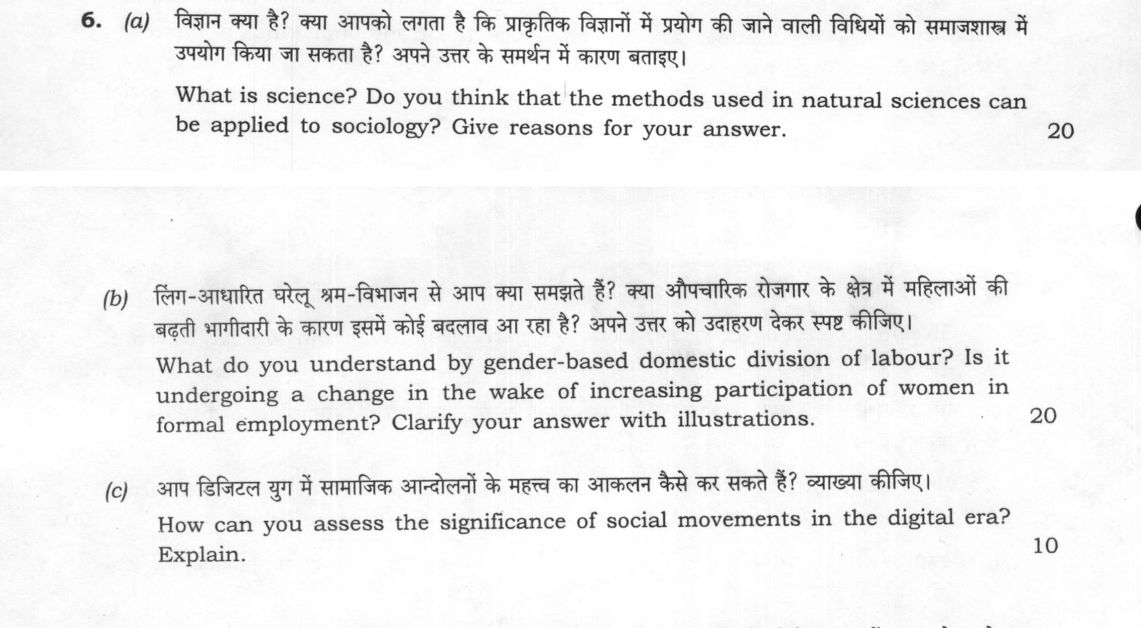
What is science? Do you think that the methods used in natural sciences can be applied to sociology? Give reasons for your answer. 20 marks
What do you understand by gender-based domestic division of labour? Is it undergoing a change in the wake of increasing participation of women in formal employment? Clarify your answer with illustrations. 20 marks
How can you assess the significance of social movements in the digital era? Explain. 10 marks
हिंदी में प्रश्न पढ़ें
विज्ञान क्या है? क्या आपको लगता है कि प्राकृतिक विज्ञानों में प्रयोग की जाने वाली विधियों को समाजशास्त्र में उपयोग किया जा सकता है? अपने उत्तर के समर्थन में कारण बताइए। (20 अंक)
लिंग-आधारित घरेलू श्रम-विभाजन से आप क्या समझते हैं? क्या औपचारिक रोजगार के क्षेत्र में महिलाओं की बढ़ती भागीदारी के कारण इसमें कोई बदलाव आ रहा है? अपने उत्तर को उदाहरण देकर स्पष्ट कीजिए। (20 अंक)
आप डिजिटल युग में सामाजिक आंदोलनों के महत्व का आकलन कैसे कर सकते हैं? व्याख्या कीजिए। (10 अंक)
Model answer
Written by UPSC Answer Check against this question's marking rubric, to the expected length. UPSC does not publish answers for Mains — this is one way to score well, not an official key.
Sociology operates at the intersection of rigorous empirical inquiry, structural dynamics of social reproduction, and the evolving spaces of collective action.
Scientific Method and its Application to Sociology
Science is a systematic enterprise that builds and organizes knowledge in the form of testable, empirical, and falsifiable explanations about the world. Early classical theorists championed a positivist paradigm: Auguste Comte argued for a "social physics," while Émile Durkheim treated social facts as "things" governed by discoverable causal laws (Erklären), applying quantitative methods analogous to the natural sciences.
However, natural science methods cannot be applied wholesale to sociology due to ontological differences between the natural and social worlds. Humans possess consciousness, agency, and reflexivity; their actions are guided by subjective meanings. Max Weber demonstrated that sociology requires Verstehen (interpretative understanding) of subjective motives rather than purely external causal mechanics. Furthermore, Peter Winch and Hans-Georg Gadamer argued that social life is linguistically mediated and rule-governed, rendering the deterministic models of natural sciences inadequate. Additionally, complete value-neutrality is elusive because researchers are embedded within the social structures they study, and human subjects react to being observed (Hawthorne effect). Consequently, while natural science techniques like statistical modelling and comparative methods enrich sociological investigation, they must be combined with qualitative, reflexive, and interpretative approaches.
Gender-Based Domestic Division of Labour and Formal Employment
Gender-based domestic division of labour refers to the normative, asymmetrical allocation of unpaid care work, house chores, and emotional labour based on socially constructed gender roles. Functionalists like Talcott Parsons rationalised this as a complementary separation between male "instrumental" and female "expressive" roles. In contrast, Marxist-feminist theorists conceptualise domestic work as unremunerated "reproductive labour" essential for the maintenance and reproduction of the capitalist labour force.
While the entry of women into formal employment has disrupted the exclusive male breadwinner model, it has not substantially dismantled the domestic division of labour. Instead, it has produced what Arlie Hochschild terms the "second shift," wherein women bear the dual burden of paid professional work and primary domestic responsibility.
In India, empirical evidence underscores this structural inertia. The NSSO Time Use Survey (2019) revealed that Indian women spend an average of 299 minutes daily on unpaid domestic services compared to just 97 minutes by men. In urban IT-sector dual-earner households, women continue to shoulder the unseen "mental load" of household management and childcare, even when outsourcing physical tasks to lower-caste, working-class domestic workers. Similarly, female workers in the gig economy—such as platform-based salon workers or drivers—face severe "time poverty" as their flexible schedules are subordinated to domestic care duties. Thus, formal employment increases women's economic autonomy but fails to transform patriarchal domestic arrangements in the absence of cultural realignment and institutional childcare support.
Social Movements in the Digital Era
Manuel Castells conceptualises contemporary social mobilisations through the framework of the "network society," where digital platforms enable decentralised, horizontal, and rapid communication. Lance Bennett and Alexandra Segerberg term this dynamic "connective action," characterized by personalized content-sharing rather than rigid organizational affiliation.
Digital platforms democratize access to the public sphere, as demonstrated by #MeTooIndia in challenging structural sexual harassment, and the 2020–21 Farmers' Protest, where digital channels (such as Kisan Ekta Morcha) bypassed legacy media gatekeepers to construct counter-narratives and mobilize transnational solidarity.
However, the efficacy of digital social movements remains dialectical. Critics note the emergence of "slacktivism" or "clicktivism," where online engagement does not translate into sustained ground mobilisations or institutional reforms. Furthermore, algorithmic censorship, platform monopolies, state-led surveillance, and structural digital divides across gender, caste, and class restrict equitable participation.
Sociology must therefore retain methodological pluralism to navigate complex human subjectivities, recognize that structural inequalities like domestic labour resist purely economic solutions, and assess digital mobilisations by interrogating both their communicative power and infrastructural constraints.
What "Explain" is asking you to do
Make the working of something clear — what sets it off, what follows from what, and what it produces. Explain is the Commission's mechanism word: it dominates the technical papers and the “explain why” stems, where the marks sit in the causal chain and not in the label.
Structure that answers it
State what it is → the initiating condition → the chain of cause, step by step → an instance where it plays out → what the chain produces
Where marks are lost
Describing what something looks like instead of why it works that way. Naming the stages without linking them reads as description too.
How this answer will be evaluated
Approach
Framework: Sociology Paper 1 (General). (a) discuss: intro > 3-4 dimensions > example > balanced close | (b) examine: intro > how/why with reasoning > evidence > conclusion | (c) explain: definition/context > points in order > small example > short close Full marks: Precise definitions, named thinkers (Comte, Durkheim, Hochschild), and specific Indian data (NFHS).
Key points expected
- Define science (empirical, systematic, objective).
- Name Comte's Positivism (sociology as physics).
- Name Durkheim's 'Social Facts' (objective reality).
- Contrast with Weber's 'Verstehen' (interpretive method).
- Define 'Gender-based domestic division of labour'.
- Reference 'Second Shift' (Arlie Hochschild).
- Cite NFHS data on women's time use.
- Discuss 'Double Burden' of working women.
Evaluation rubric
Each sub-part is marked on its own, against the marks and word limit printed on the paper.
- (a) Define science and evaluate the applicability of natural science methods to sociology. 20 marks
discuss— intro → 3-4 dimensions → example → balanced close
Must cover
- Define science (empirical, systematic, objective).
- Name Comte's Positivism (sociology as physics).
- Name Durkheim's 'Social Facts' (objective reality).
- Contrast with Weber's 'Verstehen' (interpretive method).
Loses marks
- Treating sociology as purely subjective art.
- Ignoring the Positivist-Interpretive debate.
Earns more
- Mention limitations: human agency, value-freedom.
- Reference 'Sociology as a Science' debate.
- Mention 'Quantitative' vs 'Qualitative' methods.
Extra mark
- Reference to 'Scientific Sociology' (Comte).
- (b) Define gender-based domestic division of labour and assess changes due to women's formal employment. 20 marks
examine— intro → how/why with reasoning → evidence → conclusion
Must cover
- Define 'Gender-based domestic division of labour'.
- Reference 'Second Shift' (Arlie Hochschild).
- Cite NFHS data on women's time use.
- Discuss 'Double Burden' of working women.
Loses marks
- Ignoring the 'Second Shift' concept.
- Assuming employment automatically ends domestic inequality.
Earns more
- Mention 'Mental Load' or 'Cognitive Labour'.
- Reference 'Pink Collar' vs 'Blue Collar' work.
- Discuss 'Outsourcing' of domestic work (maids).
Extra mark
- Specific NFHS-5 statistic on time spent on chores.
- (c) Assess the significance of social movements in the digital era. 10 marks
explain— definition/context → points in order → small example → short close
Must cover
- Define 'Digital Activism' or 'Cyber Activism'.
- Mention 'Slacktivism' (low cost, low commitment).
- Reference 'Hashtag Activism' (e.g., #MeToo).
- Discuss 'Echo Chambers' or 'Filter Bubbles'.
Loses marks
- Ignoring the downsides (misinformation, polarization).
Earns more
- Mention 'Viral' nature of movements.
- Reference 'Global' reach of local issues.
Extra mark
- Specific example of a successful digital movement.
Practice this exact question
Write your answer and it is marked point by point against the model answer above — what you covered, what you missed, what you got wrong.
Evaluate my answer →More from Sociology 2025 Paper I
- Q3 (a) Compare capability deprivation approach with that of social capital deprivation in un…
- Q4 (a) Give an account of the recent trends of marriage in the Indian context. How are these…
- Q5 Answer the following questions in about 150 words each: (a) In what way is the scope of s…
- Q6 (a) What is science? Do you think that the methods used in natural sciences can be applie…
- Q7 (a) What is sampling in the context of social research? Discuss different forms of sampli…
- Q8 (a) What do you understand by sustainable development? Discuss the elements of sustainabl…