Paper I — Q7
(a) What is sampling in the context of social research? Discuss different forms of sampling with their relative advantages and…
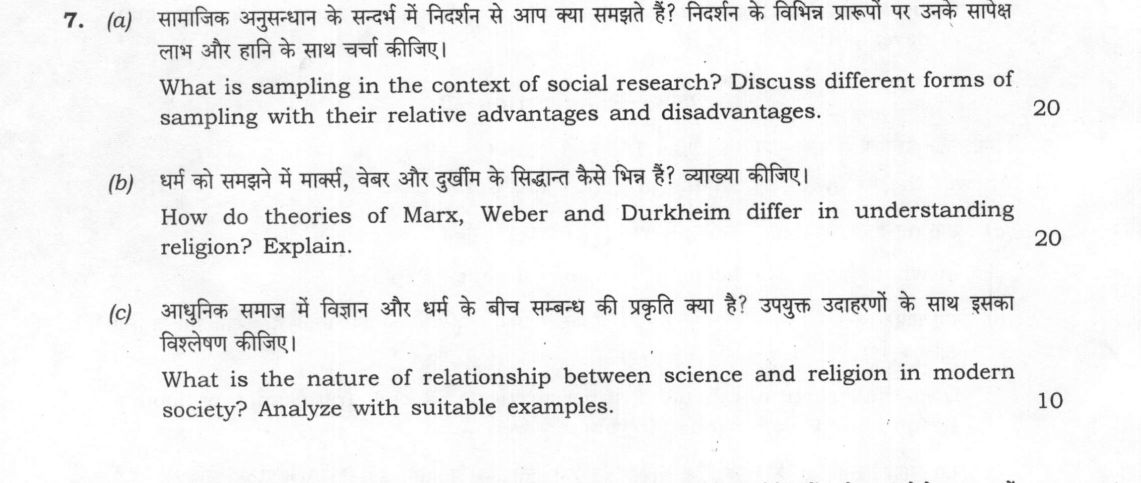
What is sampling in the context of social research? Discuss different forms of sampling with their relative advantages and disadvantages. 20 marks
How do theories of Marx, Weber and Durkheim differ in understanding religion? Explain. 20 marks
What is the nature of relationship between science and religion in modern society? Analyze with suitable examples. 10 marks
हिंदी में प्रश्न पढ़ें
सामाजिक अनुसंधान के संदर्भ में निदर्शन से आप क्या समझते हैं? निदर्शन के विभिन्न प्रारूपों पर उनके सापेक्ष लाभ और हानि के साथ चर्चा कीजिए। (20 अंक)
धर्म को समझने में मार्क्स, वेबर और दुर्खीम के सिद्धांत कैसे भिन्न हैं? व्याख्या कीजिए। (20 अंक)
आधुनिक समाज में विज्ञान और धर्म के बीच संबंध की प्रकृति क्या है? उपयुक्त उदाहरणों के साथ इसका विश्लेषण कीजिए। (10 अंक)
Model answer
Written by UPSC Answer Check against this question's marking rubric, to the expected length. UPSC does not publish answers for Mains — this is one way to score well, not an official key.
Methodological rigor and theoretical pluralism form the bedrock of sociological inquiry, enabling researchers to systematically decipher complex phenomena like religion and secularization.
Sampling in Social Research
Sampling is the systematic procedure of selecting a representative subset of units from a defined population to make valid inferences about the whole. Sampling techniques bifurcate into probability and non-probability designs, presenting distinct trade-offs between error control and empirical accessibility.
Probability sampling techniques—such as Simple Random Sampling (SRS), Stratified Sampling, and Cluster Sampling—give every unit a known, non-zero chance of selection. Their primary advantage lies in minimizing researcher bias, calculating sampling error, and enabling statistical generalizability. For example, large-scale Indian surveys like the National Family Health Survey (NFHS) deploy multi-stage stratified cluster sampling to secure nationally representative demographic data. However, their reliance on exhaustive sampling frames makes them expensive and operationally rigid in complex field settings.
Non-probability sampling methods—including Purposive, Quota, and Snowball sampling—rely on subjective criteria rather than random selection. While they lack statistical generalizability and risk high investigator bias, they are indispensable for exploratory research and hard-to-reach populations. Field studies, such as the National Council of Applied Economic Research (NCAER) village studies and research into sensitive religious behaviors, syncretic cults, or communal trauma, depend heavily on purposive and snowball sampling where formal sampling frames do not exist.
Classical Perspectives on Religion: Marx, Weber, and Durkheim
The classical sociological tradition reveals distinct epistemological stances toward the origin, nature, and function of religion.
Karl Marx adopted a historical materialist approach, viewing religion as an ideological superstructure rooted in economic alienation. To Marx, religion is the "opium of the people," a form of false consciousness that mystifies class exploitation and offers illusory solace to the oppressed, thereby sanctifying the status quo.
Max Weber utilized an interpretivist, Verstehen framework to analyze how subjective religious meanings drive socio-economic action. In The Protestant Ethic and the Spirit of Capitalism, Weber demonstrated an "elective affinity" between ascetic Calvinist theology—specifically doctrines of predestination and calling—and the rational pursuit of economic gain. Rather than reducing religion to an economic reflex, Weber treated religious worldviews as autonomous catalysts of historical transformation.
Émile Durkheim advanced a structural-functionalist perspective in The Elementary Forms of Religious Life, defining religion around the universal dichotomy between the sacred and the profane. Durkheim argued that religious rites worship society itself; collective rituals renew the "collective conscience" and reinforce social solidarity, ensuring the moral integration of the community.
Epistemologically, Marx viewed religion through conflict and structural domination, Weber through actor-centric meaning and socio-historical transformation, and Durkheim through consensus, moral order, and social integration.
Science and Religion in Modern Society
The relationship between science and religion oscillates between the conflict thesis and Stephen Jay Gould’s framework of Non-Overlapping Magisteria (NOMA), where science governs empirical facts and religion addresses moral value.
In India, this interface is institutionally negotiated rather than polarized. Rationalist interventions, from Periyar’s Self-Respect Movement to contemporary anti-superstition campaigns, directly challenge dogma. Concurrently, Indian public institutions illustrate coexistence: Indian Space Research Organisation (ISRO) scientists seeking blessings at Tirupati before rocket launches demonstrate cognitive compartmentalization. Similarly, policy debates surrounding the clinical validation of the Ayush system alongside allopathy, or state-funded claims regarding "cow science," reflect an ongoing negotiation between modern scientific epistemology and traditional belief systems.
As Jürgen Habermas and Charles Taylor observe in their analyses of the post-secular turn, scientific modernity does not extinguish religion. Instead, religious discourse adapts, requiring translation into the language of public reason. Methodological choices govern how these dynamics are captured, while theoretical pluralism reveals that the boundary between science and the sacred remains dynamic, context-bound, and socially negotiated.
What "Discuss" is asking you to do
Lay the issue out from more than one side — how it arose, what is claimed for it, what is held against it, and where it now stands. UPSC attaches discuss to broad topics with several live dimensions, so coverage of the dimensions earns more than the strength of your opinion.
Structure that answers it
Set the issue up → the case as it is made → the case against → the dimension both sides leave out → where the balance now lies
Where marks are lost
Listing facts with no thread between them, or arguing one side throughout and calling it a discussion.
How this answer will be evaluated
Approach
Framework: Sociology Paper I (UPSC). (a) discuss: intro > 3-4 dimensions > example > balanced close | (b) explain: definition/context > points in order > small example > short close | (c) analyse: intro > causes > effects > stakeholders/linkages > way forward Full marks: Comprehensive, well-structured, with clear distinctions and specific examples.
Key points expected
- Define sampling in the context of social research
- Distinguish between probability and non-probability sampling
- Discuss at least 3-4 specific forms (e.g., random, stratified, quota)
- Provide relative advantages and disadvantages for each form
- Explain Marx's view of religion as 'opium of the people'
- Explain Weber's view of religion as a driver of social change
- Explain Durkheim's view of religion as a social institution
- Clearly differentiate the three perspectives
Evaluation rubric
Each sub-part is marked on its own, against the marks and word limit printed on the paper.
- (a) Define sampling and evaluate different forms with their relative merits and demerits. 20 marks
discuss— intro → 3-4 dimensions → example → balanced close
Must cover
- Define sampling in the context of social research
- Distinguish between probability and non-probability sampling
- Discuss at least 3-4 specific forms (e.g., random, stratified, quota)
- Provide relative advantages and disadvantages for each form
Loses marks
- Listing forms without discussing their specific advantages/disadvantages
- Confusing sampling with data collection methods (interviews)
Earns more
- Mention specific sampling errors (e.g., selection bias)
- Reference to Census of India or NFHS as context
- Clear distinction between census and sample survey
Extra mark
- Reference to specific sampling technique used in a major study
- Mention of 'cluster sampling' with a specific example
- (b) Explain the distinct theoretical perspectives of Marx, Weber, and Durkheim on religion. 20 marks
explain— definition/context → points in order → small example → short close
Must cover
- Explain Marx's view of religion as 'opium of the people'
- Explain Weber's view of religion as a driver of social change
- Explain Durkheim's view of religion as a social institution
- Clearly differentiate the three perspectives
Loses marks
- Merging the three thinkers' views without clear distinction
- Focusing only on one thinker and ignoring the others
Earns more
- Mention 'The Protestant Ethic and the Spirit of Capitalism'
- Reference to 'The Elementary Forms of Religious Life'
- Use of terms like 'social solidarity' or 'false consciousness'
Extra mark
- Application of these theories to a specific Indian religious context
- Mention of 'sacred' and 'profane' in Durkheim's theory
- (c) Analyze the nature of the relationship between science and religion in modern society. 10 marks
analyse— intro → causes → effects → stakeholders/linkages → way forward
Must cover
- Define the relationship (conflict, harmony, or independent)
- Provide at least one suitable example of conflict or harmony
- Analyze the impact of modernity on this relationship
- Conclude with a balanced view
Loses marks
- Presenting only one side (conflict or harmony) without analysis
- Lack of specific examples to support the analysis
Earns more
- Mention of 'secularization' as a concept
- Reference to specific debates (e.g., evolution vs. creationism)
- Discussion of 'science and religion are not in conflict' (Stephen Jay Gould)
Extra mark
- Reference to a specific Indian context (e.g., science vs. superstition)
- Mention of 'New Atheism' movement
Practice this exact question
Write your answer and it is marked point by point against the model answer above — what you covered, what you missed, what you got wrong.
Evaluate my answer →More from Sociology 2025 Paper I
- Q4 (a) Give an account of the recent trends of marriage in the Indian context. How are these…
- Q5 Answer the following questions in about 150 words each: (a) In what way is the scope of s…
- Q6 (a) What is science? Do you think that the methods used in natural sciences can be applie…
- Q7 (a) What is sampling in the context of social research? Discuss different forms of sampli…
- Q8 (a) What do you understand by sustainable development? Discuss the elements of sustainabl…