Paper I — Q8
(a) What do you understand by sustainable development? Discuss the elements of sustainable development as proposed in the UNDP's…
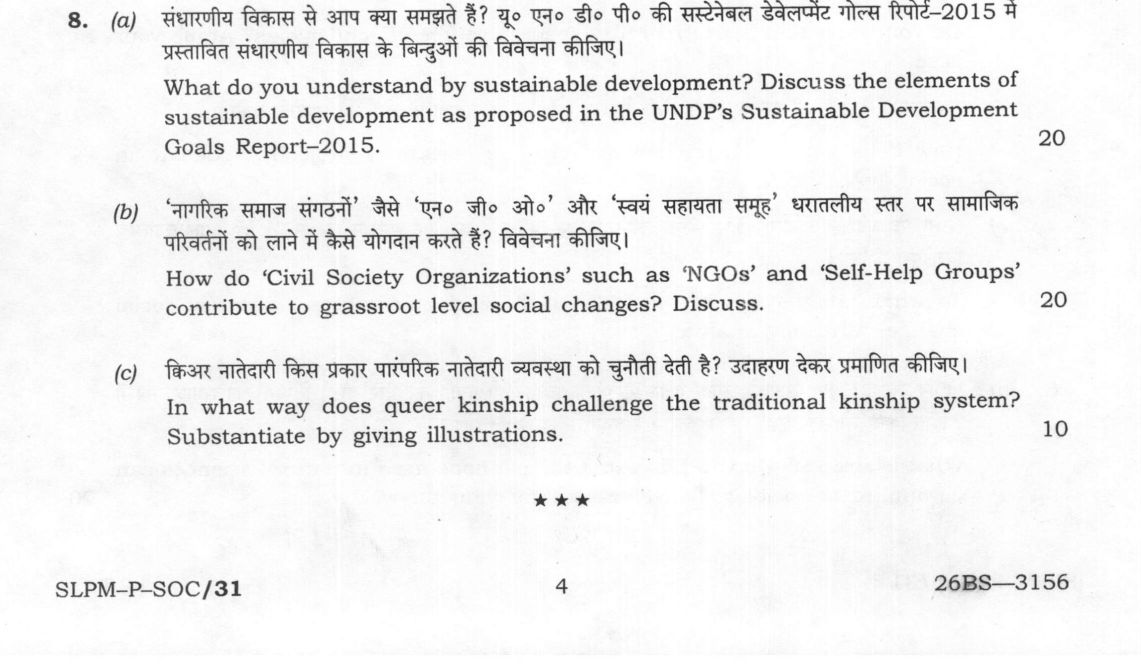
What do you understand by sustainable development? Discuss the elements of sustainable development as proposed in the UNDP's Sustainable Development Goals Report-2015. 20 marks
How do 'Civil Society Organizations' such as 'NGOs' and 'Self-Help Groups' contribute to grassroot level social changes? Discuss. 20 marks
In what way does queer kinship challenge the traditional kinship system? Substantiate by giving illustrations. 10 marks
हिंदी में प्रश्न पढ़ें
संधारणीय विकास से आप क्या समझते हैं? यू. एन. डी. पी. की सस्टेनेबल डेवलपमेंट गोल्स रिपोर्ट-2015 में प्रस्तावित संधारणीय विकास के बिंदुओं की विवेचना कीजिए। (20 अंक)
'नागरिक समाज संगठनों' जैसे 'एन. जी. ओ.' और 'स्वयं सहायता समूह' भारतीय स्तर पर सामाजिक परिवर्तनों को लाने में कैसे योगदान करते हैं? विवेचना कीजिए। (20 अंक)
क्वियर नातेदारी किस प्रकार पारंपरिक नातेदारी व्यवस्था को चुनौती देती है? उदाहरण देकर प्रमाणित कीजिए। (10 अंक)
Model answer
Written by UPSC Answer Check against this question's marking rubric, to the expected length. UPSC does not publish answers for Mains — this is one way to score well, not an official key.
Contemporary sociology views social change as a multidimensional process encompassing ecological sustainability, grassroots civil society mobilization, and the restructuring of intimate social institutions like kinship.
Sustainable Development and the 2015 SDG Framework
The World Commission on Environment and Development (Brundtland Report, 1987) defined sustainable development as meeting the needs of the present without compromising the ability of future generations to meet their own needs. The UNDP’s Sustainable Development Goals (SDG) Report 2015 institutionalized this through 17 goals anchored in the "5Ps": People, Planet, Prosperity, Peace, and Partnership.
In India, critical goals include SDG 1 (No Poverty), SDG 5 (Gender Equality), and SDG 13 (Climate Action). These reflect the socio-ecological imperatives of balancing rapid industrialization with rural livelihoods and ecological resilience. However, sociologists critique the SDG framework for its top-down universalism, which often assumes uniform developmental trajectories across disparate post-colonial contexts, ignoring local socio-cultural hierarchies. Nationally, NITI Aayog’s SDG India Index monitors localized performance, revealing persistent regional disparities in achieving these interconnected targets.
Civil Society Organizations and Grassroots Transformation
Civil society acts as an arena of counter-hegemonic contestation (Gramsci), a catalyst for bridging social capital (Putnam), and a democratic public sphere (Habermas). While Non-Governmental Organizations (NGOs) generally operate as formal, intermediate advocacy and service-delivery structures, Self-Help Groups (SHGs) function as informal, peer-based micro-collectives.
NGOs drive grassroots change via rights-based mobilization and policy influence. The Mazdoor Kisan Shakti Sangathan (MKSS) pioneered transparency struggles leading to the Right to Information Act, while the Narmada Bachao Andolan challenged state-centric displacement paradigms. Concurrently, SHGs—exemplified by Kudumbashree in Kerala and the Self Employed Women's Association (SEWA)—foster bottom-up economic empowerment, micro-credit access, and grassroots political participation under the National Rural Livelihoods Mission (NRLM).
Nonetheless, CSOs face structural limitations, including elite capture within rural hierarchies, donor dependency that depoliticizes grassroots agendas, and co-optation by the state. Despite these constraints, BRAC-inspired livelihood models and women-led SHGs demonstrate significant capacity to disrupt patriarchal and caste-based power relations at the local level.
Queer Kinship and the Critique of Traditional Systems
Classical kinship theories (Radcliffe-Brown, Meyer Fortes) conceptualized kinship through descent, marriage, and consanguinity, premised on universal heteronormativity and biological reproduction. Queer kinship deconstructs these normative assumptions by establishing "chosen families" based on emotional solidarity, mutual care, and affinity rather than genetic or legal ties.
This reconfiguration challenges traditional descent rules, alliance structures, and household units. For instance, traditional Hijra gharanas in South Asia have long operated as institutionalized non-biological kinship networks with distinct lineage, guru-chela hierarchies, and mutual economic support systems. In urban contexts, LGBTQ+ individuals form substitute domestic networks that replace alienating village-based joint families. Furthermore, contemporary debates surrounding non-biological parenting, adoption, surrogacy, and legal recognition of same-sex partnerships—catalyzed post-*Navtej Singh Johar* (2018) and subsequent marriage equality petitions—fundamentally destabilize the patriarchal, heterosexual family as the sole legitimate unit of social reproduction.
Together, the pursuit of sustainable development, democratic deepening via civil society, and the pluralization of kinship reflect a broader structural transformation. Addressing systemic exclusions requires aligning global developmental paradigms with grassroots agency and legally accommodating diverse, non-traditional social institutions.
What "Discuss" is asking you to do
Lay the issue out from more than one side — how it arose, what is claimed for it, what is held against it, and where it now stands. UPSC attaches discuss to broad topics with several live dimensions, so coverage of the dimensions earns more than the strength of your opinion.
Structure that answers it
Set the issue up → the case as it is made → the case against → the dimension both sides leave out → where the balance now lies
Where marks are lost
Listing facts with no thread between them, or arguing one side throughout and calling it a discussion.
How this answer will be evaluated
Approach
Framework: Sociology Paper 1 (SLPM-P-SOC/31). (a) discuss: intro > 3-4 dimensions > example > balanced close | (b) discuss: intro > 3-4 dimensions > example > balanced close | (c) explain: definition/context > points in order > small example > short close Full marks: Precise definitions, clear distinction between parts, strong Indian examples, and critical analysis of the 'challenge' or 'contribution'.
Key points expected
- Define sustainable development (e.g., Brundtland Report definition)
- Identify the 17 SDGs or their thematic clusters
- Discuss the '5 Ps' (People, Planet, Prosperity, Peace, Partnership)
- Link the 2015 report to the 2030 Agenda
- Define the role of NGOs in advocacy and service delivery
- Explain SHGs as a mechanism for women's economic empowerment
- Discuss the concept of 'social capital' or 'collective action'
- Provide an Indian example (e.g., SEWA, Self-Help Group Bank Linkage)
Evaluation rubric
Each sub-part is marked on its own, against the marks and word limit printed on the paper.
- (a) Define sustainable development and analyze the elements of the UNDP's 2015 SDG report. 20 marks
discuss— intro → 3-4 dimensions → example → balanced close
Must cover
- Define sustainable development (e.g., Brundtland Report definition)
- Identify the 17 SDGs or their thematic clusters
- Discuss the '5 Ps' (People, Planet, Prosperity, Peace, Partnership)
- Link the 2015 report to the 2030 Agenda
Loses marks
- Treating SDGs as a list without discussing their elements
- Confusing the 2015 report with the 2000 MDGs
- Ignoring the 'sustainable' aspect in favor of general development
Earns more
- Mention the shift from MDGs to SDGs
- Reference the 'Leave No One Behind' principle
- Discuss the integration of economic, social, and environmental pillars
Extra mark
- Cite specific SDG targets (e.g., SDG 1, 5, 13)
- Reference the UNDP Human Development Index (HDI) context
- (b) Analyze the role of NGOs and SHGs in driving grassroots social change. 20 marks
discuss— intro → 3-4 dimensions → example → balanced close
Must cover
- Define the role of NGOs in advocacy and service delivery
- Explain SHGs as a mechanism for women's economic empowerment
- Discuss the concept of 'social capital' or 'collective action'
- Provide an Indian example (e.g., SEWA, Self-Help Group Bank Linkage)
Loses marks
- Focusing only on economic benefits, ignoring social change
- Treating NGOs and SHGs as identical without distinction
- Lack of specific Indian context or examples
Earns more
- Mention the 'bottom-up' approach of social change
- Discuss the role of NGOs in filling state service gaps
- Reference the 'empowerment' of marginalized groups
Extra mark
- Cite specific data on SHG membership (e.g., NABARD data)
- Mention a specific NGO like CRY or PRADAN
- (c) Explain how queer kinship challenges traditional kinship systems with illustrations. 10 marks
explain— definition/context → points in order → small example → short close
Must cover
- Define 'queer kinship' (chosen family, non-biological ties)
- Contrast with 'traditional kinship' (biological, heteronormative)
- Provide an illustration (e.g., same-sex couples, trans families)
- Discuss the challenge to 'reproductive' or 'lineal' structures
Loses marks
- Defining queer kinship only as 'adoption'
- Ignoring the 'challenge' aspect and only describing the system
- Lack of specific illustrations or examples
Earns more
- Mention the concept of 'chosen family' or 'fictive kinship'
- Reference the 'decolonizing' of kinship structures
- Discuss the legal/social recognition of queer families
Extra mark
- Cite a specific legal case or social movement (e.g., Naz Foundation)
- Reference a specific sociological theory on kinship (e.g., Schneider)
Practice this exact question
Write your answer and it is marked point by point against the model answer above — what you covered, what you missed, what you got wrong.
Evaluate my answer →More from Sociology 2025 Paper I
- Q5 Answer the following questions in about 150 words each: (a) In what way is the scope of s…
- Q6 (a) What is science? Do you think that the methods used in natural sciences can be applie…
- Q7 (a) What is sampling in the context of social research? Discuss different forms of sampli…
- Q8 (a) What do you understand by sustainable development? Discuss the elements of sustainabl…