Paper I — Q4
(a) Give an account of the recent trends of marriage in the Indian context. How are these different from traditional practices?…
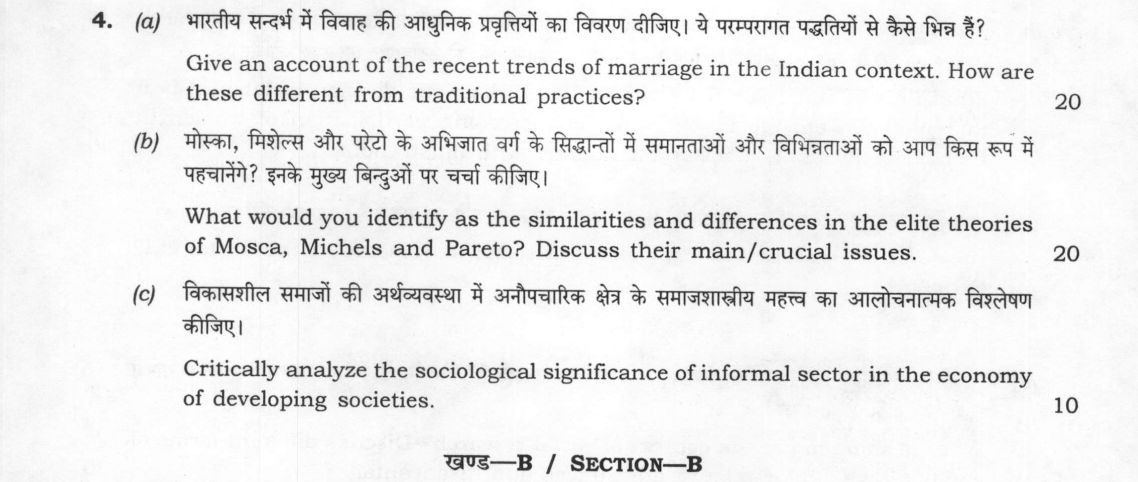
Give an account of the recent trends of marriage in the Indian context. How are these different from traditional practices? 20 marks
What would you identify as the similarities and differences in the elite theories of Mosca, Michels and Pareto? Discuss their main/crucial issues. 20 marks
Critically analyze the sociological significance of informal sector in the economy of developing societies. 10 marks
हिंदी में प्रश्न पढ़ें
भारतीय संदर्भ में विवाह की आधुनिक प्रवृत्तियों का विवरण दीजिए। ये परम्परागत पद्धतियों से कैसे भिन्न हैं? (20 अंक)
मोस्का, मिशेल्स और पेरेटो के अभिजात वर्ग के सिद्धांतों में समानताओं और विभिन्नताओं को आप किस रूप में पहचानेंगे? इनके मुख्य बिन्दुओं पर चर्चा कीजिए। (20 अंक)
विकासशील समाजों की अर्थव्यवस्था में अनौपचारिक क्षेत्र के समाजशास्त्रीय महत्व का आलोचनात्मक विश्लेषण कीजिए। (10 अंक)
Model answer
Written by UPSC Answer Check against this question's marking rubric, to the expected length. UPSC does not publish answers for Mains — this is one way to score well, not an official key.
Recent Trends in Indian Marriage and Traditional Contrasts
Marriage in India is experiencing structural shifts under the twin pressures of modernization, legal reform, and individualization. Recent trends reflect delayed age at marriage—corroborated by NFHS-5 data showing median female marriage age rising past 19 years—alongside an increase in inter-caste and inter-religious alliances. Judicial recognition of live-in relationships and debates on marriage equality in Supriyo v. Union of India signal evolving normative boundaries. Concurrently, digital platforms like Shaadi.com and BharatMatrimony reposition individual agency alongside parental consent, while declining fertility and skewed sex ratios have generated localized marriage squeezes.
These patterns contrast sharply with traditional practices anchored in strict caste endogamy, child marriage, and kin-directed alliances aimed at lineage reproduction. Traditionally, dowry functioned as an asymmetric wealth transfer, contrasting with bride-price systems prevalent in several indigenous communities. Furthermore, as Pauline Kolenda demonstrated, regional variations historically divided the North—characterized by village exogamy, patrilocal residence, and hypergamy—from the South, which favored isogamous cross-cousin alliances. While tribal societies traditionally institutionalized egalitarian, consensual unions, contemporary urban-rural divergence shows modern contractual trends coexisting with persistent caste-based endogamous reproduction.
Elite Theories: Mosca, Michels, and Pareto
Pareto, Mosca, and Michels converge on the elite inevitability thesis, arguing that all complex societies are inherently ruled by an organized minority, thereby rejecting classical democratic egalitarianism. However, their explanatory mechanisms differ substantially. Vilfredo Pareto provides a psychological and cyclical framework, asserting that the circulation of elites occurs through alternating distributions of non-logical residues—cunning speculative 'Foxes' (Class I residues) replaced by coercive, traditionalist 'Lions' (Class II residues).
Gaetano Mosca attributes elite rule to organizational and sociological superiority; the 'organized minority' rules the disorganized majority by creating ideological legitimacy through a 'political formula'. Robert Michels locates elite dominance within administrative necessity, formulating the 'Iron Law of Oligarchy' to argue that large-scale organization inevitably creates bureaucratic specialization, centralizing power within a self-serving leadership.
Crucial issues raised by these thinkers center on the democratic deficit, bureaucratic conservatism, and the structural elite-mass gap. In contemporary India, these formulations explain the persistence of dynastic political leadership, bureaucratic entrenchment, and the corporate-political nexus that resists redistributive pressures despite universal adult franchise.
Sociological Significance of the Informal Sector
First conceptualized by Keith Hart and formalized by the ILO, the informal sector in developing economies constitutes a structural reality rather than a transitional phase. Sociologically, it serves as a vital survival strategy and shock absorber for labor displaced from agrarian distress, reflecting the structural dualism modeled by Harris-Todaro. However, it imposes high costs on labor through economic precarity, absence of social security, and uncompensated social reproduction. The sector exhibits severe gendered informalization, where women are over-represented in low-end, home-based production, organized collectively by bodies like the Self Employed Women’s Association (SEWA).
Critically, the sector is analyzed through contrasting paradigms. Hernando de Soto adopts a legalist view, conceptualizing informal workers as dynamic micro-entrepreneurs trapped by bureaucratic bottlenecks and extralegal property rights. Conversely, Marxist sociology conceptualizes it as a functional 'reserve army of labor' subsidizing formal capitalism through cheap commodities and flexible subcontracting. In post-Fordist globalized economies, informalization has penetrated the formal core, creating what Guy Standing terms the 'precariat'—a class characterized by chronic insecurity, alienation, and lack of occupational identity.
Way Forward
Addressing these interconnected social transformations requires state policy to accommodate evolving familial arrangements, institutionalize internal party democracy to counter oligarchic capture, and extend universal social protection to mitigate precarity across the informal economy.
What "Discuss" is asking you to do
Lay the issue out from more than one side — how it arose, what is claimed for it, what is held against it, and where it now stands. UPSC attaches discuss to broad topics with several live dimensions, so coverage of the dimensions earns more than the strength of your opinion.
Structure that answers it
Set the issue up → the case as it is made → the case against → the dimension both sides leave out → where the balance now lies
Where marks are lost
Listing facts with no thread between them, or arguing one side throughout and calling it a discussion.
How this answer will be evaluated
Approach
Framework: UPSC Sociology Paper 1. (a) account for: state the phenomenon > the causes in order of weight > conclusion | (b) compare: paired headings or table > key differences > significance > conclusion | (c) critique: the claim > its strengths > its weaknesses > your judgment Full marks: Precise definitions, clear distinctions between thinkers, and specific Indian data/examples.
Key points expected
- Define 'recent trends' (e.g., rise in love marriage, delayed marriage).
- Identify causes: urbanization, education, and media influence.
- Contrast with traditional practices (arranged, caste-based, early age).
- Provide Indian illustration (e.g., urban vs. rural divide).
- Identify similarities: 'Iron Law of Oligarchy' or elite dominance.
- Differentiate Mosca (ruling class) from Michels (party bureaucracy).
- Differentiate Pareto (circulation of elites) from the other two.
- Discuss the 'crucial issue' of elite reproduction or control.
Evaluation rubric
Each sub-part is marked on its own, against the marks and word limit printed on the paper.
- (a) State the phenomenon of recent marriage trends and list causes in order of weight. 20 marks
account for— state the phenomenon → the causes in order of weight → conclusion
Must cover
- Define 'recent trends' (e.g., rise in love marriage, delayed marriage).
- Identify causes: urbanization, education, and media influence.
- Contrast with traditional practices (arranged, caste-based, early age).
- Provide Indian illustration (e.g., urban vs. rural divide).
Loses marks
- Generalizing trends without distinguishing urban/rural contexts.
- Focusing only on 'love vs. arranged' without structural causes.
Earns more
- Mention 'marriage market' or 'companionate marriage' concepts.
- Reference specific regional variations (e.g., South vs. North).
Extra mark
- Cite NFHS-5 data on median age at marriage.
- Reference a specific Supreme Court judgment on marriage.
- (b) Paired comparison of Mosca, Michels, and Pareto with key differences and significance. 20 marks
compare— paired headings or table → key differences → significance → conclusion
Must cover
- Identify similarities: 'Iron Law of Oligarchy' or elite dominance.
- Differentiate Mosca (ruling class) from Michels (party bureaucracy).
- Differentiate Pareto (circulation of elites) from the other two.
- Discuss the 'crucial issue' of elite reproduction or control.
Loses marks
- Name-dropping thinkers without explaining their specific arguments.
- Treating the three theories as identical without nuance.
Earns more
- Use a table or paired headings for clarity.
- Mention 'Pareto's circulation of elites' specifically.
Extra mark
- Reference specific works (e.g., Michels' 'Political Parties').
- Link to a modern Indian political party structure.
- (c) Analyze the claim of informal sector significance: strengths, weaknesses, and judgment. 10 marks
critique— the claim → its strengths → its weaknesses → your judgment
Must cover
- Define 'informal sector' in the context of developing economies.
- Analyze strengths: employment generation, survival strategy.
- Analyze weaknesses: lack of social security, low productivity.
- Provide a judgment on its role in the economy.
Loses marks
- Treating the informal sector as purely negative or purely positive.
- Ignoring the 'sociological significance' (social relations, class).
Earns more
- Mention 'dual economy' or 'structural unemployment' concepts.
- Reference specific Indian informal sectors (e.g., street vendors).
Extra mark
- Cite a specific statistic on informal employment share.
- Reference the 'National Commission for Enterprises in the Unorganised Sector'.
Practice this exact question
Write your answer and it is marked point by point against the model answer above — what you covered, what you missed, what you got wrong.
Evaluate my answer →More from Sociology 2025 Paper I
- Q1 Answer the following questions in about 150 words each: (a) What is common sense? How are…
- Q2 (a) What is positivism? Critically analyze the major arguments against it. (20 marks) (b)…
- Q3 (a) Compare capability deprivation approach with that of social capital deprivation in un…
- Q4 (a) Give an account of the recent trends of marriage in the Indian context. How are these…
- Q5 Answer the following questions in about 150 words each: (a) In what way is the scope of s…
- Q6 (a) What is science? Do you think that the methods used in natural sciences can be applie…
- Q7 (a) What is sampling in the context of social research? Discuss different forms of sampli…