Paper II — Q1
Answer the following questions in about 150 words each: (a) 'Textual perspective is important in understanding of Indian Social…
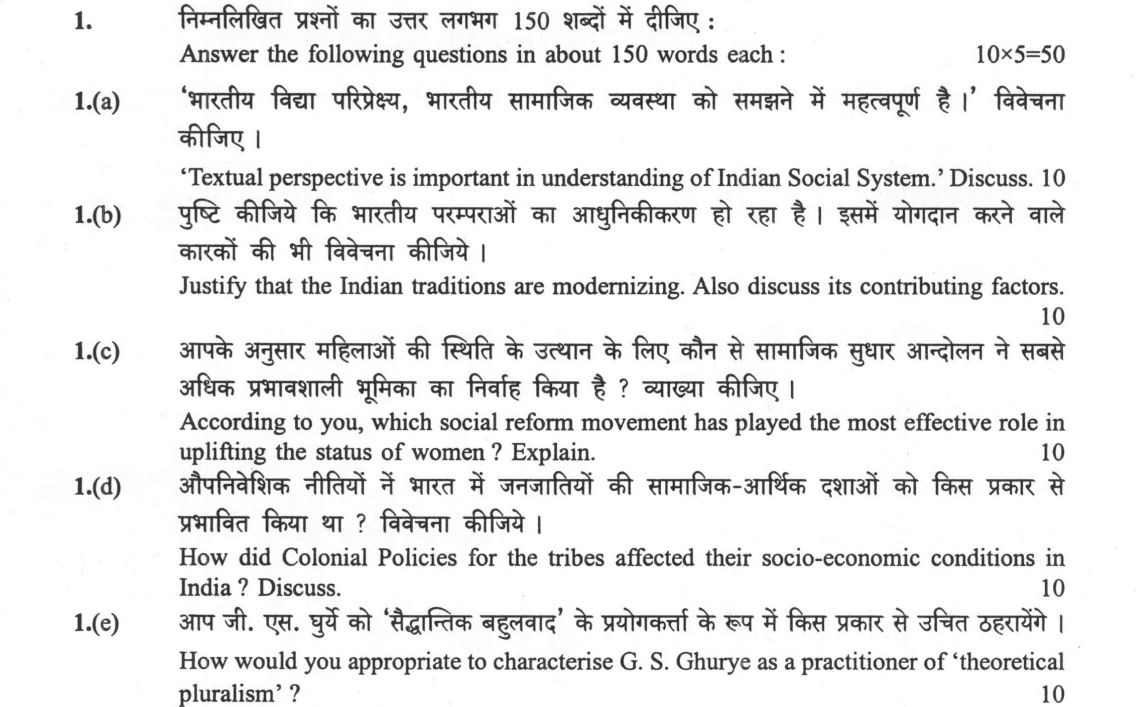
Answer the following questions in about 150 words each:
'Textual perspective is important in understanding of Indian Social System.' Discuss. 10 marks
Justify that the Indian traditions are modernizing. Also discuss its contributing factors. 10 marks
According to you, which social reform movement has played the most effective role in uplifting the status of women? Explain. 10 marks
How did Colonial Policies for the tribes affected their socio-economic conditions in India? Discuss. 10 marks
How would you appropriate to characterise G. S. Ghurye as a practitioner of 'theoretical pluralism'? 10 marks
हिंदी में प्रश्न पढ़ें
निम्नलिखित प्रश्नों का उत्तर लगभग 150 शब्दों में दीजिए :
'भारतीय विद्या परिप्रेक्ष्य, भारतीय सामाजिक व्यवस्था को समझने में महत्वपूर्ण है।' विवेचना कीजिए । (10 अंक)
पुष्टि कीजिये कि भारतीय परम्पराओं का आधुनिकीकरण हो रहा है । इसमें योगदान करने वाले कारकों की भी विवेचना कीजिये । (10 अंक)
आपके अनुसार महिलाओं की स्थिति के उत्थान के लिए कौन से सामाजिक सुधार आंदोलन ने सबसे अधिक प्रभावशाली भूमिका का निर्वाह किया है ? व्याख्या कीजिए । (10 अंक)
औपनिवेशिक नीतियों ने भारत में जनजातियों की सामाजिक-आर्थिक दशाओं को किस प्रकार से प्रभावित किया था ? विवेचना कीजिए । (10 अंक)
आप जी. एस. घुर्ये को 'सैद्धान्तिक बहुलवाद' के प्रयोगकर्ता के रूप में किस प्रकार से उचित ठहरायेंगे । (10 अंक)
Model answer
Written by UPSC Answer Check against this question's marking rubric, to the 150-word length. UPSC does not publish answers for Mains — this is one way to score well, not an official key.
(a) Textual perspective in understanding Indian Social System
The textual or Indological perspective uses classical scriptures, epics, and legal treatises like the Manusmriti and Vedas to construct the 'book-view' of Indian society. Louis Dumont in Homo Hierarchicus heavily utilized textual models to argue that the ideological charter of purity and pollution forms the civilizational core of caste hierarchy. Proponents highlight that texts preserve enduring cultural values, moral frameworks of dharma, karma, and the traditional Varna order across centuries.
However, this perspective risks treating Indian society as static and pan-Indian, over-representing upper-caste, Sanskritic, and patriarchal worldviews. M.N. Srinivas critiqued this approach by demonstrating the divergence between the book-view and the empirical 'field-view'. Srinivas’s field studies revealed that real social relations operate through dynamic, contested local hierarchies, dominant castes, and secular power, rather than rigid textual prescriptions. Thus, while the textual approach clarifies the normative ideal, it must be integrated with empirical fieldwork to comprehend lived practice.
(b) Modernizing Indian traditions and contributing factors
Yogendra Singh in Modernization of Indian Tradition conceptualizes modernization not as the outright displacement of tradition, but as an ongoing structural and cultural adaptation. Indian tradition modernizes through an initial phase of *Sanskritization*—where lower castes adopt upper-caste norms for orthogenetic cultural mobility—followed by Westernization and comprehensive, heterogenetic modernization.
This transformation is driven by several structural and cultural factors. Structural differentiation through industrialization, modern legal systems, and urban growth has decoupled caste from traditional occupations. Constitutional values (Articles 14–17), universal adult franchise, and democratic decentralization have politicized caste identities, turning them into horizontal interest groups rather than purely vertical, ritualistic hierarchies. Furthermore, modern mass education, media, and technological connectivity facilitate the rationalization of social norms and the secularization of religious practices. Traditional institutions such as the family, marriage, and kinship increasingly assimilate modern values of individualism, gender parity, and contractualism while retaining cultural continuity.
(c) Social reform movement and the status of women
While the nineteenth-century Brahmo Samaj—spearheaded by Raja Rammohun Roy—secured landmark legislative milestones like the Abolition of Sati (1829), its reforms were largely confined to upper-caste, urban contexts and framed within traditional patriarchal benevolence. In contrast, the Self-Respect Movement initiated by E.V. Ramasamy 'Periyar' in Tamil Nadu emerged as the most radically effective movement for transforming the structural status of women.
Periyar shifted the reform discourse from elite male protectionism to an egalitarian, rights-based struggle. The movement fundamentally deconstructed Brahminical patriarchy by attacking institutionalized gender subordination within the family and religious orthodoxy. It pioneered Self-Respect Marriages without priests, dowries, or patriarchal rituals, institutionalizing gender equality. Periyar championed structural reforms including equal property rights, easy divorce, female bodily autonomy, and universal birth control—viewing reproductive freedom as essential to women's liberation. By linking gender emancipation with the broader annihilation of caste and social justice, the Self-Respect Movement dismantled ideological barriers to women's public and private empowerment.
(d) Colonial tribal policies and socio-economic conditions
Colonial policies toward Indian tribes oscillated between administrative isolationism—later conceptualized by Verrier Elwin as a preservationist 'national park' approach—and exploitative assimilation, as critiqued by J.H. Hutton and G.S. Ghurye.
The British state introduced commercial forestry through the Indian Forest Acts of 1865 and 1878, which nationalized forest lands and extinguished customary usufructuary rights (nistar). This transformed self-sufficient tribal ecosystems into state-monopolized extraction zones. Concurrently, the introduction of private property rights and monetized land revenue facilitated the influx of non-tribal dikus (traders, moneylenders, and landlords), precipitating massive land alienation and debt bondage (vethi). Displaced tribals were systematically reduced to indentured labourers in Assam tea plantations, coal mines, and timber operations. Furthermore, missionary activities and administrative labelling under the Criminal Tribes Act (1871) destabilized indigenous cultural identity and customary self-governance, provoking deep structural pauperization and triggering agrarian-tribal rebellions such as the Santhal Hool and Birsa Munda’s Ulgulan.
(e) G.S. Ghurye as a practitioner of 'theoretical pluralism'
Govind Sadashiv Ghurye is characterized as a practitioner of 'theoretical pluralism' due to his methodological eclecticism, refusing adherence to any single, rigid theoretical framework in the study of Indian society.
In his seminal work Caste and Race in India (1932), Ghurye seamlessly synthesized multiple methodologies. He employed the Indological and textual method to analyse Sanskrit scriptures, tracing the historical and civilizational origins of social institutions. Simultaneously, he applied historical-diffusionist models to examine racial and cultural transmissions, alongside a structural-functional orientation to delineate the six essential attributes of the caste system (such as segmental division, hierarchy, and restrictions on commensality). Moreover, Ghurye embraced empirical, quantitative, and ethnographic methods in his field studies of tribes like the Mahadev Kolis, arguing against isolationism and characterizing them as 'backward Hindus'. By unifying textual scholarship, historical analysis, structural inquiry, and empirical field investigation, Ghurye established a pluralist sociology that captured both civilizational continuity and institutional change.
To conclude, analyzing Indian society requires navigating between the normative textual ideal and empirical ground reality, recognizing that Indian modernization remains an adaptive synthesis of changing traditions, historically altered by colonial transformations and illuminated by methodologically diverse sociological traditions.
What "Discuss" is asking you to do
Lay the issue out from more than one side — how it arose, what is claimed for it, what is held against it, and where it now stands. UPSC attaches discuss to broad topics with several live dimensions, so coverage of the dimensions earns more than the strength of your opinion.
Structure that answers it
Set the issue up → the case as it is made → the case against → the dimension both sides leave out → where the balance now lies
Where marks are lost
Listing facts with no thread between them, or arguing one side throughout and calling it a discussion.
How this answer will be evaluated
Approach
Framework: Sociology Paper II (Indian Society). (a) discuss: intro > 3-4 dimensions > example > balanced close | (b) justify: claim > 3-4 reasons > evidence > conclusion | (c) explain: definition/context > points in order > small example > short close | (d) discuss: intro > 3-4 dimensions > example > balanced close | (e) comment: context > arguments both sides > judgment > close Full marks: Precise, well-structured, uses specific examples and data, clear argumentation.
Key points expected
- Define textual perspective (scriptural/literary sources)
- Identify key texts (Vedas, Manusmriti, Epics)
- Explain how texts reveal social stratification (Varna/Jati)
- Mention limitations of textual bias (Brahmanical view)
- Define modernization of tradition (not disappearance)
- Cite specific examples (e.g., digital rituals, legal reform)
- Identify contributing factors (technology, law, education)
- Show continuity alongside change
Evaluation rubric
Each sub-part is marked on its own, against the marks and word limit printed on the paper.
- (a) Explain the utility of textual sources in analyzing the Indian social system. 10 marks · 150 words
discuss— intro → 3-4 dimensions → example → balanced close
Must cover
- Define textual perspective (scriptural/literary sources)
- Identify key texts (Vedas, Manusmriti, Epics)
- Explain how texts reveal social stratification (Varna/Jati)
- Mention limitations of textual bias (Brahmanical view)
Loses marks
- Treating texts as absolute historical fact
- Ignoring the role of oral traditions
Earns more
- Reference to specific verses or laws
- Contrast with anthropological/field data
- Mention specific scholars (e.g., Dumont)
Extra mark
- Reference to specific modern sociological study using texts
- (b) Argue that Indian traditions are undergoing modernization and identify the drivers. 10 marks · 150 words
justify— claim → 3-4 reasons → evidence → conclusion
Must cover
- Define modernization of tradition (not disappearance)
- Cite specific examples (e.g., digital rituals, legal reform)
- Identify contributing factors (technology, law, education)
- Show continuity alongside change
Loses marks
- Equating modernization with Westernization
- Ignoring the persistence of traditional structures
Earns more
- Reference to specific contemporary social change
- Mention specific legal amendments affecting tradition
- Use of concepts like 'glocalization'
Extra mark
- Reference to specific recent survey data on changing practices
- (c) Identify the most effective social reform movement for women's upliftment and explain why. 10 marks · 150 words
explain— definition/context → points in order → small example → short close
Must cover
- Name a specific movement (e.g., Arya Samaj, Brahmo Samaj)
- Detail specific reforms (education, widow remarriage, age of consent)
- Explain the mechanism of change (legislative vs social)
- Justify the choice of 'most effective'
Loses marks
- Vague generalities without naming a specific movement
- Ignoring the legislative outcomes of the movement
Earns more
- Mention specific leaders (e.g., Dayanand, Vidyasagar)
- Reference to specific Acts (e.g., 1856, 1891)
- Contrast with other movements briefly
Extra mark
- Reference to specific impact statistics (e.g., literacy rates)
- (d) Analyze the impact of colonial policies on the socio-economic conditions of tribal groups. 10 marks · 150 words
discuss— intro → 3-4 dimensions → example → balanced close
Must cover
- Identify specific colonial policies (e.g., land alienation, forest acts)
- Explain the socio-economic impact (displacement, debt)
- Mention specific tribal groups or regions
- Link policy to specific outcome (e.g., loss of autonomy)
Loses marks
- Generalizing about 'tribes' without specific examples
- Ignoring the economic dimension (land/forest rights)
Earns more
- Reference to specific Acts (e.g., Forest Act 1865)
- Mention specific tribal uprisings as a response
- Use of terms like 'internal colonialism'
Extra mark
- Reference to specific contemporary tribal issues rooted in colonialism
- (e) Evaluate G.S. Ghurye's approach as 'theoretical pluralism'. 10 marks · 150 words
comment— context → arguments both sides → judgment → close
Must cover
- Define theoretical pluralism in this context
- Explain Ghurye's synthesis of Western and Indian thought
- Cite specific works or concepts (e.g., 'Indian Sociology')
- Assess the validity of the characterization
Loses marks
- Name-dropping Ghurye without explaining his theoretical stance
- Confusing theoretical pluralism with methodological pluralism
Earns more
- Mention specific Western theorists he engaged with
- Reference to his concept of 'Sanskritization'
- Contrast with other sociologists (e.g., Srinivas)
Extra mark
- Reference to specific critiques of Ghurye's pluralism
Practice this exact question
Write your answer and it is marked point by point against the model answer above — what you covered, what you missed, what you got wrong.
Evaluate my answer →More from Sociology 2025 Paper II
- Q1 Answer the following questions in about 150 words each: (a) 'Textual perspective is impor…
- Q2 (a) Do you think that in a society like India orthogenetic changes take place through dif…
- Q3 (a) What do you mean by nation building? What is the role of religion in nation building?…
- Q4 (a) Who is said to be the pioneer of village studies in India? Illustratively describe co…