Paper II — Q4
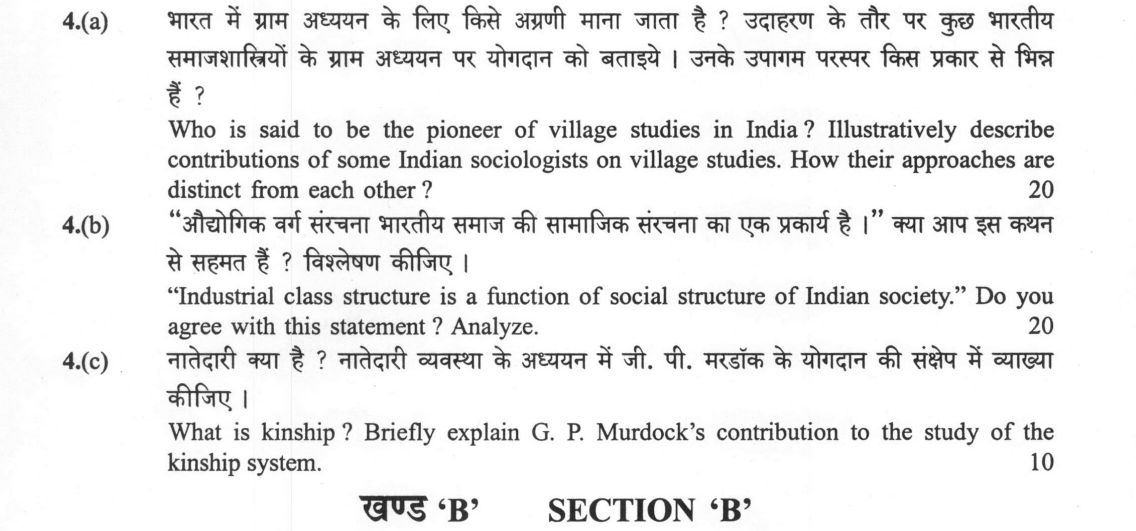
(a) Who is said to be the pioneer of village studies in India? Illustratively describe contributions of some Indian sociologists…
Who is said to be the pioneer of village studies in India? Illustratively describe contributions of some Indian sociologists on village studies. How their approaches are distinct from each other? 20 marks
"Industrial class structure is a function of social structure of Indian society." Do you agree with this statement? Analyze. 20 marks
What is kinship? Briefly explain G. P. Murdock's contribution to the study of the kinship system. 10 marks
हिंदी में प्रश्न पढ़ें
भारत में ग्राम अध्ययन के लिए किसे अग्रणी माना जाता है ? उदाहरण के तौर पर कुछ भारतीय समाजशास्त्रियों के ग्राम अध्ययन पर योगदान को बताइये । उनके उपागम परस्पर किस प्रकार से भिन्न हैं ? (20 अंक)
"औद्योगिक वर्ग संरचना भारतीय समाज की सामाजिक संरचना का एक प्रकार्य है !" क्या आप इस कथन से सहमत हैं ? विश्लेषण कीजिए । (20 अंक)
नातेदारी क्या है ? नातेदारी व्यवस्था के अध्ययन में जी. पी. मर्डॉक के योगदान की संक्षेप में व्याख्या कीजिए । (10 अंक)
Model answer
Written by UPSC Answer Check against this question's marking rubric, to the expected length. UPSC does not publish answers for Mains — this is one way to score well, not an official key.
Indian sociology has moved from monographic village studies to industrial class formation and kinship, each revealing how traditional structures mediate modern institutions. M.N. Srinivas is said to be the pioneer of village studies in India because his Rampura study (1948) established the monographic method and introduced concepts such as dominant caste, sanskritisation and modernisation. S.C. Dube’s Indian Village (1955) on Shamirpet extended this by integrating caste, class, religion and politics in a functional framework. Both were structural-functional: Srinivas emphasised status groups and dominant caste’s control over village resources; Dube emphasised interlocking institutions and the village as a social system. Against this, A.R. Desai’s Rural Sociology in India used Marxist/subaltern class analysis, treating caste as a form of class exploitation and village hierarchy as rooted in agrarian relations. Kathleen Gough’s Thanjavur study examined mode of production, land tenure and labour, showing how caste and class coexisted in a non-capitalist agrarian structure. Andre Beteille’s Tanjore study analysed the caste-class nexus, especially how caste status translated into occupational and political power. Bernard Cohn’s Senapur study brought historical anthropology, tracing how colonial and post-colonial institutions reconfigured caste and village life. Thus approaches differ: Srinivas and Dube focus on structure and integration; Desai and Gough on production and conflict; Beteille on caste-class conversion; Cohn on historical process.
Industrial class structure is indeed a function of Indian social structure, but not in a deterministic sense. The agreement position is that caste, agrarian hierarchy and colonial legacy shaped industrial class formation. Rudolf and Heber’s study of industrialists in Bombay showed many were 'bullock capitalists' from agrarian backgrounds, converting land-based wealth into industrial capital. Ramaswamy’s work on Tiruppur shows Gounder dominance in knitwear industry, where caste networks supplied capital, labour and market access. Caste-based recruitment in Ahmedabad mills and other early industries also indicates that class positions were filtered through caste. However, the counter-position is that industrial modernisation created a new class logic. Morris’s study of Bombay textile mills shows factory discipline, wage labour and unionism broke down some caste recruitment patterns. Chandavarkar’s work on working-class formation shows that industrial workers developed class consciousness that transcended village and caste ties, especially in urban slums and mill wards. In contemporary IT and service sectors, education and skill often override caste, suggesting meritocratic class formation. Yet caste continues to matter in entrepreneurship, credit, political patronage and regional industrial clusters. Hence the statement is broadly true: industrial class structure is shaped by social structure, but it also reproduces and transforms caste, creating hybrid class-caste formations.
Kinship is the socially recognised network of relationships based on blood, marriage or adoption, which organises identity, residence, inheritance and obligation. G.P. Murdock’s Social Structure (1949) made a major contribution by comparing about 250 societies and arguing that the nuclear family is a universal social unit. He analysed kinship terminology systems, such as bifurcate merging, to show how societies classify relatives and encode descent, alliance and authority. Murdock also gave a functional account of the family: sexual regulation, economic cooperation, reproduction and socialisation/education of children. This comparative, cross-cultural method made kinship a central object of sociological and anthropological study. Yet critics such as Leach and Needham argued that Murdock’s model was too biologically reductionist and underplayed the diversity of marriage, descent and domestic economies. In the Indian context, his framework helps explain joint family, caste endogamy and patrilineal inheritance, while also requiring correction for caste, religion and colonial law. The way forward is to read these domains together: village studies exposed caste as social structure, industrial analysis showed its conversion into class, and kinship analysis revealed the intimate institutions through which both persist, revealing sociology’s engagement with tradition-modernity tension in India.
What "Analyse" is asking you to do
Break the subject into its working parts and show how they act on each other. The marks are in the interconnections — which factor drives which, and what the resulting structure explains — not in the inventory of factors.
Structure that answers it
Define the whole → separate it into its parts → show which part drives which → what that interaction produces → what the structure implies
Where marks are lost
A flat list of causes with no account of which drives which. An answer of neatly separated headings, each self-contained, scores as description.
How this answer will be evaluated
Approach
Framework: Sociology Paper II (Social Structure & Social Change). (a) describe: define > structure or process in order > labelled diagram > significance | (b) analyse: intro > causes > effects > stakeholders/linkages > way forward | (c) explain: definition/context > points in order > small example > short close Full marks: Comprehensive, well-structured, and analytically sound with specific examples and references.
Key points expected
- Identify M.N. Srinivas as the pioneer of village studies
- Describe the contribution of M.N. Srinivas (e.g., Rampur, Sanskritization)
- Describe the contribution of G.S. Ghurye (e.g., Waghaleshwar, caste focus)
- Contrast the distinct approaches of the sociologists mentioned
- Define the relationship between industrial class and social structure
- Explain how caste influences industrial class formation
- Discuss the role of education and occupation in class mobility
- Provide examples of how social structure shapes industrial hierarchy
Evaluation rubric
Each sub-part is marked on its own, against the marks and word limit printed on the paper.
- (a) Identify the pioneer of Indian village studies and contrast the methodological approaches of key sociologists. 20 marks
describe— define → structure or process in order → labelled diagram → significance
Must cover
- Identify M.N. Srinivas as the pioneer of village studies
- Describe the contribution of M.N. Srinivas (e.g., Rampur, Sanskritization)
- Describe the contribution of G.S. Ghurye (e.g., Waghaleshwar, caste focus)
- Contrast the distinct approaches of the sociologists mentioned
Loses marks
- Confusing the pioneer with other rural sociologists
- Listing names without explaining their specific contributions
- Failing to distinguish between the different approaches
Earns more
- Mention of other contributors like S.C. Dube or L.P. Vidyarthi
- Specific reference to the 'Rural India' debate
- Mention of the 'Village Study' methodology (monograph vs survey)
Extra mark
- Reference to specific concepts like 'Dominant Caste' or 'Sanskritization'
- Mention of the 'Rural Sociology' vs 'Village Sociology' distinction
- (b) Analyze the relationship between India's industrial class structure and its traditional social structure. 20 marks
analyse— intro → causes → effects → stakeholders/linkages → way forward
Must cover
- Define the relationship between industrial class and social structure
- Explain how caste influences industrial class formation
- Discuss the role of education and occupation in class mobility
- Provide examples of how social structure shapes industrial hierarchy
Loses marks
- Treating class and caste as entirely separate entities
- Ignoring the role of social structure in industrial development
- Providing a purely economic analysis without social context
Earns more
- Reference to specific industrial sectors and caste composition
- Discussion of the 'Caste-Occupation' linkage
- Mention of the 'New Middle Class' and its social origins
Extra mark
- Reference to specific data on caste and industrial employment
- Mention of the 'Caste-Capital' nexus
- (c) Define kinship and explain G.P. Murdock's contribution to the study of kinship systems. 10 marks
explain— definition/context → points in order → small example → short close
Must cover
- Define kinship as a social relationship
- Explain G.P. Murdock's definition of kinship
- Describe Murdock's contribution to the study of kinship systems
- Mention the 'World Ethnographic Sample' or similar work
Loses marks
- Confusing kinship with family
- Failing to mention Murdock's specific contribution
- Providing a general definition without specific reference to Murdock
Earns more
- Reference to Murdock's 'Social Structure' (1949)
- Mention of the 'Kinship and Marriage' concepts
- Discussion of the 'Descent' and 'Alliance' systems
Extra mark
- Reference to specific kinship terms used by Murdock
- Mention of the 'Kinship and Family' distinction
Practice this exact question
Write your answer and it is marked point by point against the model answer above — what you covered, what you missed, what you got wrong.
Evaluate my answer →More from Sociology 2025 Paper II
- Q1 Answer the following questions in about 150 words each: (a) 'Textual perspective is impor…
- Q2 (a) Do you think that in a society like India orthogenetic changes take place through dif…
- Q3 (a) What do you mean by nation building? What is the role of religion in nation building?…
- Q4 (a) Who is said to be the pioneer of village studies in India? Illustratively describe co…
- Q5 Answer the following questions in about 150 words each: (a) 'The transfer of land from cu…
- Q6 (a) In what respects have the constitutional provisions changed the socio-economic and po…
- Q7 (a) What are the Private and Public network and support systems operative in Indian socie…