Paper II — Q7
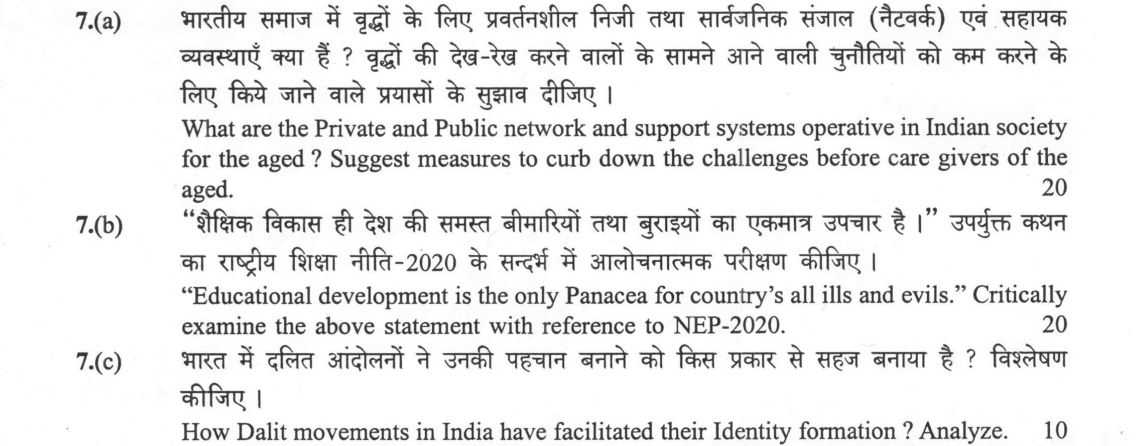
(a) What are the Private and Public network and support systems operative in Indian society for the aged? Suggest measures to…
What are the Private and Public network and support systems operative in Indian society for the aged? Suggest measures to curb down the challenges before care givers of the aged. 20 marks
"Educational development is the only Panacea for country's all ills and evils." Critically examine the above statement with reference to NEP-2020. 20 marks
How Dalit movements in India have facilitated their Identity formation? Analyze. 10 marks
हिंदी में प्रश्न पढ़ें
भारतीय समाज में बुड्ढों के लिए प्रवर्तनशील निजी तथा सार्वजनिक संजाल (नेटवर्क) एवं सहायक व्यवस्थाएं क्या हैं ? बुड्ढों की देख-रेख करने वालों के सामने आने वाली चुनौतियों को कम करने के लिए किये जाने वाले प्रयासों के सुझाव दीजिए । (20 अंक)
"शैक्षिक विकास ही देश की समस्त बीमारियों तथा बुराइयों का एकमात्र उपचार है ।" उपर्युक्त कथन का राष्ट्रीय शिक्षा नीति-2020 के संदर्भ में आलोचनात्मक परीक्षण कीजिए । (20 अंक)
भारत में दलित आंदोलनों ने उनकी पहचान बनाने को किस प्रकार से सहज बनाया है ? विश्लेषण कीजिए । (10 अंक)
Model answer
Written by UPSC Answer Check against this question's marking rubric, to the expected length. UPSC does not publish answers for Mains — this is one way to score well, not an official key.
Support Systems for the Aged and Caregiver Challenges
Support systems for the aged in India operate across private networks and public institutional frameworks. Private networks are rooted in the traditional joint family, kinship structures, caste panchayats, and faith-based community charities that offer informal financial, domestic, and emotional safety nets. To supplement eroding informal support, public systems have introduced statutory and programmatic safeguards. These include the Maintenance and Welfare of Parents and Senior Citizens Act 2007, the Indira Gandhi National Old Age Pension Scheme (IGNOAPS), the National Programme for Health Care of the Elderly under the National Rural Health Mission (NRHM), and the Seniorcare Ageing Growth Engine (SAGE) portal promoting elder-care social enterprises.
Caregivers, however, face acute structural challenges. These include the psychological and economic strains of the "sandwich generation" juggling childcare and eldercare, the disproportionate burden of unpaid care falling on women (feminization of care), severe caregiver burnout, and latent intra-household frictions that occasionally lead to elder abuse. Mitigating these pressures requires institutionalizing state-subsidized respite care services, offering formal geriatric care training for domestic caregivers, providing targeted tax exemptions for families co-residing with elderly dependents, and scaling community-based participatory care models such as Kerala’s Kudumbashree initiative.
Critical Examination of NEP-2020 as a Social Panacea
The National Education Policy (NEP) 2020 embodies a structural-functionalist approach to human capital formation. By introducing a foundational 5+3+3+4 pedagogical structure, universalizing Early Childhood Care and Education (ECCE), integrating vocational exposure, expanding digital learning infrastructure, and creating a dedicated Gender Inclusion Fund, the policy posits education as an engine of meritocracy capable of resolving poverty, social exclusion, and economic stagnation.
Critically examined, education alone cannot serve as an absolute panacea for systemic socioeconomic ills. Samuel Bowles and Herbert Gintis’s correspondence principle illustrates that formal schooling often mirrors and reproduces capitalist divisions of labor rather than eliminating them. Pierre Bourdieu’s concepts of cultural capital and habitus demonstrate that pedagogical evaluation inherently rewards dominant cultural codes, thereby legitimizing class and caste privileges under the guise of neutral merit. Furthermore, NEP-2020's push toward digital integration and vocational tracks risks deepening the digital divide and tracking marginalized groups into informal labour markets, while rapid educational commercialization undermines equal opportunity. Therefore, while education is a vital catalyst for empowerment, it is not a self-sufficient remedy unless accompanied by structural land reforms, wealth redistribution, and the elimination of institutionalized discrimination.
Dalit Movements and Identity Formation
Dalit movements have been instrumental in transforming historically stigmatized untouchable statuses into self-conscious, assertive political identities. Prior to independence, Dr. B.R. Ambedkar catalyzed this transformation through radical civil assertions such as the Mahad Satyagraha (1927) and Kalaram temple entry movements, demanding civic equality and the reclamation of human dignity. In the post-independence era, the Dalit Panthers (1972) radicalized subaltern consciousness through literature and militant anti-caste mobilization, which subsequently enabled the Bahujan Samaj Party (BSP) to convert social solidarity into decisive electoral power. In the contemporary milieu, struggles surrounding institutional casteism, such as the Justice for Rohith Vemula movement, and resistance against violent vigilantism, such as the 2016 Una anti-flogging protests, continue to forge a unified Dalit youth assertion.
Sociologically, this trajectory reflects Gail Omvedt’s concept of "cultural struggle" against Brahmanical hegemony and Sharmila Rege’s "Dalit feminist standpoint," which positions subaltern epistemologies at the center of sociological inquiry. These mobilizations continually navigate Oliver Mendelsohn’s inquiry into "who wants to be a Dalit?", maintaining a persistent tension between an autonomous, radical anti-caste identity and the pragmatic assimilationism of mainstream electoral politics.
In conclusion, rectifying deep-rooted societal vulnerabilities—whether geriatric dependency, educational inequality, or caste subordination—requires concerted institutional interventions where state regulation, redistributive economic policy, and autonomous civil society movements converge to produce substantive social justice.
What "Critically examine" is asking you to do
Test the proposition the question puts to you and return a finding on how far it holds. Examine stems carry a claim, or ask whether something has happened, and expect evidence weighed both ways before the extent is stated — often with remedial measures attached. “Critically” is not a section added at the end: name the yardstick you are judging by — the evidence, the stated objective, a constitutional principle, a rival explanation — and let a verdict close each part of the body. Where the question quotes a claim, that verdict must land on the claim itself, accepted, qualified or rejected, and not on the theme in general.
Structure that answers it
Restate the claim as the question frames it → evidence that supports it → evidence that undercuts it → the conditions under which it holds → verdict on how far it stands
Where marks are lost
Merits in one paragraph, demerits in the next, and a conclusion calling for a balanced and holistic approach. That is a survey with the judgement left out and it holds the answer in the middle band. The opposite error is reading “critically” as permission to attack — and with the odd pairings, critically describe or critically explain, the exposition still carries most of the marks, the judgement being a layer on it rather than a substitute for it.
How this answer will be evaluated
Approach
(a) suggest: the problem in one line > implementable measures > who acts > conclusion | (b) critically evaluate: positives > negatives/limits > conditions/safeguards > conclusion | (c) analyse: intro > causes > effects > stakeholders/linkages > way forward Full marks: Precise definitions, specific schemes/NEP points, and clear analytical links.
Key points expected
- Define private and public support networks
- Identify specific public schemes (e.g., Indira Gandhi scheme)
- List challenges faced by care givers
- Suggest implementable measures to curb these challenges
- Analyze NEP-2020's role in social mobility
- Critique the 'only panacea' claim (limits of education)
- Link education to specific social ills (poverty, caste)
- Provide a balanced judgment on the statement
Evaluation rubric
Each sub-part is marked on its own, against the marks and word limit printed on the paper.
- (a) Define private/public support systems for the aged and suggest measures for caregivers. 20 marks
suggest— the problem in one line → implementable measures → who acts → conclusion
Must cover
- Define private and public support networks
- Identify specific public schemes (e.g., Indira Gandhi scheme)
- List challenges faced by care givers
- Suggest implementable measures to curb these challenges
Loses marks
- Vague generalities without naming specific schemes
- Ignoring the 'caregiver' aspect of the question
Earns more
- Reference to NFHS-5 data on elderly
- Mention of specific private sector initiatives
- Discussion of 'caregiver burnout' concept
Extra mark
- Citation of specific state-level welfare schemes
- Reference to the Maintenance and Welfare of Parents Act
- (b) Critically examine the claim that education is the only panacea using NEP-2020. 20 marks
critically evaluate— positives → negatives/limits → conditions/safeguards → conclusion
Must cover
- Analyze NEP-2020's role in social mobility
- Critique the 'only panacea' claim (limits of education)
- Link education to specific social ills (poverty, caste)
- Provide a balanced judgment on the statement
Loses marks
- Treating education as a magic bullet without critique
- Ignoring the specific reference to NEP-2020
Earns more
- Reference to NEP-2020's multidisciplinary approach
- Mention of 'foundational literacy and numeracy'
- Discussion of education's role in gender equality
Extra mark
- Citation of specific NEP-2020 targets (e.g., GER 50%)
- Reference to specific social indicators (e.g., FLFPR)
- (c) Analyze how Dalit movements facilitated identity formation in India. 10 marks
analyse— intro → causes → effects → stakeholders/linkages → way forward
Must cover
- Identify key Dalit movements (e.g., Phule, Ambedkar)
- Explain the link between movement and identity
- Discuss the role of political assertion
- Mention the impact on social consciousness
Loses marks
- Generalizing without naming specific movements
- Ignoring the 'identity formation' aspect
Earns more
- Reference to specific leaders (Phule, Ambedkar)
- Mention of specific events (Poona Pact, Mahad Satyagraha)
- Discussion of 'Jat-Pat' system critique
Extra mark
- Citation of specific Dalit literature or journals
- Reference to contemporary Dalit movements
Practice this exact question
Write your answer and it is marked point by point against the model answer above — what you covered, what you missed, what you got wrong.
Evaluate my answer →More from Sociology 2025 Paper II
- Q4 (a) Who is said to be the pioneer of village studies in India? Illustratively describe co…
- Q5 Answer the following questions in about 150 words each: (a) 'The transfer of land from cu…
- Q6 (a) In what respects have the constitutional provisions changed the socio-economic and po…
- Q7 (a) What are the Private and Public network and support systems operative in Indian socie…
- Q8 (a) Is it possible to have sustainable development in India? Cite major environmental iss…