Paper II — Q6
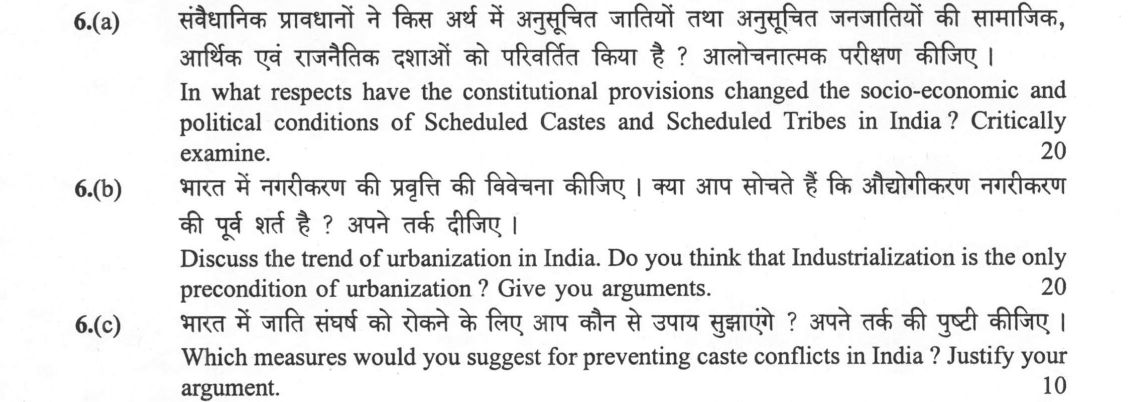
(a) In what respects have the constitutional provisions changed the socio-economic and political conditions of Scheduled Castes…
In what respects have the constitutional provisions changed the socio-economic and political conditions of Scheduled Castes and Scheduled Tribes in India? Critically examine. 20 marks
Discuss the trend of urbanization in India. Do you think that Industrialization is the only precondition of urbanization? Give you arguments. 20 marks
Which measures would you suggest for preventing caste conflicts in India? Justify your argument. 10 marks
हिंदी में प्रश्न पढ़ें
संवैधानिक प्रावधानों ने किस अर्थ में अनुसूचित जातियों तथा अनुसूचित जनजातियों की सामाजिक, आर्थिक एवं राजनीतिक दशाओं को परिवर्तित किया है ? आलोचनात्मक परीक्षण कीजिए । (20 अंक)
भारत में नगरीकरण की प्रवृत्ति की विवेचना कीजिए । क्या आप सोचते हैं कि औद्योगीकरण नगरीकरण की पूर्व शर्त है ? अपने तर्क दीजिए । (20 अंक)
भारत में जाति संघर्ष को रोकने के लिए आप कौन से उपाय सुझाएंगे ? अपने तर्क की पुष्टि कीजिए । (10 अंक)
Model answer
Written by UPSC Answer Check against this question's marking rubric, to the expected length. UPSC does not publish answers for Mains — this is one way to score well, not an official key.
India’s constitutional framework and developmental trajectory aim to reconstruct an egalitarian social order. However, empirical patterns of social justice, urban growth, and inter-group relations demonstrate a complex interplay between state intervention and structural inertia.
Constitutional Impact on Scheduled Castes and Scheduled Tribes
Constitutional provisions under Articles 15, 16, and 17, along with legislative safeguards like the Scheduled Castes and Scheduled Tribes (Prevention of Atrocities) Act, 1989, have legally delegitimized untouchability and discrimination. Political reservations under Articles 330–334, extended to local governance via the 73rd and 74th Amendments and PESA, have created an institutionalized space for descriptive political representation. Furthermore, administrative safeguards under the 5th and 6th Schedules, institutional oversight by National Commissions under Articles 338 and 338A, and targeted budgeting via the Scheduled Caste Sub-Plan and Tribal Sub-Plan have fostered an educated middle class and facilitated political mobilization.
Critically, however, constitutional guarantees have fallen short of transformative socio-economic parity. Implementation failures remain widespread: Below Poverty Line (BPL) targeting errors misallocate welfare resources, while affirmative action benefits are disproportionately absorbed by a narrow creamy layer, leaving agricultural laborers and manual scavengers structurally marginalized. Substantive parliamentary representation remains compromised, as elected SC/ST representatives often remain subordinate to dominant-caste party leaderships. In tribal belts, despite the Forest Rights Act (2006), land alienation, mineral extraction, and displacement persist. Thus, while constitutional provisions have created legal agency, they have proven insufficient on their own to dismantle entrenched agrarian and socio-economic hierarchies.
Trends of Urbanization and the Industrial Precondition
India’s urban transition accelerated significantly post-1991, reaching 31.16% in the 2011 Census. This urbanization is characterized by a top-heavy distribution concentrated in million-plus metropolitan cities, rapid peri-urbanization, and the unprecedented emergence of Census Towns, alongside the relative economic stagnation of small Class-IV to VI towns.
Industrialization is not the sole precondition for Indian urbanization. Historically and contemporarily, urban centers have evolved around administrative functions (Jaipur, Chandigarh), religious and pilgrimage economies (Varanasi, Tirupati), and post-industrial tertiary services such as Information Technology (Bengaluru, Hyderabad, Gurugram). As sociologist Ramkrishna Mukherjee highlighted through the thesis of "urbanization without industrialization," a vast share of Indian urban growth is driven by rural distress and agrarian push factors rather than industrial pull factors. Surplus rural labor migrates directly into low-productivity, informal urban service economies, bypassing traditional manufacturing-led industrial urbanism.
Measures for Preventing Caste Conflicts
Addressing caste violence requires targeting its underlying material and cultural determinants:
Structural measures: Implement rigorous land redistribution and promote rural economic diversification. Breaking the dominant castes' monopoly over land and employment removes the material dependency that dominant groups exploit to punish Dalit-Adivasi socio-political assertion.
Institutional measures: Establish exclusive fast-track courts under the PoA Act to ensure time-bound convictions and implement police reforms to eradicate caste-biased inaction, thereby establishing credible institutional deterrence against atrocities.
Cultural measures: Expand institutional incentives and security for inter-caste marriages (such as the Dr. Ambedkar Scheme) and reform primary school curricula to actively deconstruct notions of ritual purity and pollution. Inter-caste familial alliances and educational secularization undermine the social reproduction of caste endogamy and prejudice.
Conclusion
Constitutional safeguards, urbanization, and administrative remedies have cracked traditional hierarchies, yet unequal development and informalized economies continue to reproduce caste disparities. Genuine social transformation demands that state interventions transition from formal rights protection to structural asset redistribution and the active dismantling of caste hegemony across rural and urban landscapes.
What "Critically examine" is asking you to do
Test the proposition the question puts to you and return a finding on how far it holds. Examine stems carry a claim, or ask whether something has happened, and expect evidence weighed both ways before the extent is stated — often with remedial measures attached. “Critically” is not a section added at the end: name the yardstick you are judging by — the evidence, the stated objective, a constitutional principle, a rival explanation — and let a verdict close each part of the body. Where the question quotes a claim, that verdict must land on the claim itself, accepted, qualified or rejected, and not on the theme in general.
Structure that answers it
Restate the claim as the question frames it → evidence that supports it → evidence that undercuts it → the conditions under which it holds → verdict on how far it stands
Where marks are lost
Merits in one paragraph, demerits in the next, and a conclusion calling for a balanced and holistic approach. That is a survey with the judgement left out and it holds the answer in the middle band. The opposite error is reading “critically” as permission to attack — and with the odd pairings, critically describe or critically explain, the exposition still carries most of the marks, the judgement being a layer on it rather than a substitute for it.
How this answer will be evaluated
Approach
Framework: Sociology Paper II: Constitutional Sociology & Urbanization. (a) critically evaluate: positives > negatives/limits > conditions/safeguards > conclusion | (b) discuss: intro > 3-4 dimensions > example > balanced close | (c) suggest: the problem in one line > implementable measures > who acts > conclusion Full marks: Comprehensive, critical, and well-structured with specific data and legal references.
Key points expected
- Cite specific Articles (e.g., 15, 16, 335, 340, 341, 342).
- Analyze political representation via reservation (Lok Sabha/State Assemblies).
- Examine socio-economic changes (education, employment, land rights).
- Critically evaluate limitations (e.g., social boycott, implementation gaps).
- Describe trends (rural-urban migration, urban sprawl, smart cities).
- Define urbanization and its drivers.
- Argue against industrialization as the *only* precondition.
- Identify other drivers (services, education, healthcare, IT).
Evaluation rubric
Each sub-part is marked on its own, against the marks and word limit printed on the paper.
- (a) Assess the impact of constitutional provisions on SC/ST socio-economic and political status. 20 marks
critically evaluate— positives → negatives/limits → conditions/safeguards → conclusion
Must cover
- Cite specific Articles (e.g., 15, 16, 335, 340, 341, 342).
- Analyze political representation via reservation (Lok Sabha/State Assemblies).
- Examine socio-economic changes (education, employment, land rights).
- Critically evaluate limitations (e.g., social boycott, implementation gaps).
Loses marks
- Listing articles without analyzing their impact.
- Ignoring the 'critical' aspect (only listing positives).
- Confusing SC and ST specific provisions.
Earns more
- Reference to Mandal Commission or 5th/10th Schedule.
- Mention of Panchayati Raj Act (1993) provisions.
- Discussion of 'creamy layer' exclusion.
- Reference to specific SC/ST welfare schemes.
Extra mark
- Cite a specific Supreme Court judgment on reservation.
- Reference to specific data on SC/ST representation.
- (b) Analyze India's urbanization trends and debate industrialization as a precondition. 20 marks
discuss— intro → 3-4 dimensions → example → balanced close
Must cover
- Describe trends (rural-urban migration, urban sprawl, smart cities).
- Define urbanization and its drivers.
- Argue against industrialization as the *only* precondition.
- Identify other drivers (services, education, healthcare, IT).
Loses marks
- Failing to address the 'only precondition' argument.
- Ignoring the role of the service sector.
- Vague description of trends without data.
Earns more
- Reference to Census 2011 data on urban population.
- Mention of 'de-industrialization' or 'premature urbanization'.
- Discussion of service sector growth (IT/BPO).
- Reference to specific urbanization theories (Lewis model).
Extra mark
- Cite specific data on urbanization rate (e.g., 31.16% in 2011).
- Reference to specific smart city projects.
- (c) Propose measures to prevent caste conflicts in India with justification. 10 marks
suggest— the problem in one line → implementable measures → who acts → conclusion
Must cover
- Identify root causes of caste conflicts (land, honor, resources).
- Suggest implementable measures (legal, social, economic).
- Justify the suggested measures.
- Address the role of state and civil society.
Loses marks
- Vague suggestions (e.g., 'promote harmony').
- Ignoring the economic dimension of caste conflict.
- Failing to justify the measures.
Earns more
- Reference to SC/ST (Prevention of Atrocities) Act.
- Mention of inter-caste marriage schemes.
- Discussion of economic empowerment (land reform).
- Reference to role of media/education.
Extra mark
- Cite a specific case of successful conflict resolution.
- Reference to specific government schemes for social harmony.
Practice this exact question
Write your answer and it is marked point by point against the model answer above — what you covered, what you missed, what you got wrong.
Evaluate my answer →More from Sociology 2025 Paper II
- Q3 (a) What do you mean by nation building? What is the role of religion in nation building?…
- Q4 (a) Who is said to be the pioneer of village studies in India? Illustratively describe co…
- Q5 Answer the following questions in about 150 words each: (a) 'The transfer of land from cu…
- Q6 (a) In what respects have the constitutional provisions changed the socio-economic and po…
- Q7 (a) What are the Private and Public network and support systems operative in Indian socie…
- Q8 (a) Is it possible to have sustainable development in India? Cite major environmental iss…