Paper II — Q3
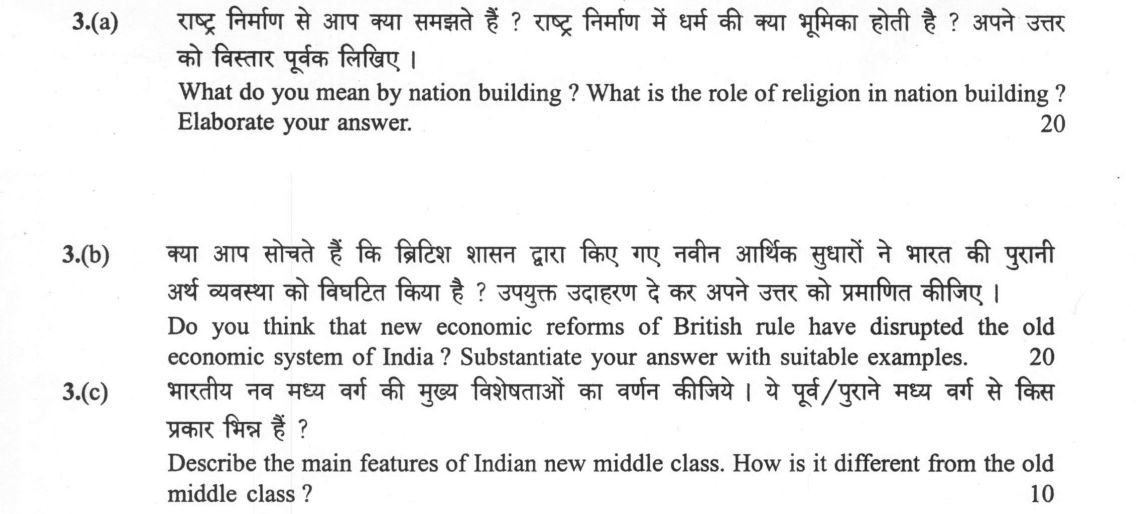
(a) What do you mean by nation building? What is the role of religion in nation building? Elaborate your answer. (20 marks) (b)…
What do you mean by nation building? What is the role of religion in nation building? Elaborate your answer. 20 marks
Do you think that new economic reforms of British rule have disrupted the old economic system of India? Substantiate your answer with suitable examples. 20 marks
Describe the main features of Indian new middle class. How is it different from the old middle class? 10 marks
हिंदी में प्रश्न पढ़ें
राष्ट्र निर्माण से आप क्या समझते हैं ? राष्ट्र निर्माण में धर्म की क्या भूमिका होती है ? अपने उत्तर को विस्तार पूर्वक लिखिए । (20 अंक)
क्या आप सोचते हैं कि ब्रिटिश शासन द्वारा किए गए नवीन आर्थिक सुधारों ने भारत की पुरानी अर्थ व्यवस्था को विघटित किया है ? उपयुक्त उदाहरण दे कर अपने उत्तर को प्रमाणित कीजिए । (20 अंक)
भारतीय नव मध्य वर्ग की मुख्य विशेषताओं का वर्णन कीजिए । ये पूर्व/पुराने मध्य वर्ग से किस प्रकार भिन्न हैं ? (10 अंक)
Model answer
Written by UPSC Answer Check against this question's marking rubric, to the expected length. UPSC does not publish answers for Mains — this is one way to score well, not an official key.
Nation-Building and the Role of Religion
Nation-building refers to the structural and socio-cultural process of constructing a cohesive national identity, civic consciousness, and integrated institutional framework within a state. Benedict Anderson conceptualized the nation as an "imagined community," while Ernest Gellner viewed nation-building as the structural imposition of a standardized, homogenized high culture essential for industrial modernity.
Religion plays a deeply dualistic role in this process. Functionally, as Emile Durkheim argued, religion provides moral integration, shared values, and collective effervescence. Robert Bellah’s concept of "civil religion" illustrates how religious idioms can sanctify national ideals and foster cohesion. In India's anti-colonial struggle, Mahatma Gandhi successfully utilized inclusive religious symbolism—such as Ram Rajya, Satyagraha, and *Ahimsa*—as a trans-communal moral ethic to mobilize the masses against British rule.
Conversely, religion can act as an intensely divisive force when instrumentalized by political elites. Politicized religious identities foster communalism, threatening social cohesion. The ultimate manifestation of this was Muhammad Ali Jinnah’s Two-Nation Theory, which defined nationality along religious cleavages, culminating in the traumatic Partition of 1947. To navigate this tension, post-independence India institutionalized the Nehruvian model of secular nation-building. Enshrined in Articles 25 to 28 of the Constitution, this framework adopts principled distance and equal respect for all faiths (sarva dharma sambhava), ensuring that diverse religious identities remain subsumed within a shared civic framework.
Colonial Economic Interventions and Structural Disruption
British rule fundamentally restructured India's traditional, relatively self-sufficient agrarian and artisanal economy. The colonial state introduced institutional land revenue systems—the Permanent Settlement in Bengal, the Ryotwari system in the South, and the Mahalwari system in the North-West. These systems transformed land into a commodified, alienable asset, dismantled customary community rights, and entrenched predatory agrarian relations characterized by absentee landlordism, rack-renting, and extreme rural indebtedness.
This structural transformation was compounded by forced commercialization of agriculture (shifting land from food grains to cash crops like indigo, cotton, and opium) and the systematic deindustrialization of India’s urban handicrafts. As Dadabhai Naoroji demonstrated through his Drain of Wealth theory and R.C. Dutt in his economic histories, one-way free trade destroyed indigenous textile hubs like Dhaka and Murshidabad. Millions of displaced artisans were forced into agriculture, creating hyper-congestion on land, suppressing rural wages, and drastically increasing famine vulnerability, as seen in the devastating Bengal Famines of 1770 and 1943. India was systematically converted into a peripheral exporter of raw materials and a captive market for British manufactured goods.
Nonetheless, this disruption carried an unintended, contradictory dimension. The construction of the railway network, postal systems, and standardized commercial laws—though designed for resource extraction and military control—integrated fragmented local markets and laid the material infrastructure that enabled modern economic linkages and pan-Indian political solidarity.
The Old and New Indian Middle Class
The "old middle class" emerged directly from the colonial encounter, comprising English-educated professionals, lawyers, teachers, and administrative personnel (babus), epitomized by the Bengali bhadralok. As Andre Beteille observed, this class derived its security primarily from state patronage and rentier, upper-caste landed origins. It played a vanguard role in the anti-colonial struggle and subsequently championed the Nehruvian, state-led developmental paradigm, viewing public employment as the primary vehicle of nation-building.
In contrast, the "new middle class" crystallized following the 1991 structural economic reforms. As sociologists like Leela Fernandes and P.N. Dhar highlight, its primary characteristics include:
- Employment in the private corporate, IT, and financial service sectors rather than state bureaucracy.
- Globalized consumption patterns, where identity and social status are constructed through lifestyle, private education, real estate, and consumer goods.
- Greater caste heterogeneity, reflecting the entry of upwardly mobile Other Backward Classes (OBCs) and Dalit entrepreneurs, though upper-caste dominance remains salient.
- A fragmented, privatized relationship with the state, shifting from the old middle class's welfare-statist orientation toward market-driven solutions, urban citizen activism, and a governance ethos framed around economic efficiency.
What "Elaborate" is asking you to do
Give the full detailed account the question has compressed into a line — every dimension of it, with specifics. Elaborate rewards completeness and detail rather than clarification or argument: the examiner is checking whether you can fill out a topic without being told what its parts are.
Structure that answers it
State the proposition → first dimension in detail → second dimension in detail → the part the statement leaves implicit → the consolidated picture
Where marks are lost
Repeating the statement at greater length instead of adding substance. Elaborate also punishes narrowness: omitting a whole dimension costs more here than anywhere else in this family.
How this answer will be evaluated
Approach
Framework: Sociology Paper II: Define > Thinker > Argument > Indian illustration. (a) explain: definition/context > points in order > small example > short close | (b) examine: intro > how/why with reasoning > evidence > conclusion | (c) describe: define > structure or process in order > labelled diagram > significance Full marks: Precise definitions, named thinkers, specific Indian examples, clear argumentation.
Key points expected
- Define nation building as social/political integration
- Identify religion as a source of social cohesion
- Identify religion as a source of social conflict
- Provide Indian examples of religious role in nation building
- Describe the pre-colonial economic system (e.g., village economy)
- Detail specific British reforms (e.g., land revenue, deindustrialization)
- Analyze the disruption of traditional trade and industry
- Substantiate with suitable examples as requested
Evaluation rubric
Each sub-part is marked on its own, against the marks and word limit printed on the paper.
- (a) Define nation building and elaborate the role of religion in it. 20 marks
explain— definition/context → points in order → small example → short close
Must cover
- Define nation building as social/political integration
- Identify religion as a source of social cohesion
- Identify religion as a source of social conflict
- Provide Indian examples of religious role in nation building
Loses marks
- Treating religion only as a negative factor
- Ignoring the Indian context
- Vague definitions without sociological depth
Earns more
- Reference to thinkers like Ambedkar or Gandhi
- Mention of secularism as a state policy
- Discussion of communalism vs. nationalism
- Reference to constitutional provisions on religion
Extra mark
- Citation of specific historical events (e.g., Partition)
- Reference to specific sociological theories of religion
- (b) Examine if British economic reforms disrupted the old Indian economic system. 20 marks
examine— intro → how/why with reasoning → evidence → conclusion
Must cover
- Describe the pre-colonial economic system (e.g., village economy)
- Detail specific British reforms (e.g., land revenue, deindustrialization)
- Analyze the disruption of traditional trade and industry
- Substantiate with suitable examples as requested
Loses marks
- Generalizing without specific examples
- Ignoring the 'disruption' aspect
- Failing to link reforms to economic outcomes
Earns more
- Mention of specific acts (e.g., Permanent Settlement)
- Reference to thinkers like R.C. Dutt or Dadabhai Naoroji
- Discussion of the drain of wealth
- Comparison of pre- and post-colonial economic structures
Extra mark
- Specific statistical data on trade decline
- Reference to specific industries (e.g., textiles)
- (c) Describe features of the new middle class and contrast with the old. 10 marks
describe— define → structure or process in order → labelled diagram → significance
Must cover
- Define the 'new middle class' in the Indian context
- List main features of the new middle class
- List main features of the old middle class
- Highlight key differences between the two
Loses marks
- Confusing 'new' and 'old' middle class features
- Lack of specific features
- Ignoring the comparative aspect
Earns more
- Mention of economic liberalization (1991) as a catalyst
- Reference to consumption patterns and lifestyle
- Discussion of education and professional status
- Mention of urbanization and mobility
Extra mark
- Reference to specific sociological studies on the middle class
- Mention of specific sectors (e.g., IT, services)
Practice this exact question
Write your answer and it is marked point by point against the model answer above — what you covered, what you missed, what you got wrong.
Evaluate my answer →More from Sociology 2025 Paper II
- Q1 Answer the following questions in about 150 words each: (a) 'Textual perspective is impor…
- Q2 (a) Do you think that in a society like India orthogenetic changes take place through dif…
- Q3 (a) What do you mean by nation building? What is the role of religion in nation building?…
- Q4 (a) Who is said to be the pioneer of village studies in India? Illustratively describe co…
- Q5 Answer the following questions in about 150 words each: (a) 'The transfer of land from cu…
- Q6 (a) In what respects have the constitutional provisions changed the socio-economic and po…