Paper II — Q2
(a) Do you think that in a society like India orthogenetic changes take place through differentiation? Do you observe…
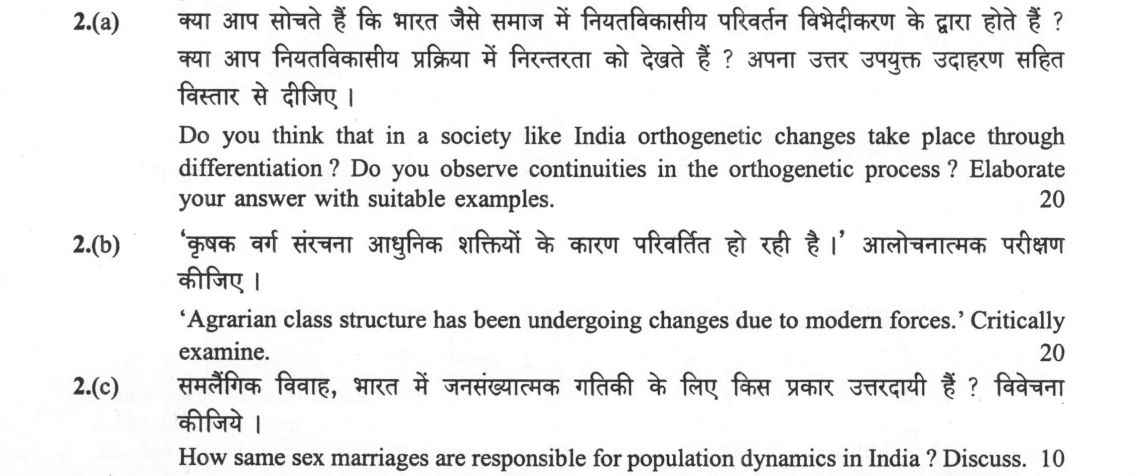
Do you think that in a society like India orthogenetic changes take place through differentiation? Do you observe continuities in the orthogenetic process? Elaborate your answer with suitable examples. 20 marks
'Agrarian class structure has been undergoing changes due to modern forces.' Critically examine. 20 marks
How same sex marriages are responsible for population dynamics in India? Discuss. 10 marks
हिंदी में प्रश्न पढ़ें
क्या आप सोचते हैं कि भारत जैसे समाज में नियतविकासीय परिवर्तन विभेदीकरण के द्वारा होते हैं ? क्या आप नियतविकासीय प्रक्रिया में निरंतरता को देखते हैं ? अपना उत्तर उपयुक्त उदाहरण सहित विस्तार से दीजिए । (20 अंक)
'कृषक वर्ग संरचना आधुनिक शक्तियों के कारण परिवर्तित हो रही है ।' आलोचनात्मक परीक्षण कीजिए । (20 अंक)
समलैंगिक विवाह, भारत में जनसंख्यात्मक गतिकी के लिए किस प्रकार उत्तरदायी हैं ? विवेचना कीजिए । (10 अंक)
Model answer
Written by UPSC Answer Check against this question's marking rubric, to the expected length. UPSC does not publish answers for Mains — this is one way to score well, not an official key.
Orthogenetic Changes and Continuities through Differentiation
Robert Redfield and Milton Singer conceptualised orthogenetic change as internal transformation within an indigenous civilisation through the continuous interaction of Great and Little Traditions. In India, orthogenetic change occurs primarily through structural differentiation—where traditional institutions, ritual roles, and sacred functions become specialised without losing their cultural moorings. M.N. Srinivas demonstrated that Sanskritisation operates as an endogenous mechanism of positional change, differentiating status through ritual emulation while preserving the overarching caste framework.
Simultaneously, continuities remain resilient. Louis Dumont observed that the ideological core of hierarchy and purity-pollution adapts to modern contexts rather than disappearing. For instance, historical temple entry movements achieved structural differentiation by opening sacred spaces to historically excluded castes, yet subtle codes of purity-pollution persist in private ritual spheres. Similarly, the formal state training and appointment of non-Brahmin priests in states like Tamil Nadu and Kerala illustrate functional differentiation and professionalisation of sacred roles; however, the scriptural canon, ritual orthopraxy, and traditional liturgical grammar remain fundamentally continuous. Thus, Indian orthogenetic evolution is characterised by differentiated adaptation rather than cultural rupture.
Agrarian Class Structure: Modern Forces and Persistence
The transformation of Indian agrarian class structure reflects the classic Lenin-Kautsky thesis of rural class differentiation, central to the Indian Mode of Production debate. Utsa Patnaik argued that the confluence of land reforms, the Green Revolution, and post-1991 neoliberal policies spearheaded capitalist transition. Modern forces—such as capital-intensive mechanisation, hybrid inputs, and contract farming—have restructured the countryside, creating a rich capitalist peasantry (kulaks) alongside an alienated, landless agrarian proletariat.
However, this transition is neither uniform nor complete. Amit Bhaduri underscored the persistence of semi-feudal relations, where interlocking markets for credit, land, and labour stifle pure capitalist dynamism. Jan Breman’s concept of 'footloose labour' demonstrates that capitalist modernisation has not created a secure, formal rural proletariat; instead, it has produced an uprooted, wage-dependent underclass trapped in seasonal migration and neo-bondage. Furthermore, the agrarian class structure remains deeply entangled with caste: dominant castes (such as Jats, Marathas, and Kammas) retain control over productive capital, while Dalits and Most Backward Classes bear the brunt of pauperisation and de-peasantisation. Consequently, the agrarian class structure has not undergone a simple linear modernisation; it exhibits an uneven, truncated capitalism characterised by agrarian distress and precarious labour rather than complete structural transformation.
Same-Sex Marriage and Population Dynamics
The legal and social debate surrounding same-sex marriage, epitomised in the Supreme Court’s Supriyo v. Union of India (2023) judgment, intersects with Indian population dynamics in qualitative and structural terms. Institutionalising same-sex unions disrupts the conventional heteronormative model of the family as the sole unit of biological reproduction and kinship. It directly impacts non-heteronormative reproductive pathways, including queer adoption under the Central Adoption Resource Authority (CARA) framework and access to Assisted Reproductive Technology (ART) and regulated surrogacy.
Demographically, however, the direct impact of same-sex marriages on national fertility rates and replacement levels is quantitatively marginal, given the small proportion of the openly queer population. The demographic anxieties of the pronatalist state regarding declining birth rates are largely unfounded. Instead, the true significance of same-sex marriage for population dynamics lies in redefining family demography: fostering inclusive household structures, formalising non-biological dependency, and extending social security networks to queer elders. The way forward requires aligning population and welfare policies with these emerging, non-traditional familial realities.
What "Critically examine" is asking you to do
Test the proposition the question puts to you and return a finding on how far it holds. Examine stems carry a claim, or ask whether something has happened, and expect evidence weighed both ways before the extent is stated — often with remedial measures attached. “Critically” is not a section added at the end: name the yardstick you are judging by — the evidence, the stated objective, a constitutional principle, a rival explanation — and let a verdict close each part of the body. Where the question quotes a claim, that verdict must land on the claim itself, accepted, qualified or rejected, and not on the theme in general.
Structure that answers it
Restate the claim as the question frames it → evidence that supports it → evidence that undercuts it → the conditions under which it holds → verdict on how far it stands
Where marks are lost
Merits in one paragraph, demerits in the next, and a conclusion calling for a balanced and holistic approach. That is a survey with the judgement left out and it holds the answer in the middle band. The opposite error is reading “critically” as permission to attack — and with the odd pairings, critically describe or critically explain, the exposition still carries most of the marks, the judgement being a layer on it rather than a substitute for it.
How this answer will be evaluated
Approach
Framework: Sociology Paper II: Define > Thinker > Argument > Indian illustration. (a) discuss: intro > 3-4 dimensions > example > balanced close | (b) examine: intro > how/why with reasoning > evidence > conclusion | (c) discuss: intro > 3-4 dimensions > example > balanced close Full marks: Comprehensive, theoretically grounded, with strong Indian examples and critical analysis.
Key points expected
- Define orthogenesis and differentiation (e.g., Radcliffe-Brown)
- Explain continuity in the orthogenetic process
- Provide Indian examples of differentiation (e.g., caste, class)
- Take a position on the extent of change
- Identify modern forces (e.g., market, technology, policy)
- Examine changes in class structure (e.g., land ownership, labor)
- Provide evidence of these changes
- Offer a balanced judgment on the extent of change
Evaluation rubric
Each sub-part is marked on its own, against the marks and word limit printed on the paper.
- (a) Evaluate orthogenetic change via differentiation and continuity in Indian society. 20 marks
discuss— intro → 3-4 dimensions → example → balanced close
Must cover
- Define orthogenesis and differentiation (e.g., Radcliffe-Brown)
- Explain continuity in the orthogenetic process
- Provide Indian examples of differentiation (e.g., caste, class)
- Take a position on the extent of change
Loses marks
- Common-sense opinion without theoretical grounding
- Name-dropping thinkers without argument
- Lack of Indian illustration
Earns more
- Reference to specific sociological theories
- Contrast of two perspectives
- Use of concepts as analytical tools
- Contemporary Indian example
Extra mark
- Specific statistic (e.g., FLFPR, NFHS)
- Reference to a current debate
- (b) Critically assess changes in agrarian class structure due to modern forces. 20 marks
examine— intro → how/why with reasoning → evidence → conclusion
Must cover
- Identify modern forces (e.g., market, technology, policy)
- Examine changes in class structure (e.g., land ownership, labor)
- Provide evidence of these changes
- Offer a balanced judgment on the extent of change
Loses marks
- Vague generalizations without specific forces
- Ignoring the 'critical' aspect (only describing changes)
- Lack of evidence or examples
Earns more
- Reference to specific agrarian reforms or policies
- Use of Indian data or case studies
- Contrast of traditional vs. modern structures
- Analysis of stakeholder impacts
Extra mark
- Specific statistic on landholding or labor
- Reference to a specific state or region
- (c) Discuss the impact of same-sex marriages on population dynamics in India. 10 marks
discuss— intro → 3-4 dimensions → example → balanced close
Must cover
- Define population dynamics in this context
- Explain the potential impact of same-sex marriages
- Provide a balanced discussion (e.g., legal, social, demographic)
- Conclude with a clear stance or summary
Loses marks
- Ignoring the 'population dynamics' aspect
- Overly moralistic or biased argument
- Lack of discussion (only stating facts)
Earns more
- Reference to legal status (e.g., Section 377, recent judgments)
- Analysis of social acceptance or resistance
- Consideration of demographic trends
- Use of relevant sociological concepts
Extra mark
- Specific statistic on LGBTQ+ population or marriage rates
- Reference to a specific court case or policy
Practice this exact question
Write your answer and it is marked point by point against the model answer above — what you covered, what you missed, what you got wrong.
Evaluate my answer →More from Sociology 2025 Paper II
- Q1 Answer the following questions in about 150 words each: (a) 'Textual perspective is impor…
- Q2 (a) Do you think that in a society like India orthogenetic changes take place through dif…
- Q3 (a) What do you mean by nation building? What is the role of religion in nation building?…
- Q4 (a) Who is said to be the pioneer of village studies in India? Illustratively describe co…
- Q5 Answer the following questions in about 150 words each: (a) 'The transfer of land from cu…