Paper II — Q8
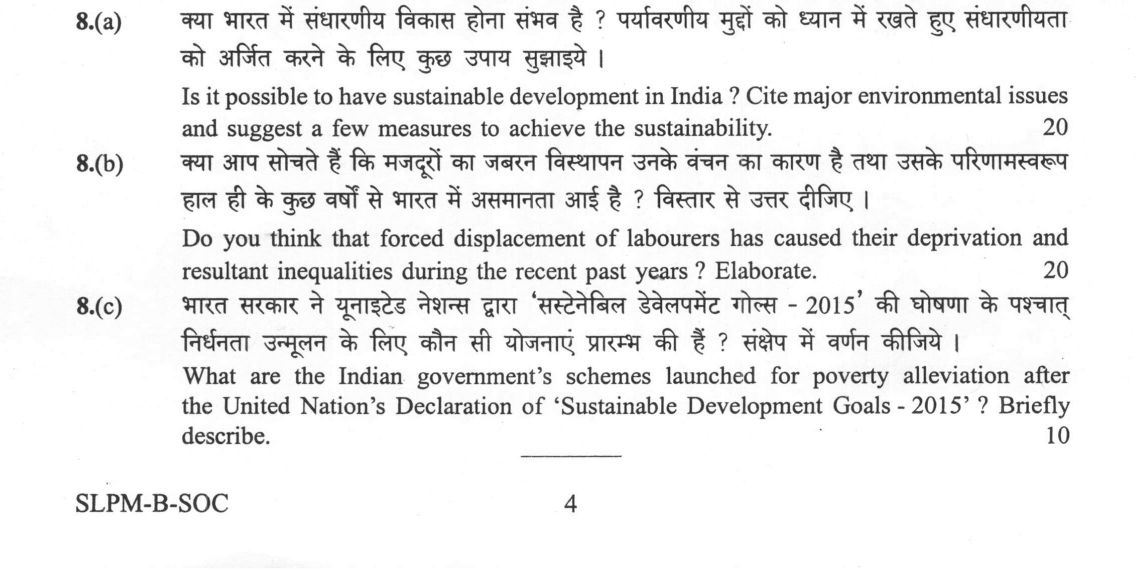
(a) Is it possible to have sustainable development in India? Cite major environmental issues and suggest a few measures to…
Is it possible to have sustainable development in India? Cite major environmental issues and suggest a few measures to achieve the sustainability. 20 marks
Do you think that forced displacement of labourers has caused their deprivation and resultant inequalities during the recent past years? Elaborate. 20 marks
What are the Indian government's schemes launched for poverty alleviation after the United Nation's Declaration of 'Sustainable Development Goals - 2015'? Briefly describe. 10 marks
हिंदी में प्रश्न पढ़ें
क्या भारत में संधारणीय विकास होना संभव है ? पर्यावरणीय मुद्दों को ध्यान में रखते हुए संधारणीयता को अर्जित करने के लिए कुछ उपाय सुझाइये । (20 अंक)
क्या आप सोचते हैं कि मजदूरों का जबरन विस्थापन उनके वंचन का कारण है तथा उसके परिणामस्वरूप हाल ही के कुछ वर्षों से भारत में असमानता आई है ? विस्तार से उत्तर दीजिए । (20 अंक)
भारत सरकार ने यूनाइटेड नेशंस द्वारा 'सस्टेनेबल डेवलपमेंट गोल्स - 2015' की घोषणा के पश्चात् निर्धनता उन्मूलन के लिए कौन सी योजनाएं प्रारंभ की हैं ? संक्षेप में वर्णन कीजिए । (10 अंक)
Model answer
Written by UPSC Answer Check against this question's marking rubric, to the expected length. UPSC does not publish answers for Mains — this is one way to score well, not an official key.
Sustainable development in India Sustainable development in India is possible, but only if growth is redefined as capability expansion rather than mere output increase. The Brundtland Report’s idea of meeting present needs without compromising future generations, and Amartya Sen’s “Development as Freedom”, provide the normative base: development must enlarge health, education, political voice and environmental security. India’s SDG localisation framework, which maps national targets to states and districts, shows institutional intent, but feasibility is tested by acute ecological constraints. Major environmental issues include air pollution in NCAP cities, where particulate matter exceeds safe limits for much of the year; water stress highlighted by the NITI Aayog Composite Water Management Index, with many districts in severe or critical stress; land degradation from over-extraction, salinity and soil erosion; and climate vulnerability in coastal, Himalayan and drought-prone regions. These problems do not make sustainability impossible, but they require a shift from extractive expansion to regenerative planning. Measures must combine circular economy principles—reduce, reuse, recycle and design out waste—with the National Green Hydrogen Mission to decarbonise industry and transport. Agriculture needs climate-smart practices such as drip irrigation, crop diversification and soil health management. Environmental Impact Assessment reforms should make public participation meaningful and enforce post-project monitoring. Equally important is integrating traditional ecological knowledge, such as watershed management and community forest practices, into policy.
Displacement, deprivation and inequality Forced displacement of labourers in recent years has indeed deepened deprivation and inequality. Displacement has occurred through SEZs, dam projects, mining leases, urban renewal under Smart Cities, and infrastructure corridors. Cases such as Sardar Sarovar, the POSCO steel-plant project in Odisha with associated mining lease demands, and Dholera show how land acquisition severs livelihoods. The deprivation pathway is not merely loss of land. Displaced workers lose common property resources—forests, ponds, grazing land—that previously provided food, fodder and informal income. They are then absorbed into informal labour markets with irregular wages, no social security and precarious housing. Broken social networks weaken mutual aid, credit and childcare, while cultural dislocation erodes identity and community cohesion. Fernandes’s work on displacement and Dreze-Sen’s framework of capabilities show that deprivation is multidimensional: it reduces freedom, not just income. Resultant inequalities include assetlessness, where landless workers cannot accumulate capital; education disruption, as children miss schooling during relocation; blockage of intergenerational mobility, because skills and networks are not transferred; and gendered impacts, where women workers face longer care burdens, unsafe commuting, and loss of self-employment in agriculture or home-based work. Thus displacement converts temporary labour migration into permanent vulnerability.
Post-2015 poverty alleviation schemes After the 2015 SDGs, India launched several poverty-alleviation schemes and strengthened existing social protection, aligned with SDG-1 (no poverty) and SDG-2 (zero hunger). PM-KISAN provides income support to small and marginal farmers. Ayushman Bharat expands health insurance, reducing out-of-pocket expenditure. Jal Jeevan Mission targets household tap water supply, linking water access to health and productivity. SVAMITVA uses geospatial mapping to help rural households secure property rights, enabling credit. The post-2015 expansion of NSAP, though the programme itself predates 2015, has strengthened old-age, widow and disability pensions. However, critical assessment is necessary. Coverage gaps remain due to weak data, exclusion errors, and informal workers missing from formal registers. Fiscal sustainability is a concern, especially for cash transfers and insurance. Convergence with MGNREGA is uneven: wage work can coexist with asset creation, but if displacement removes local works or if labourers are away, the guarantee is weakened.
Thus, sustainable development in India is possible but conditional on ecological limits and social justice. Environmental degradation and forced displacement are not separate problems; both reduce capabilities and entrench inequality. A way forward is inclusive development that combines green industrial policy, climate-resilient agriculture, meaningful displacement rehabilitation, and robust social protection, ensuring that growth expands freedom for labourers, farmers and vulnerable communities alike.
What "Elaborate" is asking you to do
Give the full detailed account the question has compressed into a line — every dimension of it, with specifics. Elaborate rewards completeness and detail rather than clarification or argument: the examiner is checking whether you can fill out a topic without being told what its parts are.
Structure that answers it
State the proposition → first dimension in detail → second dimension in detail → the part the statement leaves implicit → the consolidated picture
Where marks are lost
Repeating the statement at greater length instead of adding substance. Elaborate also punishes narrowness: omitting a whole dimension costs more here than anywhere else in this family.
How this answer will be evaluated
Approach
Framework: Sociology Paper II: Social Development & Welfare. (a) suggest: the problem in one line > implementable measures > who acts > conclusion | (b) examine: intro > how/why with reasoning > evidence > conclusion | (c) describe: define > structure or process in order > labelled diagram > significance Full marks: Precise Indian context, specific schemes/data, clear analytical linkages, balanced judgment.
Key points expected
- Define sustainable development in Indian context
- Cite 3-4 major environmental issues (e.g., air/water pollution)
- Suggest specific measures for sustainability
- Conclude on feasibility with balanced judgment
- Define forced displacement in recent context (e.g., pandemic)
- Explain mechanisms of deprivation (loss of income/assets)
- Link displacement to structural inequalities
- Provide specific examples of affected labourers
Evaluation rubric
Each sub-part is marked on its own, against the marks and word limit printed on the paper.
- (a) Assess feasibility of sustainable development in India via environmental issues and measures. 20 marks
suggest— the problem in one line → implementable measures → who acts → conclusion
Must cover
- Define sustainable development in Indian context
- Cite 3-4 major environmental issues (e.g., air/water pollution)
- Suggest specific measures for sustainability
- Conclude on feasibility with balanced judgment
Loses marks
- Generic environmentalism without Indian context
- Listing issues without linking to development
Earns more
- Reference to SDG 13 or 15
- Mention of specific Indian environmental laws
- Use of data on pollution levels
Extra mark
- Citing specific pollution index data
- Reference to recent Supreme Court judgments
- (b) Analyze the link between forced displacement of labourers and resulting inequalities. 20 marks
examine— intro → how/why with reasoning → evidence → conclusion
Must cover
- Define forced displacement in recent context (e.g., pandemic)
- Explain mechanisms of deprivation (loss of income/assets)
- Link displacement to structural inequalities
- Provide specific examples of affected labourers
Loses marks
- Generalizing without specific recent examples
- Ignoring the 'inequality' aspect of the question
Earns more
- Reference to PLFS or NFHS data
- Mention of specific migrant worker groups
- Discussion of social safety net failures
Extra mark
- Citing specific government relief scheme data
- Reference to specific sociological studies on migration
- (c) List and describe Indian government poverty alleviation schemes post-2015 SDGs. 10 marks
describe— define → structure or process in order → labelled diagram → significance
Must cover
- Identify 3-4 specific schemes post-2015
- Briefly describe the objective of each scheme
- Link schemes to poverty alleviation goals
Loses marks
- Listing pre-2015 schemes
- Vague descriptions without specific scheme names
Earns more
- Mentioning specific target groups of schemes
- Referencing specific SDG goals addressed
Extra mark
- Citing specific budget allocations for schemes
- Mentioning specific implementation agencies
Practice this exact question
Write your answer and it is marked point by point against the model answer above — what you covered, what you missed, what you got wrong.
Evaluate my answer →More from Sociology 2025 Paper II
- Q5 Answer the following questions in about 150 words each: (a) 'The transfer of land from cu…
- Q6 (a) In what respects have the constitutional provisions changed the socio-economic and po…
- Q7 (a) What are the Private and Public network and support systems operative in Indian socie…
- Q8 (a) Is it possible to have sustainable development in India? Cite major environmental iss…