Paper II — Q5
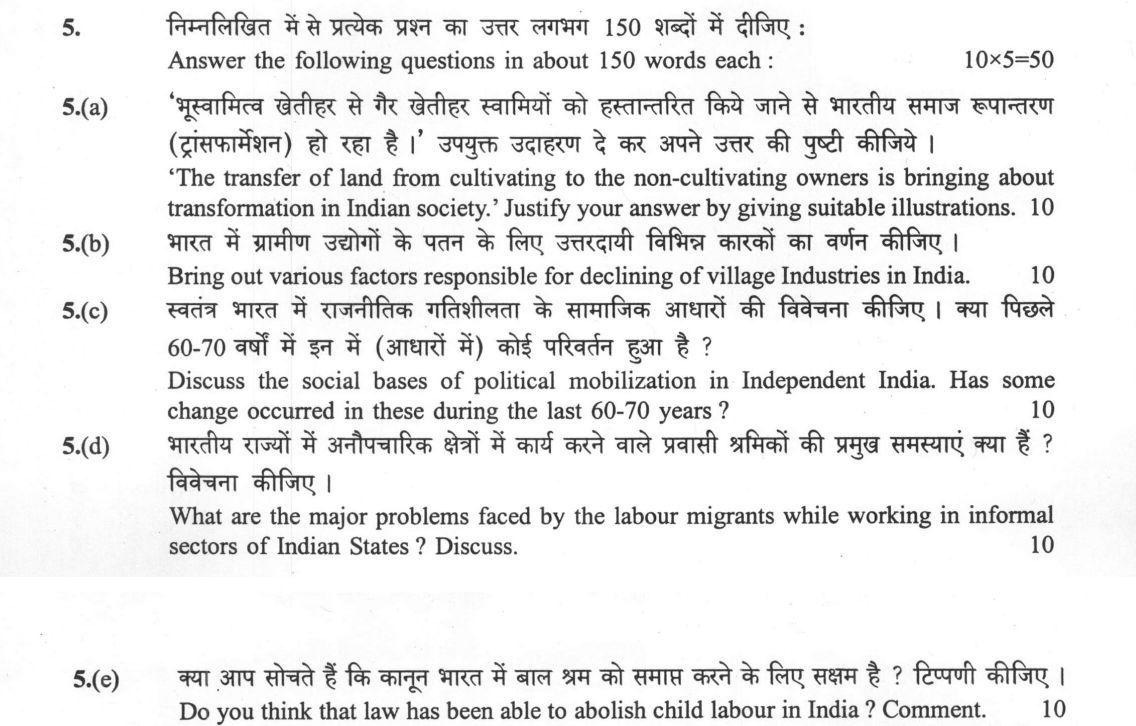
Answer the following questions in about 150 words each: (a) 'The transfer of land from cultivating to the non-cultivating owners…
Answer the following questions in about 150 words each:
'The transfer of land from cultivating to the non-cultivating owners is bringing about transformation in Indian society.' Justify your answer by giving suitable illustrations. 10 marks
Bring out various factors responsible for declining of village Industries in India. 10 marks
Discuss the social bases of political mobilization in Independent India. Has some change occurred in these during the last 60-70 years? 10 marks
What are the major problems faced by the labour migrants while working in informal sectors of Indian States? Discuss. 10 marks
Do you think that law has been able to abolish child labour in India? Comment. 10 marks
हिंदी में प्रश्न पढ़ें
निम्नलिखित में से प्रत्येक प्रश्न का उत्तर लगभग 150 शब्दों में दीजिए :
'भूस्वामित्व खेतिहर से गैर खेतिहर स्वामियों को हस्तांतरित किये जाने से भारतीय समाज रूपांतरण (ट्रांसफॉर्मेशन) हो रहा है ।' उपयुक्त उदाहरण दे कर अपने उत्तर की पुष्टि कीजिए । (10 अंक)
भारत में ग्रामीण उद्योगों के पतन के लिए उत्तरदायी विभिन्न कारकों का वर्णन कीजिए । (10 अंक)
स्वतंत्र भारत में राजनीतिक गतिशीलता के सामाजिक आधारों की विवेचना कीजिए । क्या पिछले 60-70 वर्षों में इन में (आधारों में) कोई परिवर्तन हुआ है ? (10 अंक)
भारतीय राज्यों में अनौपचारिक क्षेत्रों में कार्य करने वाले प्रवासी श्रमिकों की प्रमुख समस्याएं क्या हैं ? विवेचना कीजिए । (10 अंक)
क्या आप सोचते हैं कि कानून भारत में बाल श्रम को समाप्त करने के लिए सक्षम है ? टिप्पणी कीजिए । (10 अंक)
Model answer
Written by UPSC Answer Check against this question's marking rubric, to the 150-word length. UPSC does not publish answers for Mains — this is one way to score well, not an official key.
(a) The transfer of land from cultivating peasants to non-cultivating owners represents a profound structural transformation in rural India, fundamentally altering agrarian social relations. Viewed through the Marxist lens of agrarian transition and depeasantization, this process dissolves traditional peasant autonomy and accelerates class polarization. In the Green Revolution belt of Punjab and Haryana, the penetration of agrarian capitalism has encouraged land consolidation by wealthy non-cultivating investors and large commercial farmers, turning marginal peasants into landless agricultural wage labourers or pushing them into distress leasing. Conversely, in states like Bihar and eastern Uttar Pradesh, the persistence and resurgence of non-cultivating absentee landlords sustains semi-feudal relations, where trapped smallholders cultivate land under exploitative informal tenancy and debt-bondage. Furthermore, contemporary land acquisitions by non-cultivating corporate and real-estate entities dispossess cultivating castes, eroding traditional agrarian institutions like the jajmani system and replacing customary reciprocal ties with contractual, commodified, and insecure labor regimes.
(b) The structural decline of village industries in India stems from an interplay of economic transformations and shifting social organization. Economically, village industries suffer from severe technological obsolescence, as traditional artisanal techniques cannot match the scale, standardization, and cost-efficiency of mechanized mass production. This is compounded by acute credit squeezes, where formal institutional finance remains inaccessible, forcing rural artisans into usurious informal debt. Simultaneously, large corporate enterprises have monopolized raw materials, such as raw silk, yarn, and leather, inflating input costs for rural workers. The influx of cheap consumer goods from the organized sector has dismantled local village markets. Sociologically, the weakening of hereditary caste-based occupational structures and the decline of the jajmani network have led younger generations of traditional artisan castes—such as potters, weavers, and blacksmiths—to desert unremunerative hereditary crafts in search of non-farm informal urban employment, cementing rural de-industrialization.
(c) The social bases of political mobilization in independent India were historically anchored in the intersections of caste, class, and region. In early post-independence decades, mobilization functioned under the Congress system, a grand umbrella coalition balancing upper-caste elites with clientelist lower-caste and minority vote banks. Class mobilization emerged prominently in regions like Kerala and West Bengal through organized Left peasant and labour movements, while regional-linguistic identities drove powerful mobilizations, such as the Dravidian movement in Tamil Nadu. Over the last six to seven decades, this landscape has transitioned decisively from a single-dominant party system to competitive, multi-polar mobilization. The 1980s and 1990s witnessed the political assertion of Other Backward Classes (OBCs) via Mandal politics and Dalit assertion through parties like the BSP. In the contemporary phase, mobilization has evolved further through cross-caste religious consolidation by the BJP, combined with the strategic sub-categorization of non-dominant OBCs and Dalits, and the creation of a cross-cutting welfare-recipient class.
(d) Labour migrants in the informal sectors of Indian states confront systemic vulnerabilities conceptualized by Jan Breman as "footloose labour" and Barbara Harriss-White as the informalized economy. First, migrants suffer from a severe absence of social security, working without written contracts, accident insurance, or retirement provisions. Second, they face frequent wage theft, arbitrary deductions, and sub-minimum wages mediated through exploitative labour contractors (sardars/thekedars). Third, housing precarity is pervasive, with migrants confined to unhygienic worksites, open brick kilns, or squatter settlements lacking potable water and sanitation. Fourth, interstate migrants face welfare exclusion, as administrative boundaries and lack of local domicile proof historically barred them from accessing subsidized food grains, public healthcare, and state-specific safety nets. Finally, the prevalence of seasonal and circular migration disrupts family cohesion, leaving elderly dependents isolated and forcing children to drop out of school, thereby reproducing intergenerational poverty and marginalization.
(e) Law has not been able to completely abolish child labour in India, serving instead as a regulatory framework constrained by structural contradictions. The Child Labour (Prohibition and Regulation) Amendment Act, 2016, while banning the employment of children below 14 years in all occupations, introduced a major loophole by permitting work in "family enterprises" outside school hours. This exception legitimizes home-based child labour in unorganized supply chains such as bidi-rolling, carpet-weaving, and bangle-making. Furthermore, enforcement remains severely crippled by weak administrative surveillance, low inspection frequencies, and minimal conviction rates. Sociologically, child labour is sustained by chronic household poverty, adult underemployment, and social inequality, which compel families to treat children as economic assets. Persisting statistics from the ILO and UNICEF demonstrate that millions of Indian children remain trapped in informal, invisible sectors. Thus, statutory prohibition remains largely symbolic unless backed by universal living wages for adult labourers, comprehensive social security, and robust school-retention infrastructure.
What "Discuss" is asking you to do
Lay the issue out from more than one side — how it arose, what is claimed for it, what is held against it, and where it now stands. UPSC attaches discuss to broad topics with several live dimensions, so coverage of the dimensions earns more than the strength of your opinion.
Structure that answers it
Set the issue up → the case as it is made → the case against → the dimension both sides leave out → where the balance now lies
Where marks are lost
Listing facts with no thread between them, or arguing one side throughout and calling it a discussion.
How this answer will be evaluated
Approach
Framework: Sociology Paper II (UPSC). (a) justify: claim > 3-4 reasons > evidence > conclusion | (b) account for: state the phenomenon > the causes in order of weight > conclusion | (c) discuss: intro > 3-4 dimensions > example > balanced close | (d) discuss: intro > 3-4 dimensions > example > balanced close | (e) comment: context > arguments both sides > judgment > close Full marks: Comprehensive, well-structured answers with specific examples, data, and balanced analysis.
Key points expected
- Define the phenomenon of land transfer to non-cultivating owners
- Provide 3-4 reasons for social transformation
- Give suitable illustrations of this transformation
- Conclude with a balanced assessment
- State the phenomenon of declining village industries
- List 3-4 major factors in order of weight
- Provide evidence or examples for each factor
- Conclude with the overall impact
Evaluation rubric
Each sub-part is marked on its own, against the marks and word limit printed on the paper.
- (a) Justify the claim that land transfer to non-cultivating owners transforms Indian society. 10 marks · 150 words
justify— claim → 3-4 reasons → evidence → conclusion
Must cover
- Define the phenomenon of land transfer to non-cultivating owners
- Provide 3-4 reasons for social transformation
- Give suitable illustrations of this transformation
- Conclude with a balanced assessment
Loses marks
- Vague generalizations without specific illustrations
- Confusing land transfer with land acquisition
- Ignoring the 'transformation' aspect of the question
Earns more
- Reference to land ceiling laws or their failure
- Mention of specific regions or states
- Discussion of agrarian class structure changes
- Reference to economic or political consequences
Extra mark
- Cite specific land reform data or statistics
- Reference to a specific sociological study or report
- (b) Explain the factors responsible for the decline of village industries in India. 10 marks · 150 words
account for— state the phenomenon → the causes in order of weight → conclusion
Must cover
- State the phenomenon of declining village industries
- List 3-4 major factors in order of weight
- Provide evidence or examples for each factor
- Conclude with the overall impact
Loses marks
- Listing factors without explaining their impact
- Ignoring the 'village' context and discussing general industry
- Vague statements without specific evidence
Earns more
- Mention of competition from large-scale industries
- Reference to lack of credit or infrastructure
- Discussion of technological obsolescence
- Mention of policy failures or market changes
Extra mark
- Cite specific village industry data or case studies
- Reference to a specific government report or study
- (c) Discuss the social bases of political mobilization in Independent India and changes over 60-70 years. 10 marks · 150 words
discuss— intro → 3-4 dimensions → example → balanced close
Must cover
- Define social bases of political mobilization
- Identify 3-4 key social bases (e.g., caste, class, religion)
- Discuss changes in these bases over the last 60-70 years
- Provide examples of political mobilization
Loses marks
- Ignoring the 'change' aspect of the question
- Vague generalizations without specific examples
- Confusing social bases with political ideologies
Earns more
- Reference to caste-based political mobilization
- Mention of class-based or regional mobilization
- Discussion of the role of social movements
- Reference to specific political parties or leaders
Extra mark
- Cite specific election data or polling results
- Reference to a specific sociological theory or thinker
- (d) Discuss the major problems faced by labour migrants in informal sectors of Indian States. 10 marks · 150 words
discuss— intro → 3-4 dimensions → example → balanced close
Must cover
- Define labour migrants and informal sectors
- Identify 3-4 major problems faced by labour migrants
- Provide examples or evidence for each problem
- Conclude with the overall impact on migrants
Loses marks
- Ignoring the 'informal sector' context
- Vague generalizations without specific examples
- Confusing labour migrants with other types of migrants
Earns more
- Mention of exploitation and low wages
- Reference to lack of social security or benefits
- Discussion of discrimination or social exclusion
- Mention of poor working conditions or health issues
Extra mark
- Cite specific labour migration data or case studies
- Reference to a specific government report or study
- (e) Comment on whether law has been able to abolish child labour in India. 10 marks · 150 words
comment— context → arguments both sides → judgment → close
Must cover
- Provide context on child labour in India
- Present arguments for the effectiveness of law
- Present arguments against the effectiveness of law
- Provide a balanced judgment on the issue
Loses marks
- One-sided argument without considering both perspectives
- Vague generalizations without specific legal references
- Ignoring the 'abolish' aspect of the question
Earns more
- Reference to the Child Labour (Prohibition and Regulation) Act
- Mention of specific legal provisions or amendments
- Discussion of enforcement challenges or gaps
- Reference to specific cases or examples
Extra mark
- Cite specific child labour data or statistics
- Reference to a specific court judgment or legal case
Practice this exact question
Write your answer and it is marked point by point against the model answer above — what you covered, what you missed, what you got wrong.
Evaluate my answer →More from Sociology 2025 Paper II
- Q2 (a) Do you think that in a society like India orthogenetic changes take place through dif…
- Q3 (a) What do you mean by nation building? What is the role of religion in nation building?…
- Q4 (a) Who is said to be the pioneer of village studies in India? Illustratively describe co…
- Q5 Answer the following questions in about 150 words each: (a) 'The transfer of land from cu…
- Q6 (a) In what respects have the constitutional provisions changed the socio-economic and po…
- Q7 (a) What are the Private and Public network and support systems operative in Indian socie…
- Q8 (a) Is it possible to have sustainable development in India? Cite major environmental iss…