Paper I — Q1
(a) In what ways do class and caste intersect and overlap in shaping social structure ? (10 marks) (b) Critically examine the…
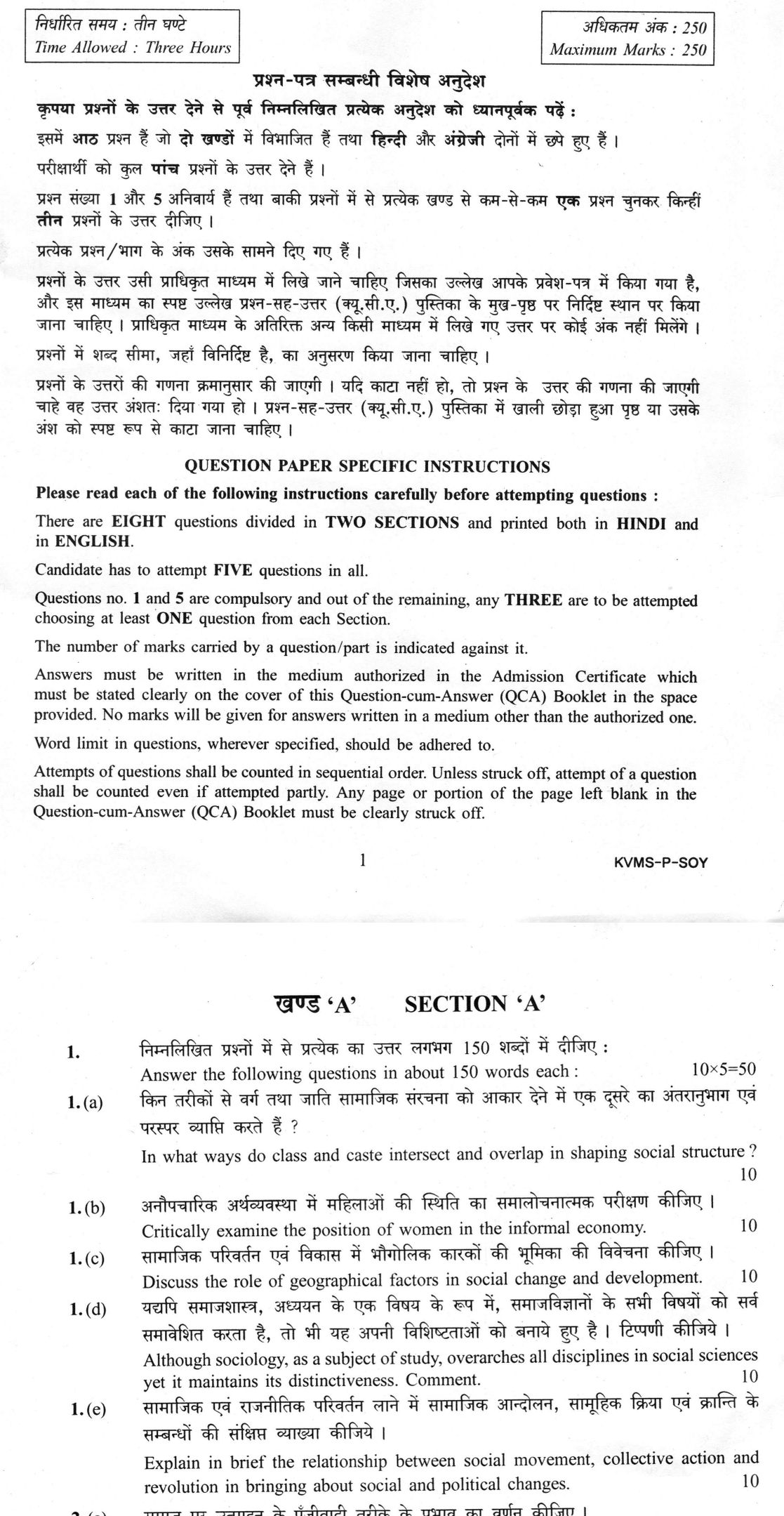
Answer the following questions in about 150 words each :
In what ways do class and caste intersect and overlap in shaping social structure ? 10 marks
Critically examine the position of women in the informal economy. 10 marks
Discuss the role of geographical factors in social change and development. 10 marks
Although sociology, as a subject of study, overarches all disciplines in social sciences yet it maintains its distinctiveness. Comment. 10 marks
Explain in brief the relationship between social movement, collective action and revolution in bringing about social and political changes. 10 marks
हिंदी में प्रश्न पढ़ें
निम्नलिखित प्रश्नों में से प्रत्येक का उत्तर लगभग 150 शब्दों में दीजिए :
किन तरीकों से वर्ग तथा जाति सामाजिक संरचना को आकार देने में एक दूसरे का अंतरानुभाग एवं परस्पर व्याप्त करते हैं ? (10 अंक)
अनौपचारिक अर्थव्यवस्था में महिलाओं की स्थिति का समालोचनात्मक परीक्षण कीजिए । (10 अंक)
सामाजिक परिवर्तन एवं विकास में भौगोलिक कारकों की भूमिका की विवेचना कीजिए । (10 अंक)
यद्यपि समाजशास्त्र, अध्ययन के एक विषय के रूप में, समाजविज्ञानों के सभी विषयों को सर्व समावेशित करता है, तो भी यह अपनी विशिष्टताओं को बनाये हुए है । टिप्पणी कीजिए । (10 अंक)
सामाजिक एवं राजनीतिक परिवर्तन लाने में सामाजिक आन्दोलन, सामूहिक क्रिया एवं क्रान्ति के सम्बन्धों की संक्षिप्त व्याख्या कीजिये । (10 अंक)
Model answer
Drafted with AI by UPSC Answer Check against this question's marking rubric, to the 150-word length. UPSC does not publish answers for Mains — this is one way to score well, not an official key. How we build rubrics and answers.
(a) Caste and class in social structure
Two distinct orders: caste is an ascribed, endogamous status order ranked by purity and pollution (Louis Dumont, Homo Hierarchicus, 1966); Max Weber (The Religion of India) saw it as the most closed status group. Class is an achieved economic position set by relation to the means of production (Marx) or by market situation (Weber).
Where they overlap:
- ritual rank historically tracked control of land: upper castes became landlords, while Dalits and Adivasis remain largely landless;
- B.R. Ambedkar called caste an "enclosed class" within a system of graded inequality;
- M.N. Srinivas's dominant caste fuses numbers, land and power, and Sanskritisation converts new wealth into ritual claims.
Where they come apart: André Béteille's study of Sripuram (Caste, Class and Power, 1965) showed the dissociation of caste, class and power: poor Brahmins, prosperous non-Brahmins, and power passing to numerically strong groups. Reservations and a new Dalit middle class loosen the overlap, but endogamy keeps it alive.
Conclusion: social structure here is an interaction of caste, class and power, not of class (Marx) or ritual (Dumont) alone.
(b) Women in the informal economy
Scale: over nine-tenths of India's women workers are informal (NCEUS, 2007), concentrated in home-based piece work, domestic service, construction, vending and unpaid family labour.
Why: Maria Mies's housewifisation (the Narsapur lace makers) shows how defining women as housewives lets capital buy their labour cheaply; Guy Standing describes the feminisation of labour under flexible employment.
Disadvantages: wage gaps, no maternity or social security, harassment at unregulated worksites, statistical invisibility of unpaid work, and the double burden of paid and care work.
The other side: organisation can transform informality: SEWA (Ela Bhatt, 1972), self-help groups, and MGNREGA worksites (now succeeded by the VB-G RAM G Act, 2025). Naila Kabeer shows that paid work empowers only under certain conditions; Bina Agarwal (A Field of One's Own, 1994) stresses land and asset rights.
Policy: the Unorganised Workers' Social Security Act, 2008 and the Code on Social Security, 2020 (in force since 21 November 2025) extend coverage, but implementation is weak. Women's position is structurally produced, so social security and asset rights are the real test.
(c) Geography, social change and development
Determinism: Ibn Khaldun linked desert life to asabiyyah; Montesquieu (The Spirit of the Laws, 1748) tied climate to temperament and government; Ellsworth Huntington (Civilization and Climate, 1915) made climate causal.
Structural links: Karl Wittfogel (Oriental Despotism, 1957) argued that hydraulic societies, dependent on large-scale irrigation, produce centralised bureaucratic states, echoing Marx's Asiatic mode of production.
Possibilism and critique: Vidal de la Blache and Lucien Febvre held that nature offers possibilities from which culture chooses; Durkheim's social morphology treats the physical substratum as socially organised. Crude determinism also served colonial racial hierarchies.
Modern evidence: Jared Diamond (Guns, Germs and Steel, 1997) links continental axes and domesticable species to uneven development; resource wealth can become a "resource curse".
India: Gadgil and Guha (This Fissured Land, 1992) trace how control of resources shaped social order; canal-irrigated Punjab gained most from the Green Revolution; dams displace tribal communities.
Conclusion: geography conditions change through technology, institutions and power; it does not determine it.
(d) Sociology and the other social sciences
Why it overarches: Auguste Comte, who coined the term (1839), placed sociology at the apex of his hierarchy of sciences because society is the most complex object. Other disciplines study institutionalised segments of social relations.
Productive overlaps: with economics, Weber's Protestant Ethic (1904–05) and the embeddedness of markets (Polanyi, 1944; Granovetter, 1985); with political science, Weber on authority; with history, C. Wright Mills's sociological imagination (1959); with anthropology, Radcliffe-Brown's "comparative sociology".
What keeps it distinct:
- subject matter: society as a whole, its structure, institutions and interaction, not one segment such as price or power;
- method: Durkheim's Rules of Sociological Method (1895) treats social facts as external, constraining and sui generis, so sociology cannot be reduced to psychology; Weber's verstehen and ideal types; the comparative method;
- reflexivity: Mannheim's sociology of knowledge.
Conclusion: the overlap is interdependence, not loss of identity; a holistic unit of analysis and distinctive concepts preserve sociology's autonomy.
(e) Collective action, social movement and revolution
Definitions: collective action is joint action on a shared interest; a social movement is sustained, organised collective action guided by ideology; a revolution is a rapid, fundamental transformation of state and class structure. They lie on a continuum of organisation, duration and radicalism.
Collective action: Mancur Olson (1965) explained the free-rider problem; Neil Smelser's value-added theory (1962) specified when grievance becomes mobilisation.
Social movements: McCarthy and Zald's resource mobilisation (1977), McAdam's political opportunity (1982) and Charles Tilly's repertoires of contention explain how episodic action becomes durable pressure.
Revolution: Marx tied it to class struggle; James Davies (J-curve) and Ted Gurr (Why Men Rebel, 1970) to relative deprivation; Theda Skocpol (States and Social Revolutions, 1979) to state breakdown.
Relationship: movements may institutionalise into parties and policy, as India's national movement did, or rarely escalate into revolution; new social movements (Touraine, Melucci) seek cultural change instead, as in Chipko and the Narmada Bachao Andolan (M.S.A. Rao; Ghanshyam Shah).
Collective action supplies energy and movements organisation; revolution follows when this pressure meets a state in crisis.
How this answer will be evaluated
Evaluation rubric
Each sub-part is marked on its own, against the marks and word limit printed on the paper.
- (a) 'In what ways' asks for identified mechanisms, not a general essay: the candidate must show the specific points at which class (economic, achieved, open) and caste (ritual, ascribed, closed) intersect and overlap in producing social structure. Both convergence (caste-class correspondence) and divergence (decomposition/dissociation) must appear. 10 marks · 150 words
Must cover
- Max Weber — caste as status group (The Religion of India)
- Karl Marx — class as relation to means of production
- Andre Beteille — Caste, Class and Power (1965), Sripuram
- M.N. Srinivas — dominant caste, Sanskritisation
- Louis Dumont — Homo Hierarchicus (1966), purity and pollution
- B.R. Ambedkar — caste as 'enclosed class', graded inequality
Loses marks
- Writing two separate descriptions of caste and of class without ever showing the points of intersection asked for
- Asserting a total caste-class correspondence and ignoring Beteille's evidence of decomposition (or the reverse — claiming caste is now irrelevant)
- Attributing 'dominant caste' to Beteille or 'decomposition' to Srinivas — the attributions must be exact
- Turning the answer into a political commentary on reservations with no sociological concepts
- Exceeding 150 words with a long historical account of varna origins
Earns more
- Mechanisms of intersection: M.N. Srinivas's dominant caste and Sanskritisation; caste as social/economic capital and network in business and labour markets
- Contemporary illustration: new Dalit middle class / Dalit entrepreneurs, reservation-led mobility, OBC assertion and Mandal politics, caste-class intersection with gender through endogamy
Extra mark
- Illustrates the dominant caste with Srinivas's Okkaligas of Rampura, or cites evidence of a Dalit middle class/Dalit entrepreneurship (e.g., DICCI) to show caste-class dissociation
- (b) 'Critically examine' requires both sides: the concentration of women in informal work and the reasons for it, and an assessment of whether informality is only exploitation or also an opening for agency. The unit of analysis is women's position — segregation, wages, security, recognition and organisation. 10 marks · 150 words
Must cover
- NCEUS (Arjun Sengupta Committee, 2007) — unorganised sector
- Maria Mies — housewifisation; Narsapur lace makers
- SEWA — Ela Bhatt, 1972
- Guy Standing — feminisation of labour through flexibilisation
- Bina Agarwal — A Field of One's Own (1994)
- Naila Kabeer — agency and empowerment
- Unorganised Workers' Social Security Act, 2008 / Code on Social Security, 2020
Loses marks
- A purely descriptive lament with no theory and no named scholar
- Quoting precise percentages or PLFS figures wrongly; safer to state the order of magnitude ('over nine-tenths of women workers are informal') than to invent a decimal
- Ignoring the 'critically' directive by presenting only victimhood and omitting agency, SEWA-type organisation or the flexibility argument
- Confusing the informal sector (type of enterprise) with informal employment (type of work relation, which also exists inside formal firms)
- Attributing housewifisation to someone other than Maria Mies, or SEWA to someone other than Ela Bhatt
Earns more
- Critical/other side: agency and collective organisation — SEWA (Ela Bhatt, 1972), self-help groups, MGNREGA (now succeeded by the VB-G RAM G Act, 2025), Naila Kabeer on conditions under which paid work empowers
- Legal-policy frame: Unorganised Workers' Social Security Act 2008 / Code on Social Security 2020, and Bina Agarwal's argument that land and asset rights matter more than employment alone
Extra mark
- Notes that the Code on Social Security, 2020, in force from 21 November 2025, extends coverage to gig and platform workers, and mentions the e-Shram portal for registering unorganised workers
- (c) 'Discuss the role of geographical factors' requires the candidate to state how physical environment, climate, terrain, resources and location act as factors of social change and development, and to weigh determinist against possibilist and political-ecology positions rather than merely listing examples. 10 marks · 150 words
Must cover
- Montesquieu — The Spirit of the Laws (1748), climate theory
- Ellsworth Huntington — Civilization and Climate (1915)
- Karl Wittfogel — Oriental Despotism (1957), hydraulic society
- Vidal de la Blache / Lucien Febvre — possibilism
- Emile Durkheim — social morphology
- Jared Diamond — Guns, Germs and Steel (1997)
- Madhav Gadgil and Ramachandra Guha — This Fissured Land (1992)
Loses marks
- Endorsing crude environmental determinism without noting its discredited, racialised colonial use
- Writing a geography answer (monsoon, soil types) with no sociological concept or thinker
- Attributing 'hydraulic society' to Marx rather than Wittfogel, or 'possibilism' to Ratzel rather than Vidal de la Blache
- Giving only foreign examples and none from India
- Omitting the evaluative balance the directive 'discuss' implies
Earns more
- Wittfogel's hydraulic society / Oriental Despotism (1957) and Marx's Asiatic mode of production as a structural link between terrain, irrigation and state form
- Contemporary/empirical illustration: Diamond's Guns, Germs and Steel (1997), resource endowment and resource curse, location and port-led urbanisation
Extra mark
- Gadgil and Guha's classification of 'ecosystem people, omnivores and ecological refugees' (Ecology and Equity, 1995) as an Indian illustration of geography mediated by power
- (d) 'Comment' on a two-part claim: that sociology overarches all the social sciences, and that it nevertheless keeps a distinct identity. Both halves must be argued — the breadth of sociology's subject matter and its relation with economics, political science, history, psychology and anthropology, and the specific perspective, unit of analysis and method that make it distinct. 10 marks · 150 words
Must cover
- Auguste Comte — coined 'sociology' (1839), hierarchy of sciences
- Emile Durkheim — The Rules of Sociological Method (1895), social facts sui generis
- Max Weber — verstehen, ideal type, The Protestant Ethic and the Spirit of Capitalism (1904-05)
- C. Wright Mills — The Sociological Imagination (1959)
- A.R. Radcliffe-Brown — social anthropology as comparative sociology
- Karl Polanyi / Mark Granovetter — embeddedness of economic action
Loses marks
- Producing a memorised list of 'sociology and economics / sociology and history' with no argument about distinctiveness — only half the question answered
- Claiming sociology is the 'mother of all social sciences' as a slogan without Comte's actual hierarchy or any reasoning
- Attributing 'social facts' to Comte or 'sociological imagination' to Weber
- Ignoring the distinguishing method (social fact, verstehen, comparative method) and resting distinctiveness on subject matter alone
- Writing a textbook definition-heavy answer with no named work
Earns more
- Distinctiveness of subject matter: society as a whole, social structure, institutions and social relationships, rather than one segment of behaviour
- Reflexive distinctiveness and balanced verdict: sociology of knowledge (Mannheim), sociology of sociology, overlap read as interdependence not loss of identity
Extra mark
- Brings in the Indian debate on sociology and social anthropology, e.g., Dumont and Pocock's call for a 'sociology of India' (Contributions to Indian Sociology, 1957)
- (e) 'Explain in brief the relationship' among three distinct concepts — social movement, collective action and revolution — and their role in producing social and political change. The answer must define each, place them on a continuum of organisation and radicalism, and show how one can become another. 10 marks · 150 words
Must cover
- Neil Smelser — Theory of Collective Behavior (1962), value-added theory
- Mancur Olson — The Logic of Collective Action (1965), free-rider problem
- McCarthy and Zald — resource mobilisation theory (1977)
- Charles Tilly — repertoires of contention, From Mobilization to Revolution (1978)
- Theda Skocpol — States and Social Revolutions (1979)
- Ted Gurr — Why Men Rebel (1970) / James Davies — J-curve
- M.S.A. Rao or Ghanshyam Shah — social movements in India
Loses marks
- Treating the three terms as synonyms, or failing to state any criterion distinguishing them
- Describing movements at length and never defining revolution, or vice versa
- Misattributing resource mobilisation to Smelser or relative deprivation to Skocpol
- Listing Indian movements as the whole answer with no theory
- Assuming every social movement aims at or leads to revolution
Earns more
- States the relationship explicitly as a continuum/nesting, with the possibilities of institutionalisation (movement to party/policy) or escalation, and notes new social movements (Alain Touraine, Alberto Melucci) aiming at cultural rather than state change
- Indian illustration with correct attribution — M.S.A. Rao or Ghanshyam Shah on Indian social movements; Chipko, Narmada Bachao Andolan, Dalit or peasant movements, the national movement
Extra mark
- Illustrates institutionalisation or escalation with a correctly described case, e.g., the Self-Respect/Dravidian movement giving rise to the DMK (1949), or the Russian Revolution of 1917 as escalation amid state breakdown
What "Explain" is asking you to do
Make the working of something clear — what sets it off, what follows from what, and what it produces. Explain is the Commission's mechanism word: it dominates the technical papers and the “explain why” stems, where the marks sit in the causal chain and not in the label.
Structure that answers it
State what it is → the initiating condition → the chain of cause, step by step → an instance where it plays out → what the chain produces
Where marks are lost
Describing what something looks like instead of why it works that way. Naming the stages without linking them reads as description too.
Practice this exact question
Write your answer and it is marked point by point against the model answer above — what you covered, what you missed, what you got wrong.
Evaluate my answer →More from Sociology 2026 Paper I
- Q1 Answer the following questions in about 150 words each : (a) In what ways do class and ca…
- Q2 (a) Describe the impact of capitalist mode of production on society. (20 marks) (b) Diffe…
- Q3 (a) Discuss the relationship between religion and science in modern society. Do they nece…
- Q4 (a) Elaborate major sociological theories of power. How do power elite shape the politica…