Paper I — Q2
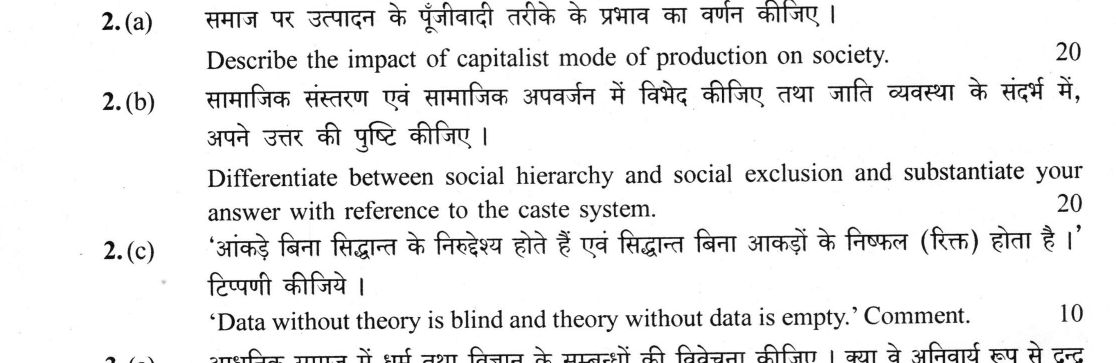
(a) Describe the impact of capitalist mode of production on society. (20 marks) (b) Differentiate between social hierarchy and…
Describe the impact of capitalist mode of production on society. 20 marks
Differentiate between social hierarchy and social exclusion and substantiate your answer with reference to the caste system. 20 marks
‘Data without theory is blind and theory without data is empty.’ Comment. 10 marks
हिंदी में प्रश्न पढ़ें
समाज पर उत्पादन के पूँजीवादी तरीके के प्रभाव का वर्णन कीजिए । (20 अंक)
सामाजिक संस्तरण एवं सामाजिक अपवर्जन में विभेद कीजिए तथा जाति व्यवस्था के संदर्भ में, अपने उत्तर की पुष्टि कीजिए । (20 अंक)
‘आँकड़े बिना सिद्धान्त के अंधे (दिशाहीन) होते हैं एवं सिद्धान्त बिना आँकड़ों के निष्फल (रिक्त) होता है ।’ टिप्पणी कीजिये । (10 अंक)
Model answer
Drafted with AI by UPSC Answer Check against this question's marking rubric, to the expected length. UPSC does not publish answers for Mains — this is one way to score well, not an official key. How we build rubrics and answers.
(a) Impact of the capitalist mode of production
What the capitalist mode of production (CMP) is: Marx (Capital, Vol. I, 1867) defined it by four features:
- private ownership of the means of production;
- labour power sold as a commodity for wages;
- production for exchange and profit (the circuit M–C–M′);
- the extraction of surplus value from wage labour.
Impact on stratification:
- the Communist Manifesto (1848) predicted a simplification of class antagonisms into bourgeoisie and proletariat, with the petty bourgeoisie sinking into the working class;
- later theorists qualified this. Dahrendorf (1959) described the decomposition of capital and labour, C. Wright Mills (White Collar, 1951) the salaried new middle class, and Erik Olin Wright the contradictory class locations of managers;
- Weber added that market capitalism ranks people by life chances, and status and party do not reduce to ownership.
Impact on work:
- alienation (Economic and Philosophic Manuscripts, 1844): the worker is estranged from the product, the labour process, their species-being and fellow workers;
- Harry Braverman (Labor and Monopoly Capital, 1974) showed deskilling under Taylorist management;
- Durkheim (The Division of Labour in Society, 1893) saw specialisation producing organic solidarity, but warned of the anomic and forced division of labour.
Impact on social relations:
- the "cash nexus" replaces personal and feudal bonds, and commodity fetishism makes relations between people appear as relations between things;
- Tönnies described the shift from Gemeinschaft to Gesellschaft (1887); Simmel (The Philosophy of Money, 1900) the calculating, blasé outlook of the money economy;
- Weber traced the spread of formal rationality and bureaucracy, the "iron cage" (The Protestant Ethic, 1904–05).
Impact on family and gender:
- the separation of home and workplace created the male breadwinner and the housewife;
- Engels (The Origin of the Family, Private Property and the State, 1884) linked monogamy to the inheritance of private property;
- Marxist feminists showed that unpaid domestic labour reproduces labour power for capital.
Impact on culture, ideology and the state:
- the "ruling ideas" are those of the ruling class (The German Ideology); Gramsci explained consent through hegemony;
- Adorno and Horkheimer's culture industry and Veblen's conspicuous consumption (1899) describe a consumer culture in which identity is bought;
- the state manages capitalism's contradictions: the Manifesto called it "a committee for managing the common affairs of the whole bourgeoisie". Polanyi's double movement (The Great Transformation, 1944) explains the rise of welfare protections.
Global impact: Wallerstein's world-system (1974) and A.G. Frank's dependency theory show capitalism producing a core–periphery hierarchy between nations.
Positive effects: an unprecedented growth of productive forces; the dissolution of feudal and ascriptive bonds; legal freedom of contract and mobility. Barrington Moore argued "no bourgeois, no democracy" (1966).
Indian context:
- colonial commercialisation of agriculture, then the mode of production debate in Indian agriculture (1970s, EPW: Utsa Patnaik, Ashok Rudra, Hamza Alavi's "colonial mode of production");
- capitalist farming after the Green Revolution; liberalisation after 1991; about nine-tenths of workers in the informal economy;
- capitalism has not dissolved caste and gender. Barbara Harriss-White (India Working, 2003) shows them regulating accumulation as social structures of accumulation, and Jan Breman documents "footloose" migrant labour.
Conclusion: the CMP restructures stratification, work, intimacy, culture and the state together. Its effects are mediated by pre-existing structures, as the Indian case shows.
(b) Social hierarchy and social exclusion in caste
Social hierarchy:
- a vertical ranking of groups by unequal status, honour or power, in which every group has a place;
- it is gradational: groups are higher or lower relative to one another;
- Louis Dumont (Homo Hierarchicus, 1966) saw hierarchy, based on the opposition of purity and impurity, as the organising value of caste.
Social exclusion:
- the term was popularised by René Lenoir (Les Exclus, 1974) in France;
- it is a relational process that denies groups participation in economic, social, political and cultural life;
- Amartya Sen (2000) distinguished constitutive from instrumental exclusion and active from passive exclusion;
- Weber's social closure, extended by Frank Parkin (1979), describes how groups monopolise resources by shutting others out.
Key differences:
| Basis | Social hierarchy | Social exclusion |
|---|---|---|
| Logic | Ranking (higher/lower) | Boundary (inside/outside) |
| Focus | Relative status and esteem | Denial of access to rights, resources and participation |
| Relationship | Groups are unequal but included in one order, often interdependent | Groups are kept out, with ties severed or restricted |
| Measure | Position on a scale | Barriers to entry and participation |
| Remedy | Equality of status and dignity | Inclusion: rights, access, anti-discrimination law, affirmative action |
Hierarchy in the caste system:
- the varna scheme and local jati rankings; Célestin Bouglé (1908) named its three principles as hierarchy, repulsion and hereditary specialisation;
- rules of commensality and marriage mark rank; the jajmani system tied ranked castes together through exchange of services;
- Sanskritisation (M.N. Srinivas) shows mobility within the hierarchy, which leaves the hierarchy itself intact.
Exclusion in the caste system:
- untouchability placed Dalits outside the varna order (avarna), excluded from temples, wells and schools, as in the Mahad Satyagraha (1927) over access to a public tank;
- residential segregation (separate hamlets), denial of land, and forced occupations such as manual scavenging;
- exclusion in modern markets: Thorat and Attewell's correspondence study (EPW, 2007) found equally qualified applicants with Dalit names less likely to be called for interview; Thorat and Newman's Blocked by Caste (2010) documents discrimination in markets;
- the IHDS-II survey (2011–12) found about 27% of households admitting to practising untouchability in some form.
How the two interlock:
- B.R. Ambedkar's graded inequality shows each caste placed above some and below others, which divides the oppressed; exclusion is harshest at the bottom of this hierarchy;
- Gerald Berreman argued that hierarchy looks like consensus from the top but is experienced as oppression from below;
- the two can separate: ritual hierarchy has weakened (commensality rules have relaxed in cities) while exclusion persists in housing, jobs and marriage; Dipankar Gupta (Interrogating Caste, 2000) sees castes asserting difference rather than accepting a single ranking;
- exclusion can also operate without ritual rank, as with Adivasis, who stood outside the caste order but faced land alienation and marginalisation.
Constitutional response: Article 17 abolishes untouchability; the Protection of Civil Rights Act, 1955 and the SC/ST (Prevention of Atrocities) Act, 1989 target exclusion; reservation seeks inclusion.
Conclusion: hierarchy ranks and exclusion shuts out. Caste combines both, so policy must address status (dignity) and access (inclusion) together.
(c) Data and theory
Origin: the statement adapts Immanuel Kant (Critique of Pure Reason, 1781): thoughts without content are empty, and intuitions without concepts are blind. In sociology it expresses the interdependence of theory and empirical research.
"Data without theory is blind":
- facts do not speak for themselves: observation is selective and theory-laden (Karl Popper; N.R. Hanson), and concepts decide what counts as data;
- C. Wright Mills (The Sociological Imagination, 1959) attacked "abstracted empiricism", meaning survey research that piles up findings without explaining them;
- big-data correlations likewise show patterns but cannot explain them.
"Theory without data is empty":
- Mills attacked Parsons's "grand theory" as abstract and untestable;
- Popper's falsifiability requires theory to face evidence;
- Robert K. Merton proposed theories of the middle range (Social Theory and Social Structure, 1949) to connect abstract theory with testable propositions.
The interplay:
- Merton showed that theory guides research, and research in turn initiates, reformulates, deflects and clarifies theory, as in the serendipity pattern;
- Walter Wallace's wheel of science (1971) runs from theory to hypotheses, observation, empirical generalisation and back to theory;
- Durkheim's Suicide (1897) tested integration and regulation against official statistics; Glaser and Strauss's grounded theory (1967) builds theory from data;
- in India, M.N. Srinivas's fieldwork in Rampura produced the concept of the dominant caste, and his "field view" corrected the "book view" of caste.
A qualification: interpretivists add that data are themselves socially constructed. Cicourel and J. Maxwell Atkinson showed that suicide statistics reflect officials' decisions, so the relationship is dialectical, not a simple test.
Theory gives data meaning, and data give theory content. Sound sociology moves continuously between the two.
How this answer will be evaluated
What earns full marks: Precise definitions, clear structural analysis, and specific Indian examples.
Evaluation rubric
Each sub-part is marked on its own, against the marks and word limit printed on the paper.
- (a) Define capitalist mode of production and describe its structural impact on society. 20 marks
describe— define → structure or process in order → labelled diagram → significance
Must cover
- Define capitalist mode of production (private ownership, wage labor).
- Describe impact on social stratification (bourgeoisie/proletariat).
- Describe impact on social relations (commodification, alienation).
- Describe impact on culture or institutions (consumerism, state role).
Loses marks
- Vague generalizations without structural analysis.
- Confusing capitalism with industrialization.
Earns more
- Reference to Marx or Weber.
- Mention of alienation or commodification.
- Reference to Indian context (e.g., liberalization, mode of production debate, caste regulating accumulation).
- Qualification of the polarisation thesis (new middle class, Dahrendorf, Wright).
Extra mark
- The Indian mode of production debate (Utsa Patnaik, Ashok Rudra, Hamza Alavi) or Harriss-White on caste and gender as social structures of accumulation
- (b) Differentiate social hierarchy and social exclusion, substantiating with the caste system. 20 marks
compare— paired headings or point-wise contrast → key differences → significance → conclusion
Must cover
- Define social hierarchy (rank/stratification).
- Define social exclusion (denial of access/rights).
- Apply hierarchy to caste (varna/jati ranking).
- Apply exclusion to caste (untouchability, discrimination).
Loses marks
- Treating hierarchy and exclusion as synonyms.
- Ignoring the caste system reference.
Earns more
- Reference to Dumont (hierarchy) or Ambedkar (graded inequality).
- Distinction between status and access.
- Origin/theory of social exclusion (Lenoir, Sen, Weberian closure).
- Empirical evidence of caste-based exclusion (e.g., Thorat and Attewell 2007, IHDS untouchability data).
Extra mark
- Reference to specific laws (e.g., SC/ST Act).
- (c) Comment on the interdependence of data and theory in sociological research. 10 marks
comment— context → arguments both sides → judgment → close
Must cover
- Explain 'data without theory is blind' (lack of interpretation).
- Explain 'theory without data is empty' (lack of empirical grounding).
- Provide a brief example of their interplay.
Loses marks
- Defining data and theory without linking them.
- Ignoring the quote's specific phrasing.
Earns more
- Traces the aphorism to Kant's Critique of Pure Reason.
- Mills's critique of abstracted empiricism and grand theory.
- Merton's middle-range theory or the theory–research interplay.
- Mention of hypothesis testing or grounded theory.
Extra mark
- A named study showing the interplay, e.g., Durkheim's Suicide (1897) testing theory against statistics, or Srinivas's 'field view' correcting the 'book view' of caste
What "Describe" is asking you to do
Give a full, ordered account of the thing named — its parts, stages or mechanism — in the sequence in which it actually exists or occurs. Most describe questions come from the science optionals, where the marks sit in correct technical detail and, where the stem says so, a labelled diagram.
Structure that answers it
One-line identification of the subject → the parts or stages in their real order, each with its defining detail → labelled diagram where the subject is structural → closing line on function or significance
Where marks are lost
Loose general prose where the examiner is ticking named parts, correct terminology and their sequence; and in the General Studies papers, turning to evaluation before the description is finished.
Practice this exact question
Write your answer and it is marked point by point against the model answer above — what you covered, what you missed, what you got wrong.
Evaluate my answer →More from Sociology 2026 Paper I
- Q1 Answer the following questions in about 150 words each : (a) In what ways do class and ca…
- Q2 (a) Describe the impact of capitalist mode of production on society. (20 marks) (b) Diffe…
- Q3 (a) Discuss the relationship between religion and science in modern society. Do they nece…
- Q4 (a) Elaborate major sociological theories of power. How do power elite shape the politica…
- Q5 Answer the following questions in about 150 words each : (a) The major challenge for soci…