Paper I — Q4
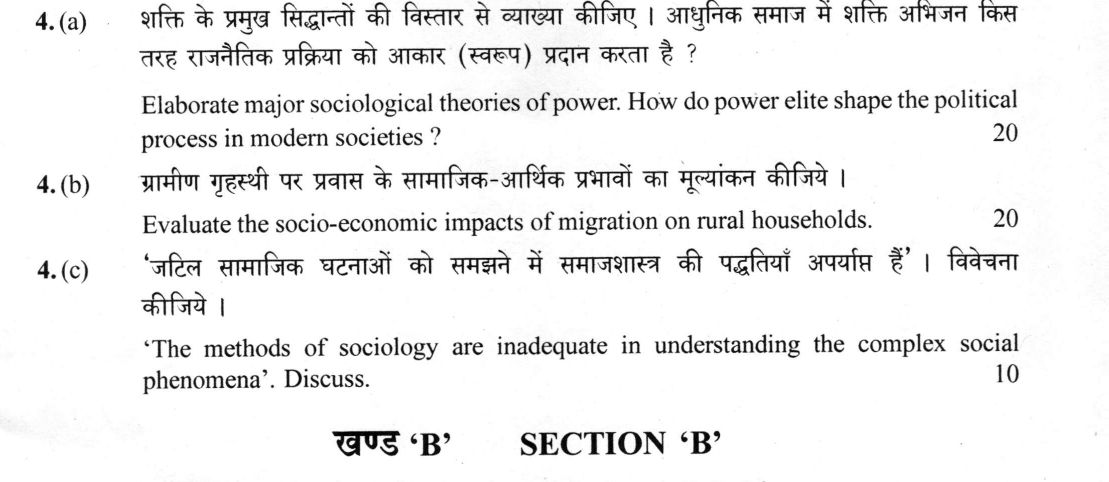
(a) Elaborate major sociological theories of power. How do power elite shape the political process in modern societies ? (20…
Elaborate major sociological theories of power. How do power elite shape the political process in modern societies ? 20 marks
Evaluate the socio-economic impacts of migration on rural households. 20 marks
'The methods of sociology are inadequate in understanding the complex social phenomena'. Discuss. 10 marks
हिंदी में प्रश्न पढ़ें
शक्ति के प्रमुख सिद्धान्तों की विस्तार से व्याख्या कीजिये । आधुनिक समाज में शक्ति अभिजन किस तरह राजनैतिक प्रक्रिया को आकार (स्वरूप) प्रदान करता है ? (20 अंक)
ग्रामीण गृहस्थी पर प्रवास के सामाजिक-आर्थिक प्रभावों का मूल्यांकन कीजिये । (20 अंक)
'जटिल सामाजिक घटनाओं को समझने में समाजशास्त्र की पद्धतियां अपर्याप्त हैं' । विवेचना कीजिये । (10 अंक)
Model answer
Drafted with AI by UPSC Answer Check against this question's marking rubric, to the expected length. UPSC does not publish answers for Mains — this is one way to score well, not an official key. How we build rubrics and answers.
(a) Theories of power and the power elite
Starting point: Max Weber defined power as the probability that an actor in a social relationship can carry out their will despite resistance. Authority is power accepted as legitimate.
Weberian theory:
- three types of legitimate domination: traditional, charismatic and legal-rational;
- class, status and party as three distinct orders through which power is distributed.
Marxist and neo-Marxist theory:
- power flows from ownership of the means of production; the Manifesto called the state "a committee for managing the common affairs of the whole bourgeoisie";
- Antonio Gramsci's hegemony: rule through consent built in civil society by intellectuals, backed by coercion;
- Louis Althusser's ideological and repressive state apparatuses (1970);
- the Miliband–Poulantzas debate: the state as an instrument of the capitalist class versus the state as a structure that serves capital whoever staffs it.
Functionalist theory: Talcott Parsons ("On the Concept of Political Power", 1963) treated power as a generalised medium, like money, and a collective capacity to attain system goals. It is non-zero-sum. Critics say it ignores coercion and conflict.
Classical elite theory:
- Vilfredo Pareto: the circulation of elites, alternating between "lions" (force) and "foxes" (cunning);
- Gaetano Mosca: an organised minority, the ruling class, always governs a disorganised majority;
- Robert Michels (Political Parties, 1911): the iron law of oligarchy, "who says organisation says oligarchy".
The pluralist counter and its critics:
- Robert Dahl (Who Governs?, 1961, New Haven) found power dispersed across issue areas and competing groups, against Floyd Hunter's reputational study of Atlanta (1953);
- Bachrach and Baratz ("Two Faces of Power", 1962) added non-decision-making, keeping issues off the agenda;
- Steven Lukes (Power: A Radical View, 1974) added a third dimension: shaping people's very preferences, which links elite theory to hegemony.
Foucault:
- power is relational, capillary and productive, not only repressive;
- power/knowledge, disciplinary power and surveillance through the panopticon (Discipline and Punish, 1975);
- governmentality and biopower over populations.
Bourdieu: symbolic power makes arbitrary hierarchies appear natural.
How the power elite shapes the political process:
Mills's thesis (The Power Elite, 1956):
- the top positions in the corporations, the military and the political directorate interlock;
- their holders share social origins, elite schooling and clubs, and personnel circulate between them;
- Congress and interest groups operate only at the "middle levels" of power, above a passive mass society.
The result is structural, not a conspiracy:
- key decisions (war, budgets, economic policy) are taken above public deliberation;
- agenda-setting, lobbying, campaign finance, think tanks and revolving doors between government and business shape policy;
- concentrated media ownership manages opinion;
- Eisenhower warned of the "military-industrial complex" (1961). G. William Domhoff (Who Rules America?, 1967) documented the upper class's policy networks.
India:
- the Supreme Court struck down the electoral bonds scheme (ADR v Union of India, 2024) for opaque corporate funding of parties;
- ADR's analysis found over 90% of MPs elected in 2024 were crorepatis;
- dynastic politics (Kanchan Chandra, Democratic Dynasties, 2016) and business–politics ties ("crony capitalism") concentrate access.
Critiques: Dahl asked for evidence that the elite actually prevails in contested decisions. Marxists argue that "elite" hides the class basis of power. Electoral competition, courts, social movements and a free press still constrain elites.
Conclusion: power is best analysed as coercive, consensual and productive at once. In modern democracies, elite concentration coexists with pluralist competition, so democracy contains elite dominance rather than abolishing it.
(b) Migration and rural households
Framing: rural out-migration in India is largely male, circular and seasonal. The household, not the individual, is the right unit of analysis.
Framework:
- Ravenstein's laws of migration (1885) and Everett Lee's push–pull model (1966) explain the drivers;
- Oded Stark's New Economics of Labour Migration treats migration as a household strategy to diversify risk and overcome credit constraints;
- Jan Breman's "footloose labour" and Deshingkar and Farrington's multi-locational livelihoods (2009) describe circular migration.
Economic gains:
- remittances raise consumption, repay debt, build houses, and fund schooling, health care and farm inputs. India has for years been the world's largest recipient of international remittances;
- the Kerala Migration Surveys (K.C. Zachariah and S. Irudaya Rajan, CDS) show Gulf remittances transforming housing and consumption;
- seasonal earnings smooth income across lean seasons, as in the Bihar–Punjab and Odisha–Andhra corridors.
Economic costs:
- recruitment debt and advances bind migrants, as with brick-kiln and sugarcane-cutting labour;
- dependence on remittances can lead to neglect of cultivation;
- the loss of prime-age labour causes peak-season shortages;
- selectivity: the poorest often cannot afford to migrate, so gains can widen village inequality.
Gender and family:
- the feminisation of agriculture and de facto female headship (noted in the Economic Survey 2017–18): women take farm and market decisions;
- this means more autonomy, but also more workload, and sometimes no real authority where in-laws control resources. Leela Gulati (In the Absence of Their Men, 1993) studied the wives of Kerala's Gulf migrants;
- left-behind children and elderly face a care deficit, even though remittances improve schooling and medicine.
Social and cultural effects:
- Peggy Levitt's "social remittances" (1998): ideas, norms and aspirations flow back to the village;
- Filippo and Caroline Osella show Kerala migrants converting Gulf money into status, consumption and inflated dowries;
- exit options loosen caste-tied jajmani labour and dependence on local landlords;
- a "culture of migration" shapes young men's aspirations.
Structural vulnerability:
- household gains rest on the migrant's informal, unprotected urban work;
- the 2020 COVID-19 lockdown exposed this through mass reverse migration without savings or social security;
- Census 2011 counted about 45 crore internal migrants. Most were counted for marriage and family reasons, which understates labour circulation;
- responses include One Nation One Ration Card, the e-Shram portal and rural employment guarantees (MGNREGA, now succeeded by the VB-G RAM G Act, 2025).
Evaluation: migration measurably improves rural household income and human capital. It shifts burdens onto women and the elderly and exposes households to urban informality. The net effect depends on whether remittances are invested or merely consumed, and whether migrant work is protected.
(c) Adequacy of sociological methods
Why the claim arises: sociology studies open, meaningful, reflexive and historically situated systems, and this sets real limits on method.
The case for inadequacy:
- whole societies cannot be put into controlled experiments, and causation is multiple and contextual;
- abstract concepts such as anomie, alienation or trust resist operationalisation;
- subjects react to being studied (reactivity, the Hawthorne effect);
- Giddens's double hermeneutic: findings re-enter and change the world they describe;
- values intrude despite Weber's value-neutrality, and ethics limit intrusive research;
- C. Wright Mills's twin charges of grand theory and abstracted empiricism.
Limits of particular methods:
- surveys gain reliability but lose depth, and capture only pre-coded categories;
- ethnography gains validity but not generalisability, and risks "going native";
- official statistics are socially produced (Jack Douglas on suicide data);
- in India, the "book view" of texts diverged from the "field view" of observation (M.N. Srinivas).
The case against inadequacy:
- methodological pluralism and Norman Denzin's triangulation offset single-method bias;
- grounded theory (Glaser and Strauss, 1967) builds concepts from data;
- Merton's middle-range theories keep claims testable;
- comparative-historical method (Weber, Theda Skocpol) handles macro complexity;
- Bourdieu's reflexivity and Gouldner's reflexive sociology turn observer bias into an object of study;
- longitudinal panel surveys, social network analysis and computational social science now model complexity at scale.
Verdict: adequacy depends on the standard used. Judged by the physics laboratory, sociology falls short. Judged by what open, meaning-laden systems demand, its methods are limited, self-correcting and adequate. The remedy for their limits is pluralism and reflexivity, not abandonment.
How this answer will be evaluated
Evaluation rubric
Each sub-part is marked on its own, against the marks and word limit printed on the paper.
- (a) Two connected tasks: elaborate the major sociological theories of power — Weberian, Marxist-Gramscian, functionalist, elite, pluralist and Foucauldian — and then answer specifically how the power elite shapes the political process in modern societies, which requires Mills's formulation and its critics. 20 marks
Must cover
- Max Weber — power vs authority; traditional, charismatic, legal-rational
- Karl Marx — power based on ownership of means of production; the state
- Antonio Gramsci — hegemony
- Talcott Parsons — power as a generalised medium, non-zero-sum
- Vilfredo Pareto — circulation of elites; Gaetano Mosca — ruling class; Robert Michels — iron law of oligarchy (Political Parties, 1911)
- Robert Dahl — Who Governs? (1961), pluralism
- Steven Lukes — Power: A Radical View (1974), three dimensions
- C. Wright Mills — The Power Elite (1956)
- Michel Foucault — power/knowledge, Discipline and Punish (1975)
Loses marks
- Listing theories of power and never answering the second question about the power elite and the political process
- Attributing the 'iron law of oligarchy' to Mosca or 'circulation of elites' to Michels — Michels wrote Political Parties (1911), Pareto theorised circulation, Mosca the ruling class
- Presenting Mills's power elite as a conspiracy rather than as structurally interlocking institutional positions
- Omitting Lukes's third dimension, which is the standard bridge between elite and hegemony arguments
- No contemporary or Indian illustration of elite influence on the political process
Earns more
- Parsons's functionalist, non-zero-sum conception of power as a generalised medium and collective capacity, with its standard criticism for ignoring coercion and conflict
- Foucault's relational, capillary and productive power: power/knowledge, discipline and surveillance (Discipline and Punish, 1975), governmentality and biopower
Extra mark
- An accurate Indian illustration of elite influence, e.g., the Supreme Court striking down electoral bonds (ADR v Union of India, 2024) or ADR data on MPs' assets; or Bachrach and Baratz's non-decision-making
- (b) 'Evaluate' demands a balanced assessment, not a list: the socio-economic consequences of out-migration for the rural household as the unit of analysis — income and remittances, land and labour, family structure and gender roles, caste and status, education and health of those left behind — with both gains and costs weighed. 20 marks
Must cover
- E.G. Ravenstein — laws of migration (1885); Everett Lee — push-pull model (1966)
- Oded Stark — New Economics of Labour Migration
- Jan Breman — footloose labour, circular migration
- remittances; Kerala Migration Survey — K.C. Zachariah and S. Irudaya Rajan (CDS)
- feminisation of agriculture / left-behind households
- Peggy Levitt — social remittances
- Filippo Osella and Caroline Osella — Gulf migration, status and consumption in Kerala
- COVID-19 reverse migration, 2020
Loses marks
- Writing about migration in general — causes, types, urbanisation — instead of impacts on the rural household as asked
- Listing only positives (remittances) or only negatives (family breakdown) and thus failing to 'evaluate'
- Quoting invented remittance figures or migrant numbers; magnitude statements are safer than fabricated precision
- Ignoring gender entirely, when feminisation of agriculture is the single most distinctive rural-household effect
- Attributing the push-pull model to Ravenstein alone or the New Economics of Labour Migration to Breman
Earns more
- Social-cultural consequences: Levitt's social remittances, Osella and Osella on Kerala Gulf migration converting money into status, consumption and dowry, loosening of caste-based jajmani labour ties, culture of migration and aspiration
- Structural vulnerability and evaluative balance: household gains rest on the migrant's informal, unprotected urban employment, demonstrated by the 2020 COVID-19 reverse migration; scale indicated by Census 2011's roughly 45 crore internal migrants
Extra mark
- Leela Gulati's In the Absence of Their Men (1993) on wives of Kerala's Gulf migrants, or Deshingkar and Farrington (2009) on multi-locational livelihoods
- (c) 'Discuss' a contentious claim: the candidate must state the genuine methodological limitations sociology faces with complex social phenomena, then defend the discipline's methodological resources, and reach a reasoned verdict — normally that methods are limited but not inadequate, given pluralism and triangulation. 10 marks
Must cover
- Anthony Giddens — double hermeneutic
- C. Wright Mills — abstracted empiricism / grand theory
- Norman Denzin — triangulation
- Glaser and Strauss — grounded theory (1967)
- Robert K. Merton — middle-range theory
- Jack Douglas — socially produced suicide statistics
- Pierre Bourdieu — reflexivity
- Max Weber — value-neutrality / verstehen
Loses marks
- Simply agreeing with the statement and listing complaints, with no defence and no verdict
- Describing research methods generically instead of assessing their adequacy to complex phenomena
- Confusing reliability with validity when discussing surveys and ethnography
- Attributing 'double hermeneutic' to Weber or 'triangulation' to Merton
- Ignoring contemporary advances (mixed methods, computational sociology) and presenting sociology as methodologically frozen
Earns more
- Contemporary capability: longitudinal panel surveys, social network analysis, computational social science and big data addressing complexity and scale
- Genuine limits stated precisely: no controlled experiment on whole societies, reactivity (Hawthorne effect), difficulty of operationalising abstract concepts, official statistics as social products
Extra mark
- Srinivas's 'book view' versus 'field view' as an Indian case of method shaping what is seen, or Gouldner's reflexive sociology
What "Elaborate" is asking you to do
Give the full detailed account the question has compressed into a line — every dimension of it, with specifics. Elaborate rewards completeness and detail rather than clarification or argument: the examiner is checking whether you can fill out a topic without being told what its parts are.
Structure that answers it
State the proposition → first dimension in detail → second dimension in detail → the part the statement leaves implicit → the consolidated picture
Where marks are lost
Repeating the statement at greater length instead of adding substance. Elaborate also punishes narrowness: omitting a whole dimension costs more here than anywhere else in this family.
Practice this exact question
Write your answer and it is marked point by point against the model answer above — what you covered, what you missed, what you got wrong.
Evaluate my answer →More from Sociology 2026 Paper I
- Q1 Answer the following questions in about 150 words each : (a) In what ways do class and ca…
- Q2 (a) Describe the impact of capitalist mode of production on society. (20 marks) (b) Diffe…
- Q3 (a) Discuss the relationship between religion and science in modern society. Do they nece…
- Q4 (a) Elaborate major sociological theories of power. How do power elite shape the politica…
- Q5 Answer the following questions in about 150 words each : (a) The major challenge for soci…
- Q6 (a) Discuss the intellectual origins of sociology and the historical antecedents of its e…
- Q7 (a) Compare and critically assess 'the grounded theory' with 'theory-driven research meth…