Paper I — Q5
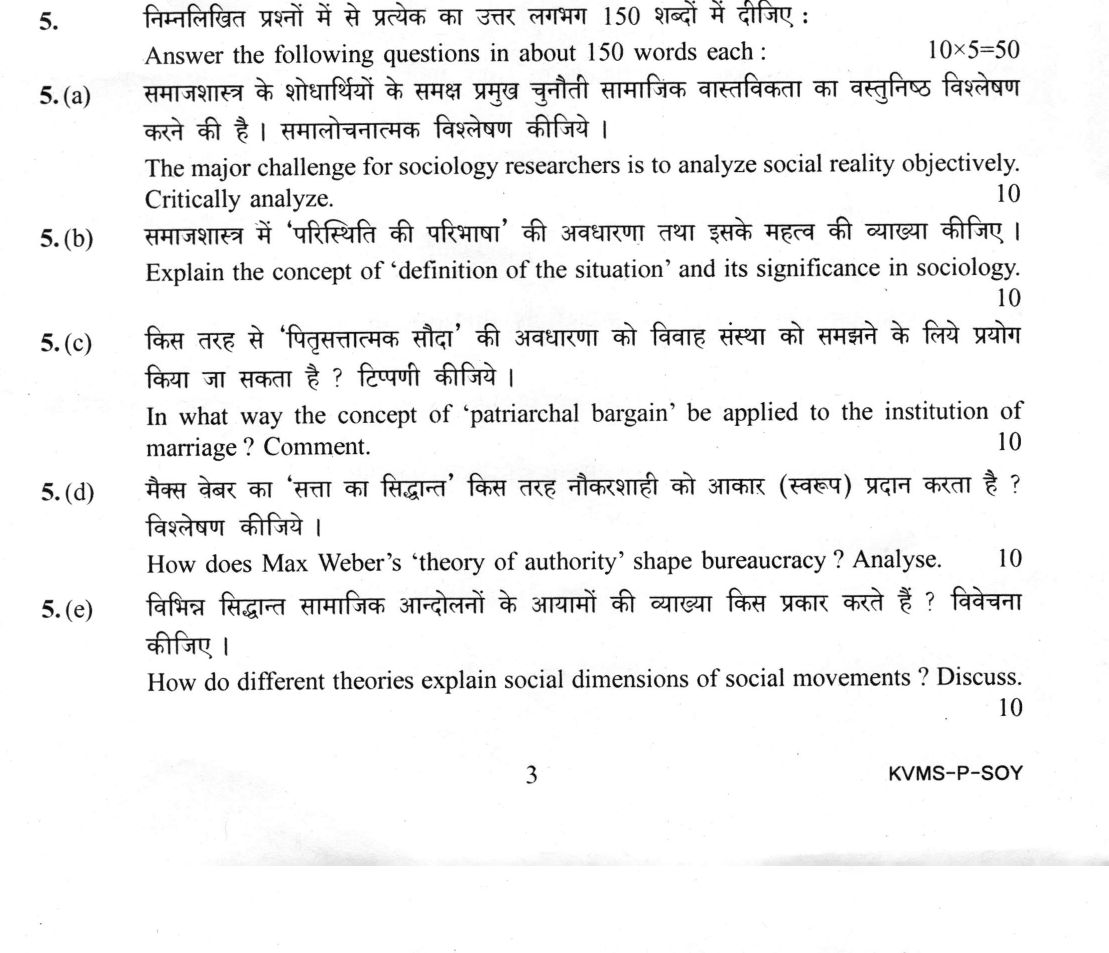
(a) The major challenge for sociology researchers is to analyze social reality objectively. Critically analyze. (10 marks) (b)…
Answer the following questions in about 150 words each :
The major challenge for sociology researchers is to analyze social reality objectively. Critically analyze. 10 marks
Explain the concept of 'definition of the situation' and its significance in sociology. 10 marks
In what way the concept of 'patriarchal bargain' be applied to the institution of marriage ? Comment. 10 marks
How does Max Weber's 'theory of authority' shape bureaucracy ? Analyse. 10 marks
How do different theories explain social dimensions of social movements ? Discuss. 10 marks
हिंदी में प्रश्न पढ़ें
निम्नलिखित प्रश्नों में से प्रत्येक का उत्तर लगभग 150 शब्दों में दीजिए :
समाजशास्त्र के शोधार्थियों के समक्ष प्रमुख चुनौती सामाजिक वास्तविकता का वस्तुनिष्ठ विश्लेषण करने की है । समालोचनात्मक विश्लेषण कीजिये । (10 अंक)
समाजशास्त्र में 'परिस्थिति की परिभाषा' की अवधारणा तथा इसके महत्व की व्याख्या कीजिये । (10 अंक)
किस तरह से 'पितृसत्तात्मक सौदा' की अवधारणा को विवाह संस्था को समझने के लिये प्रयोग किया जा सकता है ? टिप्पणी कीजिये । (10 अंक)
मैक्स वेबर का 'सत्ता का सिद्धान्त' किस तरह नौकरशाही को आकार (स्वरूप) प्रदान करता है ? विश्लेषण कीजिये । (10 अंक)
विभिन्न सिद्धान्त सामाजिक आन्दोलनों के आयामों की व्याख्या किस प्रकार करते हैं ? विवेचना कीजिये । (10 अंक)
Model answer
Drafted with AI by UPSC Answer Check against this question's marking rubric, to the 150-word length. UPSC does not publish answers for Mains — this is one way to score well, not an official key. How we build rubrics and answers.
(a) Objectivity in sociological research
Why objectivity is hard: researchers bring prenotions and their own class, caste, gender and ideology; sponsors have interests; subjects react to being studied; and social facts are meaningful and contested.
Classical prescriptions: Durkheim (The Rules of Sociological Method, 1895) asked researchers to discard prenotions and treat social facts as things. Weber ("Objectivity in Social Science and Social Policy", 1904) separated value-relevance, which legitimately guides the choice of problem, from value-neutrality (Wertfreiheit) in analysis.
The critique: Alvin Gouldner ("Anti-Minotaur: The Myth of a Value-Free Sociology", 1962); Gunnar Myrdal (Objectivity in Social Research, 1969), who asked researchers to state their value premises; Karl Mannheim (Ideology and Utopia, 1936) on socially situated knowledge; Dorothy Smith and Sandra Harding's "strong objectivity" from marginalised standpoints.
Indian illustration: M.N. Srinivas contrasted the "book view" with the "field view"; Béteille and Madan's Encounter and Experience (1975) shows the fieldworker's caste and gender shaping access.
Assessment: through triangulation, transparency and reflexivity (Bourdieu), objectivity is achievable as disciplined reflexivity, avoiding both naive positivism and relativism.
(b) Definition of the situation
The concept: people interpret a situation before acting and act on that definition rather than on objective facts. The Thomas theorem (W.I. Thomas and Dorothy Swaine Thomas, The Child in America, 1928): "if men define situations as real, they are real in their consequences". It grew out of Thomas and Znaniecki's The Polish Peasant in Europe and America (1918–20).
Theoretical location: symbolic interactionism: Blumer's premise that people act on meanings arising in interaction; Mead's taking the role of the other; Goffman's impression management (The Presentation of Self in Everyday Life, 1959) to control the definition of the situation.
Significance:
- Merton's self-fulfilling prophecy (1948): a rumour-driven run on a solvent bank;
- labelling theory: Lemert's secondary deviance and Becker's Outsiders (1963);
- the Pygmalion effect in classrooms (Rosenthal and Jacobson, 1968);
- rumour, panic and communal violence, where false definitions have real consequences.
Limitation: it can neglect structure and the unequal power to define; police and media often define situations for others.
(c) Patriarchal bargain and marriage
The concept: Deniz Kandiyoti ("Bargaining with Patriarchy", 1988): women strategise within concrete constraints, and the strategies differ by type of patriarchy.
Classic patriarchy: in the patrilocal, patrilineal joint household of South Asia, the young bride submits to her husband and mother-in-law in exchange for future authority over her own sons and daughters-in-law.
Applied to marriage:
- terms of entry: arranged, endogamous or hypergamous marriage, dowry and purdah are accepted in return for respectability, maintenance and protection;
- life-course bargain: sons as old-age security explain son preference; the mother-in-law's control is the delayed return on her own submission, so senior women reproduce patriarchy;
- resistance to change: women may oppose reforms that threaten the bargain's security, which is strategy under constraint, not complicity.
Related frames: Amartya Sen's cooperative conflicts (1990); Bina Agarwal's fallback position, especially land; Uma Chakravarti's Brahmanical patriarchy.
Limits: bargaining language can understate coercion and violence; bargains vary by caste, class and region; nuclear families, education and employment are eroding the classic bargain.
(d) Weber's authority and bureaucracy
Legitimate domination (Economy and Society): traditional authority rests on custom and works through personal retainers; charismatic authority rests on devotion to an exceptional person and becomes routinised; legal-rational authority rests on belief in enacted rules.
How legitimacy shapes bureaucracy: obedience is owed to impersonal rules and the office, not the person, so bureaucracy is the pure administrative form of legal-rational authority. Its features follow: fixed jurisdictions, an office hierarchy, written files, appointment by technical qualification, a salaried career, separation from the means of administration, and conduct sine ira et studio.
Why it prevails: it is technically superior in precision, speed and calculability, the engine of rationalisation; yet Weber feared the "iron cage" and experts escaping democratic control.
Critique: Merton ("Bureaucratic Structure and Personality", 1940) on trained incapacity and goal displacement; Gouldner (Patterns of Industrial Bureaucracy, 1954) on mock, representative and punishment-centred bureaucracy; Crozier on rules as power resources; in India, patrimonial, caste and kin loyalties persist inside formally legal-rational offices.
(e) Theories of social movements
Strain: Neil Smelser's value-added theory (1962), running from structural strain and generalised belief to mobilisation and social control, explains why discontent arises.
Relative deprivation: James Davies's J-curve (1962) and Ted Gurr (Why Men Rebel, 1970): revolt follows a gap between expectations and gains.
Marxist: movements express class contradiction as a class-in-itself becomes a class-for-itself; A.R. Desai applied this to Indian peasant struggles.
Resource mobilisation: McCarthy and Zald (1977): resources, organisation and leadership explain when movements arise, answering Olson's free-rider problem (1965).
Political process: Doug McAdam (1982) and Charles Tilly: political opportunity, cognitive liberation and repertoires of contention.
Framing: Snow and Benford's diagnostic, prognostic and motivational framing turns grievances into mobilising claims.
New social movements: Touraine, Melucci, Habermas and Offe on post-material, identity-centred movements.
India: Chipko, the Narmada Bachao Andolan, and Dalit, women's and tribal movements, analysed by M.S.A. Rao, Ghanshyam Shah and T.K. Oommen.
Assessment: each theory lights up one dimension: grievance, organisation, opportunity, meaning or identity. A full explanation combines them.
How this answer will be evaluated
Evaluation rubric
Each sub-part is marked on its own, against the marks and word limit printed on the paper.
- (a) 'Critically analyse' the claim that objectivity is the researcher's main challenge: identify the specific sources of subjectivity in sociological research, present the classical prescriptions for objectivity, engage the positions that deny value-free sociology is possible, and state what objectivity can realistically mean. 10 marks · 150 words
Must cover
- Emile Durkheim — The Rules of Sociological Method (1895), prenotions
- Max Weber — value-neutrality (Wertfreiheit) and value-relevance
- Alvin Gouldner — 'Anti-Minotaur: The Myth of a Value-Free Sociology' (1962)
- Gunnar Myrdal — Objectivity in Social Research (1969), explicit value premises
- Karl Mannheim — Ideology and Utopia (1936), sociology of knowledge
- Sandra Harding / Dorothy Smith — standpoint theory, strong objectivity
- M.N. Srinivas — insider fieldwork, book view and field view
Loses marks
- Treating value-neutrality as Weber's claim that sociology has nothing to do with values — he explicitly allowed value-relevance in choosing the problem
- Asserting that objectivity is simply achievable through 'scientific method', with no engagement with Gouldner, Myrdal or standpoint critiques
- Concluding that since objectivity is impossible, anything goes — relativism is not the same as reflexivity
- Attributing 'sociology of knowledge' to Merton rather than Mannheim in this context, or the value-free myth critique to Merton rather than Gouldner
- No mention of any concrete fieldwork difficulty, leaving the answer wholly abstract
Earns more
- Indian/fieldwork illustration: insider-outsider dilemma, Srinivas on studying one's own society, book view vs field view, effect of the investigator's caste and gender on disclosure
- Realistic safeguards: operational definitions, triangulation, peer review, transparency of data and method, and reflexivity (Bourdieu's participant objectivation)
Extra mark
- Béteille and Madan's Encounter and Experience (1975) on how the fieldworker's identity shapes access and disclosure
- (b) Two tasks: explain the concept 'definition of the situation' with its correct authorship and formulation, and establish its significance for sociology — its place in interactionist theory and the derivative concepts and research traditions it generated. 10 marks · 150 words
Must cover
- W.I. Thomas — Thomas theorem; The Child in America (1928) with Dorothy Swaine Thomas
- Thomas and Znaniecki — The Polish Peasant in Europe and America (1918-20)
- Herbert Blumer — symbolic interactionism
- Erving Goffman — The Presentation of Self in Everyday Life (1959), impression management
- Robert K. Merton — self-fulfilling prophecy
- Howard Becker — Outsiders (1963), labelling; Edwin Lemert — secondary deviance
Loses marks
- Attributing the concept or the theorem to Merton, Goffman or Cooley instead of W.I. Thomas (Merton derived the self-fulfilling prophecy from it, and credited Thomas)
- Stating the theorem loosely as 'perception is reality' without the crucial clause 'real in their consequences'
- Explaining the concept but writing nothing on its significance, which is half the question
- Omitting the interactionist lineage and treating it as an isolated aphorism
- Giving no concrete application (self-fulfilling prophecy, labelling, rumour, panic)
Earns more
- Derivative concepts and applications: Merton's self-fulfilling prophecy (bank run), labelling theory — Lemert's secondary deviance, Becker's Outsiders (1963), the Pygmalion effect (Rosenthal and Jacobson, 1968), rumour and panic
- Limitation: subjectivist neglect of structure and of the unequal power to impose definitions on others
Extra mark
- An Indian illustration of labelling, e.g., the stigma carried by denotified tribes once branded 'criminal' under the Criminal Tribes Act, 1871
- (c) 'In what way' requires an applied answer: state Kandiyoti's concept of the patriarchal bargain accurately, then show concretely how it illuminates marriage — the strategies women adopt within marital patriarchy and why they may defend the very system that subordinates them — and comment on the concept's limits. 10 marks · 150 words
Must cover
- Deniz Kandiyoti — 'Bargaining with Patriarchy' (1988), patriarchal bargain, classic patriarchy
- patrilocal and patrilineal extended household; mother-in-law and daughter-in-law relation
- son preference as old-age security
- Amartya Sen — cooperative conflicts (1990)
- Bina Agarwal — bargaining power and the fallback position
- Uma Chakravarti — Brahmanical patriarchy
Loses marks
- Attributing the patriarchal bargain to Sylvia Walby, Kate Millett or Bina Agarwal instead of Deniz Kandiyoti
- Writing a general essay on patriarchy and marriage without ever using the bargain framework
- Presenting the bargain as free consent, ignoring that it is a strategy under constraint and often under threat of violence
- Omitting the life-cycle element — the mother-in-law's later authority is the core mechanism of the classic-patriarchy bargain
- Giving no Indian marital example (dowry, purdah, son preference, joint-family authority)
Earns more
- Explains apparent complicity and change: women's resistance to reforms that threaten their security, and the erosion of the bargain under nuclearisation, education and paid work
- Related frames and critique: Sen's cooperative conflicts (1990) and Agarwal's fallback position/land rights; Uma Chakravarti's Brahmanical patriarchy; the objection that 'bargaining' language understates coercion and violence
Extra mark
- Evidence of the son-preference mechanism, e.g., the child sex ratio of 918 girls per 1,000 boys in Census 2011, tied explicitly to the bargain
- (d) 'Analyse' how Weber's theory of authority shapes bureaucracy: the answer must set out the three types of legitimate domination, establish that bureaucracy is the administrative form of legal-rational authority, derive bureaucracy's structural features from that legitimacy basis, and note the critique. 10 marks · 150 words
Must cover
- Max Weber — Economy and Society; Herrschaft/legitimate domination
- traditional, charismatic and legal-rational authority; routinisation of charisma
- bureaucracy features: hierarchy, written files, fixed jurisdiction, technical qualification, impersonality (sine ira et studio), salaried career
- iron cage / rationalisation
- Robert K. Merton — bureaucratic dysfunctions, trained incapacity, goal displacement
- Alvin Gouldner — Patterns of Industrial Bureaucracy (1954)
Loses marks
- Listing the features of bureaucracy without ever linking them to legal-rational legitimacy, which is exactly what 'how does the theory of authority shape bureaucracy' asks
- Calling Weber's three types 'types of power' rather than of legitimate domination/authority
- Attributing 'trained incapacity' to Weber rather than Merton (who took the phrase from Veblen), or the iron law of oligarchy to Weber rather than Michels
- Claiming Weber regarded bureaucracy as wholly desirable — he stressed its technical superiority and simultaneously feared the iron cage and the threat to democracy
- Offering no critique at all in a question that says 'analyse'
Earns more
- Weber's reasoning for bureaucracy's dominance — technical superiority in precision, speed, unambiguity and calculability; rationalisation and the iron cage; tension with democracy
- Critique: Merton's trained incapacity and goal displacement, Gouldner's mock/representative/punishment-centred bureaucracy (1954), Blau on informal organisation, Michels's iron law, Crozier; Indian patrimonial persistence
Extra mark
- Weber's patrimonial administration applied to Indian bureaucracy, or Peter Blau (The Dynamics of Bureaucracy, 1955) on informal organisation
- (e) 'How do different theories explain' requires a theory-wise treatment: each major theoretical approach to social movements must be named, attributed, and shown to explain a different dimension — strain, grievance, class, resources, opportunity, framing, identity — rather than a single narrative of movements. 10 marks · 150 words
Must cover
- Neil Smelser — value-added theory (1962)
- James Davies — J-curve; Ted Gurr — Why Men Rebel (1970); relative deprivation
- McCarthy and Zald — resource mobilisation (1977); Mancur Olson — free-rider problem (1965)
- Charles Tilly — repertoires of contention; Doug McAdam — political process, political opportunity structure
- Snow and Benford — frame alignment
- Alain Touraine / Alberto Melucci — new social movements
- M.S.A. Rao, Ghanshyam Shah or T.K. Oommen — social movements in India
Loses marks
- Narrating Indian movements instead of setting out theories, when the question asks how theories explain
- Cross-attributing: resource mobilisation to Smelser, value-added theory to Tilly, or political opportunity structure to Touraine
- Covering only two approaches at length and leaving out resource mobilisation or political process, the modern mainstream
- Presenting the theories as mutually exclusive without noting that they explain different dimensions
- Confusing new social movements with 'new movements in India' — the term denotes post-material, identity-centred movements theorised by Touraine, Melucci, Habermas and Offe
Earns more
- New social movement theory: Touraine, Melucci, Habermas, Offe on identity, autonomy and post-material values, with Indian illustration (Chipko, Narmada Bachao Andolan, Dalit and women's movements) and Indian analysts M.S.A. Rao, Ghanshyam Shah or T.K. Oommen
- Comparative verdict: the theories privilege different dimensions — grievance, resources, opportunity, meaning, identity — and are complementary stages of one explanation
Extra mark
- Uses Snow and Benford's three framing tasks or McAdam's cognitive liberation to explain a named movement
What "Analyse" is asking you to do
Break the subject into its working parts and show how they act on each other. The marks are in the interconnections — which factor drives which, and what the resulting structure explains — not in the inventory of factors.
Structure that answers it
Define the whole → separate it into its parts → show which part drives which → what that interaction produces → what the structure implies
Where marks are lost
A flat list of causes with no account of which drives which. An answer of neatly separated headings, each self-contained, scores as description.
Practice this exact question
Write your answer and it is marked point by point against the model answer above — what you covered, what you missed, what you got wrong.
Evaluate my answer →More from Sociology 2026 Paper I
- Q2 (a) Describe the impact of capitalist mode of production on society. (20 marks) (b) Diffe…
- Q3 (a) Discuss the relationship between religion and science in modern society. Do they nece…
- Q4 (a) Elaborate major sociological theories of power. How do power elite shape the politica…
- Q5 Answer the following questions in about 150 words each : (a) The major challenge for soci…
- Q6 (a) Discuss the intellectual origins of sociology and the historical antecedents of its e…
- Q7 (a) Compare and critically assess 'the grounded theory' with 'theory-driven research meth…
- Q8 (a) How are the concepts of nation, state and citizenship interrelated in a democracy ? E…