Paper I — Q8
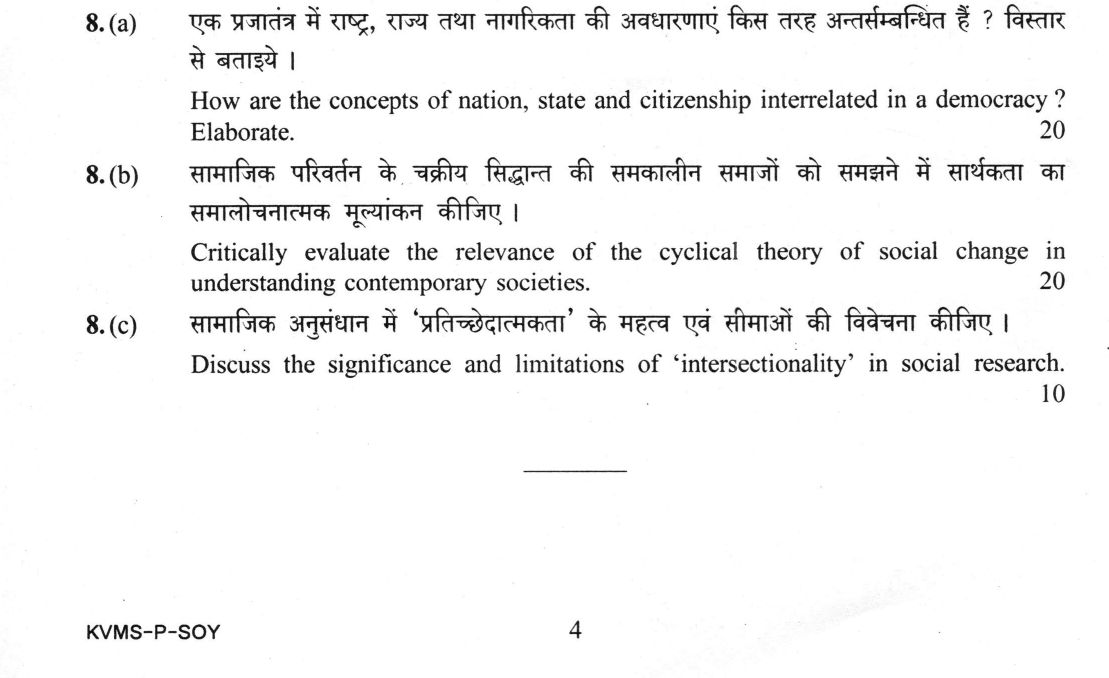
(a) How are the concepts of nation, state and citizenship interrelated in a democracy ? Elaborate. (20 marks) (b) Critically…
How are the concepts of nation, state and citizenship interrelated in a democracy ? Elaborate. 20 marks
Critically evaluate the relevance of the cyclical theory of social change in understanding contemporary societies. 20 marks
Discuss the significance and limitations of 'intersectionality' in social research. 10 marks
हिंदी में प्रश्न पढ़ें
एक प्रजातंत्र में राष्ट्र, राज्य तथा नागरिकता की अवधारणाएँ किस तरह अन्तर्सम्बन्धित हैं ? विस्तार से बताइये। (20 अंक)
सामाजिक परिवर्तन के चक्रीय सिद्धान्त की समकालीन समाजों को समझने में सार्थकता का समालोचनात्मक मूल्यांकन कीजिए। (20 अंक)
सामाजिक अनुसंधान में 'प्रतिच्छेदात्मकता' के महत्व एवं सीमाओं की विवेचना कीजिए। (10 अंक)
Model answer
Drafted with AI by UPSC Answer Check against this question's marking rubric, to the expected length. UPSC does not publish answers for Mains — this is one way to score well, not an official key. How we build rubrics and answers.
(a) Nation, state and citizenship in a democracy
The state:
- Max Weber ("Politics as a Vocation", 1919) defined it as a human community that successfully claims the monopoly of the legitimate use of physical force within a territory;
- its attributes are sovereignty, territory, bureaucracy and law. The modern state is the home of legal-rational authority.
The nation:
- Benedict Anderson (Imagined Communities, 1983): an imagined, limited and sovereign community, made possible by print capitalism;
- Ernest Gellner (Nations and Nationalism, 1983): industrial society needs a shared high culture, so nationalism creates nations, not the reverse;
- Ernest Renan ("What is a Nation?", 1882): a "daily plebiscite" resting on shared memory and shared forgetting;
- Hobsbawm's invented traditions, against Anthony D. Smith's ethno-symbolist emphasis on older ethnic cores.
Citizenship:
- T.H. Marshall (Citizenship and Social Class, 1950): full membership of the community, built through civil (18th century), political (19th) and social (20th) rights, which temper the inequalities of class;
- critics call this evolutionary and Anglocentric. Feminists point to its male, public-sphere assumptions;
- Will Kymlicka's multicultural citizenship (1995) and Iris Marion Young's differentiated citizenship extend it to group rights.
How the three interrelate in a democracy:
- the state confers and enforces citizenship rights;
- citizenship legitimates the state: coercion becomes self-imposed when citizens are also its authors;
- the nation supplies the demos, the sense of common belonging that makes majority rule tolerable to minorities and redistribution acceptable among strangers;
- democracy aligns the three: popular sovereignty (nation), territorial authority (state) and equal membership (citizenship).
Tensions:
- the "nation-state" assumes that the cultural nation and the political state coincide, which is rare. Multinational states must choose between civic and ethnic definitions of belonging, and ethnic definitions make minorities second-class citizens;
- Rogers Brubaker contrasted French jus soli with German jus sanguinis; Habermas proposed constitutional patriotism as a civic bond;
- migrants and the stateless expose the gap between human rights and citizens' rights, what Hannah Arendt called the "right to have rights";
- social rights are the weakest link wherever markets erode them.
India:
- the Constitution adopted civic-territorial nationhood and single citizenship (Articles 5–11, Citizenship Act, 1955);
- federalism accommodates linguistic and religious diversity, and reservations work as a form of differentiated citizenship;
- the 1986 and 2003 amendments shifted citizenship by birth from jus soli towards jus sanguinis. Later amendments and documentation exercises remain contested;
- B.R. Ambedkar warned the Constituent Assembly on 25 November 1949 that political democracy (one person, one vote) would be unstable without social democracy;
- Partha Chatterjee's "political society" (2004) shows how the poor deal with the state through negotiation rather than as rights-bearing citizens of "civil society"; Niraja Gopal Jayal (Citizenship and Its Discontents, 2013) traces the gap between legal and substantive citizenship.
Conclusion: in a democracy the state gives citizenship its force, citizenship gives the state its legitimacy, and the nation gives both a community. Democratic stability depends on keeping the nation civic and inclusive, so that citizenship stays equal in substance, not only in law.
(b) Cyclical theory of social change today
Cyclical theories:
- Ibn Khaldun: a cycle of asabiyyah (group solidarity), conquest, luxury and dynastic decay;
- Oswald Spengler (The Decline of the West, 1918–22): cultures are organisms that are born, mature and decay into "civilisation";
- Arnold Toynbee (A Study of History): challenge and response; a creative minority degenerates into a merely dominant one; withdrawal-and-return;
- Pitirim Sorokin (Social and Cultural Dynamics, 1937–41): ideational, idealistic and sensate cultures alternate through immanent change and the principle of limits;
- Vilfredo Pareto: the circulation of elites between lions and foxes;
- India's cosmology of yugas is also cyclical.
The case for relevance today:
- elite circulation is visible in populist waves replacing establishment elites;
- Sorokin's diagnosis of an over-ripe sensate culture speaks to consumerism, relativism and the renewed search for meaning;
- hegemonic cycles: Wallerstein; Giovanni Arrighi's systemic cycles of accumulation (The Long Twentieth Century, 1994); Paul Kennedy (The Rise and Fall of the Great Powers, 1987) on imperial overstretch, relevant to debates on US–China succession;
- real recurrence also appears in Kondratiev long waves, business cycles, Huntington's waves and reverse waves of democratisation (1991), Peter Turchin's secular cycles, and cycles of fashion;
- cyclical theory punctures the complacency of unilinear progress.
The case against:
- the theories are largely metaphysical and post hoc, with no testable mechanism. Popper (The Poverty of Historicism, 1957) rejected laws of historical destiny;
- the organic analogy is a category mistake, because societies have no fixed lifespan;
- "civilisation" is a vague, arbitrarily bounded unit, and globalisation makes civilisations interpenetrate rather than rise and fall separately;
- cumulative science and technology do not cycle, so knowledge is not lost as in earlier collapses;
- the theories are deterministic and fatalistic, leaving little room for agency or policy;
- Spengler and Toynbee carry Eurocentric and mystical assumptions.
Rival models:
- linear-evolutionary: Comte's three stages, Spencer, Durkheim's mechanical-to-organic solidarity, Parsons's evolutionary universals;
- dialectical: Marx's succession of modes of production;
- Ogburn's cultural lag, Steward's multilinear evolution, and Eisenstadt's multiple modernities, which stress contingent and path-dependent change.
Verdict: cyclical theory is weak as a general law of history but useful as a corrective and heuristic for phases of rise and decline in bounded domains: elites, hegemonies, economic waves and cultural moods. It works best combined with structural explanation.
(c) Intersectionality in social research
The concept:
- Kimberlé Crenshaw coined "intersectionality" (1989; "Mapping the Margins", 1991). Her example was DeGraffenreid v General Motors (1976), where courts could not see discrimination against Black women as either race or sex discrimination;
- antecedents include the Combahee River Collective (1977) on interlocking oppressions, Deborah King's "multiple jeopardy" (1988), and Patricia Hill Collins's "matrix of domination" (Black Feminist Thought, 1990).
Significance:
Conceptual: it replaces additive models ("caste plus gender") with the insight that a Dalit woman's position is qualitatively distinct, not the sum of two disadvantages.
Indian application:
- Gopal Guru ("Dalit Women Talk Differently", 1995) and Sharmila Rege (Writing Caste/Writing Gender, 2006) developed a Dalit feminist standpoint;
- Uma Chakravarti's Brahmanical patriarchy ties caste endogamy to the control of women.
Methodological: it demands disaggregated data and sampling designs that can find small, compounded categories. It also legitimises narrative and standpoint methods.
Policy: programmes aimed at "women" or at "Dalits" can miss Dalit women.
Limitations:
Which axes, and how many? The logic invites endless subdivision, which can dissolve the basis for collective claims.
Operationalisation:
- interaction effects need large samples that rarely exist for small groups;
- qualitative work can stay descriptive, and the framework describes compounded disadvantage better than it explains the structures that produce it;
- Leslie McCall ("The Complexity of Intersectionality", 2005) set out anticategorical, intracategorical and intercategorical strategies to manage this.
It is a framework, not a method: it must be carried through surveys, ethnography or life histories.
Translation and co-optation:
- a concept built around US race and gender fits caste imperfectly, since caste is endogamous, ritually graded and reproduced through control of women. Nivedita Menon (2015) pressed this point;
- institutional use can reduce it to a diversity buzzword, with class quietly dropped.
Intersectionality is indispensable for seeing compounded inequality. It must be paired with structural analysis and suitable methods to explain it.
How this answer will be evaluated
Evaluation rubric
Each sub-part is marked on its own, against the marks and word limit printed on the paper.
- (a) 'Elaborate' how three concepts interrelate in a democracy: nation (a community of belonging), state (an apparatus of sovereign authority) and citizenship (the legal-political membership linking individual to state). Each must be defined with the standard theorists, the mutual dependence shown, and the tensions in a democracy addressed. 20 marks
Must cover
- Max Weber — 'Politics as a Vocation' (1919), monopoly of legitimate violence
- Benedict Anderson — Imagined Communities (1983), print capitalism
- Ernest Gellner — Nations and Nationalism (1983)
- Ernest Renan — 'What is a Nation?' (1882), daily plebiscite
- T.H. Marshall — Citizenship and Social Class (1950): civil, political, social rights
- Will Kymlicka — multicultural citizenship (1995) / Iris Marion Young — differentiated citizenship
- B.R. Ambedkar — political vs social democracy, Constituent Assembly, 25 November 1949
- Partha Chatterjee — civil society and political society
Loses marks
- Using 'nation' and 'state' interchangeably, which destroys the whole question
- Giving Marshall's three rights without their content or sequence, or adding a fourth 'cultural right' as though it were Marshall's
- Attributing 'imagined communities' to Gellner or 'nationalism creates nations' to Anderson — the two arguments are related but are each author's own
- Listing the three concepts separately and never elaborating the interrelation, which the question asks for
- Turning the Indian section into a partisan account of current citizenship politics instead of a sociological analysis
Earns more
- Tensions analysed: rarity of nation-state congruence, civic versus ethnic definitions of belonging, minorities and second-class citizenship, migrants and statelessness exposing the gap between human and citizen rights, erosion of social rights
- Indian application: civic-territorial constitutional nationhood, single citizenship (Articles 5-11, Citizenship Act 1955), federal and affirmative-action accommodation as differentiated citizenship, Ambedkar's 25 November 1949 warning about political without social democracy, Chatterjee's civil society and political society
Extra mark
- Brubaker's jus soli/jus sanguinis contrast, or Niraja Gopal Jayal on the gap between legal and substantive citizenship in India
- (b) 'Critically evaluate the relevance' of cyclical theories of social change for understanding contemporary societies: the major cyclical theorists must be set out accurately, their explanatory value for present-day phenomena assessed, their weaknesses stated, and a verdict given against the rival linear, dialectical and multilinear models. 20 marks
Must cover
- Oswald Spengler — The Decline of the West (1918-22)
- Arnold Toynbee — A Study of History; challenge and response; creative minority
- Pitirim Sorokin — Social and Cultural Dynamics; ideational, sensate and idealistic cultures
- Vilfredo Pareto — circulation of elites
- Ibn Khaldun — asabiyyah and the dynastic cycle
- Giovanni Arrighi / Immanuel Wallerstein / Paul Kennedy — hegemonic cycles
- linear and dialectical alternatives — Comte, Spencer, Durkheim, Parsons, Marx
Loses marks
- Cross-attributing the signature concepts: 'challenge and response' to Spengler, the sensate-ideational scheme to Toynbee, or 'circulation of elites' to Michels
- Narrating the three theorists and never evaluating relevance to contemporary societies, which is the actual question
- Offering only criticism with no case for relevance, or only praise with no critique
- Treating the organic analogy as literally valid — societies do not have determinate lifespans
- Omitting the comparison with linear and dialectical models, which is how 'relevance' is usually judged
Earns more
- Additional cyclical formulations: Pareto's circulation of elites (lions and foxes), Ibn Khaldun's asabiyyah-based dynastic cycle, and the Indian yuga/kalpa cyclical cosmology
- Comparison with rival models: linear-evolutionary (Comte, Spencer, Durkheim, Parsons), dialectical (Marx), cultural lag (Ogburn), multilinear evolution (Steward) and multiple modernities (Eisenstadt)
Extra mark
- Huntington's waves and reverse waves of democratisation (1991) or Kondratiev long waves used as bounded, testable instances of recurrence
- (c) 'Discuss the significance and limitations' of intersectionality in social research — both halves are compulsory. The answer must attribute the concept correctly, explain what it adds methodologically over additive models, and state the specific research difficulties it creates. 10 marks
Must cover
- Kimberle Crenshaw — intersectionality (1989, 1991)
- Combahee River Collective Statement (1977) — interlocking oppressions
- Patricia Hill Collins — Black Feminist Thought (1990), matrix of domination
- Leslie McCall — 'The Complexity of Intersectionality' (2005)
- Gopal Guru — 'Dalit Women Talk Differently' (1995); Sharmila Rege — Writing Caste/Writing Gender (2006)
- Uma Chakravarti — Brahmanical patriarchy
Loses marks
- Attributing intersectionality to bell hooks, Patricia Hill Collins or Judith Butler rather than to Kimberle Crenshaw, who coined it
- Explaining the concept at length and giving no limitations, when the question demands both
- Treating intersectionality as simply 'multiple identities' or an additive list, which is exactly what it was formulated against
- Offering no Indian application in a paper where caste-gender intersection is the obvious case
- Claiming it is a research method; it is an analytical framework that must be operationalised through a method
Earns more
- Indian application with attribution: Dalit feminist scholarship — Gopal Guru's 'Dalit Women Talk Differently' (1995), Sharmila Rege's Writing Caste/Writing Gender (2006) — and Uma Chakravarti's Brahmanical patriarchy
- Limitations stated specifically: endless subdivision of categories, small-sample problems in operationalisation, a framework rather than a method, imperfect fit of a US race-gender model to caste (Nivedita Menon, 2015), co-optation as a diversity buzzword
Extra mark
- Leslie McCall's anticategorical, intracategorical and intercategorical strategies, or the DeGraffenreid v General Motors (1976) case behind Crenshaw's formulation
What "Elaborate" is asking you to do
Give the full detailed account the question has compressed into a line — every dimension of it, with specifics. Elaborate rewards completeness and detail rather than clarification or argument: the examiner is checking whether you can fill out a topic without being told what its parts are.
Structure that answers it
State the proposition → first dimension in detail → second dimension in detail → the part the statement leaves implicit → the consolidated picture
Where marks are lost
Repeating the statement at greater length instead of adding substance. Elaborate also punishes narrowness: omitting a whole dimension costs more here than anywhere else in this family.
Practice this exact question
Write your answer and it is marked point by point against the model answer above — what you covered, what you missed, what you got wrong.
Evaluate my answer →More from Sociology 2026 Paper I
- Q5 Answer the following questions in about 150 words each : (a) The major challenge for soci…
- Q6 (a) Discuss the intellectual origins of sociology and the historical antecedents of its e…
- Q7 (a) Compare and critically assess 'the grounded theory' with 'theory-driven research meth…
- Q8 (a) How are the concepts of nation, state and citizenship interrelated in a democracy ? E…