Paper I — Q7
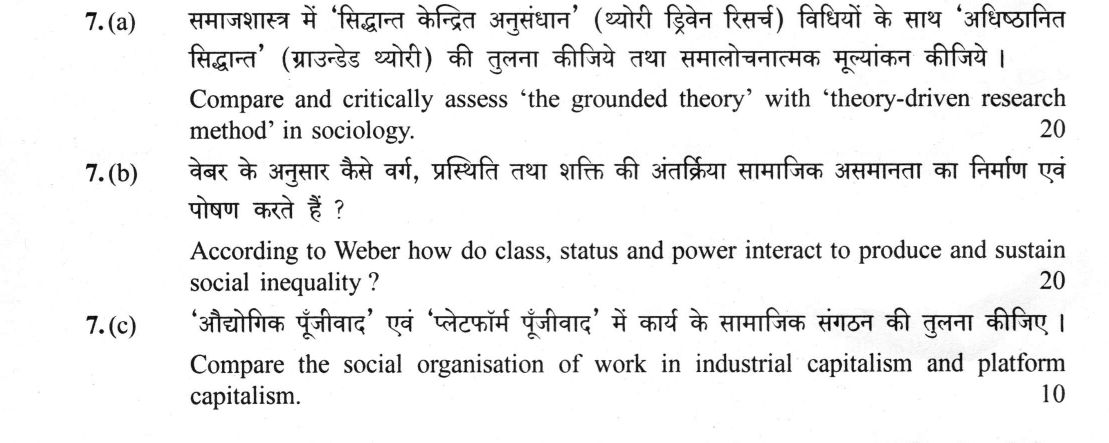
(a) Compare and critically assess 'the grounded theory' with 'theory-driven research method' in sociology. (20 marks) (b)…
Compare and critically assess 'the grounded theory' with 'theory-driven research method' in sociology. 20 marks
According to Weber how do class, status and power interact to produce and sustain social inequality ? 20 marks
Compare the social organisation of work in industrial capitalism and platform capitalism. 10 marks
हिंदी में प्रश्न पढ़ें
समाजशास्त्र में 'सिद्धान्त केन्द्रित अनुसंधान' (थ्योरी ड्रिवेन रिसर्च) विधियों के साथ 'अधिष्ठानित सिद्धान्त' (ग्राउन्डेड थ्योरी) की तुलना कीजिये तथा समालोचनात्मक मूल्यांकन कीजिये। (20 अंक)
वेबर के अनुसार कैसे वर्ग, प्रस्थिति तथा शक्ति की अंतर्क्रिया सामाजिक असमानता का निर्माण एवं पोषण करते हैं ? (20 अंक)
'औद्योगिक पूँजीवाद' एवं 'प्लेटफॉर्म पूँजीवाद' में कार्य के सामाजिक संगठन की तुलना कीजिए। (10 अंक)
Model answer
Drafted with AI by UPSC Answer Check against this question's marking rubric, to the expected length. UPSC does not publish answers for Mains — this is one way to score well, not an official key. How we build rubrics and answers.
(a) Grounded theory versus theory-driven research
Grounded theory:
- Barney Glaser and Anselm Strauss set it out in The Discovery of Grounded Theory (1967), after their hospital study Awareness of Dying (1965);
- theory is generated from data, not tested against it;
- tools: the constant comparative method, theoretical sampling (choosing cases for their theoretical relevance, not for statistical representativeness), memo-writing, and theoretical saturation as the point to stop collecting data;
- the literature review is deliberately postponed;
- Strauss and Corbin (Basics of Qualitative Research, 1990) added open, axial and selective coding. Glaser rejected this as "forcing" the data, and Kathy Charmaz later developed a constructivist version.
Theory-driven (hypothetico-deductive) research:
- it starts from an existing theory, derives hypotheses, operationalises concepts into variables, samples probabilistically, and tests the hypotheses, seeking falsification (Popper);
- Durkheim's Suicide (1897) is the classic example; Merton's middle-range theories keep theory close enough to data to be tested.
Comparison:
| Dimension | Grounded theory | Theory-driven research |
|---|---|---|
| Logic | Inductive | Deductive |
| Aim | Generating theory | Verifying or falsifying theory |
| Prior literature | Deferred | The foundation for the hypotheses |
| Sampling | Theoretical, purposive | Probability |
| Data | Mainly qualitative (interviews, observation) | Often quantitative, standardised |
| Analysis | Coding and building categories | Statistical hypothesis testing |
| Output | Substantive or formal theory | A hypothesis confirmed, refuted or refined |
| Rigour judged by | Fit, workability, relevance, modifiability | Reliability, validity, replicability, generalisability |
Critique of grounded theory:
- no one enters the field without preconceptions; observation is theory-laden, and Blumer's sensitising concepts are unavoidable;
- the Glaser–Strauss split left the method contested;
- results are often descriptive rather than truly theoretical;
- generalisability is low, and the work is labour-intensive and hard to audit;
- postponing the literature can mean rediscovering known findings.
Critique of theory-driven research:
- confirmation bias and forcing data into pre-set categories;
- it cannot discover the unanticipated and fits new, under-theorised phenomena poorly;
- it risks testing trivial hypotheses, close to what C. Wright Mills called abstracted empiricism;
- operationalisation can strip away the meaning that makes up the phenomenon.
Synthesis:
- the two are phases of one research cycle, not rivals;
- Merton's serendipity pattern and Peirce's abduction link them, as does retroduction in critical realism;
- in sequential mixed-method designs, grounded fieldwork generates hypotheses that surveys then test.
(b) Weber: class, status and party
Weber's frame ("Class, Status, Party", Economy and Society, 1922): power is distributed through three orders, the economic, the social and the political.
Class (economic order):
- a class situation is a set of shared life chances determined by market situation, meaning the possession or lack of property and of marketable skills;
- "property" and "lack of property" are the basic categories; Weber distinguishes property, acquisition and social classes;
- a class is not a community, so class-conscious action is contingent, not automatic.
Status (social order):
- a status group (Stand) shares a specific social estimation of honour, expressed in a style of life;
- it restricts social intercourse through commensality and endogamy, and monopolises ideal and material privileges;
- unlike classes, status groups are usually communities. Caste is the most closed, ritually sanctioned case.
Party (political order): an association oriented to acquiring social power and influencing communal action. It may represent class interests, status interests, or neither; it is not only a modern political party.
How they interact to produce and sustain inequality:
Conversion:
- property is not immediately a status qualification, but in the long run it becomes one "with extraordinary regularity";
- wealth turns into honour over generations through lifestyle, education and marriage, and status in turn secures market advantages, licences and credentials.
Closure and monopolisation:
- status groups restrict the free market by monopolising goods, occupations and opportunities, through what Weber called the closure of social relationships;
- Frank Parkin developed this as exclusion and usurpation, and credentialism is its modern form.
Conditions of predominance:
- when the economic and technological basis changes rapidly, class comes to the fore; in stable periods, status predominates;
- party turns both into organised power, and the state protects property and honour in return.
Illustration: in India, caste as a status order was historically fused with class (land, occupation), and is now partly dissociated from it (Béteille's Sripuram). Caste-based parties convert status into political power, and state benefits then feed back into class.
Legacy: this multidimensional view anticipates Bourdieu's economic, cultural and social capital and Giddens's structuration of class.
Conclusion: for Weber, inequality is sustained because the three orders reinforce and convert into one another, not because economics alone determines everything.
(c) Work under industrial and platform capitalism
| Dimension | Industrial capitalism | Platform capitalism |
|---|---|---|
| Workplace | Factory or office; workers co-present, with a shared occupational culture | Dispersed and individualised; workers meet only through the app |
| Control | Bureaucratic, supervisory: Taylor's scientific management (1911), Fordist assembly-line pacing | Algorithmic management: task allocation, ratings, incentives, surveillance and data asymmetry, a "digital Taylorism" with no visible supervisor |
| Employment relationship | Standard contract: permanent job, wage, fixed hours, employer liability | "Partner" or independent contractor; piece rates per task; the worker bears the costs (vehicle, phone, fuel) and the risk |
| Skill | Braverman's deskilling (1974) | Deskilling in routine location-based work, alongside a high-end freelance segment |
| Collective voice | Unions, collective bargaining, factory laws, social security | Atomisation, hard to unionise, largely outside labour law |
The new stratum: Nick Srnicek (Platform Capitalism, 2016) analyses platforms as data-extracting intermediaries. Guy Standing's "precariat" (2011) and Ursula Huws's "cybertariat" name the insecure workforce that results.
India:
- the Code on Social Security, 2020, in force with the other Labour Codes from 21 November 2025, defines "gig worker" and "platform worker" for the first time, and provides for aggregator contributions to a social security fund;
- state laws in Rajasthan (2023) and Karnataka (2025) set up welfare boards;
- unions of app-based transport and delivery workers have begun organising.
Continuity: both regimes extract surplus from labour and intensify control. David Harvey's flexible accumulation frames platform work as a mutation of, not a break from, capitalist work organisation.
How this answer will be evaluated
Evaluation rubric
Each sub-part is marked on its own, against the marks and word limit printed on the paper.
- (a) Two directives: 'compare' grounded theory with theory-driven (hypothetico-deductive) research, and 'critically assess' both. The comparison must run on stated dimensions — logic of inquiry, role of literature, sampling, data, analysis, output and criteria of rigour — and each approach must be criticised. 20 marks
Must cover
- Barney Glaser and Anselm Strauss — The Discovery of Grounded Theory (1967); Awareness of Dying (1965)
- constant comparative method; theoretical sampling; theoretical saturation
- Strauss and Corbin (1990) and Glaser's objection to 'forcing'
- Karl Popper — falsification; hypothetico-deductive method
- Emile Durkheim — Suicide (1897) as theory-driven exemplar
- Robert K. Merton — middle-range theory, serendipity pattern
- Herbert Blumer — sensitising concepts
- C. Wright Mills — abstracted empiricism
Loses marks
- Equating grounded theory with 'any qualitative research' — it is a specific method with theoretical sampling, constant comparison and saturation
- Attributing grounded theory to Strauss and Corbin alone, or to Glaser alone, and missing that the 1967 book was joint and the method later split
- Describing both approaches without ever comparing them on stated dimensions, which the directive 'compare' requires
- Criticising only one of the two, when 'critically assess' applies to both
- Claiming grounded theory requires the researcher to have no prior knowledge whatsoever, rather than to defer imposing existing categories
Earns more
- Synthesis: the two as phases of one research cycle — Merton's serendipity, abduction (Peirce), retroduction in critical realism, sequential and mixed-method designs
- Critique of both: grounded theory's unavoidable prior concepts, weak generalisability and the Glaser–Strauss split; theory-driven research's confirmation bias, blindness to the unanticipated and loss of meaning in operationalisation
Extra mark
- Kathy Charmaz's constructivist grounded theory, or an Indian example of theory built inductively from fieldwork (e.g., Srinivas's dominant caste emerging from Rampura)
- (b) A focused question on Weber's 'Class, Status, Party' analysis: define each of the three dimensions precisely as Weber does, show the orders of society they belong to, and then explain the interaction through which they jointly produce and sustain inequality, including closure, monopolisation and the conditions under which one dimension predominates. 20 marks
Must cover
- Max Weber — 'Class, Status, Party', Economy and Society (1922)
- class situation as market situation; life chances; property and lack of property
- status group (Stand) — honour, style of life, commensality, endogamy, monopolisation
- party — acquisition of social power, communal action
- economic, social and legal-political orders
- social closure — Weber; Frank Parkin's exclusion and usurpation
- caste as a closed status group
- Pierre Bourdieu — forms of capital (as legacy)
Loses marks
- Reducing Weber's argument to 'Weber added two more factors to Marx's class' without stating what class, status and party actually mean for him
- Defining class by occupation or income bracket rather than by market situation and life chances
- Treating status as merely prestige ranking and omitting its defining features — style of life, commensal and connubial restriction, monopolisation of privileges
- Confusing 'party' with a modern political party alone; for Weber it is any association oriented to acquiring social power
- Describing the three dimensions in isolation and never explaining the interaction and conversion the question asks about
Earns more
- Closure and monopolisation as the mechanism sustaining inequality: status stratification hindering the free market, Weber's closure of social relationships, Parkin's exclusion and usurpation, modern credentialism
- Conditions of predominance and legacy: class to the fore in periods of rapid economic and technological change, status in stable periods; illustration through caste-class-party in India and later multidimensional developments such as Bourdieu's forms of capital
Extra mark
- Quotes or paraphrases Weber accurately: property becomes a status qualification 'with extraordinary regularity', and technological and economic change pushes class situation into the foreground
- (c) 'Compare the social organisation of work' in two regimes: industrial and platform capitalism. The comparison must be on organisational dimensions — workplace and spatial form, mode of control, employment relationship, skill, collective organisation and social protection — and should note continuities as well as differences. 10 marks
Must cover
- F.W. Taylor — The Principles of Scientific Management (1911); Fordism
- Nick Srnicek — Platform Capitalism (2016)
- algorithmic management / digital Taylorism; ratings and surveillance
- independent contractor classification, piece rates, transfer of risk
- Guy Standing — The Precariat (2011)
- Harry Braverman — Labor and Monopoly Capital (1974), deskilling
- Code on Social Security, 2020 — definitions of gig worker and platform worker
Loses marks
- Describing gig work's problems without any comparison to industrial work organisation, which the directive requires
- Treating platform capitalism as purely novel and missing the continuity of Taylorist control and surplus extraction
- Attributing 'scientific management' to Ford or 'the precariat' to Braverman
- Confusing the informal sector generally with platform work specifically
- Quoting invented figures for the number of Indian gig workers; a general statement of rapid growth is safer
Earns more
- Contrast of collective organisation and protection: unions, collective bargaining and factory/social-security legislation versus atomisation and exclusion from labour law; Standing's precariat; India's Code on Social Security 2020 defining gig and platform workers and the Rajasthan gig workers' welfare legislation of 2023
- Continuity noted: surplus extraction, deskilling (Braverman, 1974) and intensified control persist; Srnicek's Platform Capitalism (2016) and Harvey's flexible accumulation frame platforms as a mutation of capitalist work organisation rather than a break
Extra mark
- Notes that the Code on Social Security, 2020 has been in force since 21 November 2025, with state laws (Rajasthan, 2023; Karnataka, 2025) providing welfare boards and aggregator levies
What "Critically assess" is asking you to do
Size something up where no pass-or-fail standard exists — how far a role matters, how large an impact runs, how serious a problem is. Evaluate and assess are marked on the same scale; the working difference is that evaluate answers whether it worked, assess answers how much it weighs. “Critically” is not a section added at the end: name the yardstick you are judging by — the evidence, the stated objective, a constitutional principle, a rival explanation — and let a verdict close each part of the body. Where the question quotes a claim, that verdict must land on the claim itself, accepted, qualified or rejected, and not on the theme in general.
Structure that answers it
What is being sized up and on what evidence → evidence of reach → limits and counter-evidence → a stated degree, considerable or partial or marginal, with reasons
Where marks are lost
Merits in one paragraph, demerits in the next, and a conclusion calling for a balanced and holistic approach. That is a survey with the judgement left out and it holds the answer in the middle band. The opposite error is reading “critically” as permission to attack — and with the odd pairings, critically describe or critically explain, the exposition still carries most of the marks, the judgement being a layer on it rather than a substitute for it.
Practice this exact question
Write your answer and it is marked point by point against the model answer above — what you covered, what you missed, what you got wrong.
Evaluate my answer →More from Sociology 2026 Paper I
- Q4 (a) Elaborate major sociological theories of power. How do power elite shape the politica…
- Q5 Answer the following questions in about 150 words each : (a) The major challenge for soci…
- Q6 (a) Discuss the intellectual origins of sociology and the historical antecedents of its e…
- Q7 (a) Compare and critically assess 'the grounded theory' with 'theory-driven research meth…
- Q8 (a) How are the concepts of nation, state and citizenship interrelated in a democracy ? E…