Paper I — Q6
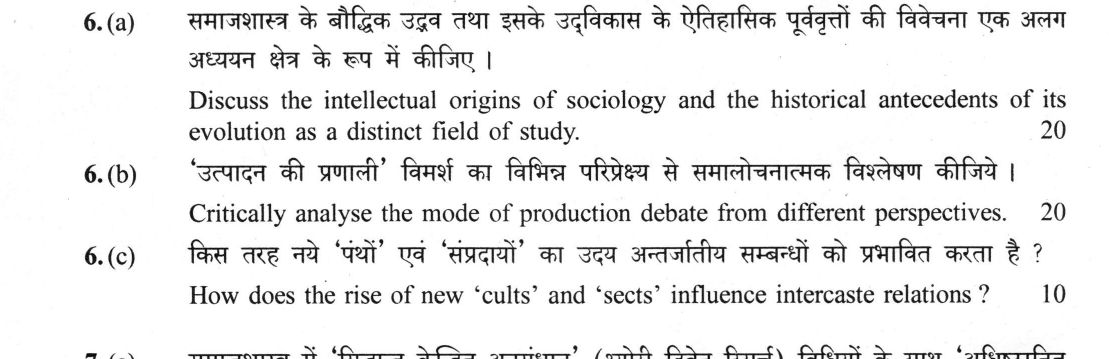
(a) Discuss the intellectual origins of sociology and the historical antecedents of its evolution as a distinct field of study…
Discuss the intellectual origins of sociology and the historical antecedents of its evolution as a distinct field of study. 20 marks
Critically analyse the mode of production debate from different perspectives. 20 marks
How does the rise of new 'cults' and 'sects' influence intercaste relations ? 10 marks
हिंदी में प्रश्न पढ़ें
समाजशास्त्र के बौद्धिक उद्भव तथा इसके उद्विकास के ऐतिहासिक पूर्ववृत्तों की विवेचना एक अलग अध्ययन क्षेत्र के रूप में कीजिए। (20 अंक)
'उत्पादन की प्रणाली' विमर्श का विभिन्न परिप्रेक्ष्य से समालोचनात्मक विश्लेषण कीजिये। (20 अंक)
किस तरह नये 'पंथों' एवं 'संप्रदायों' का उदय अन्तर्जातीय सम्बन्धों को प्रभावित करता है ? (10 अंक)
Model answer
Drafted with AI by UPSC Answer Check against this question's marking rubric, to the expected length. UPSC does not publish answers for Mains — this is one way to score well, not an official key. How we build rubrics and answers.
(a) Intellectual origins and historical antecedents of sociology
Thesis: sociology emerged in nineteenth-century Europe from the meeting of the Enlightenment's faith in reason with the upheaval of the "dual revolution" (Eric Hobsbawm), the French and the Industrial. Auguste Comte named it in 1839.
Intellectual origins:
- Early precursors: Ibn Khaldun's Muqaddimah (1377) proposed a science of society built on asabiyyah (group solidarity).
The Enlightenment:
- reason, progress, secular explanation and the idea of a science of society;
- Montesquieu's The Spirit of the Laws (1748), an early comparative sociology of laws and institutions;
- Rousseau on the social contract and Condorcet on progress;
- the Scottish moralists: Adam Ferguson (An Essay on the History of Civil Society, 1767), Adam Smith and John Millar on ranks and the division of labour.
The conservative reaction:
- de Bonald and de Maistre defended community, religion and authority against the Revolution;
- Robert Nisbet (The Sociological Tradition, 1966) shows that their "unit-ideas" of community, authority, status, the sacred and alienation organised classical sociology.
Positivism and evolutionism:
- Saint-Simon's vision of industrial society;
- Comte's Course of Positive Philosophy (1830–42), with the law of three stages, social statics and dynamics, and the hierarchy of the sciences;
- Herbert Spencer's organic analogy and evolutionism, strengthened by Darwin.
Historical antecedents:
- The French Revolution (1789): it destroyed the old regime and raised the problem of order, meaning how society can hold together without tradition.
- The Industrial Revolution: it produced the factory, wage labour, class conflict, urban slums and the "social question".
- Longer-run enablers: the Commercial Revolution, the Renaissance, the Reformation and the Scientific Revolution made a secular science of society thinkable.
Empirical inquiry into visible social problems:
- poverty, crime and suicide became visible problems;
- Quetelet's "social physics" and the "average man";
- Le Play's family budget studies;
- Charles Booth's Life and Labour of the People in London (from 1889) and Rowntree's poverty survey of York (1901).
Colonial expansion: the encounter with non-European societies supplied comparative data, along with an evolutionary bias.
Becoming a distinct discipline:
- Marx, Durkheim, Weber and Simmel defined its core problems: class and capitalism, solidarity, rationalisation, and forms of interaction;
- Durkheim secured its academic status: he taught at Bordeaux from 1887, set out a distinct object ("social facts") and method in The Rules (1895), and founded L'Année sociologique in 1898;
- the Chicago department opened in 1892;
- in India, Bombay University's department began in 1919 under Patrick Geddes, and Lucknow developed under Radhakamal Mukerjee.
Conclusion: sociology had a double parentage: the Enlightenment ambition for a science of society, and the conservative concern for the community that industrial capitalism was dissolving. The tension between order and change has shaped the discipline ever since.
(b) The mode of production debate
The concept: a mode of production is the historically specific unity of forces and relations of production. What distinguishes one mode from another is how surplus is extracted. Marx's 1859 Preface listed Asiatic, ancient, feudal and modern bourgeois modes, a scheme that opened a long controversy rather than settling one.
Structuralist perspective: Louis Althusser and Étienne Balibar argued that a social formation articulates several modes at once, under the dominance of one.
The Asiatic mode of production:
- Marx's writings on India described self-sufficient villages, no private property in land, and a state taking surplus as tax-rent;
- Karl Wittfogel's "hydraulic despotism" (1957) extended this;
- critics called it empirically wrong and orientalist. D.D. Kosambi (An Introduction to the Study of Indian History, 1956) and Irfan Habib (The Agrarian System of Mughal India, 1963) rejected the idea of a static India.
The transition debate:
- Maurice Dobb (Studies in the Development of Capitalism, 1946) located the dynamic in feudalism's internal class relations;
- Paul Sweezy stressed trade and external commerce;
- Robert Brenner (1976) argued that the balance of class forces, not demography or markets, explains why Europe took divergent paths.
The Indian feudalism debate:
- R.S. Sharma (Indian Feudalism, 1965) pointed to land grants, declining trade and fragmented sovereignty;
- Harbans Mukhia ("Was There Feudalism in Indian History?", 1981) disputed this, as did Irfan Habib's account of the Mughal agrarian order.
The dependency and world-systems perspective:
- Andre Gunder Frank's "development of underdevelopment" and Wallerstein's world-system define capitalism by market exchange and a global division of labour;
- Ernesto Laclau (1971) objected that this confuses a mode of production with a system of exchange and ignores relations of production.
The Indian agrarian debate (EPW, 1969–1980s):
- Ashok Rudra (with Majid and Talib) used Punjab survey data to question whether a distinct capitalist farmer class existed;
- Utsa Patnaik used wage labour, accumulation and reinvestment as the criterion of capitalism;
- Amit Bhaduri argued that semi-feudalism prevailed: sharecropping and usury let landlords profit without investing, which blocked technical change;
- Jairus Banaji distinguished relations of production from forms of exploitation;
- Hamza Alavi proposed a "colonial mode of production";
- Alice Thorner's review (1982) summed up the debate;
- Political stake: whether India's principal contradiction, and so its revolution, was anti-feudal or anti-capitalist.
Critical assessment:
- Strengths: it drove serious empirical agrarian research and comparative historical rigour.
Weaknesses:
- circular definitions and economism;
- difficulty classifying hybrid agrarian structures;
- neglect of caste and gender as relations of production in their own right, a point pressed by Gail Omvedt and feminist scholars.
Later work: research on the "agrarian question of labour" and on informal work (Harriss-White, Jan Breman) carries the debate forward.
Conclusion: the debate is most useful not as a taxonomy of stages but as a method: asking how surplus is produced, appropriated and legitimated. That question is still live for informal, contract and platform labour.
(c) New cults, sects and inter-caste relations
Definitions: in the church–sect typology (Weber; Ernst Troeltsch, 1912; Becker; Stark and Bainbridge):
- a sect is a schismatic, often egalitarian breakaway from an established tradition;
- a cult is a new or imported movement.
- In India these appear as panths, sampradayas and deras.
Historical pattern:
- the Bhakti sects of Kabir, Ravidas, Basava's Lingayats and Nanak;
- Narayana Guru's SNDP ("one caste, one religion, one god for man");
- the Satnamis of Chhattisgarh, the Ad-Dharm movement of Punjab, and the Matuas among Bengal's Namasudras;
- Ambedkar's conversion to Buddhism at Nagpur in 1956.
How they affect inter-caste relations:
- De-legitimation and dignity: their own gurus, scriptures and shrines end the upper-caste priestly monopoly and open a route to status that bypasses Sanskritisation. For Dumont, the renouncer stands outside caste.
- New solidarities: shared worship and commensality cross caste lines and turn scattered low castes into organised constituencies with political leverage.
- Consolidation: when members come mainly from one caste, the sect hardens caste identity, and sects can become castes over time, as the Lingayats did.
- Conflict: Dalit-majority deras in Punjab have clashed with dominant castes and religious orthodoxy. After violence in 2009, Dera Sachkhand Ballan declared a separate Ravidassia religion in 2010.
- Routinisation of charisma (Weber): the protest sect becomes an institution with property and hierarchy, and its egalitarianism is blunted.
New cults and sects loosen ritual hierarchy while often re-creating caste boundaries in new forms. The net effect depends on who joins and on how far the sect routinises.
How this answer will be evaluated
Evaluation rubric
Each sub-part is marked on its own, against the marks and word limit printed on the paper.
- (a) Two distinguishable tasks: the intellectual origins of sociology (Enlightenment rationalism, the Scottish moralists, the conservative reaction, positivism and the philosophy of science) and its historical antecedents (the French and Industrial Revolutions, urbanisation, colonialism, the social survey movement) leading to its emergence and institutionalisation as a separate discipline. 20 marks
Must cover
- Auguste Comte — coined 'sociology' (1839), Course of Positive Philosophy (1830-42), law of three stages
- Henri de Saint-Simon
- Montesquieu — The Spirit of the Laws (1748)
- Adam Ferguson — An Essay on the History of Civil Society (1767)
- Robert Nisbet — The Sociological Tradition (1966), unit-ideas; de Bonald and de Maistre
- Herbert Spencer — organic analogy, evolutionism
- the French Revolution (1789) and the Industrial Revolution
- Adolphe Quetelet — social physics; Charles Booth; Seebohm Rowntree (1901)
- Emile Durkheim — L'Annee Sociologique (1898)
Loses marks
- Writing only a list of thinkers with no account of the historical conditions — the question explicitly asks for historical antecedents
- Omitting the conservative reaction entirely and presenting sociology as purely an Enlightenment child, which misses half of Nisbet's argument
- Wrong dates or attributions: giving the coinage of 'sociology' to Saint-Simon (he used 'social physiology'; Comte coined the term after Quetelet appropriated 'social physics'), or dating the French Revolution or Comte's work incorrectly
- Ignoring the empirical-survey tradition (Quetelet, Booth, Rowntree), which is the source of sociology's research methods
- No mention of institutionalisation, so the answer never explains how sociology became a 'distinct field of study'
Earns more
- The conservative reaction as the second intellectual source: de Bonald and de Maistre, and Nisbet's unit-ideas in The Sociological Tradition (1966) — community, authority, status, the sacred, alienation
- Empirical and colonial antecedents: statistics and the social survey movement — Quetelet's social physics, Le Play's family budgets, Booth's Life and Labour of the People in London, Rowntree's York study (1901); colonial expansion supplying comparative data and evolutionary assumptions
Extra mark
- Hobsbawm's 'dual revolution' framing, or the institutionalisation of sociology in India (Bombay, 1919, under Patrick Geddes; Lucknow under Radhakamal Mukerjee)
- (b) 'Critically analyse the mode of production debate from different perspectives' requires the candidate to state Marx's concept and his sequence of modes, then reconstruct the actual debates it generated — the Asiatic mode controversy, the Dobb-Sweezy and Brenner debates on the transition from feudalism to capitalism, the dependency/world-systems intervention, and the Indian mode of production debate on agriculture — and evaluate them. 20 marks
Must cover
- Karl Marx — mode of production; 1859 Preface sequence; Asiatic mode of production
- Maurice Dobb and Paul Sweezy — the transition debate; Robert Brenner (1976)
- Amit Bhaduri — semi-feudalism
- Utsa Patnaik — criterion of capitalism in Indian agriculture
- Ashok Rudra — survey evidence from Punjab
- Jairus Banaji; Hamza Alavi — colonial mode of production
- Andre Gunder Frank and Immanuel Wallerstein; Ernesto Laclau's critique
- Irfan Habib — The Agrarian System of Mughal India (1963); R.S. Sharma — Indian Feudalism (1965); Harbans Mukhia (1981)
- Louis Althusser and Etienne Balibar — articulation of modes of production
Loses marks
- Describing Marx's five stages and stopping there, without engaging any actual debate — the question is about the debate, not the concept
- Ignoring the Indian mode of production debate in agriculture, which is what UPSC most expects under this heading
- Attributing 'semi-feudalism' to Utsa Patnaik or the 'development of underdevelopment' to Wallerstein rather than Frank
- Treating the debate as purely academic and missing its political stake — whether the principal contradiction in India was feudal or capitalist
- Offering no critical evaluation, when 'critically analyse' is the directive
Earns more
- The Asiatic mode of production controversy: Marx on the Indian village and state appropriation of surplus; Wittfogel's hydraulic extension; the orientalism and empirical critiques; Irfan Habib (The Agrarian System of Mughal India, 1963) and D.D. Kosambi against a static India
- The dependency and world-systems perspective and its critique: Frank's development of underdevelopment and Wallerstein's world-system defining capitalism by exchange, against Laclau's objection that this conflates mode of production with a system of exchange; also the Indian feudalism debate — R.S. Sharma (Indian Feudalism, 1965) versus Harbans Mukhia (1981)
Extra mark
- Alice Thorner's 1982 EPW review of the Indian debate, or Gail Omvedt's argument that caste and gender are themselves relations of production
- (c) 'How does' requires a causal account: define sect and cult sociologically, then trace the specific mechanisms by which their rise alters relations between castes — de-legitimation of ritual hierarchy, new commensality and solidarity, consolidation of separate caste identity, conflict with dominant groups and eventual routinisation. 10 marks
Must cover
- Ernst Troeltsch — church-sect typology (1912); Max Weber
- Bhakti sects — Kabir, Ravidas, Basava/Lingayat, Nanak
- Narayana Guru and the SNDP; Satnamis; Ad-Dharm; Matua movement
- B.R. Ambedkar — conversion to Buddhism, Nagpur, 1956
- deras in Punjab and Dalit constituencies
- sect-to-caste process / routinisation of charisma
- Louis Dumont — renunciation and the individual outside caste
Loses marks
- Using 'cult' in the pejorative everyday sense instead of its sociological sense as a new or imported religious movement
- Claiming sects simply abolish caste, ignoring the well-documented tendency for a sect to become a caste
- Listing sects with no mechanism connecting them to inter-caste relations, which is what the question asks
- No Indian example at all, or only medieval Bhakti with nothing on contemporary deras and new movements, though the question says 'new'
- Attributing the church-sect typology to Durkheim or Dumont rather than Weber and Troeltsch
Earns more
- Conflict and routinisation: friction with dominant castes and religious orthodoxies (Punjab dera conflicts), and Weber's routinisation of charisma blunting the sect's original egalitarianism
- Mechanisms of change: de-legitimation of the priestly monopoly and a route to dignity outside Sanskritisation; new solidarities through shared worship and commensality; consolidation of a separate caste identity
Extra mark
- A contemporary case stated accurately, e.g., Dera Sachkhand Ballan's declaration of a separate Ravidassia religion (2010) or the Matua movement's mobilisation of Namasudras
What "Discuss" is asking you to do
Lay the issue out from more than one side — how it arose, what is claimed for it, what is held against it, and where it now stands. UPSC attaches discuss to broad topics with several live dimensions, so coverage of the dimensions earns more than the strength of your opinion.
Structure that answers it
Set the issue up → the case as it is made → the case against → the dimension both sides leave out → where the balance now lies
Where marks are lost
Listing facts with no thread between them, or arguing one side throughout and calling it a discussion.
Practice this exact question
Write your answer and it is marked point by point against the model answer above — what you covered, what you missed, what you got wrong.
Evaluate my answer →More from Sociology 2026 Paper I
- Q3 (a) Discuss the relationship between religion and science in modern society. Do they nece…
- Q4 (a) Elaborate major sociological theories of power. How do power elite shape the politica…
- Q5 Answer the following questions in about 150 words each : (a) The major challenge for soci…
- Q6 (a) Discuss the intellectual origins of sociology and the historical antecedents of its e…
- Q7 (a) Compare and critically assess 'the grounded theory' with 'theory-driven research meth…
- Q8 (a) How are the concepts of nation, state and citizenship interrelated in a democracy ? E…