Paper I — Q3
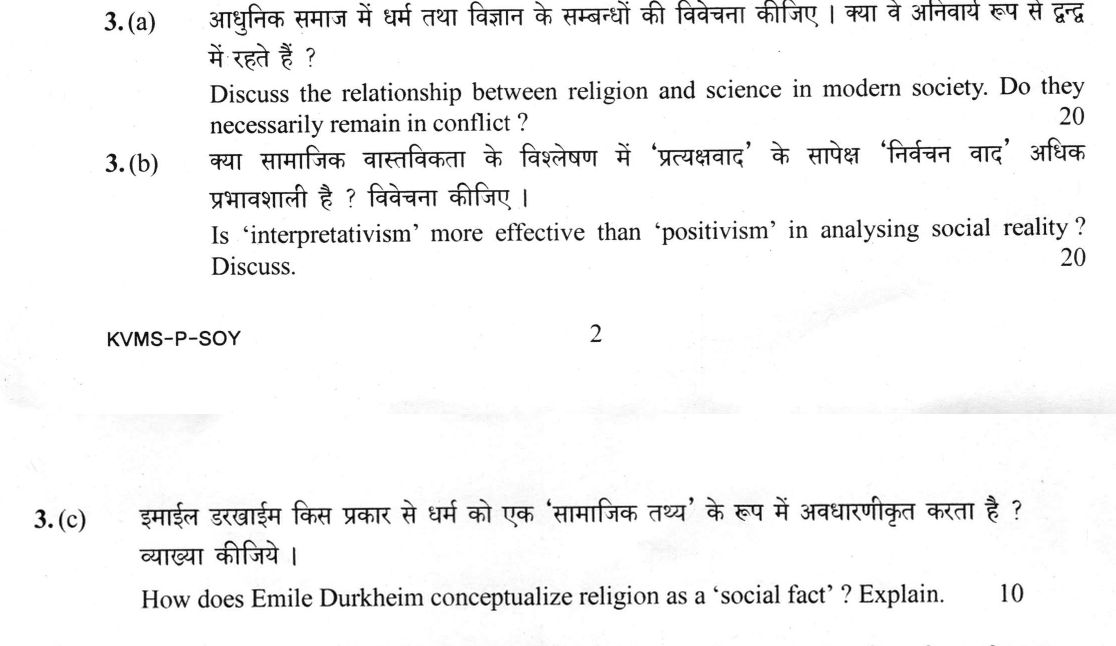
(a) Discuss the relationship between religion and science in modern society. Do they necessarily remain in conflict ? (20…
Discuss the relationship between religion and science in modern society. Do they necessarily remain in conflict ? 20 marks
Is ‘interpretativism’ more effective than ‘positivism’ in analysing social reality ? Discuss. 20 marks
How does Emile Durkheim conceptualize religion as a 'social fact' ? Explain. 10 marks
हिंदी में प्रश्न पढ़ें
आधुनिक समाज में धर्म तथा विज्ञान के सम्बन्धों की विवेचना कीजिए । क्या वे अनिवार्य रूप से द्वन्द्व में रहते हैं ? (20 अंक)
क्या सामाजिक वास्तविकता के विश्लेषण में ‘प्रत्यक्षवाद’ के सापेक्ष ‘निर्वचन वाद’ अधिक प्रभावशाली है ? विवेचना कीजिए । (20 अंक)
इमाइल डरखाइम किस प्रकार से धर्म को एक 'सामाजिक तथ्य' के रूप में अवधारणीकृत करता है ? व्याख्या कीजिये । (10 अंक)
Model answer
Drafted with AI by UPSC Answer Check against this question's marking rubric, to the expected length. UPSC does not publish answers for Mains — this is one way to score well, not an official key. How we build rubrics and answers.
(a) Religion and science in modern society
Framing: religion and science are two institutionalised systems of knowledge and authority. Classical sociology expected modernity to replace the first with the second.
The displacement thesis:
- Auguste Comte's law of three stages (theological, metaphysical, positive) ends in positive, scientific knowledge;
- Max Weber described the disenchantment of the world (Entzauberung) through rationalisation. In "Science as a Vocation" (lecture, 1917) he also conceded that science can tell us how to act but not what to live for.
The secularisation debate:
- for decline: Bryan Wilson and Steve Bruce on religion's declining social significance; Peter Berger's The Sacred Canopy (1967) on the collapse of religious plausibility structures;
- against: Berger later spoke of desecularisation (1999); Thomas Luckmann (The Invisible Religion, 1967) found religion privatised rather than gone; Grace Davie described "believing without belonging"; José Casanova (Public Religions in the Modern World, 1994) documented the deprivatisation of religion, from liberation theology to religious nationalism;
- Habermas now speaks of a "post-secular" society in which religious and secular citizens must coexist.
Evidence that conflict is not necessary:
- Robert K. Merton's thesis (Science, Technology and Society in Seventeenth Century England, 1938): Puritan values of empiricism and utility encouraged early modern science;
- Weber's Protestant Ethic likewise found religious sources of rational conduct;
- Stephen Jay Gould's "non-overlapping magisteria": science deals with facts, religion with meaning and value;
- historians treat the "warfare" model of Draper (1874) and A.D. White (1896) as a nineteenth-century construction.
Evidence that conflict is real where jurisdictions overlap:
- evolution and creationism, bioethics, reproductive and genetic technology, end-of-life decisions;
- Merton's CUDOS norms of science (communism, universalism, disinterestedness, organised scepticism, 1942) clash with dogmatic authority: religion claims revealed certainty, science offers provisional, testable knowledge.
Science is itself a social institution:
- Thomas Kuhn's paradigms show science resting on communities and shared commitments, not pure reason;
- Foucault links knowledge to power;
- Ulrich Beck's risk society shows science producing new uncertainties, which reopens space for faith.
Indian context:
- Nehru's "scientific temper" is a fundamental duty under Article 51A(h) (added by the 42nd Amendment, 1976);
- T.N. Madan ("Secularism in its Place", 1987) and Ashis Nandy argue that secularism sits uneasily in a deeply religious society; Meera Nanda criticises claims of "Vedic science";
- coexistence is everyday: scientists and engineers consult astrologers and perform rituals, and space agency officials offer prayers before launches.
Verdict: conflict is contingent, not necessary. It arises when either side claims jurisdiction over the other's domain. Modern societies more often show differentiation and negotiated coexistence than the replacement of religion by science.
(b) Interpretativism versus positivism
The core divide: positivism treats social reality as objective and law-governed, to be explained causally; interpretativism treats it as meaningfully constituted by actors, to be understood from within.
Positivism:
- Comte's positive stage and the unity of scientific method;
- Durkheim's The Rules of Sociological Method (1895): "consider social facts as things", external and constraining, applied in Suicide (1897), which explained suicide rates by integration and regulation;
- strengths: quantification, causal explanation (Erklären), reliability, replicability and generalisability; in India, the Census, NSS and NFHS reveal patterns such as the child sex ratio that no single account could.
Interpretativism:
- Wilhelm Dilthey distinguished the natural sciences from the human sciences (Geisteswissenschaften), which need Verstehen;
- Weber defined sociology as the interpretive understanding of social action for a causal explanation of its course, using ideal types;
- Alfred Schutz (The Phenomenology of the Social World, 1932): the life-world and typifications;
- Herbert Blumer's symbolic interactionism: meanings arise in interaction;
- Harold Garfinkel's ethnomethodology (Studies in Ethnomethodology, 1967) and breaching experiments;
- Clifford Geertz's thick description; Peter Winch (The Idea of a Social Science, 1958).
The case that interpretativism is more effective:
- social action is meaningful, not mere behaviour, so measurement that strips context misses the phenomenon;
- Jack Douglas (The Social Meanings of Suicide, 1967) and J. Maxwell Atkinson (Discovering Suicide, 1978) showed that suicide statistics are themselves the product of coroners' interpretations, which undermines Durkheim's data; Aaron Cicourel made the same point about juvenile justice records;
- it gives validity and depth and recovers the standpoint of the marginalised (Dorothy Smith's feminist standpoint, Dalit and subaltern voices);
- Indian field studies, such as M.N. Srinivas's Rampura, revealed caste as lived rather than as described in texts.
The case against:
- small samples, weak generalisation, little replication;
- researcher subjectivity and the risk of "going native";
- blindness to structure, power and unintended consequences that actors themselves cannot see (Marxist and structuralist critiques).
Beyond the dichotomy:
- Weber himself combined Verstehen with causal adequacy;
- Popper's falsificationism replaced naive positivism;
- Roy Bhaskar's critical realism distinguishes real structures from observed events and actors' meanings;
- Giddens's double hermeneutic (1976): sociology interprets a world already interpreted by its members;
- Norman Denzin's triangulation (1970) and mixed methods combine the two.
Verdict: interpretativism is more effective for meaning, identity and micro-processes; positivism is more effective for patterns, distributions and comparison. Effectiveness depends on the research problem, and the strongest designs combine both.
(c) Durkheim: religion as a social fact
What a social fact is: in The Rules of Sociological Method (1895), a social fact is a way of acting, thinking or feeling that is:
- external to the individual;
- constraining;
- general throughout a society;
- sui generis, existing independently of its individual manifestations. It is to be studied as a thing.
Religion as the paradigm case (The Elementary Forms of Religious Life, 1912):
- Definition: religion is a unified system of beliefs and practices relative to sacred things, that is, things set apart and forbidden. These beliefs and practices unite all adherents into a single moral community called a Church, so religion is collective by definition.
- Sacred and profane: this is a classification that society imposes, not a property of objects. The individual meets it as external and binding.
- Totemism: Durkheim treated the totemism of the Arunta (Aranda) of central Australia as religion's elementary form, drawing on Spencer and Gillen's ethnography. The totem is at once the emblem of the clan and the sign of the god, so in worshipping the totem society worships itself.
- Collective effervescence: the exalted force people feel when the clan assembles is real, but its source is the group. It is objectified as the sacred, so it is produced by interaction yet stands above individuals.
- Rites: negative rites (taboos), positive rites (sacrifice, commemoration) and piacular rites (mourning) periodically renew the collective conscience and solidarity. They constrain individuals and outlive them.
- Categories of thought: time, space and causality have religious and social origins (Durkheim and Mauss, Primitive Classification, 1903).
Wider relevance: Durkheim expected new "effervescences", citing the French Revolution's cults. Robert Bellah's civil religion (1967) and national rituals such as Republic Day show secular forms of the sacred.
Critique:
- E.E. Evans-Pritchard and Alexander Goldenweiser doubted the totemic evidence and the generalisation from one case;
- the argument is charged with circularity;
- Malinowski stressed individual anxiety rather than society.
For Durkheim, religion is social in origin, object and function. It is society experienced as sacred, which makes it a social fact rather than an individual belief.
How this answer will be evaluated
Evaluation rubric
Each sub-part is marked on its own, against the marks and word limit printed on the paper.
- (a) Two tasks: discuss the relationship between religion and science in modern society, and then answer the direct question of whether conflict between them is necessary. A verdict on the second part is compulsory, supported by the secularisation debate and by evidence of coexistence and of conflict. 20 marks
Must cover
- Auguste Comte — law of three stages
- Max Weber — disenchantment (Entzauberung), 'Science as a Vocation' (1917)
- Peter Berger — The Sacred Canopy (1967) and later desecularisation
- Bryan Wilson / Steve Bruce — secularisation
- Jose Casanova — Public Religions in the Modern World (1994)
- Robert K. Merton — Science, Technology and Society in Seventeenth Century England (1938); CUDOS norms
- Thomas Kuhn — paradigms
- T.N. Madan / Ashis Nandy — secularism in India; Article 51A(h) scientific temper
Loses marks
- Answering only the first sentence and never delivering a verdict on whether conflict is necessary
- Presenting secularisation as an uncontested fact and omitting Berger's reversal, Davie or Casanova
- Attributing 'disenchantment' to Durkheim or the 'three stages' to Spencer
- Confusing secularisation (sociological process) with Indian constitutional secularism (state-religion relation) without noticing the difference
- No Indian material at all in a paper where Indian illustration is expected
Earns more
- Evidence that conflict is real where jurisdictions overlap: evolution/creationism, bioethics and reproductive technology; Merton's CUDOS norms (universalism, communism, disinterestedness, organised scepticism) against dogmatic authority; revealed certainty vs falsifiable knowledge
- Sociology of science itself: Kuhn's paradigms and scientific communities, Foucault's power/knowledge, Beck's risk society showing science producing new uncertainties
- Indian illustration: Nehru's scientific temper and Article 51A(h), T.N. Madan and Ashis Nandy on secularism in a religious society, Meera Nanda on 'Vedic science', coexistence of technical professions with ritual and astrology
Extra mark
- Stephen Jay Gould's 'non-overlapping magisteria', or historians' rejection of the Draper–White 'warfare' thesis as a nineteenth-century construction
- (b) A direct comparative question requiring a judgement: the candidate must set out positivism and interpretativism as methodological positions (ontology, epistemology, methods), assess the claim that interpretativism is more effective in analysing social reality, and take a defended position — most safely that effectiveness depends on the research problem and that the two are complementary. 20 marks
Must cover
- Auguste Comte — positivism
- Emile Durkheim — The Rules of Sociological Method (1895), Suicide (1897)
- Wilhelm Dilthey — Verstehen, Geisteswissenschaften
- Max Weber — interpretive understanding of social action, ideal type
- Alfred Schutz — The Phenomenology of the Social World (1932)
- Herbert Blumer — symbolic interactionism
- Harold Garfinkel — Studies in Ethnomethodology (1967)
- Jack Douglas — The Social Meanings of Suicide (1967)
- Norman Denzin — triangulation / Roy Bhaskar — critical realism
Loses marks
- Describing the two schools in parallel and never answering 'is interpretativism more effective?'
- Equating positivism with quantitative method and interpretativism with qualitative method as if the labels were identical — they are epistemologies, not techniques
- Attributing Verstehen to Durkheim, or 'social facts as things' to Weber
- Praising interpretativism without stating a single limitation, which contradicts the 'discuss' directive
- Omitting the ethnomethodological and phenomenological strands and reducing interpretativism to Weber alone
Earns more
- Transcending the dichotomy: Weber's own combination of Verstehen with causal adequacy, Popper's falsificationism, Bhaskar's critical realism, Giddens's double hermeneutic, Denzin's triangulation and mixed methods
- Interpretivist critique of positivist data: Douglas (1967) and Atkinson (1978) on suicide statistics as socially constructed, Cicourel on official records
Extra mark
- An Indian methodological example showing where each approach works best, e.g., Census/NFHS data on the child sex ratio versus Srinivas's field view of caste
- (c) 'Explain' how Durkheim conceptualises religion as a social fact. The answer must connect his criteria of a social fact from The Rules of Sociological Method (1895) — externality, constraint, generality, sui generis — to his substantive theory of religion in The Elementary Forms of Religious Life (1912). 10 marks
Must cover
- The Elementary Forms of Religious Life (1912)
- The Rules of Sociological Method (1895) — social fact: external, constraining, general, sui generis
- sacred and profane
- totemism, Arunta/Aranda, Australian Aborigines (Spencer and Gillen)
- collective conscience and collective effervescence
- 'society worshipping itself' / god as society
- E.E. Evans-Pritchard — critique
Loses marks
- Describing the functions of religion generally without ever applying the social-fact criteria the question asks about
- Getting the empirical case wrong — naming a different tribe or continent for the totemism study
- Dating The Elementary Forms to 1893 (that is The Division of Labour in Society) or 1897 (Suicide)
- Defining the sacred as 'things connected with god' rather than as whatever a society sets apart and forbids
- Offering no critique at all, which a 10-mark 'explain' answer can still accommodate in one line
Earns more
- Collective effervescence generated in assembly as the experiential source of the sacred, and the role of rites (negative, positive, piacular) in renewing the collective conscience and solidarity
- Critical appraisal: Evans-Pritchard's and Goldenweiser's objections to the totemic evidence and to generalising from one case, the charge of circular reasoning, Malinowski's individual-anxiety alternative
Extra mark
- Links religion as a social fact to Durkheim and Mauss's Primitive Classification (1903) on the social origin of categories, or to Bellah's civil religion (1967)
What "Discuss" is asking you to do
Lay the issue out from more than one side — how it arose, what is claimed for it, what is held against it, and where it now stands. UPSC attaches discuss to broad topics with several live dimensions, so coverage of the dimensions earns more than the strength of your opinion.
Structure that answers it
Set the issue up → the case as it is made → the case against → the dimension both sides leave out → where the balance now lies
Where marks are lost
Listing facts with no thread between them, or arguing one side throughout and calling it a discussion.
Practice this exact question
Write your answer and it is marked point by point against the model answer above — what you covered, what you missed, what you got wrong.
Evaluate my answer →More from Sociology 2026 Paper I
- Q1 Answer the following questions in about 150 words each : (a) In what ways do class and ca…
- Q2 (a) Describe the impact of capitalist mode of production on society. (20 marks) (b) Diffe…
- Q3 (a) Discuss the relationship between religion and science in modern society. Do they nece…
- Q4 (a) Elaborate major sociological theories of power. How do power elite shape the politica…
- Q5 Answer the following questions in about 150 words each : (a) The major challenge for soci…
- Q6 (a) Discuss the intellectual origins of sociology and the historical antecedents of its e…